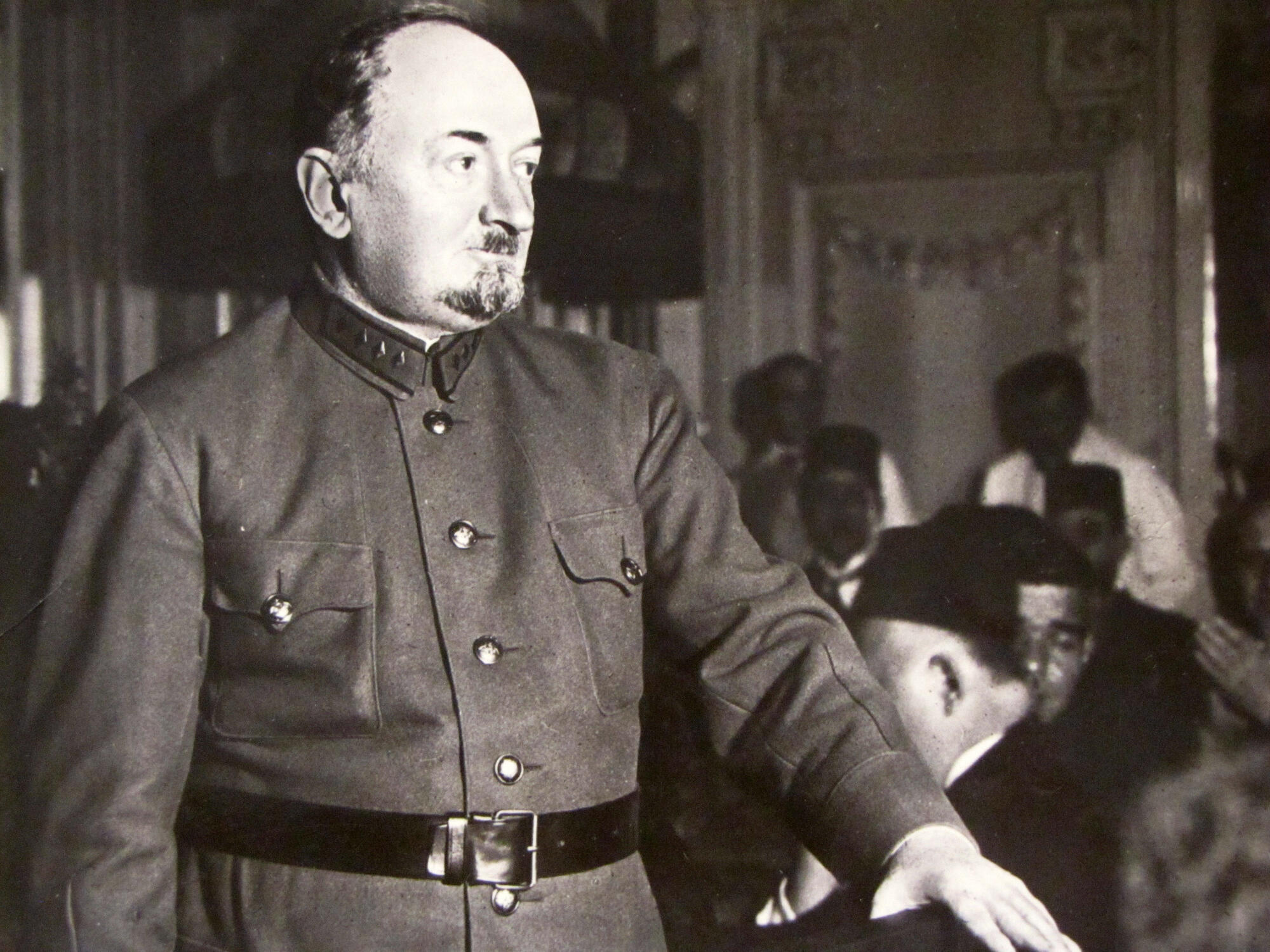
British imperialism was the Soviet Republic’s greatest external threat during its first decade. Those years saw the U.S.S.R.’s diplomacy under the guidance of its irreplaceable Georgy Chicherin, a too-little appreciated hero of that period. Here are excerpts from a speech to the All-Union Soviet Congress on relations with England.
‘The Relations of the Soviet Union to England’ by Georgy Chicherin from International Press Correspondence. Vol. 5 No. 45. May 28, 1925.
Extract from the Report on the Foreign Political Situation at the 3rd. Congress of the Soviet Union.
We print below that portion of Comrade Chicherin’s Foreign Political Report dealing with the relations of the Soviet Union to England. Ed.
The Combinations of the Great Powers. Everywhere, no matter where we look, in the last resort we encounter the chief combinations of world politics, that is, the world politics of the great Powers which are stretching out their feelers in all directions, which are active in Poland, in our Western neighbouring States and in the whole of the Near and Far East. And here in these main combinations of world politics we can distinguish two categories, two important, one could say, antagonistic tendencies. The one category consists in the formation of a united front against us.
The combinations of the other kind consist in the efforts, arising out of the antagonism of the great Powers and which seek to draw us into one or the other combinations of the capitalist States. For example, in France in the press and in the statements of statesmen in the period of Herriot government–of course not of Herriot himself the following combination was contemplated: France against England, that is, France and Russia along with Poland and Japan against England, which latter on her part is allied with Germany. That was one of the recent combinations, while at the same time other combinations existed, for example, Germany along with us etc.
In the complicated political situation in which we have to conduct our policy of peace, our policy of creating peaceable relations upon the basis of the right of determination of the peoples, we stand between these two categories of international combinations: united front against us, or attempts by means of this or that combination to make use of us and draw us over to one or the other side.
One must say, however, that in recent times the first of these categories has prevailed. In the recent political situation, in connection with the strengthening of reaction in the most important countries of the world, the setting up of a united front against us is the main theme. If in the Geneva press, which is in close touch with the League of Nations, the League of Nations is represented as a possible basis of a united front against us, it is only the continuation of that policy of combinations which during the last six months has filled the press of all the ruling great Powers.
The chief role is still being played by England. England, however, is closely connected with America. In cases where it is a question of the immediate interests of the United States, the latter comes forward with decisive declarations and speaks in a tone of command, as the deciding factor.
The Dawes Plan, the results of which consist in the immediate domination of American capital over European conditions, is of so much interest to the American government that it threatens the European States with the withdrawal of its support in the event of the Dawes Plan being threatened by the disunity of the European States. As after the world war the world’s gold supplies have accumulated in the vaults of the American Banks, that means, that as America is the present chief creditor and also the only possible chief creditor of the whole world in the future, it is quite clear that this threat of financial pressure can play a decisive role in international relations. If, however, American diplomacy, in some main questions which interest American capital, acts quite independently and in a decisive manner, in other cases of international daily life, where the minor questions of all countries are interwoven with one another and constitute the object of discussions, it is England and English diplomacy which plays the most active and influential role.
England.
The English Foreign Minister has officially declared that he was not, is not and will not be the initiator and originator of any plans of a united front against us. Nevertheless we find many indications in the world press and in the English press, that English influence is playing a role in creating that atmosphere of general hostility against us in which we now have to work.
We have already mentioned that a deputation of conservatives approached the English government with the demand that relations be broken off with us. The Conservative press states that the English Foreign Minister declared that England could not alone venture on a breach with the Soviet Union. If these words are rightly reported, this would suggest that England as a member of a united front, would be capable of severing relations with us. This means that influential conservative circles, which belong to that Party which is in power, consider it important to support the idea of the united front against us.
Thus, whether this only represents a tendency within the Conservative Party, or whether we have to reckon with the possibility of government actions in this direction, we must at any rate reckon with the existence of an exceedingly strong tendency to the creation of a united front against us. And we must say, that it is one thing to make reassuring declarations regarding the general principle of a boycott, or the creation of a united front against us, while practical politics is another thing. We should like to express the wish that the real political actions of the English government were more in harmony with these declarations of the English Minister.
Meanwhile the official attitude of the English government towards us during the last few months has been vacillating. It has altered. At the commencement of the year, in that period when, in a whole number of questions, as Morocco, Tunis etc. England did not succeed in arriving at an understanding with the Continental States, the official position of the English government was as follows: the Soviet government may propose negotiations, we are prepared to negotiate: the Soviet government may make proposals, we will examine these proposals.
We declared at that time: we are ready at any moment and with the greatest pleasure to commence and conduct these negotiations, we only want to know in which respect the Treaty signed by MacDonald is unacceptable for the new English government. They said to us: “Submit a proposal”: We, however, said: “There is the Treaty, show us wherein it is unacceptable and then we will know what proposals are possible.” This however was not done.
The Question of Propaganda.
The present standpoint of the English Foreign Minister is somewhat different. He says, that the establishment of friendly relations with the Soviet Union is impossible so long as it does not cease its propaganda. That is another question. That is the literal repetition of the words of Lord Curzon when we met in Lausanne.
When I asked him what possibilities he saw of improving our relations, he replied that no better relations were possible, so long as we did not cease our propaganda. I then asked him:
“What is propaganda? We have a government which has an official apparatus and employees at its disposal. The government and its whole apparatus pledges not to carry on any propaganda. The government, however, cannot accept responsibility for what any private citizen may say. If a private citizen infringes the laws or the Treaties, then he will be made responsible. We cannot however compel the Communist Party to cease to be a Communist Party. We cannot compel the members of the Communis to refrain from acting as communists.” And Curzon replied to me:
“If it means that it is here a question, not of a 100%, but of a 50% propaganda being conducted, then the government of His Majesty cannot negotiate in this respect.”
The same idea is to be seen in the declaration of Chamberlain: “Cease conducting propaganda!”
What is propaganda? We stand before the main question of our foreign political relations. Our government is prepared to accept, and accepts all the obligations bound up with international relations. If the English government proves that we are misusing our diplomatic connections, our diplomatic rights, our diplomatic apparatus, that this or that official person violates the international obligations, then we are prepared to agree to everything demanded of us in this respect.
If however we are told that all propaganda must cease in the Soviet Unions, this is tantamount to demanding that the Communist Party shall cease to be a Communist Party. Here it is a question of whether we shall continue to exist or not. It concerns the main question of our relations with the capitalist world by which we are surrounded.
If Chamberlain says to us: “All propaganda must cease, the Communist Party shall cease to be a Communist Party”, then we must answer: “Faites le, citoyen chamberlain”. “Do it, citizen Chamberlain!”
You have already attempted it, but you did not succeed. What do you really want? War? You do not want war. You cannot want war. A fresh intervention? You have already tried that. What then do you want? You must understand that between England and ourselves, between the capitalist States and our State, a modus vivendi must be created. But in order to create a modus vivendi, the English government must adopt its former standpoint, that is to say, regulate the relations from government to government. The English government must abandon its present standpoint which consists in demanding that the Communist Party shall cease to be a Communist Party. Everything that is possible with regard to the government’s policy, with regard to agreements, obligations of the government as regards the official apparatus, our government is prepared to undertake and will undertake.
On this basis concrete demands can be discussed and definite agreements arrived at. We may mention that when, in 1921, we concluded a temporary Treaty with England, which today is the only valid Treaty between us and England, we proposed to England that it should not limit herself to this short and all too general agreement.
We proposed to examine all questions which are of interest to us, and in all these questions to create an acceptable modus vivendi between ourselves and England. This was rejected at the time. The government of Lloyd George did not desire such a conference. Even Macdonald did not undertake an exhaustive concrete examination of all disputed questions.
So long as this is not done, there will exist between us and England, and therefore in the whole of international politics, that element of uncertainty which the capitalist States find so painful today. And if Chamberlain says that the cause of this uncertainty is the existence of the Soviet Union, then Chamberlain is guilty for this, because he does not attempt to arrive at a compromise with us, which would be capable of removing, so far as is possible and so far as the present historical period permits, that element of uncertainty between us and England, and therefore the uncertainty of international relations in general.
The working masses of all countries must understand this. They understand and perceive that it is precisely our government that constitutes the element of peaceful settlement of those problems with which we are confronted, and that those actions which lead to further uncertainty in international relations do not proceed from us.
International Press Correspondence, widely known as”Inprecorr” was published by the Executive Committee of the Communist International (ECCI) regularly in German and English, occasionally in many other languages, beginning in 1921 and lasting in English until 1938. Inprecorr’s role was to supply translated articles to the English-speaking press of the International from the Comintern’s different sections, as well as news and statements from the ECCI. Many ‘Daily Worker’ and ‘Communist’ articles originated in Inprecorr, and it also published articles by American comrades for use in other countries. It was published at least weekly, and often thrice weekly.
PDF of full issue: https://www.marxists.org/history/international/comintern/inprecor/1925/v05n45-may-28-1925-Inprecor.pdf

