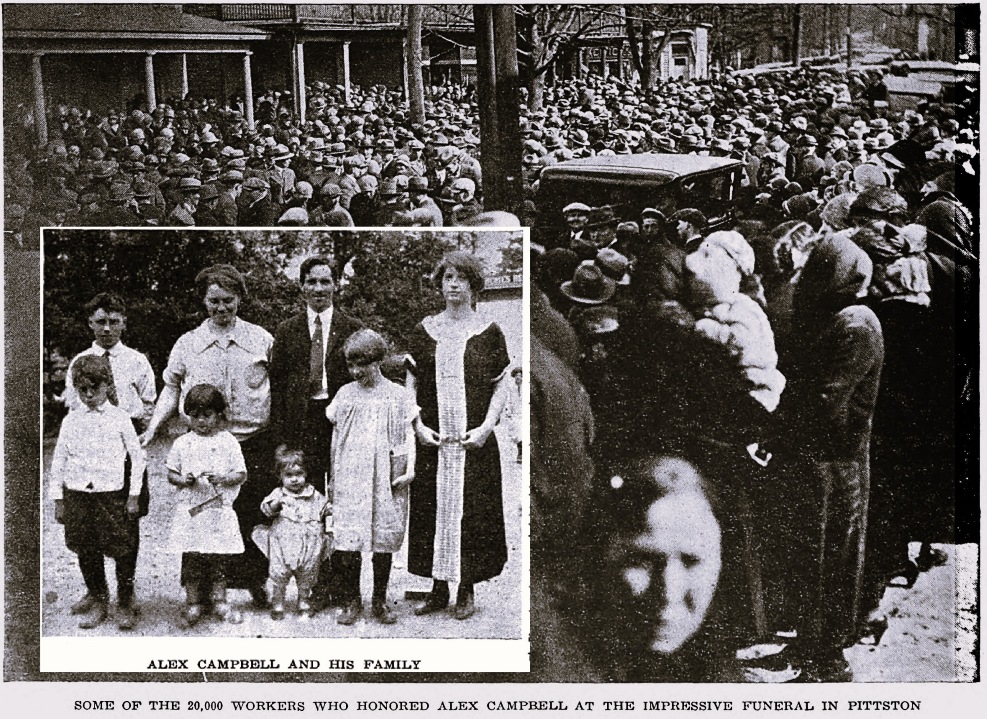
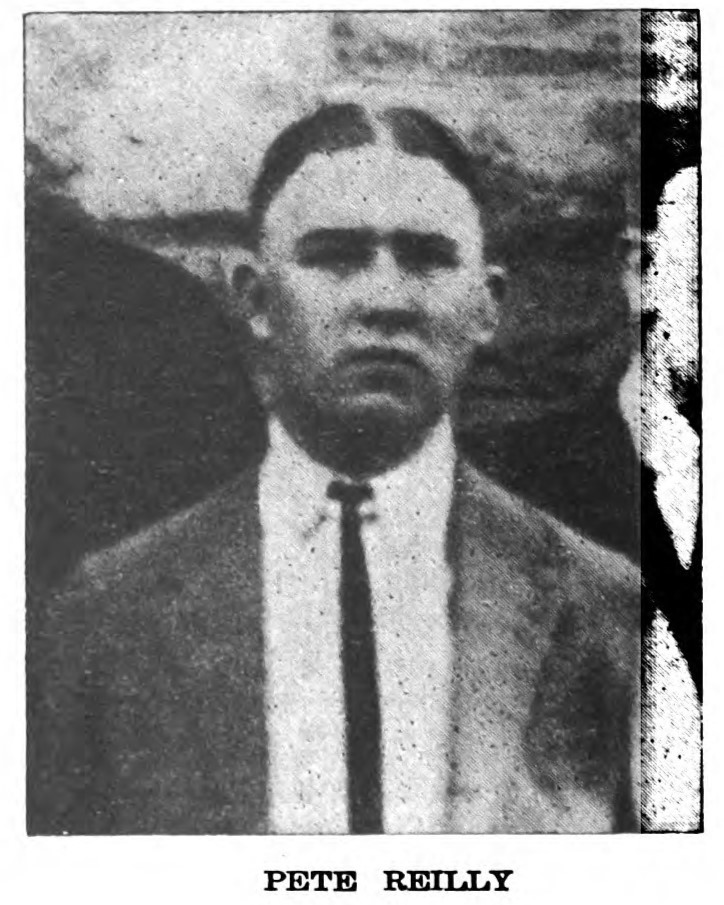
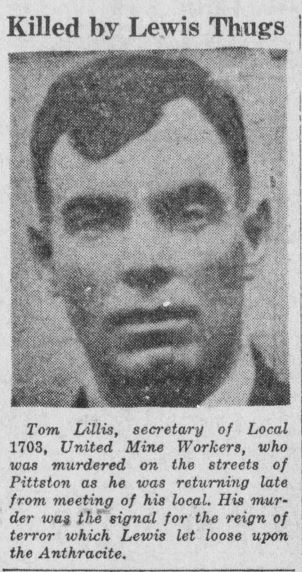
Crafting and solidifying a single bureaucracy over the largest, most combative union in the country was a bloody business. The murder of leading union progressives Thomas Lillis, Alex Campbell and Pete Reilly in 1928 by local forces of the John L. Lewis U.M.W.A. machine helped to push many militants out of the U.M.W.A. and look to new, democratic unions in the late 1920s. A look at the specific conditions in the Pennsylvania coal fields in which their deaths occurred.
‘Behind the Anthracite Murders’ by Stanley Dziengielewski from Labor Defender. Vol. 4 No. 3. April, 1928.
Chairman of the “Save the Union Committee” of Districts One, Seven and Nine
BEHIND the murder of three progressive miners in Pittston, Pennsylvania, and the frame-up against three others, lies an evil cancer that is sapping the strength and fighting spirit of the anthracite miners’ union. No one can properly understand what it is all about without knowing something about the infamous contractor system.
Among the types of contract is one where an individual miner takes control over a whole seam of coal, even a whole mine. He hires as many men as he wants and pays them as much as he want and uses them the way he wants. They cannot file grievances to the local union because the company has nothing to do with these contractors’ employees. The union has an agreement with the coal operators but not with the contractor who is always a union member. These men having no chance to file a grievance may appeal to the contractor only, and that doesn’t do them any good. Such a contractor may employ a hundred men, as for example Frank Fedatti, in Grassey Island Colliery at Olyphant, who employs 150 men.
Another type of contract is the mechanical loader. One man, usually picked from among the officials, or a grievance committee man, gets a contract on a seam of coal or a portion of it. He hires about eight men for each mechanical leader, pays them so much per day and sees to it that they make their day’s wages and in addition to that about $1,000 in two weeks for himself. The laborers are absolute slaves of the contractor, within the local union on the same ground as in the former type of a contract. They are not employees of a coal company; they are employees of the contractor who has no agreement with the union but with the coal company; and while he union is a member of the he is the one that claims its protection! And in many cases he is protected by the union officials, as was the case in Pittston.
In 1920 or thereabouts, an individual by the name of Rinaldo Cappellini, not even a member of the miners’ union then, fought radically against the special contract system. For his activity against this evil, he was called Anarchist, Communist, Socialist and he was proud of it. For his activity, he was rewarded by the miners with the presidency of District One, United Mine Workers of America. Since he became president, there are more contractors than there ever were before in the anthracite field. And when the miners now seek to fight the contractor system, they are told that these are the established conditions, and therefore it is law.
There has not been any improvement, rather a worsening of conditions. In the Grassey Island Colliery at Olyphant, which is under the jurisdiction of Local Union 1672, there are 18 contractors. Seventeen of them operate the mechanical loaders and one has a contract over a whole seam of coal. He controls 150 men. All contractors put together at this colliery alone control over 300 men. When an important question is to come before the local meeting these contractors are notified by the bosses to appear with their men at he meeting in order to put over whatever the boss wants put across. The men working for the contractors must do what the latter tells them to if they want to keep on working. He is their boss. That is why in many in- stances one contractor is president of the local, another is secretary, and so on down the line.
This vicious system has not only intensified the unemployment evil in the district, but has brought a spirit of demoralization and disintegration into the miners’ union. Those who have dared to fight against it consistently and courageously have been met with the most furious opposition on the part of the reactionary officialdom and the coal operators, an opposition which has recently taken the form of organized murder.
The victory of the progressives in Local 1703, Pittston, was the signal for the opening of the murderous attacks which began with the murder of Thomas Lillis, followed by the almost fatal shooting of “Big Sam” Grecio, and the brutal and cowardly murder of Alex Campbell, president of the Local and Pete Reilly, its secretary. All of them were persistent and unflinching opponents of the contractors system pledged to eliminate it from the industry. They were killed in the course of their duty.
They are not the only victims. Three other miners, Sam Bonita, Adam Moleski and Steve Mendola, are today imprisoned under the charge of murder of Frank Agati, personal bodyguard of Cappellini, well-known bully, union organizer, and one who was known to be a contractor himself. The facts of this frame-up case are very clear and simple. These three workers visited Agati in the offices of the union to take up the question of the closing of the No. 6 Colliery in Pittston. In the course of the discussion, Agati struck Bonita; guns were drawn and Agati fell mortally wounded. Bonita was the one attacked, and he fired in self-defense, and probably after Agati had fired at him, for one of the six bullets found in the walls came from Agati’s gun. Neither Mendola nor Moleski even fired a gun, but they too are being held on the murder charge.
The unholy alliance of reactionary bureaucrats, contractors, politicians, and coal operators are not satisfied with the murder of Lillis, Reilly and Campbell. They now seek to murder courts, three other militants. The legally, with the aid of their kept Bonita-Moleski-Mendola Defense Committee with Powers Hapgood as chairman Stanely Dziengielewski, secretary and George Papcun assistant secretary, at Wilkes Barre, Pa., has already been formed for this purpose. The need for their defense is desperate and it demands the swift support of every worker in the country. The International Labor Defense and the Save the Union Committee have already pledged unstinting support. They have set an example that should be followed in every part of the country before it is too late to save three more innocent victims of the frame-up system from being railroaded to their death for their loyalty to their class!
Labor Defender was published monthly from 1926 until 1937 by the International Labor Defense (ILD), a Workers Party of America, and later Communist Party-led, non-partisan defense organization founded by James Cannon and William Haywood while in Moscow, 1925 to support prisoners of the class war, victims of racism and imperialism, and the struggle against fascism. It included, poetry, letters from prisoners, and was heavily illustrated with photos, images, and cartoons. Labor Defender was the central organ of the Scottsboro and Sacco and Vanzetti defense campaigns. Editors included T. J. O’ Flaherty, Max Shactman, Karl Reeve, J. Louis Engdahl, William L. Patterson, Sasha Small, and Sender Garlin.
PDF of full issue: https://www.marxists.org/history/usa/pubs/labordefender/1928/apr-1928-LD.pdf

