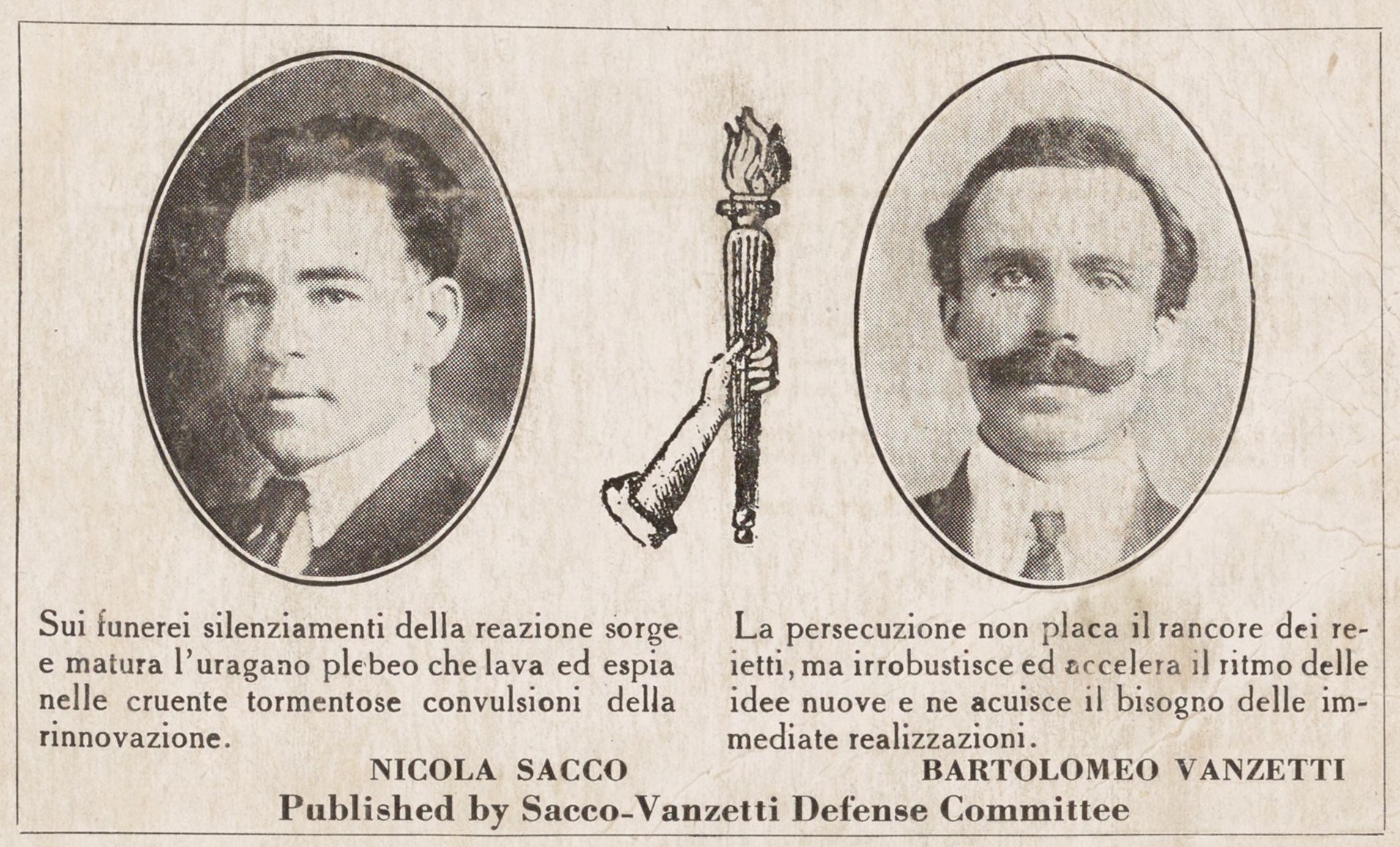
Very much victims of the First Red Scare and associated vile anti-immigrant campaign, Sacco and Vanzetti are defended shortly after their first trials by an enraged Mary Heaton Vorse at her best. Innocent, and with alibis, Sacco and Vanzetti, despite a vast international campaign, were executed by the State of Massachusetts on the night of August 22-23, 1927.
‘The Convenient Frame-Up in Massachusetts’ by Mary Heaton Vorse from Industrial Worker. Vol. 1 (new) No. 87. December 18, 1920.
We drove through the sweet New England towns on our way to the jail in Dedham where Nicola Sacco has been sitting for six months waiting his trial.
He is accused of having killed two men on April 15 and having made off in an automobile with $18,000 from the payroll of the Slater & Morril shoe plant in South Braintree. Labor is again on trial in Massachusetts.
Bartolemeo Vanzetti is also accused of this crime. But he is not in Dedham jail, because he is already serving a fifteen-year sentence in Charlestown. On December 24, 1919, there was an attempted hold-up in Bridgewater of another shoe company. No arrests were made–not until May 5, 1920. There were eighteen people who swore an alibi for Vanzetti. Eighteen people testified that on the afternoon and evening of December 24, Vanzetti was selling eels in Plymouth. These witnesses knew Vanzetti very well, for he was a fish peddler in Plymouth. But the testimony of these eighteen people did not count with the American jury. There were three people who identified Vanzetti as the man whom they had seen six months before driving in an automobile from which shots were fired in Bridgewater. One of the women who identified Vanzetti was blind in one eye. But their identification convicted him.
As for Sacco, he was in Boston getting his passport on the day the murder was committed. He has witnesses to prove this alibi. Nor would one of the people brought in to identify him swear that this was the man they saw shooting.
But Sacco and Vanzetti are offenders of another sort. They have both taken an active part as labor leaders among the Italians. Not only were they gallant fighters, both of them, but moreover, they were inconveniently holding meetings about Salsedo. Salsedo, who went crazy–maybe–and on May 1st jumped from the fourteenth floor window of the Post Office, Building in New York City, where he had been illegally detained by the Department of Justice agents for months–the only man who died in Mr. Palmer’s great May Day revolution. Among the Italians there is ghastly suspicion that Salsedo did not jump anyway it was mighty inconvenient having young men holding meetings about him.
It would make your blood run cold to read the statement made by Elia who was also detained in the Post Office Building and who heard Salsedo’s shrieks when they tortured him. This statement begins: “I am afraid of the Department of Justice and I do not want this made public until I leave the country.”
So meetings among Italians about Salsedo and Elia were not popular and a crime had been committed in East Bridgewater, for which convictions were wanted. Well, Sacco and Vanzetti are in jail now. Dedham jail is a model jail. You go into a big hall off which are four corridors leading from it. It has the vague air of a library turned into a jail. Even the warden, in his neat blue clothes and close-clipped mustache, looks more like a librarian than a warden. But instead of books they put men on the shelves; they keep young men and old in the pigeon holes of cells on the galleries. Men grow old on the shelves of the large light jail where the warden reads the “Outlook” and keeps a flower on his desk.
As we waited men in the jail uniform of field gray trousers, shirt of narrow blue and white stripes, came and went, their hands clasped after the manner of some sort of penitent. It made one nervous to see them walking, their hands clasped in front of them in the unnatural meek fashion.
After a time Sacco appeared, a little fellow, well built, alert, so life-loving that even six months of inaction in jail had not effaced his vividness. Short, clean-cut as a Roman coin, eyes that looked at you straight, and, above all, a friendly way with him almost like a child who had never known anything but affection. There was something vivid about Sacco that made you think of the swift happy flashing things–jumping fish, a bird on the wing.
We sat down and Sacco told us how he came to America, how he got interested in books and in ideas, and then in THE IDEA, which is the way he and his wife always speak of social justice–The Idea, the one great idea, something to work for, something to suffer for.
Sacco was saying: “If I am arrested because of The Idea I am glad to suffer. If I must I will die for it. But they have arrested me for gunman job. What have I worked for all my life? I have worked for educate myself, my comrades. Only so we go on by learning. Do I want to go back to gorily day, shooting man in the back? Why should they say I do things like that, when I love all people–my wife, my child, ideas? I love them all the same. Always my wife and I try to help everybody. We give little theater shows, we get money for strikes. We get money for all people who need help–not only our own comrades, Catholics, all people.”
Loving people as he did, loving learning as he did, he was wounded to the quick that he should be accused of a crime like this.
I wasn’t ready for a boy like this, a boy who would wring your heart with his enthusiasm for life and learning, a boy so undimmed by his six months of waiting inactive in jail. Soon his talk drifted away from his case and his trial. He tumbled out his story. Seven years’ employment in one place, and how he missed his e and how he wanted to see the new baby, and how his boss had come to visit him in jail, and the boss’ wife had given him a sacred heart and he had taken it, “not to hurt the lady’s feelings,” and the guard had seen it and said: “Hell, why didn’t you say you was a Catholic and you’d’a been out of here,” and couldn’t we get him some more of D’Annunzio’s books and scientific books–in Italian, could we?
And suddenly there stabbed through me the certainty that this boy wasn’t worried about himself. He didn’t even dream he could be in danger. He didn’t know what powers there were massed against him. He did not realize that he is the greatest enemy of the organized manufacturer, for Sacco had fought labor’s fight all his days. He loves people and children; he loves learning. He has another quality which his wife shares with him. Wherever Sacco and his wife pass by they leave a trail of affection behind them. People love them for their enthusiasm, their gaiety and their ready helpfulness. Such men are dangerous.
Maybe it is just as well he does not know this. Maybe the clear light of his confident innocence will shine out in the courtroom as it did in the jail that day.
This story is not all Sacco’s and Vanzetti’s; there is Mrs. Sacco, of whose unbroken courage everybody, even the warden, speaks. You couldn’t hear about these imprisoned boys without hearing about Mrs. Sacco too. Her second baby has been born since his arrest. She has not seen him since, she has not been strong enough to. It isn’t the people in prison who do all the suffering.
There are unwritten stories of such people. Mrs. Salsedo, for instance, who waited these terrific months while they kept her husband illegally up in the fourteenth story of the Post Office Building while they tortured him until he jumped out of the window on the morning May 1st–if he did jump. And there is Mrs. Sacco and her new baby, keeping her courage undimmed.
I went to see her. She lives in a little bungalow on a hill with woods around it. Her little boy of seven ran to meet us. Then she came out. Her goodness is what you thought of first. No wonder people loved her. It was easy enough to imagine these two young people giving their plays for the cause of labor and for every comrade in misfortune. There is something most lovable about the quality of her beauty. Dark red hair and a sprinkle of golden freckles and now a look of fragility, because of the baby, because of the long wait.
There is a big book published, I think by the Russell Sage Foundation, about justice and the poor. It is a very big book, and what their lengthy investigation proved could be summed up in five words:
POOR MEN CANNOT GET JUSTICE. As for active labor men, all the dice were loaded against them if they fall into the clutches of the law. All labor is on trial with Nicola Sacco and Bartolemeo Vanzetti. It is bound up with all the fight that is going on for the closed shop and the unalterable determination of the employers to smash the workers. Labor can save these boys and at the same time help to win their own battle.
The Industrial Union Bulletin, and the Industrial Worker were newspapers published by the Industrial Workers of the World (IWW) from 1907 until 1913. First printed in Joliet, Illinois, IUB incorporated The Voice of Labor, the newspaper of the American Labor Union which had joined the IWW, and another IWW affiliate, International Metal Worker.The Trautmann-DeLeon faction issued its weekly from March 1907. Soon after, De Leon would be expelled and Trautmann would continue IUB until March 1909. It was edited by A. S. Edwards. 1909, production moved to Spokane, Washington and became The Industrial Worker, “the voice of revolutionary industrial unionism.” A victim of finances and internal disputes, the IW ceased publication in 1913, only to be revived in 1916 and surviving as a weekly, sometimes more, until 1931. Easily among the most important working class newspapers in U.S. history and an essential resource on the wobbly, and larger radical labor experience.
PDF of full issue: https://washingtondigitalnewspapers.org/?a=d&d=IWW19201218

