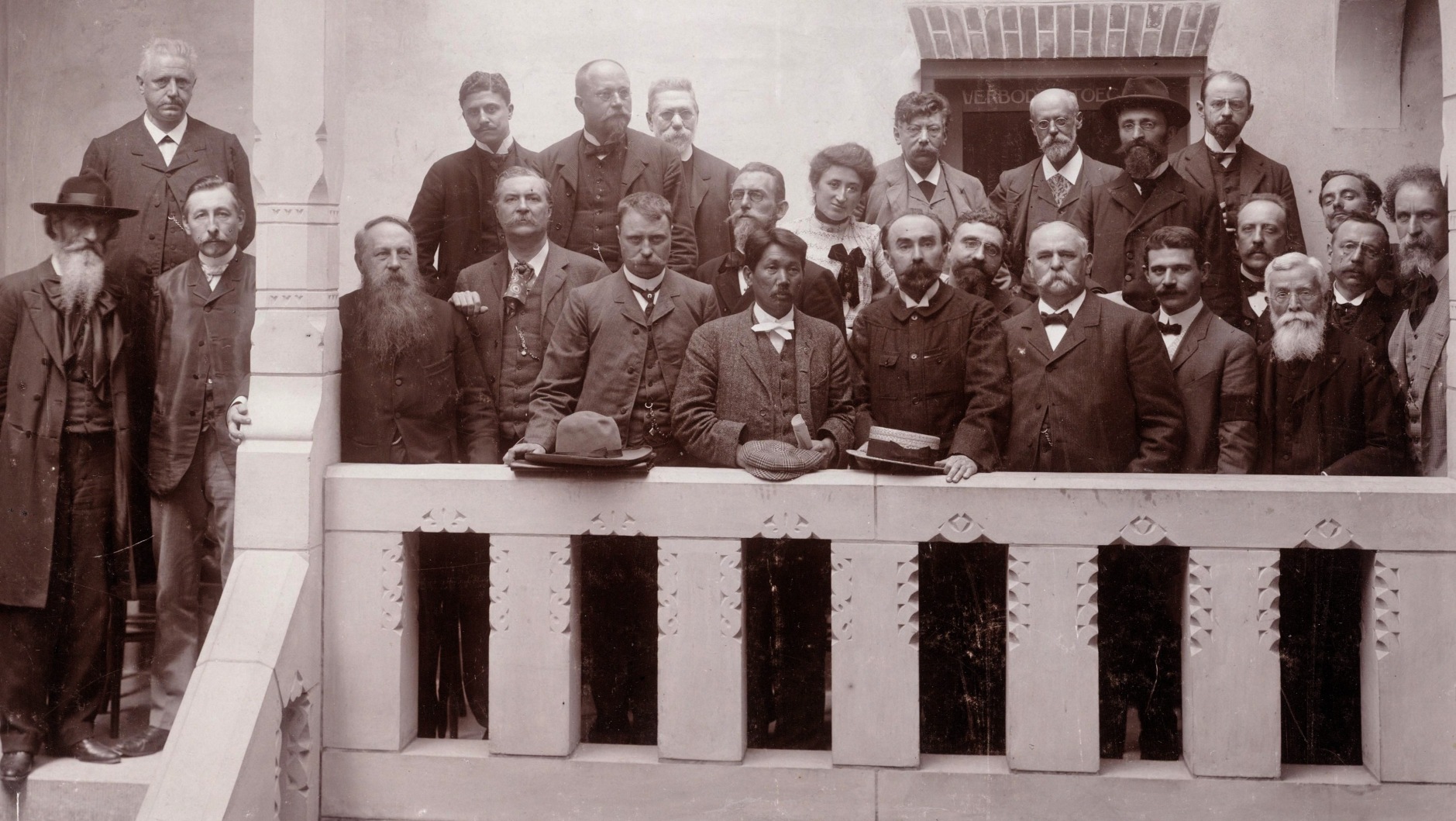
De Leon reports from the International’s 1904 Amsterdam Congress on his actions and the debate around Kautsky’s resolution on the ‘Millerand Affair,’ whereby a leading member of the Socialist Party, Millerand, became a cabinet member of a French capitalist government.
‘Millerandism Repudiated’ by Daniel De Leon from The Weekly People. Vol. 14 No. 23. September 3, 1904.
International Congress Condemns Kautsky Resolution–De Leon Leads In Attack Thereon and Ably Presents the Socialist Labor Party’s Attitude.
Amsterdam, August 19. The International Congress has been in session, nominally since last Sunday, that is six days. In point of fact, however, what has been in session virtually all this time was the committee on International Political policy, that is, the committee to rectify the blunder of the last International Congress of 1900 when the Kautsky resolution was adopted. So important was the subject before this committee considered to be that, if not the bulk, yet so large a portion of the convention crowded into the lobby of the committee’s room, that for one day and a half the sessions of the convention were wholly suspended, and that for another day and a half the convention was allowed to hold its sessions and transact trifles. Thus, while the Hyndman Social Democratic Federation was “entertaining” the mutilated congress with the former’s banale propositions and its Dabhahai Naoradji, Hindoo member of its delegation, the sober part of the convention attended the debates of the committee. These lasted from Monday afternoon, the 15th, to yesterday, Thursday, at noon, the 18th–
To sum up the situation in the committee it was this: One-fourth of the committee was perfectly satisfied with the Kautsky Resolution. This element was typified by Jaures: he would have liked to see the Kautsky Resolution reaffirmed, if possible made more convenient to his utopian bent of mind; the rest of that element, consisting of the Belgians, the Dan, the Swedes, the Norwegians, the Dutch, the Austrians, one Polish and one Swiss delegate, preferred on the whole the status quo. The other three-fourths of the committee were dissatisfied with the Kautsky Resolution, and wanted to get rid of it somehow. Of these I held the extreme position–extreme in the sense that I moved plump and plain its repeal. I did not typify this element; the bulk of it, either out of consideration for Kautsky, or out of consideration for the German Social Democracy, or out of some other reasons, preferred to proceed with a tenderer hand and in a round about way.
The debate opened early on the afternoon of Monday, the 15th, with a short speech by Guesde. He was answered by Jaures; Jaures Was answered Kautsky: Kautsky was answered by myself. I said in substance:
“Both Kautsky and Jaures have agreed that an International Congress can do no more than establish cardinal general principles; and they both agree that concrete measures of policy must be left to the requirements of individual countries. So do I hold. Kautsky scored the point against Jaures that the latter is estopped from objecting to decrees by the congress on concrete matters of policy, because Jaures voted in Paris for the Kautsky Resolution. That argument also is correct, and being correct it scores a point against Kautsky, himself, also. His argument is an admission that his resolution goes beyond the theoretical sphere that, according to himself, it is the province of an International Congress to legislate upon. It must be admitted that the countries of the sisterhood of nations are not all at the same grade of social development. We know that the bulk of them still are hampered by feudal conditions. The concrete tactics applicable and permissible in them, are inapplicable and unpermissible in a republic like the United States, for instance. But the sins of the Kautsky Resolution are more serious than even that. Kautsky just stated that his resolution contemplated only an extreme emergency a war, for instance, and that he never could or did contemplate the case of a Socialist sitting in a cabinet alongside of a Galifet. He says so. We must believe him. But while he was contemplating the distant, the imaginary possibility of a war that was not in sight, everybody else at the Paris Congress had in mind a thing that WAS in sight; a thing that was palpitating and throbbing with a feverish pulse; aye, a spectacle under which the very opening of the Paris Congress was thrown into convulsions. And what spectacle was that!–Why, it was the very spectacle and fact of a Socialist sitting in a cabinet cheek by jowl, merely with A, but with THE Galifet. Whatever Kautsky may have been thinking of when he presented his resolution and voted for it, we have his own, officially recorded words that go to show that he knew what the minds of all others were filled with at the time. I have here in my satchel the official report of the Dresden convention. In his speech, therein recorded, he says himself that Auer, the spokesman of the German delegation in favor of the Kautsky Resolution said when speaking for the resolution: “We, in Germany, have not yet a Millerand; we are not yet so far; but I hope we may soon be so far–that is what was in the minds of all–Millerand, the associate of Galifet.
“It is obvious that a resolution adopted under such conditions–its own framer keeping his eyes on an emergency that was not above the horizon, while all others kept their eyes upon the malodorous enormity that was bumping against their noses and shocking the Socialist conference of the world–it goes without saying that such a resolution, adopted under such conditions, should have thrown the Socialist world into the convulsions of the discussions that we all know of during the last four years; it goes without saying that such a resolution would be interpreted in conflicting senses, and that has happened to such an extent that the Kautsky Resolution has come to be known as the “Caoutchoue Resolution” (Uproarious laughter).
“In view of this fact the first thing to do is to clear the road of such an encumbrance. For that reason I move the adoption of the following resolution:
“Whereas, The struggle between the working class and the capitalist class is a continuous and irrepressible conflict, a conflict that tends every day rather to be intensified than to be softened;
“Whereas, The existing governments are committees of the ruling class, intended to safeguard the yoke of capitalist exploitation upon the neck of the working class;
“Whereas, At the last International Congress, held in Paris, in 1900, a resolution generally known as the Kautsky, Resolution, was adopted, the closing clauses of which contemplate the emergency of the working class accepting office at the hand of such capitalist governments, and also, especially, PRESUPPOSES THE POSSIBILITY OF IMPARTIALITY ON THE PART OF THE RULING CLASS GOVERNMENTS IN THE CONFLICTS BETWEEN THE WORKING CLASS AND THE CAPITALIST CLASS; and
“Whereas, The said clauses–applicable, perhaps, in countries not yet wholly freed from feudal institutions–were adopted under conditions both in France and in the Paris Congress itself, that justify erroneous conclusions on the nature of the class struggle, the character of capitalist governments and the tactics that are imperative upon the proletariat in the pursuit of its campaign to overthrow the capitalist system in countries, which, like the United States of America, have wholly wiped out feudal institutions; therefore, be it
“Resolved, First, That the said Kautsky Resolution be and the same is hereby repealed as a principle of general Socialist tactics;
“Second, That, in fully developed capitalist countries like America, the working class cannot, without betrayal of the cause of the proletariat, fill any political office other than such that they conquer for and by themselves.
“Offered by DANIEL DE LEON, Delegate of the Socialist Labor Party of the United States of America with Credentials from the Socialist Labor Parties of Australia and Canada,
“From New York to California the Socialist Labor Party, that I here represent, felt the shock of that Kautsky Resolution. ‘The Evening Post’ quoted it as an illustration of the ‘sanity’ of the European Socialists as against us ‘insane’ Socialists of America. From the way you have received my proposition to repeal the mistake, I judge my proposition will not be accepted. So much the worse for you. But whether accepted or not, I shall be able to return to America, as our Socialist Labor Party delegation did from Paris four years ago–with my hands and the skirts of Party clear from all blame, the real victors in the case.” During the rest of that Monday afternoon, the whole of the following Tuesday and Wednesday until 7 and 8 p.m., and down to Thursday, at noon the debate raged. The representatives of all the nations (there were two of each on the committee) spoke. Where they stood is indicated by my introductory remarks. The last speech but one was a one and a half hour speech by Jaures. It was a grandioso effort of Utopian Socialism, which Guesde immediately ripped up magnificently with a twenty minute speech in answer. That closed the debate.
The parliamentary practice here in vogue is unique. According thereto, besides mine, there were five other resolutions. They each reflected the different shade of opinion. One of them was positively humorous. It came from the Swiss. Its purport was that no nation can learn by the experience of other nations; that the evils of what they called the policy of “the co-operation of the classes”–meaning thereby the Jaures policy of the Kautsky Resolution–must first be felt by all nations before they would be wise enough to condemn and reject it. The resolution allowed each nation to “go its own cake-walk,” as we would say in American. Another resolution, proposed by Adler of Austria jointly with Vandervelde of Belgium, was the adoption of the Dresden resolution with such amendments, such sweetenings, as to be tantamount to pulling out all its teeth. The British contingent of freaks on the committee was dead stuck on this. Another resolution was to adopt the Dresden Congress resolution. The proposal was made by our friends of the so-called Guesde party, the Socialist party of France. Around this resolution was ranked the bulk of the committee for the reasons indicated above. The resolution emphatically condemned, and without qualification, the very wrongs that The Kautsky Resolution approve of under qualifications. It condemned them so emphatically that although, in order let Kautsky and the German Socialists generally, down softly, the Dresden resolution claims that its condemnations are in line with the Kautsky Resolution (!!) Jaures emphatically opposed them. The ranking of the several resolutions made the Dresden resolution the original motion; the Adler-Vandervelde proposition the first amendment; some other propositions amendments to the amendment; then my motion; and first of all the Swiss proposition. The whole set was to be voted on in the inverse order that I mentioned them here, and they were all voted down, my own receiving but my own vote, until the vote came on the Dresden resolution. The real test was not reached until the Adler-Vandervelde omelette was reached. It was defeated by twenty-four votes against sixteen–myself voting with the majority. When the vote was reached on the Dresden: resolution it was carried by twenty-seven votes against three, with Belgium, Denmark, Norway, Sweden and one delegate of Poland and of Switzerland each abstaining from voting. The three votes against came, two from Argentina and one (Jaures’) from France. My own motion having been defeated, and, the Adler-Vandervelde, together with all the other covert pro-Kautsky Resolution motions, having also been rejected, there was nothing for me to do but to vote for the Dresden resolution as the best thing that could be obtained under the circumstances. To vote against it would have been to rank the S.L.P. of America alongside of Jaures; to abstain from voting would be a round-about way of doing the same thing. In voting as I did I explained my position as wishing to give the greatest emphasis that the circumstances allowed me to the condemnation of the Jaures policy, and the Kautsky Resolution; and I stated that I would so explain my position in the Congress when I would there present my own resolution again.
Upon the subject of the committee’s report to the Congress a spirited discussion, possible only under this unique parliamentary practice, sprang up. Bebel expressed his horror of the whole question being again threshed over in the Congress. He hoped none of the defeated propositions would be re-introduced on the floor; and he proposed that Vandervelde, whose own proposition had been defeated, be made the committee’s reporter, he to make, not a report for the majority, but a comprehensive report for the whole committee, each side furnishing him with a short statement to be embodied in his general report. I furnished him with the following statement which he correctly wove into his report:
“The Socialist Labor Party of the United States of America voted at Paris in 1900 against the Kautsky Resolution, and continues to oppose it.
“It did and does so because the said resolution contains two clauses: “First, it contemplates participation by the working class in capitalist governments by the grace of capitalist officials;
“Second, it supposes impartiality on the part of bourgeois governments in the conflicts between the working class and the capitalist class.
“I carry the express mandate to vote for the repeal of that resolution; and in obedience thereto I have presented the following resolution. [The resolution above given follows here]:
“The majority of the committee did not look upon the Kautsky Resolution as the Socialist Labor Party does. But it was obvious to me that the committee agrees with the S.L.P. in that the Kautsky Resolution has led to numerous misunderstandings, in view of which they rallied around the Dresden resolution: which corrects the defects of the Kautsky Resolution.
“Therefore, my motion to repeal the Kautsky Resolution having been rejected, I joined the majority, in favor of the Dresden resolution, although it quotes the Kautsky Resolution approvingly, because its wording does in fact repeal the Kautsky Resolution, to which my party is unalterably opposed.”
To-day’s session was taken up with the matter, and, excepting Bebel and Jaures, most of the members of the committee abstained from speaking again before the congress, so as to give the other delegates. a chance to take the floor. The decision of the committee was approved by the congress overwhelmingly.
There is a good deal of grumbling in the congress on the score of the matter: having been actually debated in committee, while the congress itself was given only the dregs. The grumbling is all the louder owing to the fact that this matter was the one and real subject of interest. But how do it otherwise? Here is a Babel of languages, a score of nationalities, temperaments and habits–and last, not least, barely six days to handle a question that would require as many months.
All I wish to add to this report is a characterization of the speeches made in committee. These speeches were, with hardly an exception, full of information, practical and valuable, and most of them replete with theoretical principles. Ferri’s (Italy) speech was essentially theoretical upon political methods. Adler’s (Austria) was well characterized by Rosa Luxemburg’s (a Polish wing) as sausage or hash. Vandervelde’s (Belgium) was theatrical. Plechanoff’s (Russian) Social Democratic Labor party) satirical; his stilleto digs made Adler and Vandevelde squirm; he characterized their attitude as one of “systematic doubt”; they in turn answered with the charge that it was easy for him to have unity in his party, because whoever disagreed with him was kicked out. (Has not this charge a familiar ring on American cars?) Bax’s and Macdonald’s speeches (Eng. S.D.F. and Labor Fakir combination) were genuine products of whence they came from. Bax, for instance, objected to the word “civilization,” he preferred “socialization” and spoke lengthily on that; Macdonald claimed to represent “millions.” There was a general giggle at both. Menke (Bohemia) stated that the present looseness of things had replaced Anarchy on its feet; even in Berlin a meeting 1,500 strong had been addressed by an Anarchist: he had charged the German Social Democracy with being a bourgeois affair with a Socialist cloak, and that not a single voice was raised in the meeting in denial. Hilquit (so-called S.P. of America) stated the Kautsky Resolution was accurate and good and suited him. He denied that it had shocked the class-conscious workers of America. It may seem strange, but such, on me at least, was the effect, Bebel’s speech was among the weakest in point of substance. Its bulk was taken up with an attack on Jaures for having given the preference to the Republic of France above the German monarchy. True enough, Bebel said he also would prefer a republic, but his argument against that part of Jaures’ utterances came perilously near sounding like German nativism. For the rest he said many good things.
With the vote on this subject by the convention the congress may be said to have adjourned de facto.
DANIEL DE LEON.
New York Labor News Company was the publishing house of the Socialist Labor Party and their paper The People. The People was the official paper of the Socialist Labor Party of America (SLP), established in New York City in 1891 as a weekly. The New York SLP, and The People, were dominated Daniel De Leon and his supporters, the dominant ideological leader of the SLP from the 1890s until the time of his death. The People became a daily in 1900. It’s first editor was the French socialist Lucien Sanial who was quickly replaced by De Leon who held the position until his death in 1914. Morris Hillquit and Henry Slobodin, future leaders of the Socialist Party of America were writers before their split from the SLP in 1899. For a while there were two SLPs and two Peoples, requiring a legal case to determine ownership. Eventual the anti-De Leonist produced what would become the New York Call and became the Social Democratic, later Socialist, Party. The De Leonist The People continued publishing until 2008.
PDF of full issue: https://www.marxists.org/history/usa/pubs/the-people-slp/040903-weeklypeople-v14n23.pdf

