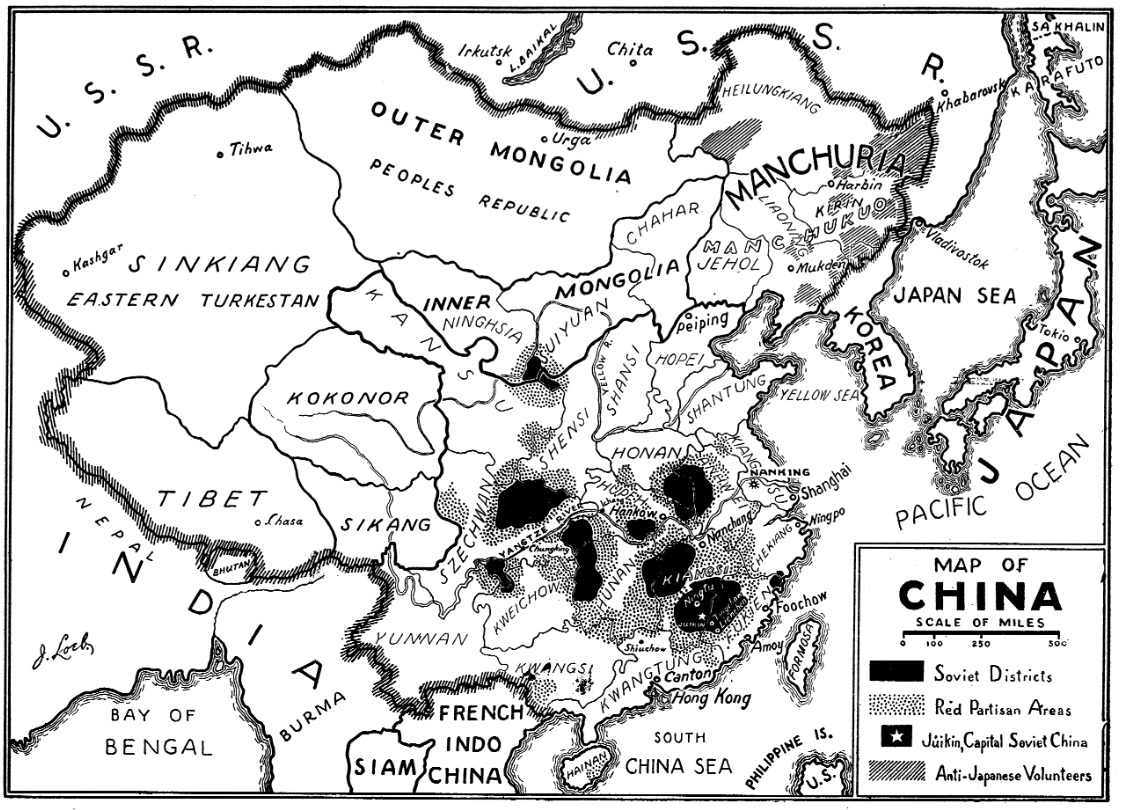
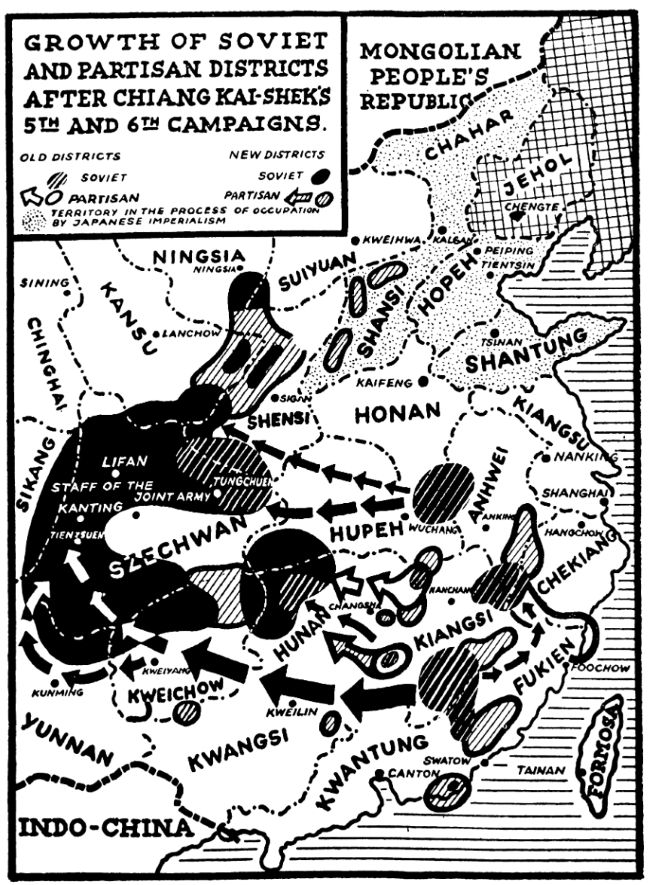
What must be among the very first histories of the Long March to be published in English below.
‘A Heroic Trek’ by Shee Pin from Communist International. Vol. 13. No. 1. January, 1936.
OUR GOAL ACHIEVED
HE Red Army carried through its heroic trek from Kiangsi province into Western China under the most difficult conditions. Over what kind of roads did we travel? Not over asphalt or concrete roads, of course. Mostly our trek took us into impenetrable places, over narrow footpaths. We crossed the highest mountain ranges of China, which, between Szechwan and Sinkiang, reach a height of over 5,000 meters. In May, when the most terrible heat blazes over China, the mountains are covered with a thick layer of snow.
We crossed over twenty well-known rivers, including the Yangtse, the Yukiang, the Tienshan, the Chinshachiang, and the Tatwho. What means did we have at our disposal for crossing the rivers? None at all.
A period of eight and a half months went by from the moment when our forces left the former central Soviet region, in Kiangsi province, until they joined forces with the Fourth Army. We covered 11,000 to 12,000 li—over 3,000 miles. We crossed the boundaries of twelve provinces: Fukien, Kiangsi, Kwantung, Honan, Kwangsi, Kweichow, Szechwan, Yunnan, Sinkiang, Kiangsu, Tsinhai and Shensi. We passed through twelve of the eighteen provinces of China proper.
What was our aim, why did we undertake this heroic trek?
The question of establishing a territorial base for the Soviet Revolution has been one of the most important questions confronting our Party in recent years. We realized that the Red Army needed a stable and permanent territorial base, that the absence of such a base was giving rise to tremendous difficulties hindering the further conduct of the civil war. Ever since 1930, the Communist Party had been exerting every effort to carry out this primary and most important task, which today still remains one of the most important tasks. And when, in 1934, the enemy surrounded our former central Soviet region, and drove us into a comparatively small stretch of territory, our Party, to preserve the Red Army as a vital force, evacuated our main forces from the former central Soviet region, in order to set up a new territorial base on the vast stretches of Western China. It was for this purpose that the Chinese Communist Party organized the famous heroic trek of the Red Army from Kiangsi province to Western China.
All our plans in preparation for the trek were to be fulfilled within three months, but in view of the serious situation which had arisen, our commanders were forced to reduce the time limit to two months. In spite of this, the preparation work was performed excellently.
How did we prepare for our trek? First, before our main columns moved out of the central Soviet region to Western China, the Party sent part of our military forces beyond the confines of the Soviet region, into the rear of the enemy. In particular, the Party organized the march of the Seventh Army Corps, the vanguard of the anti-Japanese army, in the direction of Fukien and to the border-line between Kiangsi and Fukien. In this way our forces were placed in the rear of the enemy, in the northeast.
The second operation was that forces were dispatched from the eastern region of Honan, far into the interior of the province. This was done by the Sixth Army Corps under Sao Keh, which joined forces with Ho Lun under the command of the Red Army, so that our forces were situated in the rear of the enemy, to the northwest as well.
In addition, we performed still other preparatory work for the further advance of the main forces of the Red Army, viz., we reinforced the main units of the Red Army with new young recruits. Over 30,000 volunteers were recruited.
Second, our main cadres, the backbone of the army, were put through an accelerated course of training and drilling. They passed through three military schools: infantry school, the Kun Lo school and a special military school where the men were trained in anti-aircraft and anti-gas defense, etc. The majority of the regulars in our army passed through these three schools.
Third, 600,000 piculs (*A picul equals 133 1/3 pounds.) of foodstuffs were set aside to supply the Red Army during the first part of the campaign. The production of ammunition, bullets, shells, etc., was increased from six to thirty times the former output. Special uniforms were provided for the men, etc. What was the position as regards food?
In the main, we lived on supplies provided by the population voluntarily. Then we confiscated food for the Red Army from the enemy, the landlords, the gentry.
Today we can record that the aims of our trek have been achieved. We have really preserved the Red Army as a vital force. We have joined forces with the Fourth Red Army. After joining the forces of the two armies, we have established a big, new, Soviet territorial base which is stronger and wealthier than the former one.
HOW WE FOUGHT
The first stage of our trek was from the province of Kiangsi to the frontier of Kweichow. This stage must be considered a triumphant one, because we fought our way through four lines of the enemy, though they were covered by concrete defenses, and protected by nests of machine-guns. In general this territory was held to be impenetrable, but we broke through all the four lines of defense, swept aside all obstacles in our path, routed the enemy troops out of their concrete defenses, and broke through their chain.
The enemy’s first line of defense followed the banks of the River Kwanchiang, in Kiangsi province. The second passed between Chenchua in the north of Kwantung province and the south of the Kiangsi province. The third—along the Chencha-Canton railway (this railway is not yet finished, but there is a paved road alongside where concrete defense works have been built). The fourth line followed the southern part of the Honan province to the north of Kwangsi.
Along these lines the enemy had their nests of machine-guns, which raised a complete fire screen. Despite the fact that we had a powerful enemy pressing upon us from both flanks, we very rapidly broke through the first three lines. We crossed the River Kweikiang and occupied Chenkow, i.e., forced the second line. We then took possession of the town of Yichuan, i.e., forced the third line. Between the third and fourth lines lay a huge chain of mountains, and it was here that Chiang Kai-shek intended to destroy us.
We immediately occupied six districts: Linyu, Kiaho, Lanshan, Kianhua, Taochow, Yunmin. Thus we rapidly forced a way through the fourth line as well, which actually meant the failure of Chiang Kai-shek’s plan, the complete breakdown of his attempt to surround and destroy us. We escaped from this locality, contrary to all the expectations of the enemy.
However, we must mention a number of our mistakes and shortcomings.
The first mistake was that the requisite explanatory work had not been carried on viz: the Party, in the army, and among the masses, on the eve of the troops departing on their trek. Preparations for the trek were seriously hampered by the fact that work had not been done in the Soviet regions to explain the position. And this fact also led to some of the younger fighters, who were unaware of the aim and prospects of our trek, as well as a number of other elements, not being fully steadfast during our march. This was especially noticeable in the southern part of the Honan province.
Why did we make this mistake? Because we had a mechanical conception of the question of military secrets. We thought that members of the Party, the army men, and the masses, etc., must not be told about the tasks of the trek.
The second mistake was that we took too much transport with us, too many heavy machines and heavy loads. We dragged with us machines from the arsenal, printing machines, machinery for the mint, etc. Of the total, 5,000 men were occupied exclusively with the transport of this load.
Experience has taught us that the horses, mules and donkeys were a hindrance to us, especially when crossing the rivers. This heavy transport seriously impeded our military operations. In a number of cases the rear guard lagged ten days’ march behind the vanguard.
How difficult was our advance can be seen from such a fact as that there were times when during a twelve-hour march in torrents of rain, and thick mud, we only moved over a distance of four kilometers.
In the main, we advanced in three columns: the right flank and the left flank, and in the middle our main military forces. But we had, in addition, a vanguard and a rear guard.
This, in the main, was the order in which we advanced. But of course the roads did not always permit us to adhere to this scheme. We were sometimes compelled to advance in two columns. But we never advanced in one column.
Having occupied Yichuan, we should have immediately occupied Kwangchow as well, so as to force the river at that point, which was a very important one. But our cumbersome transport hung like a millstone round our necks, and so we were unable to occupy Kwangchow in time. The enemy outstripped us and occupied Kwangchow before we could. Had it not been for the transport, our rear guard would have moved more rapidly and we would not have been forced to engage in so many battles. On the frontier of Honan and Kweichow, we lost about 100 days in overcoming the resistance offered by the enemy.
As a result of the mistakes we made, our main forces became transformed into guards for the transport, and we had not enough forces with which to maneuver freely. The vanguard marched ahead and the rear guard lagged behind at a distance of 200-300 li (i.e., 60 to 90 miles). All this weakened our fighting strength, and not infrequently made it possible for the enemy to attack us in the flank.
Why did we drag such heavy transport with us? This was the result of an idea we had which was naive and politically incorrect, namely, that the establishment of a new Soviet base is simply a matter of removing from one place to another, and that it does not require big efforts and a new and severe struggle.
The third mistake of the first period of our trek was of a purely military character. We advanced all the time along a straight line, that might have been drawn by a pencil across the country. As a result the enemy lay in wait for us everywhere, for they knew in advance where we would be and in what direction we were marching. This meant that we became an object of attack instead of ourselves taking the initiative and the offensive. We should have marched forward more rapidly and occupied the different places more quickly. Instead, we had to take these points in battle, under conditions where the enemy was in possession of automobiles and other means of transport. And we moved forward in a straight line, stubbornly refusing to change our direction, and as the places were often indicated incorrectly in our topographical maps, we frequently found ourselves in impasses from which we had to make our way back. Once we had to fight for three days over a distance of four kilometers. For three days on end our comrades on the staff and the commanders of the corps neither slept nor ate. We wasted time trying to find the right road. And the Commissar in charge of the rear units whose work it was to hurry along the rear guard did not sleep for six days on end.
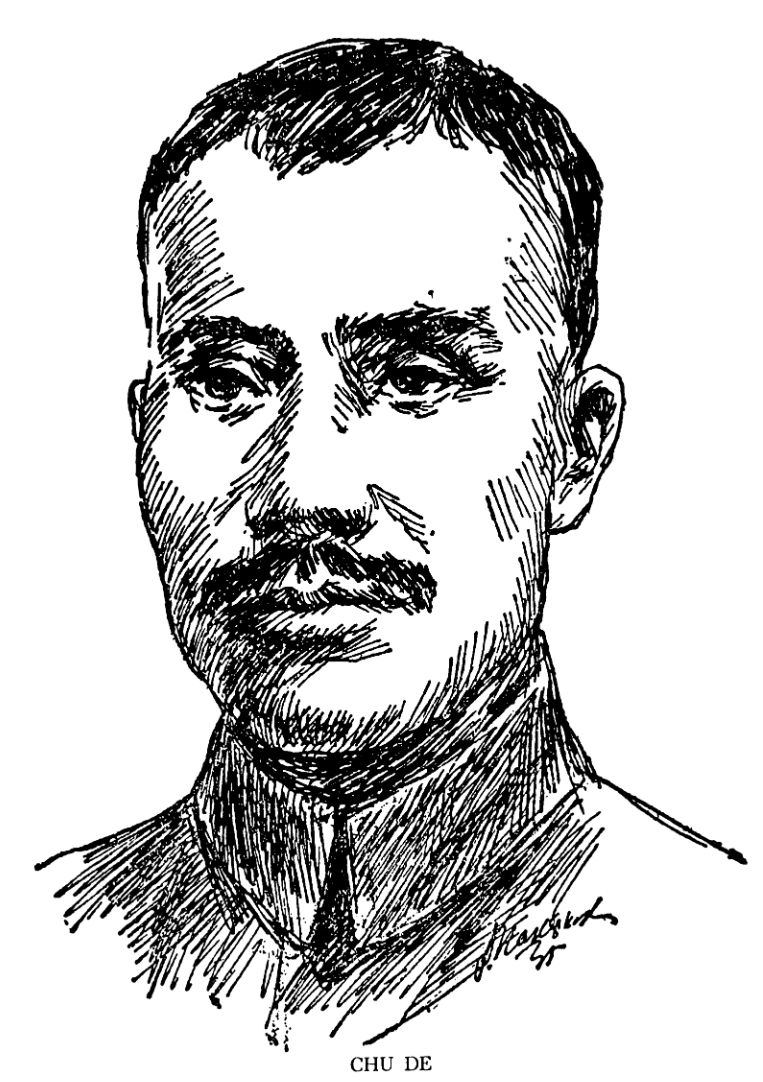
What did we do with the wounded in cases like this?
If we were unable to take them along with us, we billeted them among the population. Sometimes we formed partisan detachments to keep them safely in hiding. And we must say that the population adopted a very good attitude towards our wounded and despatched them on to us when they recovered.
In Lipin we corrected the mistakes we had made. On the frontier of Hunan and Kweichow, the enemy lay in wait for us with five to six times as many troops as we had, expecting that we would follow the old route taken by the Sixth Army corps. The Kwangsi troops attacked our rear guard from the south, while a big enemy army was following us up. The whole of the Red Army was of the opinion that the weak link should be broken, i.e., that we should advance in the direction where the enemy’s line was weakest and where we could get new reinforcements. A decision was made to change our direction. And here ended the first stage of our trek, which lasted approximately one hundred days. When we reached Kweichow province, the Red Army had ceased to be a shifting object of attack, and had in turn become an active force, » capable of attacking the enemy.
The second stage of our trek lasted from the time we left the boundaries of Kweichow to the time we occupied the town of Tsunyi.
The Red Army men by now knew the immediate prospects and the goal of the march. We had explained to them that we were going to Kweichow, in order to “take General Wang Chia-lei alive”. This was the immediate aim which our fighters were pursuing.
Instead of the former method of marching “in a straight line”, we began to resort more to maneuvers in our march. The change of tactics enabled us to advance successfully, to enter the province of Kweichow and take the town of Tsunyi. Here we routed two divisions under the command of General Kuei Tse-tan. We performed this operation comparatively easily. We occupied nine districts to the south of the River Yukien, and forced our way across this river which is a most difficult obstacle in the strategic sense. Comrade Liu Po-chen, a graduate of our military academy, was in charge of this operation. He had one division and one regiment at his disposal. By continuously pushing ahead, he occupied the enemy foreposts at the bridge extremely rapidly. He transferred his units across the river so rapidly that the enemy had no time to blow up the bridge. On the opposite bank he occupied the town of Tsunyi, which is a very big center, and also the town of Meitan.
Our second big victory was that we reinforced our ranks with fresh local forces. In Tsunyi the Red Army men rested for 12 days, while our chief political workers recruited new fighters there. We were successful in recruiting 3,000 new young fighters. Now we no longer dragged heavy transport after us. The Red Army men bathed, and, their clothes refreshed, set forth again proudly.
Here we organized a revolutionary committee from the local forces, and established armed forces and a partisan detachment under the leadership of the revolutionary committee. We mobilized the masses to confiscate the property of the landlords, the gentry and the militarists, and distributed the confiscated property among the population. Our actions called forth the enthusiasm of the population.
The third stage of our trek was from the time we occupied the town of Tsunyi right up to the time we came out at the river Yangtse. Here, too, we met with a number of big successes. During this period we, and not the enemy, took the initiative in attacking. Here we crossed the river Chinsha, a tributary of the Yangtse.
We decided to move towards Szechwan, first retreating northward and then turning to the west. We did not know how strong the forces of the enemy were, but on reaching the borders of Szechwan we found that the enemy forces were many times superior to our own. We then occupied the town of Huankiang, concentrated our military forces there and altered our line of advance. The enemy discovered that we intended to cross the river, and began therefore to concentrate their forces on the border between Kweichow and Szechwan. If we had gone straight to the West, from the position we occupied, we should have met with very serious resistance, as the enemy had prepared their defense there. We therefore turned to the East. And only when the Red Army approached the town of Tungchi, did the enemy discover that we were marching eastward, and not westward. But by that time we were far away. That was a fine maneuver.
The second extremely important point about this stage was that we occupied the gates to Kweichow province, which are of great military and strategic importance, thirty kilometers away from Tungchi. Two divisions commanded by General Wang Chia-lei attacked us on the way to these gates. But we defended the gates by strengthening especially our flanks on both sides of the gates. And when General Wang Chia-lei troops came closer, we surrounded them, and routed his principal units; only a small number of his people succeeded in getting away. That evening we again occupied the town of Tsunyi.
The second day General Lung Chi-wei once again made an attack upon the town of Tsunyi from the other side. But after the victory over Wang Chia-lei, our army had had time to make preparations. Having camouflaged our flank, we waited for the enemy to attack. At 8 o’clock in the morning the battle began, and by 12 o’clock General Lung was already surrounded. The majority of the general’s soldiers were disarmed, and only a small section retreated to Hueian on lorries.
Thus, between Tungchi and Tsunyi, we were successful in completely demolishing four of the enemy’s divisions. This victory still further strengthened the fighting spirit of the whole of the Red Army. The authority of the Red Army among the population of four provinces (Hunan, Szechwan, Yunnan and Kweichow) rose high. The population felt that we represented a strong force. Moreover, this victory eased the position of the Second Army led by Ho Lun and of the Sixth Army led by Hsiao Keh, which had first been attacked by these four divisions of the enemy. The enemy were forced to cease their offensive against these armies, and to turn their forces against us.
Having weakened the forces of the enemy, our second corps rapidly destroyed a whole enemy brigade, which gave the Second and Sixth Corps an opportunity to fortify themselves in the district. This was at the end of April and the beginning of May, 1935. The following was our third success during this period: in the course of the fighting we seized many uniforms and much ammunition, machine-gun bullets, pack animals, etc. We must say that our men don’t very much like fighting the local generals but rather prefer to fight against the Nanking generals, for after we have demolished one of the Nanking generals we usually obtain a large quantity of foodstuffs, uniforms and ammunition. The local generals are considerably poorer.
The other positive side of this stage of our trek was that we executed flexible maneuverg and it was difficult for the enemy to discover the direction we intended to take: they lay in wait for us, say, in the west, and we were in the east, and vice versa.
Why did we do this? Because war at home—in the Soviet regions— against an enemy attack, the war in the White regions, are two different things. If the enemy attacks us in the Soviet regions, we sometimes retreat in order the better to concentrate our forces and prepare a very heavy blow, but the enemy does not know where our main forces are situated. We continually force them to give up their plans and to relinquish their original intentions. In the Soviet regions, it is impossible for the enemy to find out the exact disposition of the main forces of the Red Army, for the population in the Soviet regions would not inform the enemy. But conditions are quite different in the White regions, where the enemy moves freely against us in several columns and from different directions, and if any column is weakened it can obtain reinforcements the same day.
Therefore, since we had not the necessary forces to demolish four or five columns at a time, we could not engage in long battles with the enemy. If the enemy attacks us from different sides and we have not sufficient forces to engage in battle, i.e., if we are unable to make a counter-attack, then we resort to some maneuver to get out of the encirclement. That is why we had to advance and retreat in the districts of North Kweichow four times. We were convinced that it was difficult to force the Yangtse at that point, and so we decided to find another point at which to cross.
Our second crossing of the River Yuchiang was the most difficult undertaking in the history of our trek. Had we approached the river directly, according to our original line of march, we would never have been able to cross it. When we occupied the town of Tsunyi for the last time, the enemy was preparing to attack in the northeast of Kweichow, being of the impression that we were marching to join the Second and Sixth Armies. We actually did send part of our troops in that direction in order to create the impression that we were marching to join the Second and Sixth Armies. But our main forces took the opposite direction. In the course of one night we built three bridges and dispatched all the forces of the Red Army across them. It should be said that Yuchiang is a very rapid-flowing river, with very strong currents and big cataracts. It flows at the rate of three meters a second. There was not a single boat to be found there, neither had we the military-technical knowledge to build pontoon bridges. And yet we crossed the river: we made floats of bamboo and transported the whole of the Red Army across the river on them.
We have worked out a special method of building bridges: we take ordinary wire, twist it into thick cables the ends of which we attach to both banks of the river, lay boards across and thus arrange the crossing.
By despatching a section of our forces to the East, we misled the enemy. The Hunan generals received orders to go in the direction of Kweichow, i.e., to concentrate all their forces against us in the East.
But we moved our main forces to the South, and avoiding Kuyang, rapidly turned to the West, along the southern part of Kweichow. Thus, all the enemy’s troops from Hunan, Szechwan and Nanking remained behind us.
From experience we knew that there is nothing to fear from an army which is behind, because there are extremely few roads, the enemy cannot hurl large forces into the attack at once, and it is difficult for it to develop a broad front.
We occupied Tingfang, Kuanshun, Kueihua, Chanchai, Chenfu.
At the same time, in order to extend our front, we dispatched another column parallel to this direction. This column demolished five regiments of the Yunnan enemy, and seized a tremendous amount of ammunition. We entered the territory occupied by the Yao tribe, where we recruited over 10,000 young fighters. In the same region we confiscated the property and money of the local landlords, loading over forty mules with silver coins.
Then we occupied Kweikiang, and to the west of the town crossed the River Kiansha. Having occupied a position on the boundary between Yunnan and Kweichow, we wanted to turn in the direction of the river in order to cross it. But if we had gone there directly, the enemy would very quickly have overtaken us. Consequently we turned off at first into the heart of Yunnan, to the South, and occupied a number of points near Kunming, the capital of the Yunnan province. Thus we cut the enemy off the river. And even then we were not confident that we would be able to cross the river.
We were fortunate in seizing the topographical maps of the enemy, but they were only a little better than ours, which did not excel in accuracy. But still, the places where the river could be crossed, of which there were three, were marked on these maps, and it was indicated that there was a ferry at one point.
It should be mentioned that General Lung Yun involuntarily did us a great service in Yunnan. He had intended despatching topographical maps and a large quantity of medical supplies to one of the Szechwan generals by airplane. But the pilot fell ill, and the general decided to despatch everything by motor-car. A chauffeur was found to do the work. After we had occupied one of the towns, a group of our comrades from headquarters went out to the highway. They saw an automobile speeding towards them. They succeeded in getting possession of the car, and in it found dozens of copies of topographical maps and the finest medical supplies. We were in great need of all these things.
We found indicated on these topographical maps nine points where the river could be crossed; we also discovered that at some points there was one ferry, at others—three ferries each. This inspired us with confidence in the success of the operation which faced us of crossing the river.
We must say that the stupidity of the Yunnan generals got us out of difficulties on more than one occasion. Once our division was approaching a town in Kweichow. Our men were all in Red Army uniforms. With a proud front, we approached the wall of the town. The district chief popped his head out of the window and looked at us in surprise. He decided that since these people were so well-dressed, they could not be the Reds. In their minds the Red Army are so many bandits. They took us for the central Nanking troops, for the uniforms of the Yunnan and Szechwan troops were worse than those of the Nanking troops and worse than ours.
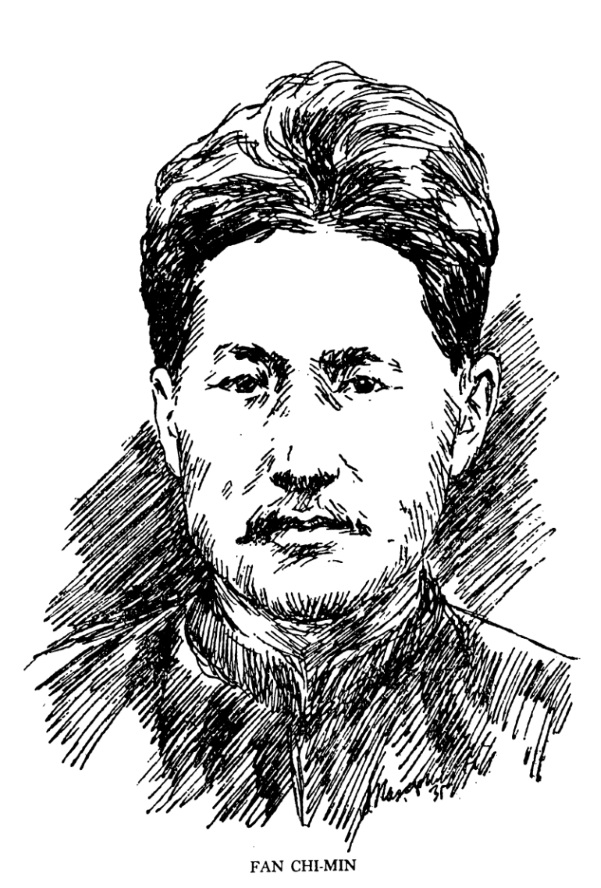
When we entered the town mentioned we were in good shape. We had steel helmets, shirts with four pockets, good belts, leggings and breeches. Each of us had a leather dispatch case, seized from Chiang-Kai-shek’s troops. Every commander, from battalion commander downwards, had field-glasses. We had light and heavy machine guns, whereas neither the Yunnan nor the Kweichow army had as many of these.
Seeing that he was not dealing with bandits, the district chief opened the gates of the town to us, and greeted us politely. They entertained us well and we rested. After that we asked: “Have you prepared food and money for our army?” He replied: “Yes, we have it.” We asked for a dozen guides. All the city authorities came out to us, each of them hastening to introduce himself: “I am the chief of the garrison guards”, “I am the chief of police,” “I am the district sheriff”, etc. After they had themselves told us who they were, we knew how to deal with them.
Indeed, it was not for nothing that Mao Tse-tung once said that if all our enemies were as stupid as the Yunnan generals, the Chinese revolution would have been victorious long ago.
After the event with the topographical maps, our commanding officers indicated definite points where we were to cross the river. In order to cover up the fact that we were crossing, we dispatched one unit in another direction. After we had occupied the town, the enemy burnt the rafts at one crossing. In order to distract the attention of the enemy, we especially started building a bridge at that spot. It was one-third built. Chiang Kai-shek’s air forces immediately concentrated their attention upon this district. They discovered that we were building a bridge, and all the troops which were following us up advanced in this false direction. By this time all our other units had made the crossing in other places.
It should be mentioned that the enemy had four, six, and even eight airplanes flying overhead at the same time.
We rapidly turned to the real crossing place. We found six rafts at the river. The main forces had crossed over by means of these six rafts, and this was no easy matter. The reader should know what the River Chensa is like. It is not particularly wide, but the current is much stronger than that of other rivers. On both banks the cliffs rise to a height of 300 meters. It is not such an easy thing to build a bridge here. On both banks of this river, for a stretch of land of about ten kilometers, there is no plant life whatsoever. Chinese history tells us, it was just at this spot that the fabulous hero of the epoch of wars of the three kingdoms suffered defeat. The air currents on the banks of this river are so strong that they can lift a man off his feet. All the six rafts at this point of the river were broken. They had to be patched up if they were to be used at all.
The crossing lasted nine days, night and day. We did not lose a le single man or horse. The horses were tied to the rafts and made to swim across. We were forced to make haste, otherwise the enemy would overtake us. The work required excellent organization.
For the better execution of this task, the Central Committee of the Party and the Revolutionary Military Council organized an authoritative committee to guide all operations connected with the crossing. All the units without exception were subordinated to this committee. The units were to cross the river in definite order. A watch had to be kept that the men did not jump on to the floats, otherwise they might overturn. We required skilled boatsmen because the current was so strong there was danger of the floats capsizing. We paid the local skilled workers and boatsmen very well. The local population adopted a very good attitude towards us. The workers voluntarily came to assist us, and many of the boatsmen left the district together with the Red Army.
This river crossing once more confirmed the degree of discipline, organization, and consciousness possessed by our fighters.
After crossing the river we occupied the town of Kuili. The enemy discovered this, but the river had been crossed by then. We took nine days to cross, while the enemy arrived only on the eleventh day. Chiang Kai-shek was too late to catch us.
In this connection, our fighters composed a play in which they mocked at Chiang Kai-shek, who gallops from one province to another in pursuit of us, and arrives at the River Chensa, only to find a pair of worn-out straw shoes on an empty float.
When Chiang Kai-shek tried to cross the river, we arranged to meet him with machine-guns. He was forced to turn to the North and find a place at which to cross there. His divisions starved, and consequently demoralization was rife among his troops, and the soldiers deserted in large numbers.
After we had crossed the River Chensa, we became masters of the situation. We were able to prevent the enemy from crossing the river. Our position had changed for the better, and from that moment the fourth stage of our great trek began.
We rested five days in the town of Kuili.
It was decided to move in a northerly direction at a more rapid pace, so as to join the Fourth Red Army.
We succeeded in reinforcing the Red Army with 5,000 young fighters, and in addition organized a large number of partisan detachments in these districts. Here also we drew up a plan for securing the necessary supplies and foodstuffs. All the plans were fully carried out.
Five days later, having rested in the town, we moved northwards to the River Tatunhe. Traveling at the rate of 30 kilometers a day this would have taken twenty-nine days, but we still had to reckon with the enemy on our way. In many parts the bridges were burned to hinder our crossing. We moved extremely rapidly without attempting to occupy towns on the way. Still, we successfully organized partisan detachments in the different localities. Here we found isolated Party organizations, which had been out of contact with the provincial committee of the Communist Party for three years. In one of the district centers we found a local committee leading the movement. The next day over a thousand men were mobilized there, and an army to boycott taxes was organized. This committee is now continuing its work and has strengthened its ranks.
From this spot two roads ran to Tatuho: a highway and a narrow road. We estimated that we would probably meet the enemy on the big road, and that they would endeavor to destroy our food supplies. We therefore dispatched part of our troops along that road, in order to distract the attention of the enemy, while we moved our main forces along the other road.
We arrived at a mountainous district where the native tribe of the Mantsi lived. This is a tribe of Turkish origin, which particularly has suffered from the oppression of the Chinese landlords and militarists, and is consequently hostile towards the Chinese. A short time before our arrival, a Chinese anti-Red chief was killed by the natives while trying to cross their territory, and his detachment was annihilated.
When our units came up, they were surrounded on all sides. Comrade Liu Po-chen, the chief of the Red Army staff, was in personal command of our units. He proved that he was not only capable of fighting well, but that he could set up a united front. He made use of the contradictions within the tribe, and before the eyes of the assembled tribe, tore apart a chicken and drank its blood. This was to signify that henceforth he was a blood relation of theirs. After this, one section of the tribe observed strict neutrality, but the other half still wanted to fight against us. We began to agitate, persuading them that we wanted to help them, etc. Our attitude towards them created a profound impression upon them, and their friendliness increased. They gave us horses, cows, sheep, and brought us different presents, while we in return gave them money and presents.
After this we arrived at the banks of the River Tatuho. This is a somewhat historical spot. It has been famous since the time of the Taiping uprising. It was at this spot that Shih Ta-kai (the general in command of the Taiping army) perished while retreating from Nanking into Szechwan. We met an old man of ninety who had been an eyewitness of these events and who had personally seen Shih Ta-kai and the Taiping army. The old man told us that the Taiping army and Shih Ta-kai perished because there were differences of opinion in the army, because the Taiping army was not a band of “long-haired men.” Somebody asked him: “Grandfather, what do you think? Is our attitude to the population better than that of the Taipings?” He replied that the Taipings behaved well towards the population, but that our attitude was much better.
We found only two ferries on the banks of the river. On the opposite bank there was a battalion of the enemy. The Commander of this battalion, fearing our advance, gave orders for the two ferry-boats to be tied to the opposite bank. That same night our army reached the river bank. In the morning, at dawn, we realized that the river was very wide and difficult to cross. The River Tatuho is somewhat bigger than the Chensi, but its current is still stronger. It takes no less than fifty minutes to cross and re-cross the river, at this spot. At that rate, it would have taken one and a half months to transfer all our main forces to the other side of the river on two ferry-boats. Of course such delay was out of the question. We could not find any local ferrymen. So we selected nineteen brave stalwarts from our Party members and young Communists, equipped them with bombs, rifles, and light machine guns. On our part, we stood prepared in machine-gun emplacements on our side of the river, opened fire from our bomb-throwers, and utilized our experienced snipers. Under cover of our fire, our nineteen comrades landed safely on the other bank. The enemy opened machine-gun fire against them. They paid no heed at all, but moved forward and landed at last on the other bank, and disarmed one of the enemy units. The fire from our bomb-throwers compelled the enemy constantly to change the position of their machine-guns, and while this was being done our comrades climbed higher and higher up the mountain. Then covered by these nineteen stalwarts, we began to cross the river. In two and a half days we had landed our whole division on the other bank.
During this attack only five of this group of nineteen courageous comrades were wounded. The political department gave high awards to these stalwarts. They were given the title of Heroes of the Red Army.
But the fact that one division had crossed did not decide the question, because the main forces of the Red Army still remained on the other bank. So we turned westwards, in order to cross the river by the only existing suspension bridge. The division which was on the opposite bank also turned westwards. Our main forces moved along the near bank. The enemy retreating on the opposite side stubbornly clung to the place, defending line after line. In spite of this, our units on the opposite side safely arrived at the appointed place.
We attacked from three sides, and although the enemy obtained strong reinforcements, they could not withstand our pressure. There were many new soldiers among the troops of the enemy who knew that the Red Army had no desire to kill them. These men threw down their rifles and waited for us. We took them with us and reinforced our own forces with them.
When we approached the suspension bridge, we found that it was partly destroyed. The boards had already been removed from the chains. The bridge was over 300 meters long. It consisted of thirteen spans, of link chains. Above there are four chains like bannisters, and nine chains covered with boards. The chains of the bridge are anchored to high cliffs. To approach the bridge, a rock tunnel had to be passed through first.
Chiang Kai-shek’s air forces bombarded the bridge for three days. However, they failed to destroy a single chain, since both banks are very high and from such a height the airplane could not aim accurately.
From the other side of the river, however, the enemy kept us under constant fire. We sent out one company, the best, to go in advance. Holding on to the chains, the Red Army men moved across the river, hand over hand, like acrobats. Finally we managed to find the boards. Covered by the advance company, we crossed the bridge on hands and knees.
The most courageous and heroic men in the history of Chinese wars inevitably perished at this river. Chiang Kai-shek expected the same fate to await us. He told his troops that the Reds would inevitably perish at this spot. But contrary to the expectations and calculations of Chiang-Kai-shek we surmounted this bridge. There can be no doubt that this was a very great victory in the history of our trek.
A good road runs from the place where we crossed the river to the town of Yachow. But the enemy had set up strong fortifications and it was of no advantage to continue along this road. We decided not to use this big road, but to advance by narrow footpaths. We had to surmount a most difficult mountain pass, but we succeeded in doing so, and when we descended to the inhabited parts the people were thoroughly astounded. They could not understand where we had come from, for although the stories of their forefathers told of passes existing up in the mountains nobody had crossed these heights for centuries. It was as though we had dropped from the skies. We crossed this pass on hands and knees, often up to our knees in mud and clay.
In making the descent into the valley, we came up against the enemy’s entrenched position which we attacked for a whole day but could not drive the enemy out. It was only after we had successfully crossed the next mountain range, 16,000 feet high, that we occupied the town of Tangwang.
To unite with the Fourth Red Army, we had the choice of two roads. On one of them we would have met with strong fortifications and large forces of the enemy. On the narrow road difficulties awaited us as regards food supplies. Nevertheless we decided to take the narrow road.
By this time the Fourth Red Army had occupied the town of Lifan. We gradually moved northwards, and the Fourth Army was moving towards us—from the North towards the South. Thus it was that the historic meeting of two big forces took place, namely, between the Fourth Red Army and the Red Army from the Kiangsi province.
***
What was the political significance of this historic meeting? First, Chiang Kai-shek’s plans were to surround the central Soviet region, to set up blockhouses, and to capture our main forces. The fact that we broke through their ring and transferred the main units of the Red Army to fresh territory meant that the plans of Chiang Kai-shek to clear the Red Army out of China had failed. The Chinese Red Army became still more steeled in these battles, and its fighting capacity enhanced. Every rank-and-file fighter who took part in that trek passed through an excellent school. The army that performed the march is an army of trained forces. Every Red Army man is not an ordinary fighter, but a trained army man of high qualifications.
The Red Army has successfully preserved its vitality, and that is one of the greatest victories of our trek.
Second, the Red Army was formerly scattered, diffused over different territories. After the Fourth Red Army had joined the main forces of the Red Army, we established a mighty base of the Red Army, creating a force hitherto unknown in the history of the development of the Chinese Red Army. Thanks to this, it has become possible for us to carry on still greater struggles against the enemy.
Third, a very great victory achieved by our trek is the fact that from a military and strategic point of view the Red Army is now situated in more favorable conditions than before. In Kiangsi the enemy could surround us on all sides, but now that is impossible. Today the Red Army is situated in the region of North Szechwan, Shensi, Kiangsu and Tsinhai. Thus, the enemy cannot get at us from the northwest.
Chiang Kai-shek can attack us only from the East in a westerly direction and from the South in a northerly direction. But he cannot surround us on all sides. This advantageous strategic position is one of the most essential conditions for the further victorious conduct of the civil war.
Finding ourselves in such conditions, favorable from a military and strategic point of view, we were able to achieve two important measures.
First, the main forces of the Red Army, together with the Fourth Army, were dispatched to the North, to Kiangsu and Shensi. After uniting, they had two months in which to rest, reinforce ee ranks and consolidate their forces.
Why could they rest and consolidate there? Because Chiang Kai-shek had first to bring up reinforcements from Central China in order to advance against us. What is more, his troops had to undergo certain military training, and this also took some time.
After such a tremendous trek, the Red Army was of course tired and needed a respite. The fact must be emphasized once more that this was not merely a breathing-space, for this rest gave us the opportunity of reinforcing our ranks with fresh forces, and of fortifying ourselves. In Kueili we were able to recruit 5,000 young fighters in the course of only five days. Hence it is easy to imagine the extent to which the Red Army increased in the course of two months. We had wide opportunities here of really reinforcing our ranks.
Second—and this is of great importance—after our armies had united, we occupied the town of Sunpan and wiped out twelve regiments of the model divisions under general Hu Tsun-nan. These were Chiang Kai-shek’s best military detachments. After we had demolished Hu Tsun-nan’s divisions, we were able to press forward to the Northwest.
WHY WERE WE VICTORIOUS?
Why was our Red Army able to achieve its aim in spite of all such difficult conditions?
First, because we have truly heroic, self-sacrificing Red Army fighters. We have already mentioned a few episodes to illustrate this fact. We could give a host of facts which testify to the heroism of our army.
Our Red Army has been educated and grown up in the fire of the civil war. It knows how to attack and how to make an offensive. It can undertake big marches. Our ranks are very solid, so that it is impossible to smash us.
When, in Tsunyi we attacked the two divisions of General Wang Chia-lei; the latter’s army retreated along the high road, We, however, took to the footpaths, and advanced on foot, by night, without any opportunity even of lighting our way with torches. We covered fifty kilometers in eight hours. When we reached the River Yutsian, the last regiments of the enemy had not yet managed to cross. We first began to destroy the bridge, and then demolished the remaining regiments of the enemy. Is not this evidence of the extremely great mobility of our Red Army and its ability to attack the enemy?
On the borders of Szechwan and Kweichow, the enemy threw up three-tier fortifications and concentrated their guns there. The enemy had their guns placed on the slopes of the mountain ranges, the upper tier being at a height of 1,000 meters. In the course of ten minutes we had occupied the first two tiers of fortifications and were rapidly moving forward. That day we began our offensive not from the foot of the mountains, but from a starting point which we arrived at after marching thirty kilometers. We marched into battle with songs on our lips. This is an illustration of the tremendous enthusiasm which inspires the Red Army.
But the Red Army knows not only how to attack, but when necessary, how to retreat in an organized fashion.
For example, near Chishui, where we had been fighting all day long, ave learned at 10 o’clock in the evening that the enemy had received reinforcements. We decided to retreat. A bridge was prepared. We built it overnight, and at dawn, the main forces of the Red Army were already fifteen kilometers away from the river. It should be mentioned that during this retreat there was not a sign of discontent or bad humor displayed by a single Red Army man. The enemy always retreated in panic, in disorder; but the Red Army knows how to retreat in good order and in an organized fashion.
During the eight months of our march, we kept up a daily average of 100-120 li; i.e., 50-60 kilometers, in mountainous country and frequently by night. On an average our army covered a distance of three and a half kilometers an hour. If any unit or group found itself cut off, it retreated in an organized fashion, and later linked up again with the Red Army.
There was one occasion when a boy of thirteen, secretary of the Young Pioneers’ Bureau, working among the local population, found himself cut off from the main forces of the Red Army. For three days he crawled over the mountains. He was exhausted for want of food, suffered from thirst, and with no opportunity of quenching it, he drank his own urine. Finally he found his comrades and his detachment. These individual facts illustrate the solidarity in our Red Army, the tremendous heroism of our fighters, their ability to act in an organized fashion, whatever the conditions in which they find themselves. The knowledge of military technique has increased. Seven groups have graduated our various military schools of commanders. We have a special military-technical school. There is a special school which trains leaders for guerilla detachments.
We have succeeded in accumulating tremendous practical military experience during the many years of the civil war, and it is on the basis of that experience that we train our fighters, enhancing the fighting capacity of the entire Red Army.
The technical units of the Red Army have also considerably raised their level. For example, although we have no good means of crossing rivers, we have to some degree mastered the technical side of this job, and know how to arrange crossings.
Never for a single moment during our trek did we neglect the political and educational work among the Red Army men. In the mornings, before we set out on the march, and when we had performed our physical exercises, or later in the evenings, we held little talks with the men. We use every opportunity for training our Red Army men. We teach the young fighters how to use the rifle, read topographical maps, etc. We carry on this work first and foremost with the help of the comrades who have been trained in military schools. These comrades play a big role in the army.
The heroism of the Red Army is great because our fighters possess a high degree of political consciousness. Our Red Army in Kiangsi knew that it was called upon to defend the agrarian revolution. Today it knows in addition that its task is to struggle for national liberation, and for the Soviet revolution throughout the whole of China. And the Red Army is trained not only in the spirit of struggle for the victory of the Soviet revolution in China, but also in the spirit of struggle for the international revolution.
The Red Army fighters are very much interested in international events and in the struggles of the international proletariat. The Party press, the Soviet newspapers and the Red Army newspaper, the Red Star, constantly carry information on the struggles of the international proletariat for the world revolution.
We have organized a fund in aid of political prisoners, and have carried on a campaign in defense of Thaelmann, just as we organized a fund to help release Dimitroff, and carried on a campaign for his release. We organized the collection of funds to help the insurgent proletariat of Spain. This was all of tremendous educational importance, especially in connection with the training of cadres for the national-liberation movement in the Eastern countries. It should be mentioned that Koreans, natives of Formosa, Annamites, and other peoples of the East, are trained in our Soviet schools.
The Red Army is distinguished for its heroism because workers constitute a large percentage of it, amounting to as much as 20 per cent. We have swelled the ranks of the Red Army with fresh forces, and we must say that our young fighters display the same heroism as their older comrades. Why? Because every fighter in the Red Army is class-conscious.
The Red Army possesses such heroism because it has good, strong cadres. The main cadres of the Red Army grew up in the fire of civil war, springing from the heart of the anti-imperialist and agrarian revolution. They enjoy tremendous authority among the rank-and-file Red Army men and are truly loyal fighters for Communism. Many of our commanders are very young. For instance, Comrade Lin Piao, commander of the First Army Corps, is only 28 years old; the commander of the Second Division is 24 years old; while Chen Chang-hao, the commander of the Fourth Army Corps is 25 years old.
All these cadres have grown up in the years of civil war. Our cadres are not only military specialists of a higher order, but are splendid politicians who put into effect the line of our Party. They display initiative, raise questions before the Party leadership about future plans, about the tasks facing our Red Army, and about the prospects for our development. They always bear in mind the state of our forces. They are very versatile, and know how to apply flexible tactics. When the Party entrusts them with a task, they are capable of fulfilling it independently. They use their own initiative in adopting various maneuvers, but they fulfil the task to perfection. It is just because we have such leading cadres that we achieved such tremendous victories during our great trek.
The second guarantee of our success in this trek was the fact that our Party has grown ideologically and organizationally, and this is particularly true of our Party leadership. It has become steeled in the fire of the civil war, and has really proved itself capable of standing at the head of such a mighty undertaking as our glorious trek.
The success of our trek was also assured because there are many Party members in our Red Army. In some of our units as many as 40 per cent of the men are Party members and Young Communists. All commanders of higher rank than company commanders are exclusively Communist, while the majority of platoon commanders are also either Party members or Young Communists. The Communists in the army, both among the commanders and among the rank and file, set examples of courage and loyalty to the Party and the cause of the working class.
We are also proud of our non-Party Bolsheviks, our commanders and rank-and-file fighters who compete with the Party men in the army in heroism and loyalty to the revolution.
On the eve of every battle, the Party members of the companies select from their midst four or five men as reserve commanders.
If the company commander is killed or wounded at the front, the detachment does not disperse, but the first reserve commander immediately takes his place, and in case of need, his place is taken by the second, etc. Wounded Party men try not to upset their comrades but encourage them by saying, “It’s nothing, go ahead”. It must be said that the Communists in the Red Army are the best members of our Party. Our Communists, whether they work in the trade unions or in the Young Communist League or in other mass work, always pay attention to training cadres to swell the ranks of the Red Army. The Party sends its best comrades into the Red Army units. Thus, our best Party forces are actually concentrated in the army.
Our Communists set examples of excellent work, not only in the ed Army units, but also in the rear—in ensuring supplies for the army, in swelling its ranks, collecting foodstuffs, etc.
We advance the following slogans: “For the victory of the Chinese people over Japanese imperialism!” “All for the struggle for the agrarian evolution and freedom!” “For the victory of the Chinese Revolution!” Join the Red Army!” We have Red Army reserves which include the youth organized in the Young Guard, the Red Guard, and other auxiliary forces. All these youths are gradually transferred into the ranks of the Red Army.
Through the network of mass organizations under our guidance, we can mobilize the masses. The population willingly give us food. During the trek, we had no difficulties as regards supplies. It was only in the mountains, where the population is sparse, that there were one or two days when food was scarce. In spite of the economic blockade, we were able to supply our fighters with new uniforms and other essentials.
The Party has always guided the army, its plans and tactics. We have been conducting a civil war against the Kuomintang for many years now, but if we had not received really correct leadership from the Party we would not have achieved such success. Of course, there have been individual mistakes and failures in leadership, but our strength lies just in this, that we can discover and correct our shortcomings in time. The success of our great trek into Western China was achieved first and foremost because of the correct and strong Party leadership we had.
The third guarantee of our victory was that we met with support from the masses on all sides. Whenever we occupied new regions we rallied the masses to confiscate the property and food supplies of the local generals, landlords and gentry. This property and food was distributed among the poorest of the population. Wherever it was possible to do so, we set up local revolutionary authorities, revolutionary committees. Part of the ammunition taken was set aside for organization of partisan detachments in the locality. We organized a boycott of taxes, etc.
When General Kung Chui from Szechwan passed through villages where the population were starving he engaged in incendiarism for the express provocative purpose of spreading rumors to the effect that the Red Army burns everything on its way. Actually our troops helped to put out the fires, and in general did everything within their power to help the population. We formed mass organizations to struggle against the payment of land-rent, etc. This was the reason why we met with so much support among the population.
During our trek we also acquired experience in connection with work among the national minorities, as, for instance, the Yao Tsi in Kwangsi, the Maotsi in Kweichow, and the Mantsi in Sikiang and Szechwan. In our leaflets and slogans we raised the question of national emancipation for these small peoples, and we supplied them with weapons to organize partisan defense detachments. In the Red Army there are not a few representatives of these tribes as well as of the Moslems.
It was just because we had close ties with the masses that we gained their support and successfully recruited volunteers into the Red Army. The workers helped us everywhere with our transport, and we found it possible everywhere to billet the Red Army men among the population.
It is worth while dwelling briefly on the methods of work which the Red Army carried on among the population. We could not stay for a long time in any one place, we had to push forward all the time. In the evening we arrived at a village, the next morning we were on our way again. Nevertheless we did much work among the population.
Every Red Army fighter knows three rules regarding discipline, end eight rules regarding behavior as a fighter. Very fine traditions are included in these rules, and we demand that each fighter should observe them. Every Red Army man billeted with a family is expected to arrange a meeting of the family together with the family head. Hie has to explain the nature of the Red Army, the aims for which it is fighting, and strive to make his agitation penetrate to the widest strata of the population. Every Red Army fighter carries a piece of chalk with him, and is obliged to write no less than three slogans a day in the places through which he passes.
The Political Department of the Red Army, and the political departments in the divisions and units, as well as every company, have special Departments for work among the population. All the best local forces of the Party, the Young Communist League, the trade unions, and the mass organizations are responsible for work among the population along the route taken by the Red Army. And yet we still do not do enough of this work. But it is a fact that every Red Army man carries on work among the population, and this work brings its results. A few words about our shortcomings. Have we made any mistakes? of course we have. If we had not, our successes would have been greater. We did not have a correct political line as regards the establishment of the anti-imperialist people’s front. Had we adopted the new line of tactics during our trek westwards we should have gained greater successes. But even now it is not too late to do so. Today the united front is absolutely essential, and is the only correct line.
The offensive of Japanese imperialism against North China is calling forth more and more indignation and discontent among the broad masses of the Chinese population. Serious antagonisms exist between the different militarist cliques. We must make use of these antagonisms among the militarists. On the other hand—and this is undoubtedly much more important—a mighty anti-imperialist wave is mounting among the masses of the people. This is an extremely favorable moment for organizing the national anti-imperialist united front.
After completing so brilliantly the great trek, we must give an appraisal of our army and of our Party. After so many years of civil war, the Red Army has become an efficient fighting body, and has really grown considerably. Of course, in the course of our trek we had to overcome a multitude of difficulties and obstacles. We suffered certain losses nm the ranks of the Red Army, and in the former Soviet regions and northeast region of Kiangsi. On the other hand, the Second and Sixth Armies met with no small successes. We can record big successes in northwest China—in Shansi, Szechwan and Kiangsu.
In spite of its losses, the total numerical composition of the Red Army today has not decreased but, on the contrary, has increased. During the trek northwestwards, the Red Army organized local partisan detachments all along the line of march, and we established armed detachments in various regions.
In the regions which we have now occupied, we are trying to carry out the slogan of building up a Red Army one million strong. We shall carry out this slogan.
What should be the appraisal of the work of our Party? After the Fourth Plenum of our Central Committee our Party really gained big successes. The authority of the Communist Party in the Soviet regions is high. The Party is defending scores of millions of the inhabitants of the Soviet regions. Of course our Party has made a number of mistakes, but these have been rectified by the Party’s own forces. There has been no repetition of the position which arose after the treachery of Chen Tu-hsiu, or when the mistakes of Li Li-san and Tu Chin-po were current. In the new situation, our Party knows how to raise new tasks itself.
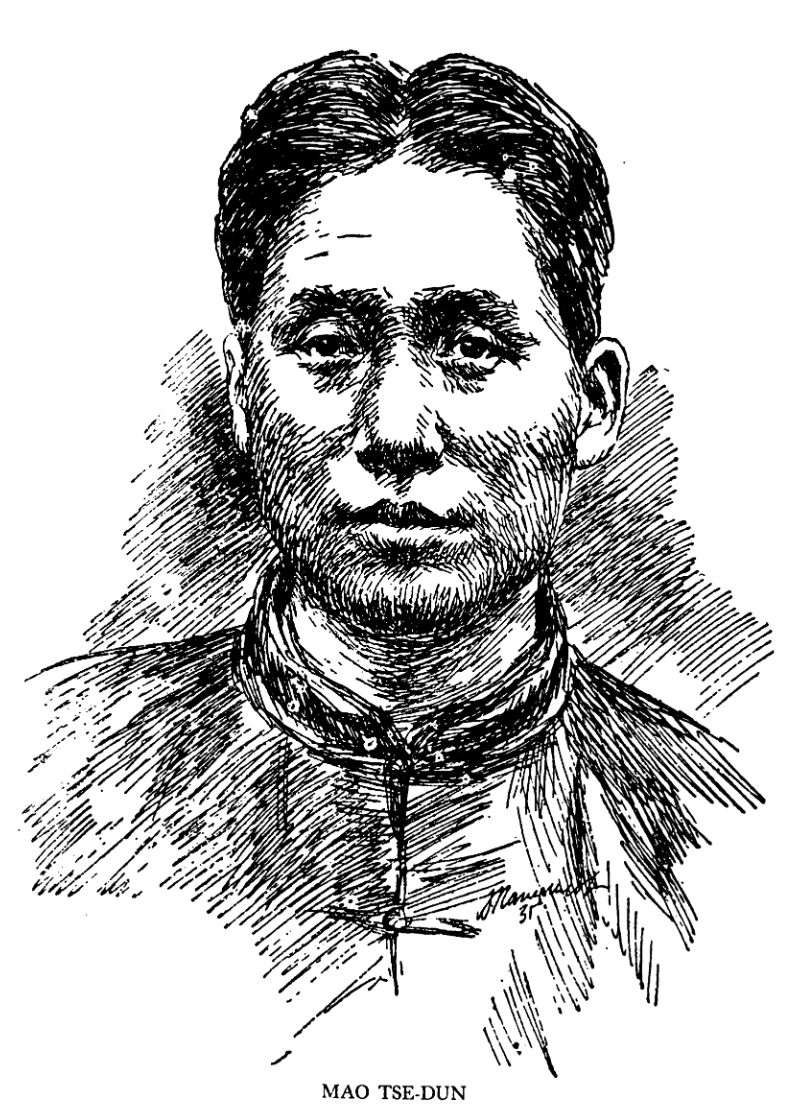
Our Party is capable of leading the civil war, and does so correctly and flexibly. We have developed such political and military leaders as Mao Tse-tung and Chu Teh—these talented military and Party leaders of ours, tried in hundreds of battles. We have really heroic Communist cadres who are fighting self-sacrificingly for the fundamental interests of the Chinese people.
Our Party must carry out the new tactics. It must in the new situation and on the basis of the positions we have already won build up a real anti-imperialist people’s front, and through this people’s front gain victory over the enemies of the Chinese people, and first and foremost over Japanese imperialism.
The ECCI published the magazine ‘Communist International’ edited by Zinoviev and Karl Radek from 1919 until 1926 irregularly in German, French, Russian, and English. Restarting in 1927 until 1934. Unlike, Inprecorr, CI contained long-form articles by the leading figures of the International as well as proceedings, statements, and notices of the Comintern. No complete run of Communist International is available in English. Both were largely published outside of Soviet territory, with Communist International printed in London, to facilitate distribution and both were major contributors to the Communist press in the U.S. Communist International and Inprecorr are an invaluable English-language source on the history of the Communist International and its sections.
PDF of full issue: https://www.marxists.org/history/international/comintern/ci/vol-13/v13-n01-special-China-At-Bay-reprocessed-by-riaz.pdf

