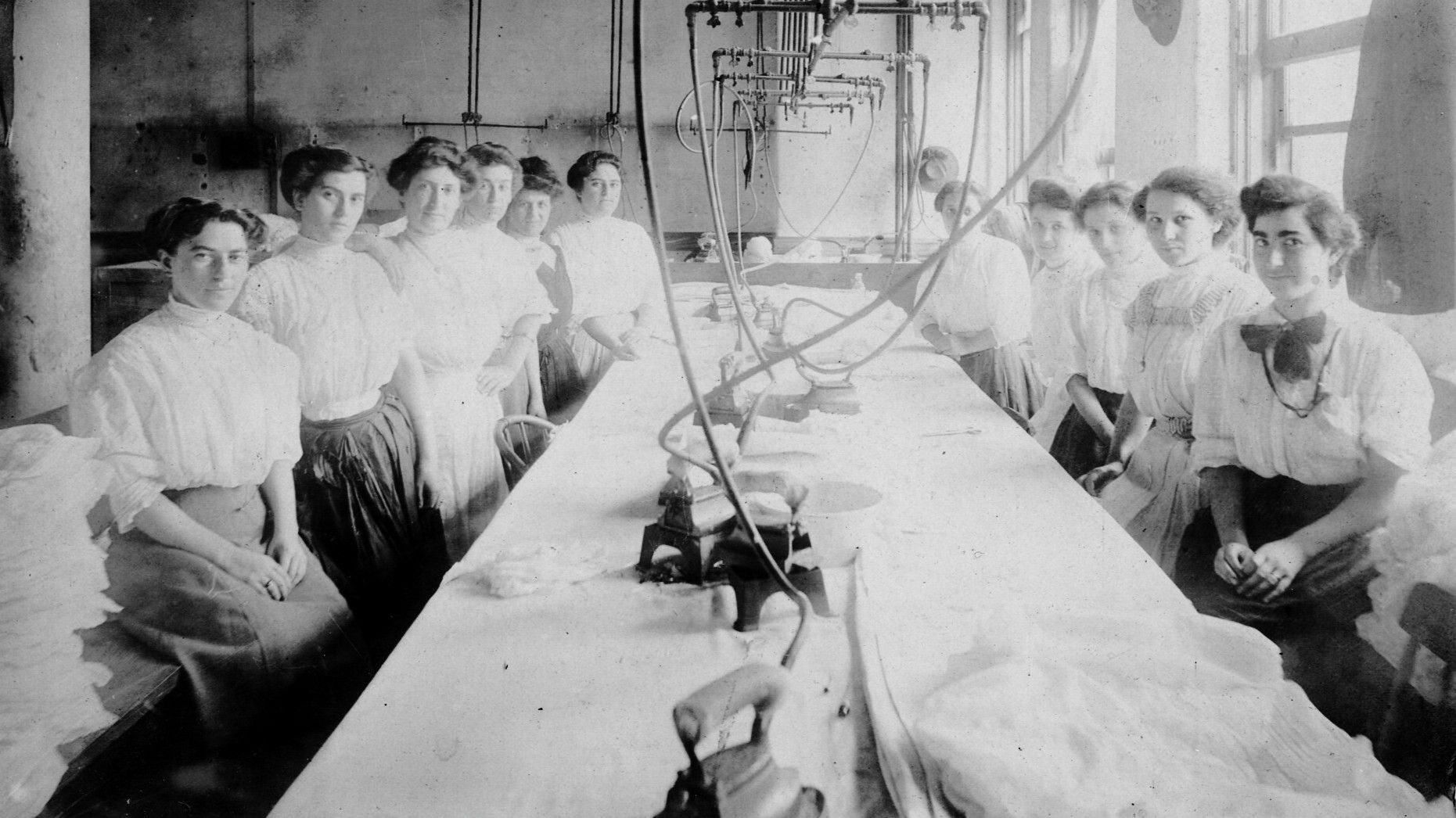
A union can transform lives, and no union transformed more lives than the International Ladies Garment Workers with their brand of social unionism. A look at some of their workers in Philadelphia.
‘Impressions of the Philadelphia Waist Makers’ Union’ by Ellen A. Kennan from Justice (I.L.G.W.U.). Vol. 1 No. 11. March 29, 1919.
The Waist and Dressmakers’ Union of Philadelphia co-operating with the educational department of the International Ladies Garment Workers’ Union of New York brought me to Philadelphia last December to supervise the educational work of the union. For the first time in my life I have come into close contact with a trade union. For almost four months I have had a desk in the headquarters of the union. I have had free access to all the different offices, the manager’s, the complaint clerk’s, the secretary’s. I have attended the union meetings, the executive board meetings, the chairladies’ meetings. I have accompanies a group of girls going out at 7.30 P.M. to take down a shop. I have walked up and down with them as they picketed a shop. With them I have lived through a period of several weeks when a strike was threatening, when, keyed up to the highest pitch of excitement, the members haunted the union headquarters to know the latest developments, I have seen them in their classes at school. I have had them in my own course in literature. I have watched them at their games and dances in the school gymnasium. I’ve gone to the theatres, concerts and operas with them. Never has it been my good fortune to be associated with a finer group of people, with a group more idealistic, more devoted to their organization. The union is to them an ideal, a religion–no sacrifice is too great to make for it. Chair-ladies willingly and gladly give hours of time to adjusting difficulties for which, of course they receive no pay. Price committees make the same generous sacrifice of their time. Why? It’s for the union, the union they have, struggled for, the union they have seen grow from a membership of fifteen or twenty to a membership of five thousand in a brief period of three years. They have denied themselves for it, they have gone on strike for it, they have picketed for it, they have gone to jail for it.
The classes at school are first and foremost union classes, this is the union’s first experiment in education, the reputation of the union is at stake, this experiment must be successful. Therefore tired as they often are at the end of the day’s work far away from the school as many of them live none the less for the most part they make the effort, they are present in their places at the appointed hour. Only, one thing can tear them away from school an opera or a concert such an attraction they can not resist. In addition to the regular night school classes in English and physical culture, the union has arranged two other courses, one in economics and labor problems by Prof. John B. Leeds of Temple University, and one by myself in literature we are studying the modern drama at present.
And there are other educational activities not housed by the Southern High School. There is the Chorus Club with its own special teacher provided by the union. The Chorus Club has its lesson once a week in the headquarters of the union–in a room on the third floor where the union has installed a piano. The guitar and mandolin club has its lesson in the same room under the direction of a special teacher, paid by the union. The members of Local 15 seem to regard the building that houses the union activities as a sort of home, as the center of all their interests. There is an atmosphere of cordiality and sociability about the place that seems irresistible. Girls out of work come and bring their knitting and sit about and talk; others seek out a quiet corner and read–it is always possible to get a book from the union’s well-stocked library–Mr. Mindin, the librarian, is always there ready with suggestions when consulted. Still others go to the music room and practice on mandolins and guitars, or do the new dance steps they have learned at school. Little groups of men and women stand around and discuss the League of Nations, Socialism or what not. The union is a very real and vital factor in the lives of its members.
The idealism and enthusiasm of the manager, Mr. Silver, makes itself felt in every direction. His passion for the finer things of life, his conviction, constantly expressed, that nothing is too good for the members of Local 15, that their desire for knowledge and art and beauty must be satisfied and that it is the union’s duty to aid in that satisfaction, permeates the whole organization. Nor has the manager a monopoly of idealism. It is also the spirit of the large group that is most active in all the work of the union. The members of the guitar and mandolin club are not satisfied to buy the ordinary, cheap instruments, they are paying from forty to sixty dollars a piece for their mandolins and guitars, buying them of course, on the Installment plan. And again it was the union, by its guarantee that made it possible to get favorable terms from the company from which they are buying. According to the night school system of Philadelphia every one registering in the school must pay a dollar, the dollar to be refunded at the end of the term provided the pupil has been present seventy percent of the school nights. Now when our Unity Center opened, It was the dull season in the trade, and the dull season this particular year was just a little duller than usual. It was plain that many would not be able to pay the dollar until they had work again. So at the suggestion of Mr. Silver the union undertook the payment of the registration fee, advancing the money until such time as those not able to pay were again at work. It is this human touch of the organization that makes it so loved by its members.
When the union moved into the new building at 38 N. 11th St., shop after shop sent up great bouquets of flowers for the new officers accompanying them with congratulations on the more convenient and more commodious quarters.
At Christmas time the chair-ladies in the various shops quite generally received beautiful presents–wrist watches, lavaliers and so on from the workers in their shops in appreciation of the time and effort sacrificed in their behalf.
This generous and enthusiastic spirit of self-sacrifice that I have been trying to give some Impression of are now finding expression in the cause of the Waist and Dressmakers’ Union of New York. No meeting takes place at which, the New York strikers are not remembered, every week ten per cent of the wages drawn goes to New York, In many cases far more than ten per cent. Just the other day I heard our secretary and treasurer say to some one, “You have already given more than you should, I won’t take any more from you”. Up to the present time the union has contributed ten thousand dollars to the New York strike fund and the contributions are still coming in.
But not only in giving money are the Waist and Dressmakers of Philadelphia active in the interests of the New York strikers, they are ever on the alert to see that no New York work is being done by Philadelphia manufacturers. They have grown quite “panicky” becoming suspicious on the slightest pretext. Poor Mr. Silver has been embarrassed more than once by an over zealous chair-lady who has brought her shop down absolutely sure that her manufacturer was taking New York work, although after a thorough investigation it has been proved beyond the shadow of a doubt that the suspicion was ungrounded.
I have heard of only one case so far in which it has been clearly shown that a manufacturer was doing New York work. I cannot refrain from giving the details of this case. I had stepped into the office of our complaint clerk, Miss Ada Rosenfelt, to consult her about something. I was more than amazed to see one of the chairladies wringing her hands and walling out something in Jewish which I unfortunately do not understand; she was evidently in the greatest distress–Rachel weeping for the children could not have been a more tragic figure. Instinctively I drew back; to intrude at such a moment seemed unfitting. As soon, however, as I could get hold of Miss Rosenfelt I hastened to question her. This is what she told me. This particular chairlady had discovered that her shop was doing New York work. Although she had instantly taken her whole shop down, still she felt personally defiled, unclean. When I stepped into the office she was wailing out in Jewish, “Oh, woe is me! woe is me! To think that these hands, these, hands of mine have been doing scab work! To think that I should have touched the dirty, vile work. He’ll pay for this, he’ll pay for these unclean hands of mine!” Before the shop went back to work again, the manufacturer had to contribute fifty dollars as a fine to the New York strikers’ fund.
The weekly newspaper of the International Ladies Garment Workers Union, Justice began in 1909 would sometimes be published in Yiddish, Spanish, Italian, and English, ran until 1995. As one of the most important unions in U.S. labor history, the paper is important. But as the I.L.G.W.U. also had a large left wing membership, and sometimes leadership, with nearly all the Socialist and Communist formations represented, the newspaper, especially in its earlier years, is also an important left paper with editors often coming straight from the ranks radical organizations. Given that the union had a large female membership, and was multi-lingual and multi-racial, the paper also addressed concerns not often raised in other parts of the labor movement, particularly in the American Federation of Labor.
PDF of full issue: https://www.marxists.org/history/usa/pubs/justice/1919/v01n11-mar-29-1919-justice.pdf

