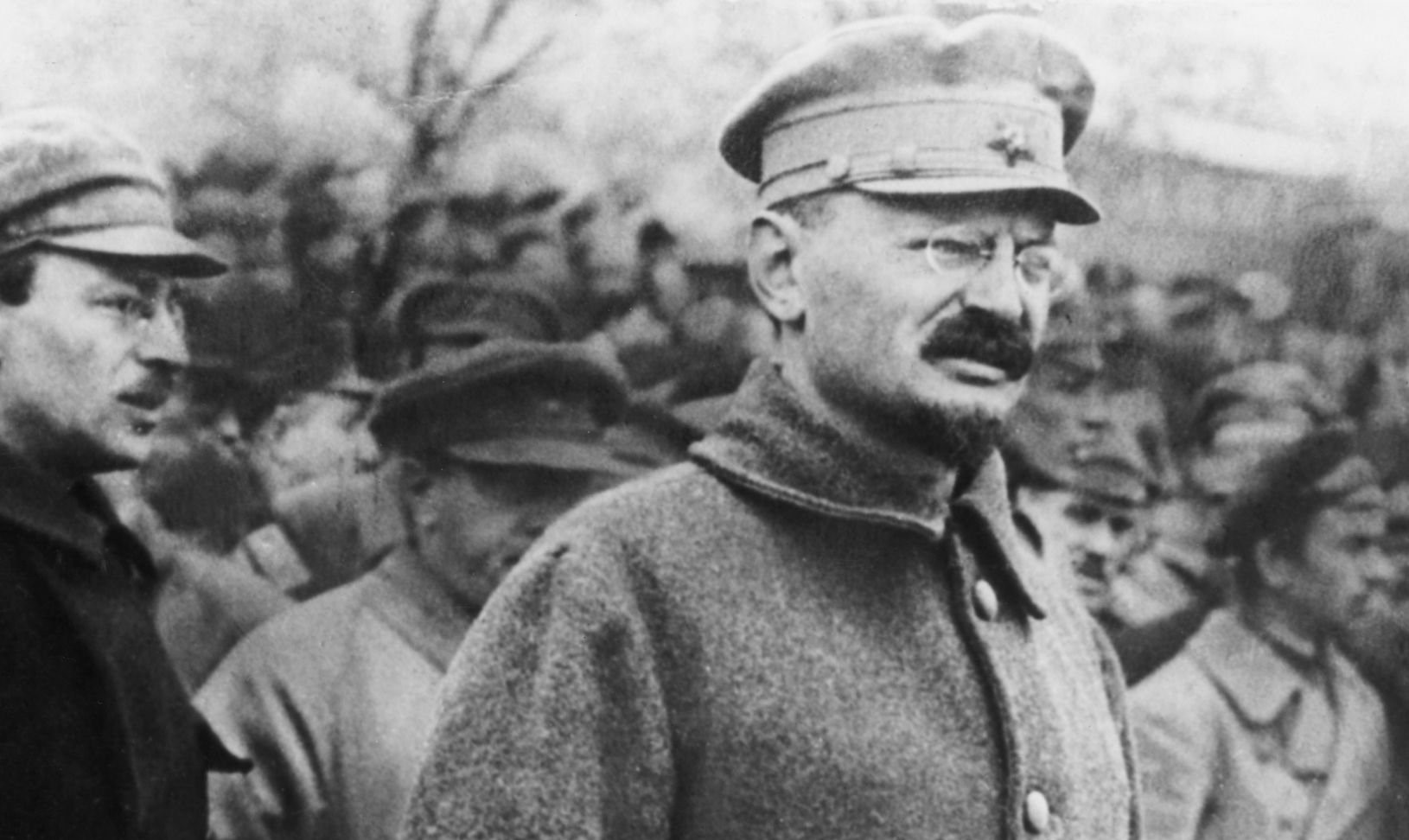
The ‘pacifist’ imperialism of a defunct Social Democracy simply will not die. Extolling the ‘brotherhood of man’ and claiming you would call a strike against a ‘future’ war, all while supporting state military budgets today, Trotsky takes to task the Amsterdamers, the labor arm (International Federation of Trade Unions formed in Amsterdam in 1919) of the reconstructed (1923) reformists in Labor and Socialist International that followed the demise of the Second International.
‘The Amsterdam International and War’ by Leon Trotzky from International Press Correspondence. Vol. 4 No. 35 & 36. June 19 & 26, 1924.
I.
News has arrived regarding the debates and decisions of the Vienna Congress of the Amsterdam Trade Unions concerning the question of war and the means of combatting it. Why has this question arisen at all? Obviously because the danger of a new war is becoming continually more apparent. This is the conclusion which must be drawn before all else. If the Amsterdam trade unions are compelled to return again to the question of war, it is because the danger of a new bloody conflict is being perceived with ever greater clearness by even the most backward of the working masses.
The resolution on the danger of war and on the measures to combat the same was introduced by Jouhaux, the general secretary of the CCT. (reformist trade union federation) of France. By this M. Jouhaux recognises the danger of a new war. But we all remember very well that during the last imperialist war, M. Jouhaux continually asserted that this was the last war, that it had as its aim the destruction of militarism and that as a result there would be established the triumph of Democratic International Right. It was for precisely this reason that Jouhaux summoned the French workers to come to the active aid of the French bourgeoisie in the “last” war which was to end war. And now, ten years after the outbreak and nearly six years after the conclusion of the “last” war, M. Jouhaux introduces a resolution on the fight against the danger of new wars. This means that someone has blundered, this means that somebody has been duped. Who? By whom? Has M. Jouhaux been duped by the French bourgeoisie? Or has M. Jouhaux duped the French workers in the interest of the French bourgeoisie? The question is of no little importance. Before we discuss with Jouhaux the methods of fighting against war dangers, it is necessary to settle this preliminary question. There are only these two alternatives: Either during the imperialist slaughter Jouhaux consciously duped the workers concerning the import and the consequences of the war, in which case he must be thrown out of the workers’ movement or he has been duped himself, i.e. in other words, he fell a victim to his false reformist policy, in which case he should proclaim to the whole world the incorrectness of his reformist policy during the imperialist war, before he assumes the right to express an opinion upon the policy to be pursued by the working class in face of the new danger. It is impossible to escape this alternative.
As far as we know, neither M. Jouhaux nor any of his crowd have declared or do declare that their policy during the greatest event in world history, during the imperialist war, has been throughout false and disastrous. And since this is the case, we are justified without more ado in regarding their policy, and along with it the resolutions of the Vienna Congress as the continuation of their old policy. We know also that before the imperialist war, the trade unions and the Social Democratic parties adopted resolutions against war with the same unanimity as did the last Vienna Congress. When the war was immediately imminent not one of the European Social Democratic parties, not one of the trade unions was able or even attempted to prevent the war, but on the contrary, nearly all of them rushed to the assistance of their national bourgeoisie in the bloody work. Where have we even the least guarantee, or even the shadow of a hope, that with the outbreak of a new war the attitude of Jouhaux and of the remaining Amsterdamers will be in any way different from their attitude during the years 1914-1918?
Such is our preliminary question. The same people who, before the imperialist war, at their congress, abjured militarism and war and then during the war turned out to be chauvinists of the rankest type–now in the interval between two wars, again begin to repeat their abjurations against militarism in order, in the event of war, again to prove themselves to be its most faithful and reliable helpers and servants. Is this not obvious? Can this be denied?
We could leave the matter at that if it were not for the fact that people are very prone to forget the experiences they have passed through and if there were not young generations growing up who have not made such experiences. The whole policy of the Amsterdam leaders reckons upon the shortness of memory of the one and the lack of experience of the other.
Let us therefore more closely examine their fighting program. This program has a two-fold character: on the one hand it recommends a propaganda aimed at destroying the feeling of hostility existing between the peoples of the various nations, at the establishment of a compulsory Court of Arbitration and so forth, i.e. it bears a pacifist character; and on the other hand, it has the semblance of a fighting program, as, in the event of war danger, it recommends a cessation of work in all munition factories and in the transport industry, economic boycott and finally, the declaration of the international general strike. As regards the pacifist portion of the program it is not worthwhile speaking. Of course it would be a splendid thing were it possible to establish a “just” international tribunal which would be compulsory for all. But such a tribunal would evidently have to be established by the bourgeois governments, because power is in their hands. It is, however, precisely these bourgeois governments which threaten us with the war danger. That means that the question in any case is transferred from the pacifist program to the militant program, and will be decided by the extent and the means by which the workers are able to prevent the bourgeoisie from provoking another international conflict.
We have already heard something of the means proposed: partial strikes (in the munition factories) boycott, general strike. Let us at once say: these patent methods of Jouhaux and company constitute a sleeping draught and nothing else.
The munition factories are working in all countries without interruption. Why should they not be called upon to strike at once? If the Amsterdamers seriously decided to resist a new war, then if would appear absurd to manufacture stocks of war material. As a first instalment of the great heroic deeds, to be performed in the fight against war, it would have been as well to have commenced by summoning the workers straightaway to abandon their work in the munition factories. A Utopian proposal, the Amsterdamers will retort, the workers will not respond to such a summons, the government will always find the necessary number of blacklegs etc. etc. This retort it must be confessed is not without foundation. But is it easier to organize a strike in the munition factories on the eve of the outbreak of a war than in normal times of peace? Only idle chatterers and swindlers can assert such a thing. To promulgate a strike in the munition factories and other military undertakings at the moment when war immediately threatens, means in practice the postponing of the strike to such a moment when it will be least possible to carry it out. We remember July 1914. The state is most powerful at the beginning of a war. It finally monopolises in its hands all organs, means and instruments for the mobilisation of public opinion, it adds to this the means of terror. We should have liked to have heard in July 1914, the voice of M. Jouhaux calling for a strike in the munition factories of France. But no, we remember the quite different program which Jouhaux carried out, following the coat-tails of M. Thomas. “Des canons! Des munitions!” (Guns and munitions). What reason is there for supposing that at the commencement of a new war things will prove different? It is ridiculous to transfer the whole burden of the fight against war on to the workers in the munition establishments. None of the Amsterdamers seriously does so. They do not believe in this themselves: they still retain sufficient good sense to avoid this.
It is true that the resolution speaks of a general strike, thereby pretending to impose the duty of militant action against war upon the whole working class. It is, however, not hard to show that all the talk about a general strike differs but little from the talk about a strike in the munition factories. By a general strike there must obviously be understood, such a powerful action on the part of the proletariat as would prevent the bourgeoisie from realising its will in the most important question in that of war and peace. It assumes that the working class is able at any moment to paralyse the will of the bourgeoisie. Why then does it not do so in question of less import: Prolongation of the working day, increase of military expenditure, etc. From whence have the Amsterdamers derived their amazing confidence that within twenty four hours before the bourgeoisie decides to hurl the people again into war, the proletariat will prove to be powerful enough to thwart this plan by means of a general strike? In the period preceding war the bourgeoisie, as already mentioned, concentrates all power in its hands. General strike under such conditions means revolution. Thus the valiant Amsterdamers pledge themselves to carry out a proletarian revolution at a certain moment, not chosen by themselves but by the bourgeoisie. But it seems that for this one must have the necessary forces. And if they are available, why then postpone the revolution until the moment when war is imminent? Is it not simpler to achieve this in good time thereby eliminating the very possibility of war?
II.
The question of the struggle against war is lit up with even greater clearness from another side. The French GGT. (reformist trade union federation) which is led by Jouhaux is closely connected with the French Socialist Party, just as the English trade. unions are connected with the party of MacDonald, just as the German trade unions stand in the closest relationship with the Social Democrats etc. Naval and military expenditure the same which among other things, secures work for the munition factories, constitutes the most important section of the Budget of Mr. Snowden, of the “labour” minister, who is carrying out the task of British imperialism. Thus the Amsterdam Snowden compels the English workers to pay taxes to meet the demands of the English manufactures of high explosives etc. And as soon as the feverish time arrives when these high explosives are to be brought into use, these English workers are expected to put a stop to the production of munitions and to the whole of industry in general. And this does not refer to England alone. The French Socialist party has decided to vote for the Radical Budget. The Radical Budget provides for pretty radical expenditure on military purposes. And at the same time M. Jouhaux, who is conducting a common policy with the French Socialists, wants to pledge the French workers to enter on a strike at the very moment when it will become evident that the “radical” army does not exist as a mere play-thing, but is destined for very serious work, i.e. for war. Can one imagine a more contemptible piece of charlatanism? In peace time we shall provide the Budget of the bourgeoisie, and in the capacity of Socialist ministers, shall urge the workers to pay the taxes for military purposes, support develop and promote the munition industry, maintain the strictest discipline in the bourgeois army and inculcate the idea into the workers that it is their duty to support the imperialist state…But at the very moment when the bourgeoisie, which takes the matter seriously, decides that the army, which has been created with the help of Socialist ministers and reformist trade union leaders, must go into action, oh! at that very moment we shall summon the workers to a general strike and to adopt all other means of struggle. This policy assumes that it is a question of rams who are to be led to the slaughter.
But if, according to your opinion, a general strike for the prevention of war is impossible–we hear the cunning Amsterdamers reply what else is to be done? Then the working class is defenceless against militarism. To this we reply: the working class is not unarmed against militarism, but you Amsterdamers are doing everything in order to disarm it. Let us begin with small things. Before calling for a strike in the munition factories, not to speak of a general strike, it would be better to decide on refusing to vote those sums provided in the bourgeois budget for the maintenance of munition factories. It is nonsense to talk about the complete independence of the trade unions and of the Socialist parties from each other, for it is clear and indisputable that they follow a joint policy. Should the parliamentary parties refuse to subordinate themselves to such a decision, then it would be the duty of the trade unions to call for a boycott of any party which, either directly or indirectly, supports a war Budget in a bourgeois state. But would this not mean a rupture with the reformists, with the compromisers, that is with oneself? Truly an insoluble task! One cannot day after day support the bourgeois state, sanction its budgets in the name of the proletariat, allow it to collect its forces and to restore its muscular system which had been seriously injured by the last war, and declare at the same time: At the very moment when you, the state, seek to put this muscular system to use, then we will at once oppose it with all our might. The criminal stupidity of such an attitude is truly enormous!
But would the refusal to vote for the budget in itself decide the question? So long as the bourgeoisie maintains parliamentary government, it always secures a majority for itself. This means that it will have its war budget even in the event of the representatives of the workers voting against it. The war danger will not be removed by this means. This is beyond dispute. The war danger cannot be abolished by means of mere parliamentary opposition. But it is perfectly clear that those workers’ organizations which even lack the spirit to conduct parliamentary opposition are absolutely worthless. To vote against war expenditure (and against the capitalist budget generally) has some sense in so far as the trade unions and parties unite the workers for an irreconcilable struggle against the domination of the bourgeoisie, not only in the case of war danger, but also in peace time, i.e. in the time of systematic preparation of war danger. Of course the bourgeoisie will still have its budget and its militarism. But the trade unionists will say: Only the damnable enemies of the working class can vote for this budget; in this budget there is rooted, not only the slavery of today, but also the war of tomorrow; and whoever among the so-called “labour” representatives votes for this budget, is a traitor who should not be allowed to come within a mile of a labour organization.
The creation of a political mood of this kind among the working masses means the creation of the first elementary premise for the fight against the war danger.
This premise cannot of course be regarded in itself as sufficient. It is necessary to set up a militant organization of the working class. To render a strike in the munition factories. possible, it is necessary, in the first place, that the working mass in these factories, at least in its majority, be filled with hate against the bourgeois rule; and in the second place, that there exist, in this mass a solid core which is capable of leading the masses behind it at the decisive moment. Of course, even given these conditions, we can by no means guarantee that we shall be able to carry out a general strike precisely on the eve of the war. At that moment a strike (that is to say, a revolution) is less probable than at any other time. In fact either a revolution, with a general strike as one of its accompaniments, will arise out of the course of the class struggle and thereby render a war impossible, or the new war will bring with it a new aggravation of the class struggle and lead to a general strike and to a revolution. No serious revolutionary can give formal guarantees in this respect. It is otherwise with the political charlatan: he juggles, with the general strike, revolts, boycott, war etc. just as a clown does with tin plates.
Just as if it expressly intended to show itself in its complete reformist nakedness, the Congress of the Amsterdamers. decided to appoint the 21st September next as a “day of protest against war.” Woe to Militarism! but half a minute!–the reader will interject the working class has already its day of protest against militarism: the 1st of May. But that is just the trouble, it is only once in so many years that this day falls on a Sunday. One cannot “protest” against war on the 1st of May without going on strike and coming into conflict with the bourgeoisie. And it is a far more difficult matter to prevent capital from exploiting labour on one day in a year than to promise general strikes, generally boycott and other miracles in the event of a war. It is for this reason that the Amsterdamers have postponed their protest to the third Sunday in September. On this day their terrifying protest will assume such a form that no one will notice it. Sunday is always Sunday. The final abandonment of the holiday on the 1st of May is the only new word of the Amsterdamers in the fight against the war danger.
The general conclusions to be derived from the anti-militarist decisions of the Congress of the Amsterdam International are: It is necessary to render clear to the working masses, in a more persistent, urgent and systematic manner than hitherto, that the Amsterdamers are most treacherously betraying them on the most fundamental and most vital question of the development of modern society: on the question of war. The recipes of the Amsterdamers constitute a political opiate in the service of capitalist militarism. The chief war danger is to be found precisely in the position of the Amsterdamers. To destroy this position, that is to deprive them of the confidence of the masses is synonymous with disarming the bourgeoisie and arming the proletariat. That is the work which must be fulfilled.
International Press Correspondence, widely known as”Inprecorr” was published by the Executive Committee of the Communist International (ECCI) regularly in German and English, occasionally in many other languages, beginning in 1921 and lasting in English until 1938. Inprecorr’s role was to supply translated articles to the English-speaking press of the International from the Comintern’s different sections, as well as news and statements from the ECCI. Many ‘Daily Worker’ and ‘Communist’ articles originated in Inprecorr, and it also published articles by American comrades for use in other countries. It was published at least weekly, and often thrice weekly.
PDF of full issue: https://www.marxists.org/history/international/comintern/inprecor/1924/v04n35-jun-19-1924-inprecor.pdf
PDF of full issue: https://www.marxists.org/history/international/comintern/inprecor/1924/v04n36-jun-26-1924-inprecor.pdf

