The third national, and final, conference of the T.U.E.L. took place four years after the second, an indication of the dog days for labor that were the mid-1920s, in New York City during early December, 1927. happening in the midst of the drama of that year’s life and death strike for the U.M.W.A. and the Revolution in China it was an indication of the beginnings of a rising class struggle at the end of the decade. Below is a report on the meetings, the speeches of Foster and others, and the resolutions passed. The next national gathering held two years later would transform into the Trade Union Unity League and formalize the period of New Unions, or Red Unions, where labor organizations were built outside of existing unions.
‘Trade Union Educational League Pledges to “Save the Unions”’ from The Daily Worker. Vol. 4 No. 278. December 5, 1927.
Delegates Send Telegrams of Greeting To Tom Mooney and Warren Billings
Two thousand workers, including three hundred delegates to the third national conference to the Trade Union Educational League were brought to their feet in enthusiastic applause in one of the most dramatic incidents ever to have taken place at a New York workers’ meeting, when three members of the Miners’ Relief Committee, dressed in their miners’ costumes, with their head lamps lighted as if prepared to enter the gloomy recesses of a Pennsylvania mine, marched into the meeting chamber at Central Opera House, in which the third national conference of the Trade Union Educational League was being held, and called upon the representatives to unite the forces of the left wing movement in an attempt to save the miners’ union from the destruction with which it is threatened.
Hardly less picturesque was the Chinese delegation of militants representing sections of Oriental workers as they paraded into the crowded auditorium the cheering of the visiting sympathizers and delegates. With banners flying and slogans held aloft they too symbolized the spirit of militancy and promise which has characterized the most significant conference yet to be held by the advance guard of the American working class.
Telegrams to Mooney and Billings, prisoners of California class war justice, as well as to the Colorado prisoners and the Pennsylvania and Ohio miners were sent by the conference with the expressions of the solidarity and support of the left wing in the struggle to free these militant sufferers for the labor movement.
The delegates representing the militant sections of the organized and unorganized labor movement of the country listened to a report by Secretary-Treasurer William Z. Foster, in which he analyzed the policies and past program of the League, and heard him issue a stirring call for renewed activity in a “Save The Trade Union Movement” campaign.
Other speakers at the conference were Earl Browder, American delegate to the Pan Pacific Trade Union Conference, who spoke on the International Situation; Wm. F. Dunne, whose subject was Organize the Unorganized; H.M. Wicks, delegate from the Typographical Union left wing section, who spoke on For a Labor Party and Jack Johnstone, whose subject was Build the Left Wing.
General discussion by the delegates followed the reports of these speakers after which the conference divided itself into special committees for the analysis of special topics relating to the coming year’s work.
The Fight on Reaction.
Foster, in pointing out the especially critical condition of the trade union movement of the united States and the unusual significance of the present conference of the advance guard of the workers, called attention to the increasing reaction of the bureaucratic officials and their attempt to stifle all militancy within the unions. This was the sign for redoubled activity on the part of the left wing, he said. The Trade Union Educational League had been proven entirely correct in its estimate of the situation and the slogans which had been issued.
Previous Judgment Correct.
He referred in particular to the slogans directed in the railroad workers’ and miners’ struggles. The slogan of “Amalgamation or Annihilation” issued to meet the drive of the railroads against the workers in 1922, even though ridiculed at the time by the reactionaries in the trade unions had been proven correct, he pointed out. The slogan of “Save The Miners’ Union” had met with equal derision, even calling forth ridicule from European officials of the Internation- al Federation of Trade Unions, the reformist International. It is now ap- parent, he said, that the miners’ union is actually in just such danger as these officials scorned.
Stop Surrender Policy.
The burning slogan before the labor movement at the present moment, he concluded is “Save The Trade Union”; that unless the present policy of surrender on the part of the labor officialdom to, the bosses was reversed in a policy of militancy and struggle the same fate was in store for the whole labor movement as had occurred in the case of the railroad and mine workers.
Foster emphasized that it depended upon the members of the Trade Union Educational League and the left wing to carry out the policy of struggle within the unions and to force a program of militancy into the movement, as well as to organize the unorganized.
The delegates heard with enthusiasm the reading of a cablegram sent to the Red International of Labor Unions at Moscow with which the T.U.E.L. is affiliated. The message expressed the agreement of the conference with the program laid out by the R.I.L.U. in a cable Saturday, and pledged itself to muster around the slogans of Organize the Unorganized, Stop the War Danger, and For a Labor Party.
In his talk on the International situation, Earl Browder referred to the outstanding tasks of the left wing to unite the labor forces against the war danger and for the support of the Chinese Revolution.
Must Remedy Disorganization.
Wm. F. Dunne, in emphasizing the tasks of the T.U.E.L. as the motivating force in the organization of the unorganized, gave a graphic account of the state of unorganization in the various industries in the United States showing how utterly the labor bureaucracy had failed to deal with the task of organizing the workers in the basic industries. Dunne’s analysis showed that in such industries as steel, packing houses, boots and shoes, etc., hardly more than 3 per cent of the workers were organized.
The remarks of H.W. Wicks emphasized the necessity of building a labor party to offset the method of selling out to the old capitalist parties which had characterized the A. F. of L. policy of rewarding its friends and punishing its enemies.
Pledge Money For Relief.
The miners’ delegation consisting of rank and file representatives, Smith, Anthony, and Minerich, spoke in detail of the plight the miners’ union found itself in as a result both of the attacks of the mine bosses and the fatal policies of John Lewis. Smith pointed out the role which the left wing would have to play if the American labor movement was to be saved from the same fate and called upon those present and the forces represented there to get behind the miners’ strike. The delegates and visitors to the conference responded by pledging over fifteen hundred dollars towards miners’ relief.
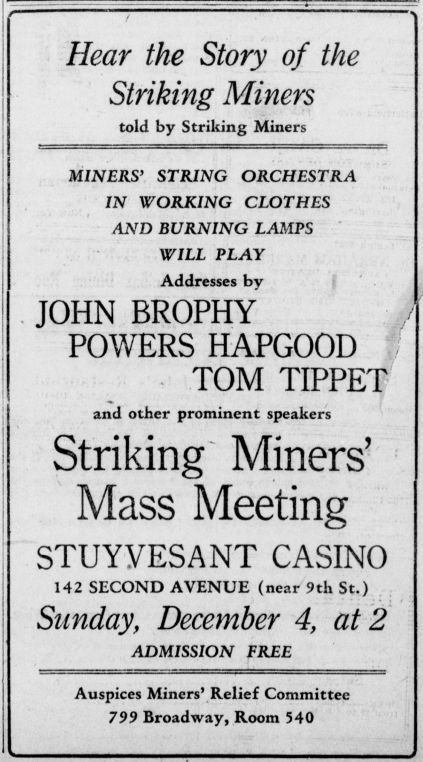
Anthony pointed out the role of the coal and iron police in the Pennsylvania conflict and reported that scores of Chicago gangsters had been imported into that state, clothed with the uniforms of the police and were now engaged in their nefarious work.
More Reactionary Than Governor.
That John L. Lewis, president of the United Mine Workers, was even more reactionary than Governor Fisher of Pennsylvania in’ that Lewis had not even made the pretense of Fisher’s investigation of the police brutalities, was the theme of Minerich’s talk.
Ogmo, speaking for the Chinese delegation, emphasized the spirit of international solidarity of the Chinese, Japanese and other Oriental workers with their American brothers and comrades.
Telegrams To Mooney & Billings.
In addition to the telegrams sent to Mooney and Billings, the Colorado prisoners’ and the striking miners of Ohio and Pennsylvania, pledging the support of the left wing in every possible way in the task of freeing these militant workers, the T.U.E.L. conference passed resolutions in support of the striking miners of Ohio and Pennsylvania.
Chief among the resolutions was the one in support of the Soviet Union on its completion of ten years of workers’ rule, pledging the conference to carry on the struggle against the war danger and for the recognition of the Soviet Union.
Another resolution called attention of the American working class to the struggle in defense of class war prisoners against capitalist justice and in particular pledged its support of the International Labor Defense in its heroic activities in behalf of all oppressed workers.
***
‘Trade Union Educational League Resolutions’ from The Daily Worker. Vol. 4 No. 279. December 6, 1927.
(Adopted at Third National Conference, New York, Dec. 3-4, 1927.)
Resolution on Miners’ Strikes
“The strike of the bituminous miners has entered upon its ninth month, with 125,000 miners in Pennsylvania and Ohio, still heroically struggling for the preservation of their union. With more than two-thirds of all coal being mined in non-union fields, with, according to Secretary Davis and coal operators, 300,000 miners unable to find employment when the industry is meeting the full demands of the market, with the Central Competitive District agreement being liquidated through separate district agreements, with the ruinous policy of John L. Lewis dominating the union with denial of inner-union democracy to the members, while collaborating with the employers–with all these conditions against them in addition to the widespread oppression by the government, through injunctions, militia, state cossacks, private armies, etc., the miners’ union is in danger of destruction.
“Responsibility for the deep-going crisis in the union must primarily be placed on the misleadership of Lewis and his machine. In refusing to organize the miners in the unorganized fields, Lewis predetermined his policy of surrender to the local operators. By leaving great masses of workers unorganized in West Virginia, Pennsylvania, Kentucky, Tennessee, Alabama, Colorado, etc., in spite of their manifest willingness to organize, Lewis undermined the strength of the union miners in the other fields and furnished the operators with a vast flood of non-union coal which made ineffective the sufferings and struggles of the union members.
“Instead of consolidating the inner-union strength, Lewis carried on war within the union against its most militant sections (Howat in Kansas, McLaughlan in Nova Scotia, etc.), and smashed several district organizations, twice he stole the national elections when they went against him; he expelled large numbers of active militant miners from the union; and established legal discrimination against foreign-born miners who make up a majority of the workers in the industry. Toward the employers, Lewis’ policy was one of collaboration, accepting their program of eliminating 300,000 miners from the industry, refusing to enter into the non-union fields for the organization of the unorganized, keeping the anthracite and bituminous miners separated so that common action was made impossible, and finally abandoning the Central Competitive Field agreement and accepting separate agreements for some sections while others are still fighting for their lives.
“In the seventh month of the national struggle, there began the strike of the Colorado miners, unorganized for 13 years. Repeatedly betrayed and completely neglected by the Lewis machine, they struck under the leadership of the I.W.W., which provided them with machinery for the struggle. The Colorado strike is a complete and crushing answer to Lewis and his henchmen, who blame the non-union miners for the condition of the Miners Union. It proves that the non-union miners are only waiting for an opportunity to unite with their brothers for the common struggle, but they have been practically excluded by the policies of Lewis & Co. In spite of their comparative isolation, the Colorado miners have put up a struggle that has inspired the whole working class, and thrown fear into the hearts of the employers.
“The bloody suppression of the miners in this present national struggle by courts, gunmen, police, cos- sacks, and militia, has been a new black page in the history of crime of American capitalism. Many miners have been killed in the Pittsburgh-Ohio struggle; six Colorado miners were slaughtered and 20 were wounded in the wanton massacre at Columbine. Thus are the traditions of the miners’ struggles of the past, of bitter suppression by the operators and resolute resistance by the workers, from the early days of Illinois, Ohio, and Pennsylvania, thru the Ludlow massacre, the civil war in West Virginia, etc., carried over into the latest days of capitalist ‘prosperity’ and expansion. But, while the miners struggle just as heroically as in the past, they are betrayed in to- day’s struggle by a misleadership worse than anything previously known in the labor movement.
“To save their union and to prevent themselves from sinking into slavery, the miners must remove their misleaders and replace them with militant leaders, reconsolidate the union on the basis of inner-democracy, restore the broken-up district organizations by drawing in the masses of unorganized; aggressively reach out into the non-union fields with organization; unite the forces of bituminous and anthracite miners with the agreements expiring simultaneously; place the coal industry, in its dealing with the workers, upon a national basis; move aggressively for the nationalization of the mines; establish the shorter work-day; prevent all wage reductions, sever their officials’ connections with the capitalist parties and move for the formation of a Labor Party.
“The strikes in Ohio, Pennsylvania, and Colorado must be won. The miners should conduct their strikes militantly, violating the shameful injunctions and other restrictions on picketing. The railroad men should refuse to haul scab coal. The backdoor conferences of A.F. of L. leaders with Coolidge and other enemies of the workers has served only to defeat the miners. The strikes can be won only by militant action of the whole body of miners, supported aggressively by the entire labor movement.
“All workers everywhere must come to the assistance of the miners who are in the front lines, holding the union trenches against overwhelming odds. Money in large sums must be raised for the relief of the Pittsburgh-Ohio and the Colorado striking miners. The T.U.E.L. calls for generous and enthusiastic support of the relief campaigns conducted by
“Pennsylvania-Ohio Miners’ Relief Committee, 611 Penn Ave., Rm. 307, Pittsburgh, Pa. and by,
“Colorado Miners’ Defense & Re- lief Committee, H.J. Childs, Secretary, P. O. Box 87, Walsenburg, Colorado.”
Greetings to Mooney and Billings
“To Tom Mooney and Warren K. Billings:
“The Third National Conference of the Trade Union Educational League, three hundred delegates present, representing militant section of the working class, sends you warmest fraternal greetings and pledges to carry on the struggle for your liberation throughout length and breath of the labor movement.
Greetings to Colorado Prisoners
“Colorado Prisoners:
“The Third National Conference of the Trade Union Educational League, speaking in the name of the militant section of the working class greets your heroic struggle and pledges its support in your defense and its aid to the fighting miners of Colorado.
Pennsylvania and Ohio Miners.
“The Third National Conference of the Trade Union Educational League pledges its fullest support to the miners and their families of Ohio and Pennsylvania in their great struggle to save their union and repel the attack of the coal barons and their government.
Resolution on Labor Defense.
“Every struggle of the workers for better conditions of life and work in the United States and elsewhere has brought victims of class justice. The prison, the gallows and the electric chair are weapons used by the exploiters’ government against the labor movement. In strikes, the capitalists are often able to put the best fighters behind prison bars. “During the past year Sacco and Vanzetti have perished in the electric chair as victims to the vengeance of the master class. Now Greco and Carrillo are threatened, with the same fate.
“For defending the rights of the working man and his class, dozens of workers are today in prison in this country. Mooney and Billings, the Centralia prisoners and many other members of the I.W.W., are still held. Eight of the leading fighters of the Passaic strike are serving penitentiary sentences along with a number of New York garment workers. Cases are pending against the Cheawick miners and other militants. The cases of the Michigan Communists, in Pittsburgh and Farrell, in every part of the country, are still pending and the workers involved are threatened with imprisonment because they fought for the working class.
“In order to help and defend these class war prisoners, it is necessary to support a united-non-partisan organization which has as its aim and purpose the defense of victims of capitalist class injustice. International Labor Defense, by its record of activity, has shown that it is such an organization. The National Conference of the Trade Union Educational League therefore endorses the International Labor Defense and its work, and calls upon its members to aid it in the work which it is carrying on for the working class.”
T.U.E.L. Resolution on Ten Years Of the Workers’ Republic.
“The Third National Conference of the Trade Union Educational League greets enthusiastically the Tenth Anniversary of the Workers’ Republic of Russia, of the proletarian revolution, which was celebrated on November 7, 1927. In spite of the most terrible obstacles (war, civil war, blockade, famine, sabotage, international boycott, slander), the Workers’ Republic has not only broken the powers of reaction and freed the 150,000,000 population of Russia from oppression, it has successfully consolidated the workers’ power, and has proceeded to the construction of socialism.
“During the first five years of its existence the Soviet Union had to prove its right to existence by defeating in struggle a world of enemies. Its victory in this series of wars was decisive. During the last five years the struggle was primarily on the economic front, and there the victory has been as definite. Banking, transportation, and heavy industry have been concentrated entirely in the hands of the Workers’ State; small industry and trading is predominantly under control of State or the cooperatives; production has been increased above the pre-war level, technique is being modernized, and the first great units of the program of electrification are already in operation.
“For the toiling masses, the gains secured by the Workers’ Republic have been immediate; after removing the former intolerable oppression of the old regime, the Soviet Union has brought incalculable social, cultural, and economic gains to the workers and peasants. it gave land to the peasants, improved the standard of living are working conditions of the workers; installed comprehensive social insurance; established the equality of women, and protection of mothers and children; enormously extended educational facilities, and gave the workers the first opportunities for them, and has drawn millions of workers and peasants into direct administration of political and economic power. It has freed all the former subject nationalities, and united all upon the basis of free autonomous federation. It has transformed Russia from an aggressive imperialist power, ‘the gendarme of Power,’ which was a constant threat against the peace of the world, into a rower, the only one in the world consciously striving for peace and fighting against imperialism, and for the liberation of all oppressed peoples. Under the Soviet Power the Russian working class has built up the most powerful trade union movement the world has ever seen.
“Facts, historically established, have given the lie to all the slanders of the enemies of the Russian Revolution. While the leaders of the A. F. of L. denounce the ‘despotism’ of the Workers’ Republic, the autocracy of American capitalism, praised by Green and Woll, is engaged in smashing the miners’ union, breaking down the 8-hour day, cutting wages, and corrupting the trade union movement. “At the same time that capitalism is attempting to stabilize itself by increasing hours and reducing wages, the Soviet Union celebrates its Tenth Anniversary by proclaiming the Seven Hour Day as the basic workday. These contrasting facts are the complete answer to the slanderers of the Workers’ Republic.
“We take especial note of the danger of war against the Soviet Union, being organized by the British government. We call upon all workers to fight against this war, to mobilize the workers in support of the Soviet Union, and to demand of the U.S. Government complete and unconditional recognition of the Soviet Union.
“We greet with pleasure the recent trade union delegations from America to the Soviet Union. Their reports are rapidly dispelling the fog of slander and misrepresentation created by the capitalist press about the Soviet Union and its achievements. We particularly urge the sending of men workers’ delegations to the Soviet Union.
“Greetings to the working class of the Soviet Union, leaders in the struggle for the liberation of the human race.”
The Daily Worker began in 1924 and was published in New York City by the Communist Party US and its predecessor organizations. Among the most long-lasting and important left publications in US history, it had a circulation of 35,000 at its peak. The Daily Worker came from The Ohio Socialist, published by the Left Wing-dominated Socialist Party of Ohio in Cleveland from 1917 to November 1919, when it became became The Toiler, paper of the Communist Labor Party. In December 1921 the above-ground Workers Party of America merged the Toiler with the paper Workers Council to found The Worker, which became The Daily Worker beginning January 13, 1924.
PDF of full issue: https://www.marxists.org/history/usa/pubs/dailyworker/1927/1927-ny/v04-n278-NY-dec-05-1927-DW-LOC.pdf
PDF of full issue: https://www.marxists.org/history/usa/pubs/dailyworker/1927/1927-ny/v04-n279-NY-dec-06-1927-DW-LOC.pdf

