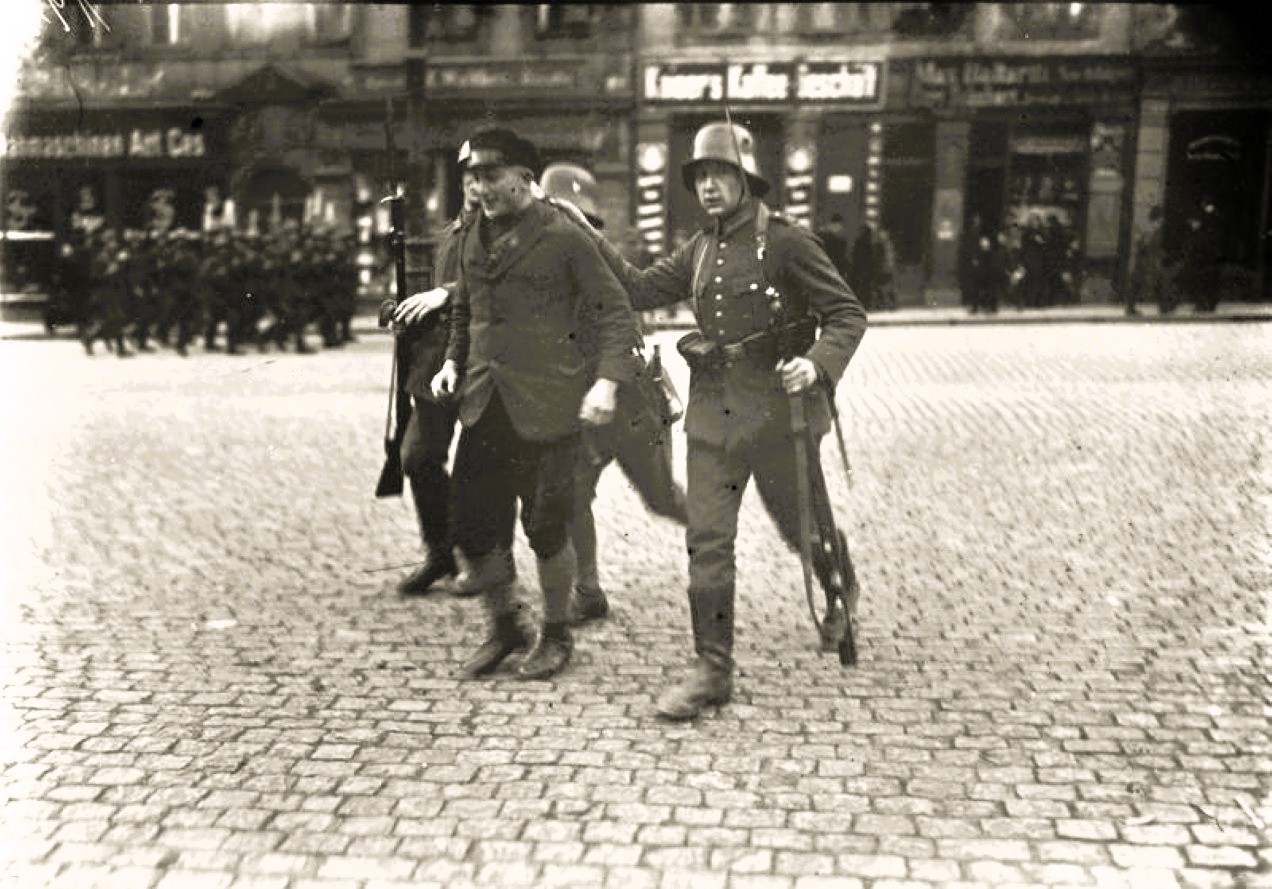
After the turning point that was the failed 1923 ‘German October,’ representatives of a divided Communist Party meet with the Comintern leadership in Moscow in the aftermath for discussions, with this thesis emerging from the meeting. An important document from the E.C.C.I. for the history of both the Third International and its German section.
‘The Lessons of the German Events’ from International Press Correspondence. Vol. 4 No. 14. February 27, 1924.
Introduction
The present document, which is of extreme importance for the whole of the Comintern, was drawn up at a recent conference of the ECCI with representatives of the Central Committee of the German Communist Party.
A serious regrouping of political forces within the Central Committee of the German Communist Party has taken place, as the result of the political crisis just passed through.
These groups have crystallised out as follows. A right group (Brandler), which however, received an insignificant minority on the Central Committee (2 votes against 27); then a compact group, which at present represents the main body of the Party (17 votes on the Central Committee); and finally, the old left (Berlin and Hamburg).
In the opinion of the ECCI it is necessary at present to achieve a complete fusion of the central group with the left group against the opportunist errors of the right. The beginning of this fusion is marked in the present document, on which with the assistance of the ECCI both these tendencies representing together 99 per cent of the German Communist Party were united.
All the representatives of the Sections of the Comintern now in Moscow (including the Polish communists) voted for the resolution.
At the last moment even the followers of Comrade Brandler subscribed in principle to the resolution, making a special declaration.
The ECCI is convinced that the fusion of the central main body with the left against the opportunist errors of the right will assist the German Communist Party in carrying out correctly the great tasks now confronting it. The EČCI will take the most severe measures against any manifestation of fractionism, from whatever side it comes. G.Z.
***
The events which took place in Germany, Poland and Bulgaria in the period from May to November 1923 marked the beginning of a new chapter in the history of the international movement.
In Germany, along with the development of the crisis in the Ruhr, the proletarian class war passed from the phase of gradual accumulation of revolutionary forces into a new phase concerning the fight for power.
In view of the great significance of the German revolutionary movement, the historical change which took place in August and September and the events of the autumn are of great importance to the Communist International. The lessons and the conclusions to be derived from these experiences must be taken advantage of to the greatest detail by the whole of the Communist International.
Since a tactical estimate of these events must be made almost entirely on the fundamental principles of the Communist International, the Executive desires once more to give a fully concrete exposition of the tactical method of the Communist International, which in the present epoch is both theoretically and practically of extreme importance the tactic of the United Front.
1. The Tactics of the United Front.
At the Third World Congress of the Communist International, the tasks of the German Communist Party arising from the March defeat were discussed in the greatest detail and summed up in the slogan: To the Masses! In December of the same year, the method by which the masses were to be won over was embodied concretely in the resolution of the Executive on the tactics of the united front.
In Germany the Communist Party immediately proceeded to carry out the tactics of the united front with the greatest earnestness. The whole objective situation in Germany favoured these tactics. As a result of its labours the Party achieved great success; it won the increasing sympathy of the masses, and caused disruption in the ranks of the Social-Democrats.
A number of our Sections began to employ the tactics of the united front only slowly, after overcoming much resistance and along with many errors. In France a considerable section of the Party in 1922 failed to understand the tactics of the united front, and seriously feared that they would be interpreted as an ideological concession to the Social-Democrats. In England a section of the comrades wrongly interpreted the tactics of the united front in the sense that communists were not to criticize the opportunist Labour Party in Parliament. In Finland, similar false conclusions were come to. In Roumania, a section of the comrades honestly believed that the tactics of the united front meant a parliamentary collaboration with the Social-Democrats. In Italy the Communist Party for a long time committed the exact reversed error, and refrained from giving the tactics of the united front a wide application for fear that the purity of the theory and program of the communist movement might thereby be compromised. A number of other parties made a too mechanical interpretation of these tactics, and thought it was enough to address a stereotyped open letter to the Social-Democrats once a month and then forget all about it. They were not able to employ the tactics of the united front for the purpose of carrying on a real political fight.
The mistaken application of the tactics of the united front made in a number of countries, especially at the beginning, does however, not mean that the tactics themselves are wrong. This conclusion would be just as mistaken as the rejection of the revolutionary exploitation of parliamentarism on the grounds that certain parliamentary fractions are only able to learn to make use of it after many errors. The tactics of the united front were, and are, in themselves, right, in spite of incidental errors connected with them.
The tactics of the united front have their strong sides and they have their dangers. Although in October 1923 we did not possess a safe and certain majority in the German proletariat, nevertheless, the very fact that the young Communist Party at that period could seriously ask itself whether it had not already a reliable majority to proceed to seize power, proves that the tactics of the united front are capable of bringing about the most essential pre-requisite for the seizure of power, namely, the winning over of a majority of the proletariat for the proletarian revolution. If the Communist Parties have to take into consideration the psychology and the mood of the backward masses still remaining under the influence of the Social Democrats, this does not prove the erroneous of the tactics but merely points to a source of danger in the application of the tactics.
In the first theses of the Executive in December 1921, the dangers connected with the tactics of the united front were emphatically indicated: “Not all the communist parties are sufficiently strengthened and consolidated, not all have finally discarded the centrist and semi-centrist ideologies. Cases of going to the other extreme are possible, of tendencies which, in effect will lead to the dissolution of the communist parties and groups into a formless united bloc. If the tactics planned are to be carried out with success for the cause of Communism, then the communist parties themselves which carry out the tactics must be strongly and firmly united and their leadership must be marked by clarity of thought.”
The Fourth World Congress also pointed out the dangers concealed both in the whole tactics of the united front and in the special slogan of the Workers’ Government. The Congress declared: “In order to avoid these dangers, and in order to be able to take up immediately the fight against the illusion that a stage of ‘democratic coalition’ is inevitable, the communist parties must not forget that every bourgeois government is at the same time a capitalist government, but that not every workers’ government is in reality a proletarian socialist government!”
These warnings of the Communist International must be borne in mind, particularly since the recent events in Germany; for the German Communist Party, which after the Russian Section, is the most mature party in the International, has committed grave errors in the application of the tactics of the united front.
It is essential that communists in all countries should now ponder carefully what the tactics of the united front are and are not. They are tactics of revolution, not of evolution Just as the Workers’ (and Peasants’) Government cannot be for us a marked democratic transitional stage, so the tactics of the united front are not a democratic coalition nor an alliance with the Social Democrats. They are purely a method of revolutionary agitation and mobilisation. We reject all other interpretations as opportunist.
We must bear this clearly in mind, for only then can the tactics of the united front have any meaning for the Communist International and contribute to the aim of winning over the bulk of the proletariat for the revolutionary fight for power.
Naturally the tactics of the united front as a method of agitation among the wide masses of the workers are suited for a definite epoch, namely, the epoch when the communists in nearly every country which is of decisive importance to the working class movement are still in the minority. In proportion as concrete conditions change, so also will the application of the tactics of the united front have to be modified. Even today application of the tactics must differ in different countries. As the fight becomes sterner and assumes the character of a decisive struggle, we shall more than once have to change the manner of application of the tactics of the united front in the various countries. The time will come when entire and now still powerful Social-Democratic parties will collapse, or, if they persist in their treachery, will burst like soap bubbles; and when whole strata of the Social-Democratic workers will come over to us. The tactics of the united front further and expedite this process.
2. The Revolutionary Crisis in Germany.
Shortly after the occupation of the Ruhr by the French army, the Executive of the Communist International drew the attention of all the Sections to the approaching revolutionary crisis. The International Conferences in Essen and Frankfurt were also devoted to this question.
The beginning of the revolutionary wave in Germany was signalised by the great strikes in the Ruhr and the struggles in May and June, the strike in Upper Silesia, the metal workers strike in Berlin, the fights in the Erzgebirge and the Vogtland and the political mass strike of August 1923, which brought about the fall of the Cuno Government.
The rapid increase in the acuteness of the situation was expressed in the rise in prices, the depreciation of the currency, inflation, burdensome taxation, the decline of parliament, the increased capitalist offensive following on a feeble offensive of the proletariat, food scarcity, decreases in wages, the abolition of the social conquests of the working class, as well as in the growth of separatist and particularist movements, the increasing impoverishment of the old and the new middle classes, and in the decline of the influence of the democratic middle parties. The whole burden of the war in the Ruhr was laid upon the proletariat and the middle classes, who were being steadily proletarianised. The aggravation of the class antagonisms proceeded step by step with the rapid decline of German capitalist economy, which was severed from its centres of power.
In many provinces, the starving masses armed themselves and marched into the country in order to seize the foodstuffs they lacked. Large sections of the middle classes fell into despair, and vacillated between the two poles which indicated a way out of their plight, the communist and the fascist groups. In the large towns plundering, hunger demonstrations and rioting became frequent occurrences.
In the months leading up to the winter of 1923, the relation of class power in Germany moved steadily in favour of the proletarian revolution. Before the movement in the Ruhr began, the eighteen to twenty millions of the German proletariat were far removed from any nationalist frame of mind. A profound ferment was taking place among the six to seven million petty bourgeois of the towns and the four to five million small peasants and tenant farmers.
The democratic coalition policy was patently bankrupt. The Social Democrats, who had shared the power of government with the democratic bourgeois parties, had to decide whether they should enter into a firm bloc with the representatives of heavy industry and of reactionary militarism; and this they finally did.
The task of the German Communist Party was, and is, to take advantage of the period of international complications arising out of the crisis of the Ruhr, the internal and extremely difficult crisis of German capitalism, and the proceeding liquidation of the Ruhr crisis in order to overthrow the bourgeoisie and to set up the dictatorship of the proletariat.
To this end, the Party should have mobilised the industrial proletariat for the fight, both against German heavy industry and French imperialism, but at the same time, it should at least have neutralised the middle classes of the town and country, and, if possible, brought them under its leadership.
The first task could be fulfilled only if the Party succeeded in freeing the majority of the proletariat from the influence of the Social Democrats of whatever shade, and in organising them so that they should be prepared for the attack upon the capitalist positions.
This task has not been adequately carried out, the reasons for which will be examined below.
The second task, in essence, involved destroying the fascist influence and transforming the nationalist frame of mind into the will to fight in alliance with the proletariat, against the German big capitalists and against French imperialism. This task was tackled by the German Communist Party with success, as is best evidenced by the Anti-Fascist Day of July 29, 1923. Large sections of the petty bourgeois population were already in sympathy with the German Communist Party, which had succeeded, in a rather high degree in pointing out to these strata, the hypocrisy of the “social propaganda” of the fascisti and their objective role as aiders and abettors of the big bourgeoisie, who were betraying the nation, as well as the community of interests of the proletariat and petty bourgeoisie.
The disintegration in the ranks of the bourgeoisie grew from week to week. At the same time confidence in the German Communist Party increased. It was necessary to organize this confidence and to prepare all available forces for the final blow.
In September, the German Communist Party and the Executive of the Comintern, in consultation with the representatives of the five largest parties, came to the conclusion that the revolutionary situation in Germany had so far matured that the question of the decisive struggle was a matter of only a few weeks.
From that time forth the Party mobilised all the forces at its disposal and armed itself with every means for the decisive fight. The Party worked feverishly to make everyone of its members an active fighter, armed for the struggle. In order to bring the whole proletariat into the revolutionary fighting front, the Party initiated and supported local councils of action everywhere. Intensive agitation was carried on among the railwaymen, electrical workers, and state and municipal workers.
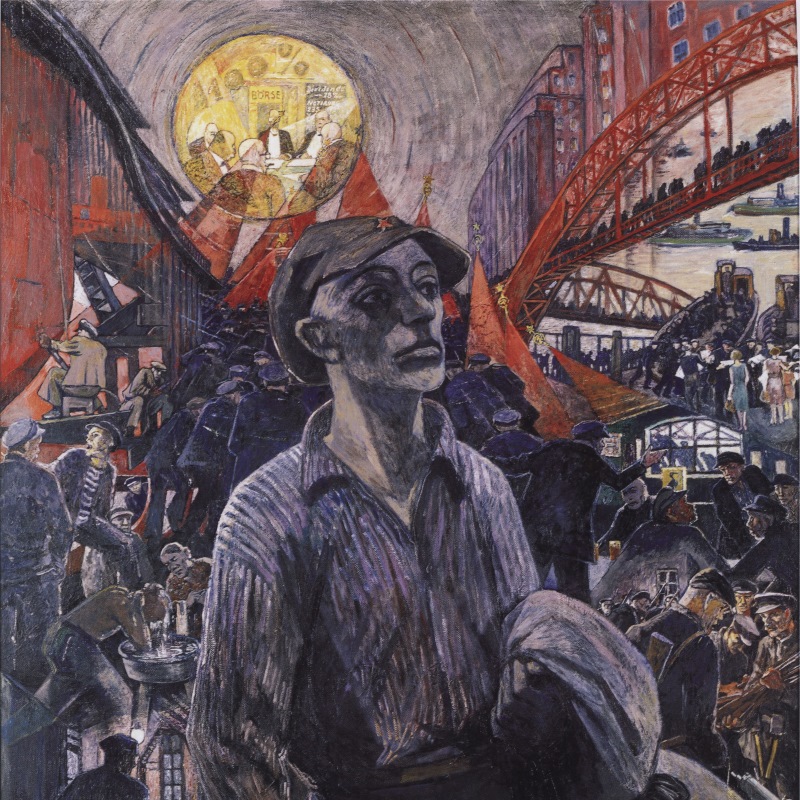
The Executive of the Communist International concentrated the whole of the International, and particularly the sections of the countries adjacent to Germany, and of Soviet Russia on the impending German revolution, and settled the duties of the individual Sections.
3. The October Retreat and its Causes.
In October, the German Communist Party, despite its weaknesses, was prepared for the revolutionary fight for power. If, in spite of the revolutionary situation, and in spite of the exertions of the Communist International and the German Communist Party, neither a revolutionary decisive struggle, nor political mass struggles resulted, this was due to a number of errors and defects, and in part, to opportunist deviations.
Defects in estimating the revolutionary march of events.
The Party realised too late that the revolutionary situation in Germany had matured. The Executive of the Communist International also failed to draw attention energetically enough to the oncoming crisis, with the result that the necessary fighting measures were not taken in hand in time. Already, with the end of the preceding period (Cuno Government, occupation of the Ruhr), the question of power should have been raised and the technical preparations should have been undertaken. The Party failed to realize in time the significance of the mass struggles in the Ruhr and in Upper Silesia, as a sign of increased consciousness of power and growing political activity, and only after the strike against Cuno was the necessary readjustment of attitude made.
Tactical errors.
The task of intensifying and broadening the numerous isolated actions which took place between July and September and to develop them right up to actions with political slogans, was not fulfilled.
After the Cuno strike, the mistake was made of wanting to put off elemental movements until the decisive struggle took place. One of the most serious errors was that the instinctive rebellion of the masses was not transformed into a conscious revolutionary will to fight by giving it political aims.
The Party failed in making an energetic and vigorous agitation for the tasks of the political workers’ councils, and in connecting most closely the transitional demands and the partial struggles with the final aim of the dictatorship of the proletariat. The neglect of the factory councils’ movement also made it impossible to place upon them temporarily the functions of workers’ councils, so that when the decisive moment came, an authoritative centre around which the vacillating workers who were drawn away from the influence of the Social Democratic Party could rally, was lacking.
Since other united front bodies also (councils of action, control commissions, fighting committees) were not systematically used in order politically to prepare the fight, the fight was almost entirely interpreted as a party affair and not as a united fight of the whole proletariat.
Political-Organizational Weaknesses and Defects.
The Party showed very little ability to consolidate organizationally its growing influence in the mass organizations of the proletariat. It displayed still less ability to concentrate its forces for a protracted period on one fighting aim.
The amount of technical preparation, of readjustment of the organization for the fight for power, of the arming and internal consolidation of the centuries, was at a minimum. The much too brief and feverish technical preparations, practically produced no results; it is true, they technically prepared the Party members for action, but they did not embrace the wide proletarian masses.
Errors in estimating the relation of forces.
The feverishness of the technical preparations during the decisive week, the view that the struggle was only a Party struggle, and the concentration on the “final blow” without preliminary and accumulative partial struggles and mass movements, made it impossible to examine the true relation of forces and to fix proper dates. Therefore the statement as to whether the majority of the working class at the decisive points would follow the lead of the German Communist Party, was rendered an absolutely unreal and unsafe calculation. In fact, the only thing that could be asserted was that the Party was on the way to winning over the majority without yet possessing the leadership of them.
The underestimation of the forces of the counterrevolution, consisted of the fact that the Party underestimated the power of the Social Democrats as a hampering force within the proletariat. The Party also misunderstood the nature and the role of the left social democratic leaders, and allowed the illusion to be cherished in its own ranks that by exerting the necessary mass pressure, we could compel these leaders to join with us in calling for the fight.
The mistaken political-strategic orientation on Saxony.
The rigid one-sided policy of passing to the decisive struggle only from the defence of the Central German positions was a mistaken one. It resulted in the neglect of other industrial and fighting provinces, and in severe disorientation after the Saxon position was surrendered without a fight. It was a fatal error of the Party to stake all its cards on Saxony, and thereby fail to provide itself with a line of retreat and defence in case of failure, and a reserve line of attack.
As a result of all these errors and defects of the Party, and of the weakness of the working class, there was a shrinking from the decisive fight for power at the last moment. While in Bulgaria, where the Party had formerly not participated in armed struggles, the defeat can still form the basis for future victories in Germany, after the defeats of 1919 and of March 1921, the Communists are in such a position that they must in the fight understand how to lead the masses to victory.
In any case, it was a great mistake of the Party not to have immediately changed its front and proceeded at once to partial struggles, and that in spite of the fact that some partial preparations had been made it retreated without a fight immediately upon the entry of the Reichswehr, the pronouncement of a state of siege throughout the Reich and the suppression of the Party.
4. The Saxon Experiment and the Hamburg Struggles.
The aggravation of the class antagonisms in Germany, the sharpening of the economic crisis, the concentration of the Party upon the decisive struggle, induced the Executive Committee of the Communist International and of the German Communist Party to undertake the experiment of allowing the communists to enter the Saxon Government.
The idea of the participation in the Saxon Government was, in the opinion of the Executive, a special military and political task, which was defined in an instruction as follows:
“Since, as we estimate the situation, the decisive moment will take place not later than four, five or six weeks hence, we consider it necessary that every position that can be directly useful should be immediately occupied. In view of the prevailing situation, the question of entering the Saxon Government must be treated as a practical one. On the condition that Zeigner and his people will be prepared sincerely to defend Saxony against Bavaria and the fascisti, we must enter the government, immediately arm from fifty to sixty thousand men in an effective manner, and ignore General Müller. The same in Thuringia.”
Under these originally assumed premises, the participation in the Government conformed to the resolutions of the Fourth Congress. The promotion of revolutionary struggles, the welding of the working masses should have been the pre-conditions for the entry into the Saxon Government: this entry should have been based upon mass movements. Although the direct military task had to be put off in view of the slowing-down of the revolutionary process, nevertheless, the communists could and ought to have carried on a real revolutionary activity. In this however, they showed themselves gravely below expectations.
It was their duty first of all to advance ruthlessly the question of arming the workers; from the first moment of their participation in the Workers’ Government, the communists should have known no other basic principle but the arming of the proletariat.
It was further their duty to unfold before the masses their proletarian program for saving the country, and to carry on an energetic propaganda for the political workers’ councils, and thereby to counteract the sabotage of the left socialist ministers. It was their duty to work in parliament and in the factory councils for the immediate adoption of revolutionary measures, such as the confiscation of the enterprises of manufactures who were sabotaging production, and the requisition of the houses of rich families for homeless workers and their children.
It was also the duty of the communists from the first moment of their participation in the government to brand in the eyes of the masses the double-dealing policy of Zeigner, his secret negotiations with the military dictators, as well as the whole counter-revolutionary role of the left social democratic leaders. Owing to this negligence, and to the fact that the Party was not capable of mobilising the masses, the Saxon experiment failed to mark a forward move in the fight: Instead of revolutionary strategy, we had a non-revolutionary parliamentary co-operation with the “left” social democrats. The special assertion of the Communist ministers that they were responsible only to the Landtag and to the constitution, was scarcely suited to destroy democratic illusions.
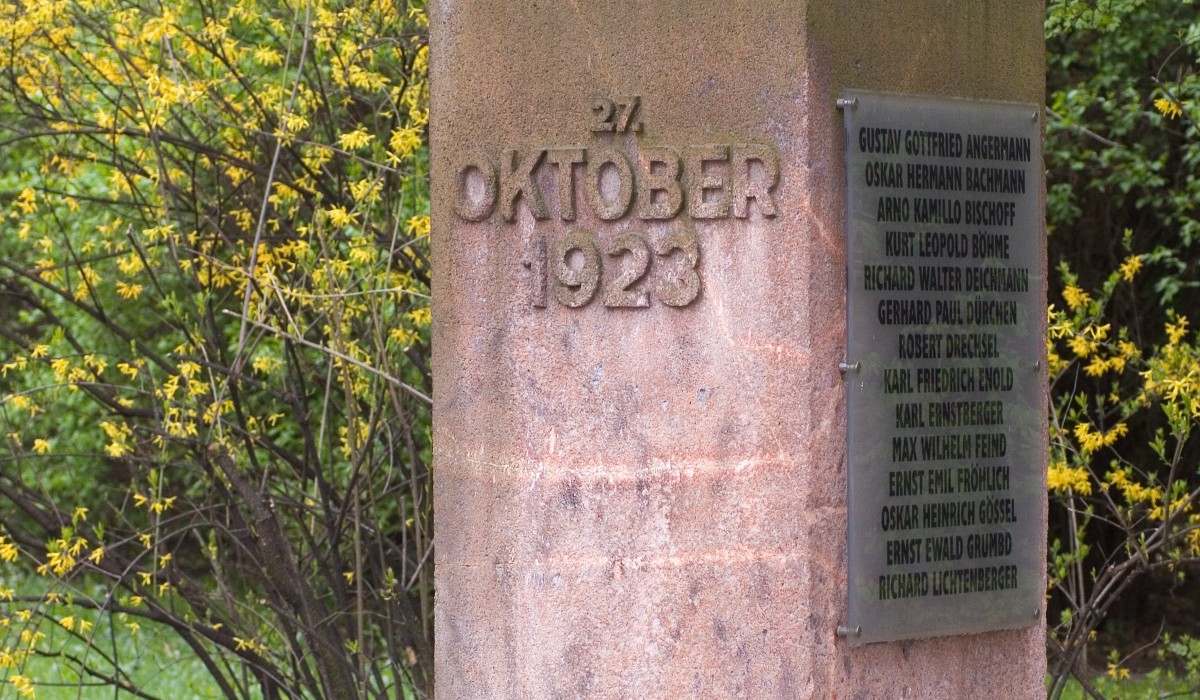
The Chemnitz Conference could have been a success for the Party only if adequate revolutionary work had been undertaken by all the Party bodies. The Party allowed itself to be caught unprepared by the thrust of the enemy, the Reichsexecutive (*The expeditionary force of the Reich sent against one of its individual states.) which everyone foresaw. The greater therefore was the error that, although the general strike was to be proposed, no attempt was made to concentrate the conference from the moment of its opening exclusively on the question of defence against the Reichexecutive. These were errors, which undoubtedly facilitated the treacherous game of the left social democratic leaders.
A direct contrast to Saxony was the uprising in Hamburg. Here it was proved that a bold surprise attack of determined fighters could smash the enemy militarily. But it also showed that such an armed struggle, even though, as was the case in Hamburg, it is regarded by the population not without sympathy and is supported by a mass movement, is nevertheless doomed to failure if it remains isolated and is not supported on the spot by a workers’ council movement, the absence of which was severely felt in Hamburg.
The fight itself in the Reich was hampered by contradictory orders issued by the centre, and the strike movements which were actually taking place, suffered from lack of news of the fight in the Reich generally, and by the news which was received of the outcome of the Chemnitz Conference.
Nevertheless, it was possible to call off the fight in Hamburg with exemplary discipline. The lessons to be derived from it are valuable for the Party and for the International. Particularly noteworthy was the villainous conduct of the Hamburg social democratic leaders who supported the military action against the rebels. Their conduct is but the reverse side of the medal, the face of which is the conduct of Zeigner and his “lefts” in Saxony.
The Saxon experiment has severely discredited the “left” social democrats; it has demonstrated that they are in reality the lackeys of the counter-revolution. The Hamburg uprising has considerably strengthened the consciousness of power of the German proletariat, and was at the same time a severe blow for the social democrats.
The Communist Party must realize clearly the errors which were committed during the Saxon experiment and in connection with the fight in Hamburg. Without this it will be impossible for the Party to conduct correct tactics in the future.
5. The Role of the Social Democrats and the Change in the Tactics of the United Front in Germany.
The leading strata of the German Social Democrats are at the present moment nothing else than a fraction of German fascism under a socialist mask. They have handed the power of the state over to the representatives of the capitalist dictatorship in order to save Capitalism from the proletarian revolution. Sollmann, the Minister for Internal Affaires, declared a state of siege; Radbruch, the Minister for Justice, has converted “democratic” justice into extraordinary justice against the revolutionary proletariat. Ebert, the President of the Reich, also formally handed over government power to Seeckt. The social democratic fraction in the Reichstag screened these actions and voted for the Special Powers Act which set aside the constitution and handed over power to the White generals.
The whole international social democracy is gradually becoming the official armour bearer of the capitalist dictatorship. Men like Turati and Modigliani in Italy, Sakasov in Bulgaria, Pilsudski in Poland, and the social democratic leaders of the stamp of Severing in Germany, are direct participators in the government power of the capitalist dictatorship.
For five years the German social democrats of all shades had been gradually passing over to the camp of the counter-revolution. The process is now nearing its completion. The legitimate heir of the “revolutionary” Government of Scheidemann and Haase is the fascist General Seeckt.
It is true there are differences even in the camp of the capitalist dictatorship, and these may be of great enough importance to be exploited for our class fight. There are shades of difference between Ebert, Seeckt and Ludendorff. But, apart, from those differences in the camp of the enemy, the German communists must not forget that the main thing is to bring the working class to understand what is the essence of the whole affair, namely, that in the fight between capital and labour the leaders of the Social Democratic Party of Germany are irrevocably united with the White generals.
It is not only just now that the German social democrats have passed over to the side of capitalism. At bottom, they have always been the class enemies of the proletariat. But it is only now, after they have passed from capitalist democracy to capitalist dictatorship that this has become grossly evident to the masses.
It is this fact which induces us to introduce some modification into the tactics of the united front as applied to Germany.
No negotiations with the mercenaries of the White dictatorship! This is what every communist in Germany must plainly realize and proclaim loudly and emphatically to the whole German proletariat.
But even more dangerous than the right wing of the Social Democratic Party leaders are the left wing leaders, this last illusion of the deceived workers, these last fig leaves covering the counter-revolutionary policy of Severing, Noske, and Ebert.
The Communist Party of Germany rejects all negotiations not only with the Central Committee of the German Social Democratic Party, but also with the “left” leaders as long as these heroes do not summon up enough manhood to break openly with the counter-revolutionary gang sitting in the Central Committee of the German Social Democratic Party.
The tactic of the united front to be employed in Germany is now: “Unity from below.”
In the first theses of the Executive of the Communist International of December 1921, we find:
“As a counter-poise to the diplomatic game of the Menshevik leaders, the Russian Bolsheviks put forward the slogan: Unity from Below! i.e., the unity of the working masses themselves in the practical fight for the revolutionary demands of the workers against Capitalism. Practice has proved that this was the only correct reply. As a result of this tactic, which was modified according to the circumstances of time and place, a huge section of the best Menshevik workers was gradually won over for Communism!”
The Communist Party of Germany must learn how to realize the slogan of the united front from below.
A ferment such as had never before existed is going on among the workers who still belong to the German Social Democratic Party. They see the bankruptcy of their leaders and are seeking new paths. There is therefore no reason why we should reject local negotiations and agreements with the German S.D.P. workers wherever we are faced with honest proletarians who are prepared to prove their devotion to the revolution.
The organs of the united front, the factory councils, control commissions and committees of action, must be so closely interwoven that they finally become the centrally directed apparatus of the proletarian fight for power.
6. Immediate Tasks of the Party.
The main estimate of the situation in Germany which was made in September by the Executive of the Communist International, remains essentially unchanged. The character of the fighting phase which has begun and the main tasks of the Communist Party remain the same. The German Communist Party must not strike from the agenda the question of uprising and the seizure of power. This question must stand before us as urgent and portentous as ever. However great the partial victories of the German counter-revolution may be they cannot solve any of the crisis problems of capitalist Germany.
Therefore, in view of its experiences gathered during the last few months, the German Communist Party is faced with a number of immediate tasks.
The Party must organise the fights of the proletariat against the abolition of the eight-hour day and of the workers’ rights. The Party must unite the unemployed movement organisationally and politically with the movement of the employed workers and thus avoid the danger of the working class being split into starving unemployed and employed workers who still have a crust of bread. The Party will be best able to fulfil this task if it prepares the impending economic struggles in advance, in such a manner that they will be rot only directed against reduction of wages, but will also have a political aim as expressed in the slogan: “Work for the unemployed!”
The Party propaganda must be directed towards making the broadest masses conscious that only the dictatorship of the proletariat can save them. This task must be bound up with the aim of politically annihilating the Social Democratic Party. This demands the organisation of the united front bodies and that every partial struggle should be given a definite aim.
The Party must seek to win over in addition to the industrial proletariat, the rural proletariat, the clerks and officials, the small peasants, and the proletarianised middle classes, and make them the allies of the working class under the hegemony of the revolutionary workers. This can be done by clear and definite agitation, by propaganda on behalf of the economic program of the German Communist Party, by fighting against still existing remnants of pacifist orientation in the West, by pointing out the national role of the German revolution and the significance of an alliance between the German Soviet Republic and Soviet Russia, and by determined and indefatigable work in the organization of the control commissions and similar organs of the revolutionary movement.
The work of organization within and without the Party must go hand in hand with agitation and propaganda. The German Communist Party must be not only a good propaganda party, but also a good fighting party. The work of arming the workers and of technically preparing for the decisive struggle must be carried on with tenacity. The proletarian “centuries” must be organized in fact and not merely on paper, and must be supported by the sympathy of the broad masses of the workers, which can only be won by the active leadership on the part of the C.P.G. in all struggles and actions of the proletariat. Only when the working masses can count upon the protection of the “centuries” in their demonstrations and strikes and in all their conflicts, will the centuries receive the hearty support of the masses in their arming and training and in securing information as to the forces of the enemy.
The pre-requisite for all this is that the Party should make a thorough utilization of all its experiences. Every remnant of democratic illusions and of the notion within the Party that the German Social Democratic Party, or groups of this party which are ideologically and organisationally under its influence, can as such lead revolutionary struggles, must be rooted out. It must be hammered into the heads of the members that the German Communist Party before the victory of the proletarian revolution, is the party of the uprising, the only party for destroying the capitalist system, and that in all the partial struggles its work can only be revolutionary if it aims at smashing the state apparatus of the bourgeoisie, keeps constantly in view the aim of stablishing the dictatorship of the proletariat.
The Communist Party is the only revolutionary party, it is strong enough to prepare for and achieve the victory of the masses of the proletariat against all other parties this must be the firm conviction of every Party member.
In order to bring about this orientation within the Party, the C.P.G. must openly discuss throughout its membership the experiences it has passed through. The Party must learn how to carry on discussions without weakening its power of action. In order to consolidate its whole power of action it must, in spite of all difficulties and its position of illegality, not neglect to clear up all its differences and put an end to discussions at a Party Congress.
The Communist International absolutely demands that the unity of the Party should be maintained. The Executive of the Communist International calls upon the whole membership of the German Communist Party to do everything in its power to that to the fractional conflicts and achieve complete power of action, the whole Party on the Party Congress should unitedly put an end.
The Executive of the Communist International calls the attention of every member of the German Communist Party and of all the other Sections of the Communist International, to the gigantic tasks of the present revolutionary crisis. The Executive is firmly convinced that the experiences of the last few months have not been in vain, and if they are carefully studied and utilized, will bring the victory of the proletariat nearer.
Moscow 21 January 1924.
The Executive Committee of the Communist International.
International Press Correspondence, widely known as”Inprecorr” was published by the Executive Committee of the Communist International (ECCI) regularly in German and English, occasionally in many other languages, beginning in 1921 and lasting in English until 1938. Inprecorr’s role was to supply translated articles to the English-speaking press of the International from the Comintern’s different sections, as well as news and statements from the ECCI. Many ‘Daily Worker’ and ‘Communist’ articles originated in Inprecorr, and it also published articles by American comrades for use in other countries. It was published at least weekly, and often thrice weekly.
PDF of full issue: https://www.marxists.org/history/international/comintern/inprecor/1924/v04n14-feb-27-1924-inprecor.pdf

