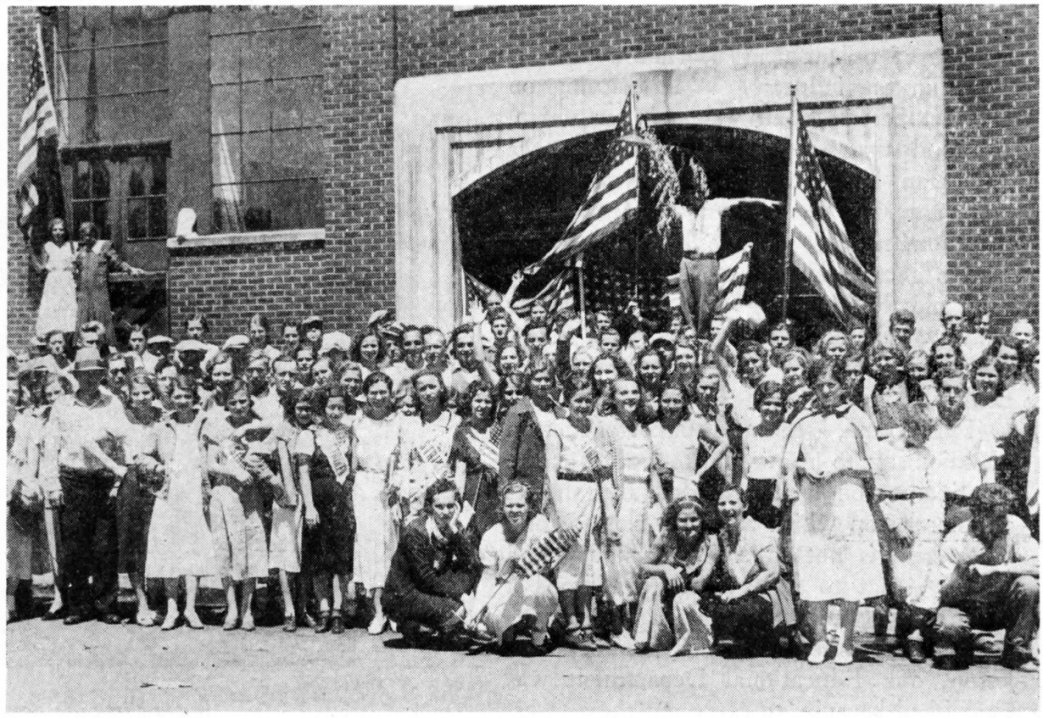
Being a member of an active union in struggle can be life changing for everyone; for women historically denied access to many of society’s basic institutions, a union could be truly transformative.
‘What the Amalgamated Has Meant to Women by Dorothy J. Bellanca from The Woman Today. Vol. 1 No. 11. March, 1937.
Member, General Executive Board, Amalgamated Clothing Workers of America
THE WOMEN WORKERS in the shops that are in contractual relations with the Amalgamated Clothing Workers of America have been a great factor in the struggle for security and industrial liberty which has gone on steadily since the Amalgamated was formed. Women members have always stood shoulder to shoulder with the men in the struggle to secure better wages and better conditions and more protection on their jobs. As the years have passed, a growing number of them have not been satisfied with being just members in the union, but have become active leaders, sharing a great part of the responsibility and doing much of the important work of the day-to-day activity.
There is not an organization of the Amalgamated, whether it be in a large industrial city or in a small country town, where the work of the Amalgamated women has not stood forth both in vitality and importance. In the clothing workers’ organizations in Baltimore, Chicago, Philadelphia, Rochester and other cities, groups of women have been broadening their influence, holding office, and strengthening the links that bind them to the entire Amalgamated organization.
In the shirt industry, which has come to be in recent years a very considerable portion of the Amalgamated membership, young girl chairladies have carried and are now carrying remarkable loads on their shoulders, and discharging their responsibilities with energy and judgment.
Women members are doing important organization work, carrying the union’s message to other women in the industry; they serve on executive boards and joint boards and act as business agents. Women have received no favors for being women, but, on the contrary, they have won their places in the union on their records as members. This is as it should be. A voice in leadership should only come as a reward for active service.
As the years have gone on an increasing number of women have earned themselves a place in the executive branch of the Amalgamated, and our experience shows that the same intelligence that led so many thousands of women out of the sweatshops by organizing their mass power in a union has led them each year to more active work, not only in the Amalgamated but in the labor movement as a whole. It is in the organization activities of the Amalgamated that women have particularly made their influence felt. For years it was claimed that women couldn’t be organized because even when they were in industry they didn’t expect to remain there and, consequently, the argument presented as to the importance of their protecting themselves and improving their wages and conditions did not have the same effect upon them as it did upon men, most of whom expected to remain in a particular industry all their lives and provide for their families through their toil.
There was perhaps some validity in this argument two decades ago but certainly it does not hold good today. Many women have been compelled to continue work even after marriage and many other women, after rearing families, have been compelled to re-enter the factory. The protection of the union is therefore most vital to them and an ever-increasing number of women workers are understanding this.
If it were true that women were as “unorganizable” as some writers on industry claim, then organizations in the garment industry would certainly have been less powerful than they are today. As a matter of fact, the garment industries employ a much larger proportion of women than men, and no one can deny that these industries are among the best organized in the country.
SINCE I WAS fifteen years old and a worker in a garment shop in the city of Baltimore, I have taken part in many strikes; strikes in which both women and men took part. I am not holding a brief for one sex against the other; both the men and women involved in these strikes were of the sort who have brought what decrease in hardship has come to the workers in the country; but in this article I am stressing the part which the women have played.
In staying quality, in all of my experience, women have never proved inferior to men. They have borne every hardship just as cheerfully as their male co-workers. And in some ways, in reaching out to organize the women workers outside the union, they have been even more successful. They have been particularly efficient on the picket line and many times while I have been marching with them in the small hours of the morning, sometimes in the intense cold of the Winter, I have secured inspiration which nothing else has ever given me in my work as an organizer.
Organizing the unorganized is a hard task and only those engaged in it know how difficult it is. There is nothing romantic about it. Those who think this work is done mostly in halls where the workers gather and where oratory is largely indulged in, know little about the hard grinding task which comes to all those engaged in this work. The real effective work is done very often in house-to-house canvassing, among those who work in a particular shop where the organization is seeking to establish a union. Doors are often slammed in one’s face; abuse is sometimes showered upon those who are trying to bring about better conditions through a union. Almost infinite patience is at times required on the part of those doing this work and the Amalgamated has eloquent proof through the years that the work of its women members in this particular field has been most effective. The part which women have played in the constant struggle to improve the wages and conditions of the workers is at times, if not ignored, at least not stressed by some writers dealing with the industrial history of our country. Women workers should never forget the part played by the brave women in the needle trades in Philadelphia, just after the nineteenth century was ushered in, and the first strike of women weavers in Pawtucket in 1924. It is a far cry from then to this year 1937, but as valiant soldiers of the common good women have remained in the forefront of the battle for industrial freedom.
The Working Woman, ‘A Paper for Working Women, Farm Women, and Working-Class Housewives,’ was first published monthly by the Communist Party USA Central Committee Women’s Department from 1929 to 1935, continuing until 1937. It was the first official English-language paper of a Socialist or Communist Party specifically for women (there had been many independent such papers). At first a newspaper and very much an exponent of ‘Third Period’ politics, it played particular attention to Black women, long invisible in the left press. In addition, the magazine covered home-life, women’s health and women’s history, trade union and unemployment struggles, Party activities, as well poems and short stories. The newspaper became a magazine in 1933, and in late 1935 it was folded into The Woman Today which sought to compete with bourgeois women’s magazines in the Popular Front era. The Woman today published until 1937. During its run editors included Isobel Walker Soule, Elinor Curtis, and Margaret Cowl among others.
PDF of full issue: https://www.marxists.org/history/usa/pubs/wt/v1n11%20%2812%29-mar-1937-women-today.pdf
 Revolution's Newsstand