Completing Anna J. Haines’ 1928 investigation into Soviet health with the final chapters, XVI. The Russian Red Cross, XVII. Medical Education n Soviet Russia, XVIII. Taking Health to the People, XIX. Conclusion.
‘Chapters XVI, XVII, XVIII & XIV’ by Anna J. Haines from Health Work in Soviet Russia; Vanguard Studies of Soviet Russia. Vanguard Press, New York, 1928.
XVI. The Russian Red Cross
In a review of the factors making for better health conditions in Soviet Russia, the work of the Russian Red Cross must not be omitted. As a general statement Russian medical work may be said to be nationalized, but it is true that the Red Cross Society there is functioning as a semi-private organization, very much as our own American Red Cross does.
Indeed, it has the traditions of all national Red Cross Societies, as it was originally founded in 1860, and when it was recognized after the Revolution in 1918 it was allowed to retain its original name and general principles. During the period of the World War and civil war, its attention was entirely given to military aid, hospitals and medical personnel and supplies being furnished for soldiers in all parts of the country. During the famine days it provided feeding stations and first aid medical work. Food was prepared for 120,000 persons daily during 1921 and 1922, and many village dispensaries were opened.
By 1924 these emergencies were over and the Society prepared to work out a more constructive peacetime program. Conferences with the officials of the Commissariat of Health showed that the official health departments were strongest in industrial and commercial centers and weakest in the rural communities, especially in those wide stretches of Siberia, East Russia and the Caucasus inhabited by nomadic, non-Slavic tribes. Here was a great opportunity for a flexible, sympathetic type of medical service such as a private organization could best offer. With this outlet for practical work among what are called the “minor nationalities,” the Russian Red Cross has also the wider educational aim of interesting the great mass of working people in improving its own health and the health of its even less cultured fellow-citizens. The social foundations of the Society are to be widened and deepened not by a mere mechanical enrollment of members paying small fees, but by instructing those members in the meaning and value of Red Cross ideals and encouraging the local committees to campaign against social diseases and social poverty.
The central organization through which these aims are put into effect is a committee of seven members located in Moscow, the president being Dr. Soloviev, Assistant Commissar of Health. Local sub-committees exist in all parts of the country, their connections with the center being maintained by visits from members of the central committee, by circulars of general instruction for organizing Red Cross branches and by individual letters of advice in regard to the special problems which arise in each locality. The membership during 1926 was about 75,000, of whom 54 percent were peasants, 10 percent industrial workers, 29 percent civil servants, 5 percent students and 2 percent soldiers. The annual fees were fifteen cents for workers and civil servants, seven-and-a-half cents for peasants and two-and-a-half cents for students and soldiers. Fees are purposely kept low in order to encourage a wide membership, but the greater part of the income of the Society comes indirectly from the government through permission to collect a tax added to the price of railroad, steamboat and aeroplane tickets, tickets to the theatre and to other places of amusement. The total income of the Russian Red Cross Society for 1925 was about $1,250,000. There are representatives of the Society in many foreign countries, including Switzerland, Great Britain, the United States, Germany, Italy and Poland. In Persia the representatives of the Russian Red Cross have helped to organize the Society of the Red Lion and Sun, and in Turkey the Society of the Red Crescent. The Russian Red Cross Society is also affiliated with the International Red Cross, whose headquarters are at Geneva. In the practical work of the Russian Red Cross there is a romance which scarcely any other country can show. Sixty-eight percent of all its institutions are in rural neighborhoods, and over sixty percent are among non-Slavic Mohammedan or pagan tribes whose culture is centuries behind that of the tiny medical units sent out to work among them. To the Yakuts and the Samoyeds of northern Siberia a clinic to combat venereal disease is a mystery far less comprehensible than the dances and tom-toms of their own medicine-men, even though the doctor and the little glass phials may have come riding into camp in a familiar reindeer sledge. When the first malaria stations were opened among the Chuvash of the Ural mountains they refused to let their fingers be pricked for blood smears because they thought the doctors would sell their blood to the Christian Devil, who was admitted to be a personage of some power. In the Irkutsk region a Red Cross medical unit discovered a tribe—the Karagossi—never before known. Among the Bashkirs, the Buriats, the Kalmucks, the Ossetini and many others from the Arctic Ocean to the semi-tropical Caucasus, clinics have been set up, brought to these out-of-the-way haunts by camel train—or dog-sled—or hollow-log canoe. And because these people live so dependently on their herds there is also a veterinary doctor to accompany the two medical doctors, and usually an ethnographer and sometimes a midwife and a social worker to complete the unit.
At first there had been the intention to keep the Red Cross to a specialized service of campaigns against the social diseases of tuberculosis, syphilis, malaria, trachoma, etc. But it was soon found impossible to continue specialization when for hundreds of miles there was no general medical service to be obtained. At the present time, therefore, the Red Cross clinics on the fringes of civilization are almost all general medical stations, but as they are able to show the local population the value of medical service they hope that taxes may be levied to support local official medical work and the Red Cross units may again be free to develop the specialized service for which they were originally intended. In 1925 there were 72 of these general medical dispensaries being conducted by the Red Cross; 27 institutions for the treatment of tuberculosis, with 700 beds for patients needing hospital care; 34 clinics for the treatment of venereal disease; 8 clinics for eye diseases, especially trachoma, which is very prevalent in Siberia and the Caucasus owing to the uncleanly housekeeping habits in those regions; 20 malaria dispensaries; and 72 day nurseries and consultations for young children and their mothers.
In addition to the actual curative work being done in these medical out-posts there is a tremendous program of education and sanitary instruction. The tuberculosis workers lecture in schools and factories and clubs, organizing temporary anti-tuberculosis campaigns to acquaint the general working population with the menace of tuberculosis and to popularize treatment for it. Day-camps for tuberculous children have been opened, especially in the formerly famine regions where the child population is riddled with tuberculosis. The same type of educational work is carried on in regard to venereal disease and to infant mortality, and always in districts which the official dispensaries of the Commissariat of Health have not yet had the time and money to approach.
Most important of all, perhaps, in its bearing on the future is the “Health Service” organized among the Pioneers. The fundamental aim of this Health Service is to help young people to become responsible for the conservation of their own health. Medical workers of the Red Cross brought the “health game” to children’s institutions and to schools. Lectures, competitions, excursions to museums of health and to first-aid stations, and medical and sanitary fairs were arranged for and by the children. The best results from these efforts were found in the cities among the children of intelligent workers who cooperated with the Red Cross in encouraging their children’s health habits, but especial efforts are now being made among peasant children to wage war on the hygienic ignorance of the Russian village.
The first pamphlets for children about their own health have been written and distributed by the Red Cross: Thy Health Is in Thine Own Hands, The Rules of Health, Pioneers Should Be Healthy, etc. Also a number of posters depicting the rules of health have been made in bright colors for use in schools and clubrooms. Nor have the Red Cross publications been entirely centered on children. The central committee has found it can most widely and most economically spread the Red Cross ideals by means of pamphlets, and has issued several: What Is The Red Cross?, The Red Cross on the Famine Front, a Red Cross calendar, as well as a number of small folders for free distribution dealing with health problems or cleanliness, malaria, infant welfare, etc. Many of these are issued in half a dozen different languages for effective work among the minor nationalities.
It is easy to understand from this description that the Russian Red Cross is a very active organization with a program of practical and educational work calling for a large and increasing budget. It counts among its employees 147 doctors and 178 other trained workers. Of the total income of approximately $1,250,000 for 1925, the central committee raised 74 percent, the local units throughout the country 24.4 percent and the representatives in foreign countries 1.6 percent. In an interview in October, 1926, with Dr. Korovin, the general executive secretary in Moscow, who has been responsible for much of the recent development of the Red Cross movement in Russia, he outlined the future peace-time program as centering more and more on preventive and educational work for children in the rural and sparsely settled regions, in the encouragement of these neighborhoods to take the financial responsibility for their own general medical service, and in the pushing out into yet more remote districts of the tiny pioneer medical units for which the Red Cross is already so well known.
All of the statistics for this chapter were obtained from a personal interview with Dr. Korovin and from the Annual Report for 1925 of the Red Cross Society of the R.S.F.S.R.
XVII. Medical Education n Soviet Russia.
With the changes effected by the Revolution in the sphere both of medicine and of education, it is needless to say that the medical education of Russia today differs in many respects from that of pre-war days. The old Russian medical schools were excellent from the scientific point of view, but wholly inadequate in enrollment of students to meet the country’s medical needs; nor did anyone seem to feel the social disgrace involved in the fact that large portions of the population were left without any medical aid. At a time when there was one doctor in the United States to every 800 people and one in Great Britain to every 400 there was an average in Russia of one to every 5,800, according to “A Review of Medical Education in Soviet Russia,” by W. Horsley Gantt in The Journal of the British Medical Association, June 14, 1924. In spite of the small number of doctors there was much intensive experimental work done in the medical school laboratories, and many graduate students devoted themselves entirely to research. The Revolution smashed completely through this academic approach to medicine. In no other sphere did it announce more clearly its intention to make science the practical handmaid to humanity. There was, according to the above source, an immediate increase in the number of students admitted to the medical courses, and a change in the type of student whose application was favorably received. For example, at the University of Saratov before the war there were between four and five hundred students registered, while in 1922 there were two thousand. In the Military Medical Academy in Leningrad 19 percent of the medical students in 1913 came from peasant or working class families, while in 1922 these sources furnished 93 percent of the students. The capacity of the laboratory space and of the teaching force was soon overloaded; equipment which had formerly been purchased in Germany was exhausted without possibility of replacement; and, worst of all perhaps, students were admitted with so little mental preparation that they could not have profited by the course even if the teaching conditions had been ideal. During this period, also, the state was waging continuous war with foreign and internal enemies, and only the barest amount of money for running expenses was granted to the universities which since the Revolution had become entirely dependent on the state for support.
Yet with all these adverse conditions there were certain positive gains. A new attitude grew up toward medical work as a social service, and a great zeal burned in these young student-workers to eliminate the suffering and hindrance to progress which disease had caused among the great mass of Russia’s population. They taught their professors to look outside of test-tubes for the causes of disease; laboratory work was extended to include the investigation of insanitary factories and overcrowded homes. The organization of preventive public health work emerged as a new ideal in Russian medical education.
The same source also says, that since 1923 the trend has been upward along all lines. There are at the present time fifteen medical schools in Russia, of which three are in Leningrad, two in Moscow, and one in each of the following cities: Kiev, Odessa, Kazan, Saratov, Kharkov, Ekaterinoslav, Perm, Krasnodar, Rostov-on-Don, and Varonej. The students are now expected to pass entrance examinations, and only those are admitted who show enough ability to warrant their attempting the course. All of these must have finished the secondary schools or taken special courses for adult workers which guarantee the same academic standing.
The program is practically the same in all the medical schools, having been standardized by a central committee in Moscow. According to a statement issued by the Council on Medical Education in April, 1925, it aims to produce doctors with (a) a thorough scientific preparation, sufficiently familiarizing them with the physical, chemical and biological sciences to understand the laws which lie at the base of biological processes; (5) sufficient social science to enable them to understand current social life and world events; (c) that materialistic point of view which is essential to a correct understanding of the mutual relationship between an organism and its milieu; (d) the social service point of view which takes into account the working conditions and home life of the patient; (e) the knowledge and ability not only to treat diseases, but to prevent them.
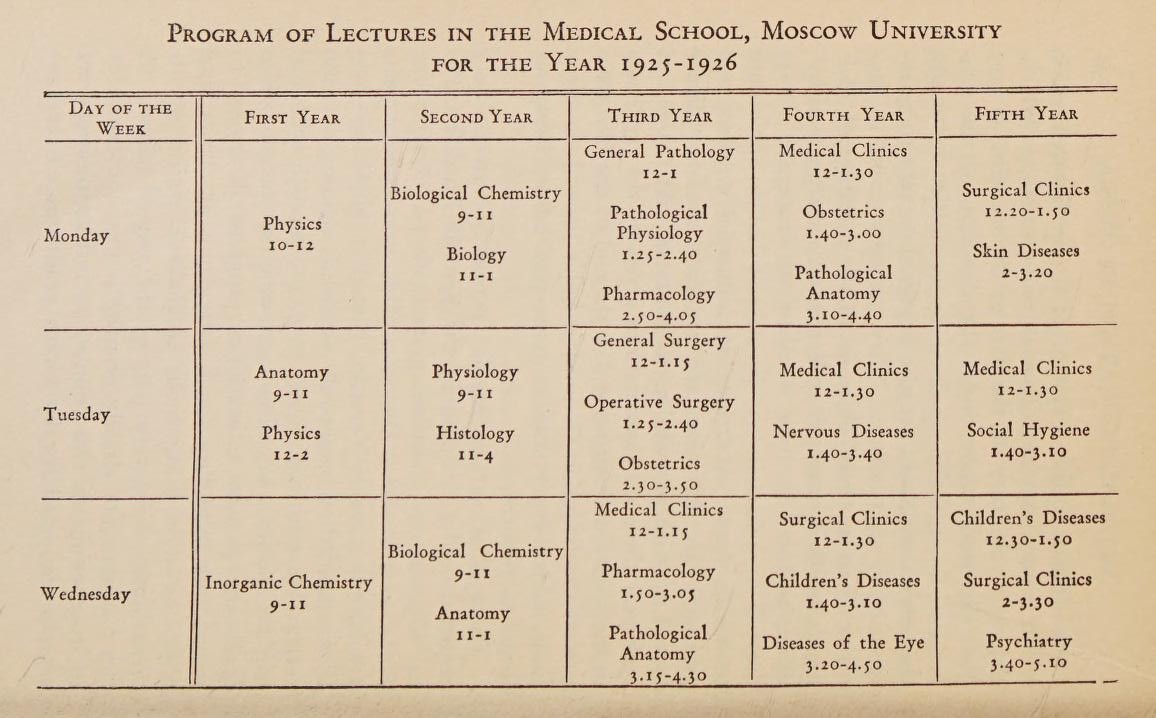
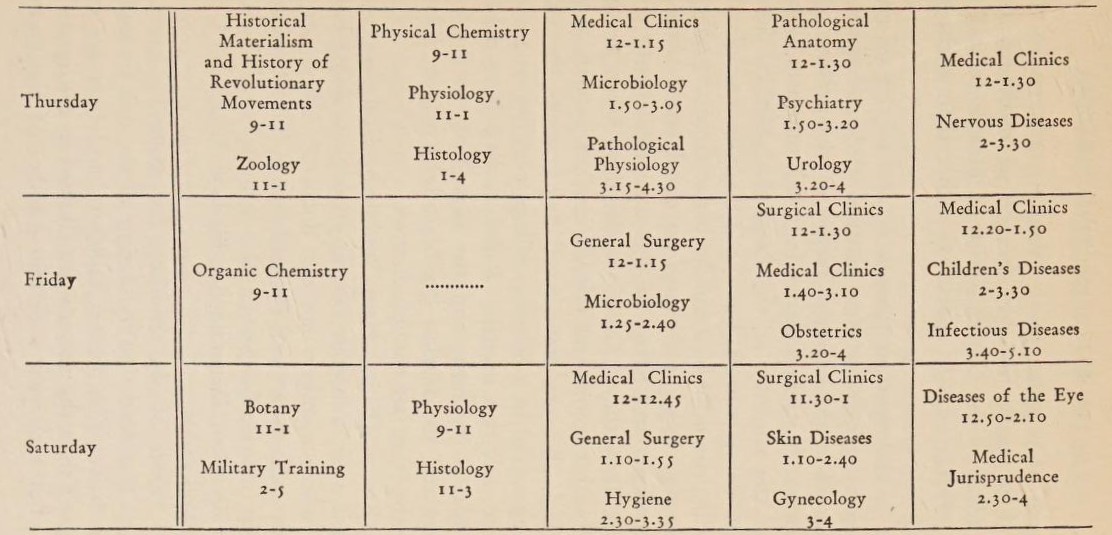
The course, as given in the program of the Medical School of Moscow University for 1925-1926, covers a period of five years, the first two of which are devoted largely to what we would call pre-medical work.
For the first year the curriculum includes Botany, Zoology, Anatomy, Histology, Inorganic and Organic Chemistry, Physics, Historical Materialism and the History of Revolutionary Movements and Military Training.
In the second year the courses are in Anatomy, Histology, Embryology, Physiology, Biology, Biological Chemistry, Analytical Chemistry, and Physical Chemistry.
In the third year the more definitely medical work begins together with the introduction of the student to the hospital wards and to out-patient dispensaries. The lectures cover Pathological Anatomy and Pathological Physiology, Topographical Anatomy, General Surgery, General Medicine, Pharmacology, Microbiology, Hygiene, Obstetrics, Dialectical Materialism, and Common Law.
The fourth year program includes lectures given in the medical and surgical clinics connected with the medical school, Gynecology, Pediatrics, Nervous Diseases, Psychiatry, Skin Diseases, Diseases of the Eye, Special Pathological Anatomy, Hygiene, Urology.
The fifth year is especially devoted to individual work on the part of the student in clinics, under the direction of the professors. These clinics include medicine, surgery, pediatrics, venereal disease, gynecology, nervous diseases, diseases of the eye, ear, nose, throat and teeth, as well as practical work in the physiotherapy institute, and courses in social hygiene and medical jurisprudence.
The weekly program, as shown in the accompanying diagram on pages 150-151, seems to provide fewer hours of work than are expected of students in our medical schools, but it gives only the minimum requirements of lecture courses and does not account for any of the laboratory work; nor does it show the recommended elective courses, some of which are taken by all the students. There is also a system of group research work which is very popular in Russian universities, and which, although voluntary on the part of the students, is very generally undertaken under the direction of the professors. In addition to these opportunities for study the medical students are also expected to take some responsibility as teachers. They are often sent to factories or to mothers’ clubs or to the meetings of children’s health committees to lecture on some phase of hygiene, and on Sundays numbers of them are always drafted as guides in the permanent health exhibitions to which come excursions of industrial workers and peasants. In this way the students are continually linked up with practical social contacts. At the end of each year there are examinations given by the professors in the individual courses and at the end of the five years a State Qualification Committee holds general examinations, which every student must pass before being allowed to practise.
There is as yet no regular period of interne duty required. The criticism in the past of Russia’s medical education—a criticism given wide publicity in the Notes of a Country Doctor written over twenty years ago by the novelist Veresaev, himself a physician—was that it tended to be entirely academic, sending out into responsible positions young men and women who had had far too little actual contact with sick people. This fault the present educational program is trying to remedy by including much attendance at clinics, and plans are now being made to make a period of interneship an obligatory part of the general course. A few hospitals are already offering positions comparable to internships in this country and these positions are eagerly competed for by recent graduates. Every encouragement is given to the young graduates to continue their studies in some branch of medicine, as it is the ideal of the Commissariat of Health to staff its clinics with groups of specialists rather than with general practitioners.
One of the most picturesque figures of the old days, the poverty-gripped woman medical student, has almost disappeared in the practical reality of the present time. Her successor attends classes in great numbers, almost half of the students at the Leningrad Medical School last year being women, but she is there on a scholarship from the provincial board of health or from the political organization in some factory, on equal terms with the men students and living in the same moderately comfortable dormitory. Gone are the days when an attic shared with two or three friends was her portion, to pay for which she may have saved her kopecks for years, teaching school in a Siberian village perhaps on a salary of seven dollars a month. Russia owes a long debt of gratitude to the nuns and the anarchists, to the busy mothers and the fearless explorers into plague districts who have been her women doctors.
The Russians have a term “middle medical personnel,” which is used to include several professions doing health work whose members are not doctors. These are the feldshers, the nurses and the midwives. The Revolution brought many changes to this group in addition to gathering them into one big Medical Workers’ Union with the doctors.
The career of the feldsher, for example, has been brought to a dead stop by closing all the courses leading to this title. The present feldshers, and they are more numerous than the doctors, are allowed to continue their work, but each year a certain number of the younger men and women are given scholarships to the regular medical universities, and eventually this type of half-qualified doctor will cease to exist.
The midwifery courses, on the other hand, have been greatly improved and new institutes opened, as there is a very general feeling that high infant mortality and maternal mortality can be most quickly reduced by sending into the remote villages, which would be too poor to support a doctor, a midwife well trained in medical and surgical asepsis.
The central Department for the Protection of Motherhood and Infancy maintains a midwifery institute in Moscow on which other schools throughout the country are modeled. The applicants must have finished the seven years of preliminary schooling which is all that is required of medical students; then they are given two-and-a-half years of quite intensive work at the institute. At the end of this time they are prepared to carry on independent work as midwives, and since they are usually of peasant or proletarian stock themselves, it is reasonable to expect that they will be able to go into the villages and factory towns with a real sympathy and knowledge of conditions that will enable them to cope with the superstition and prejudices of the illiterate women there.
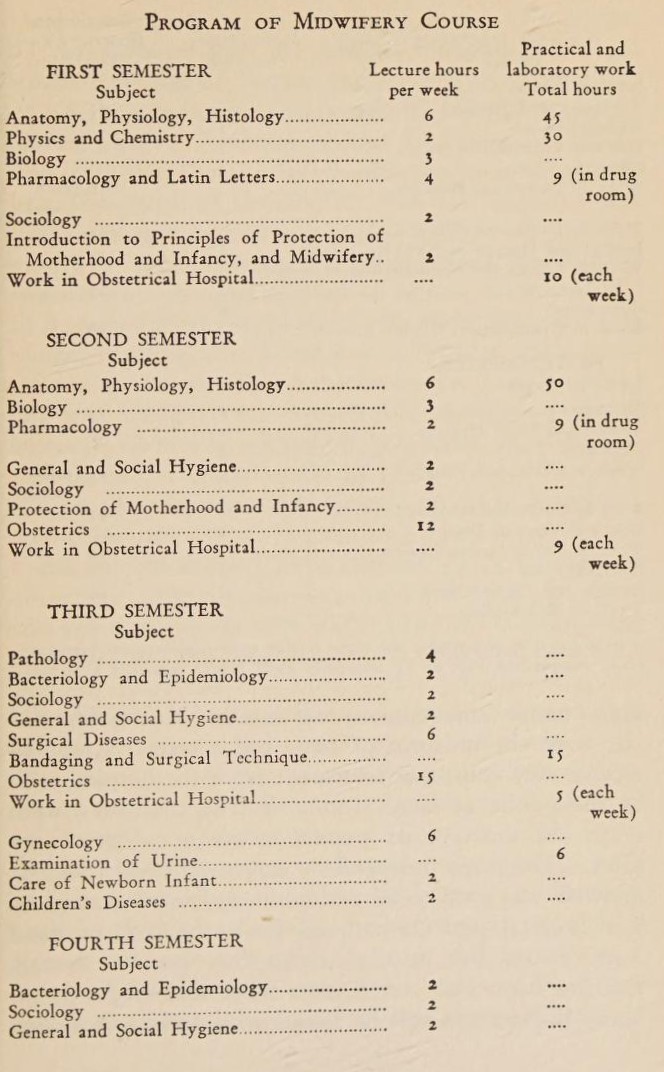
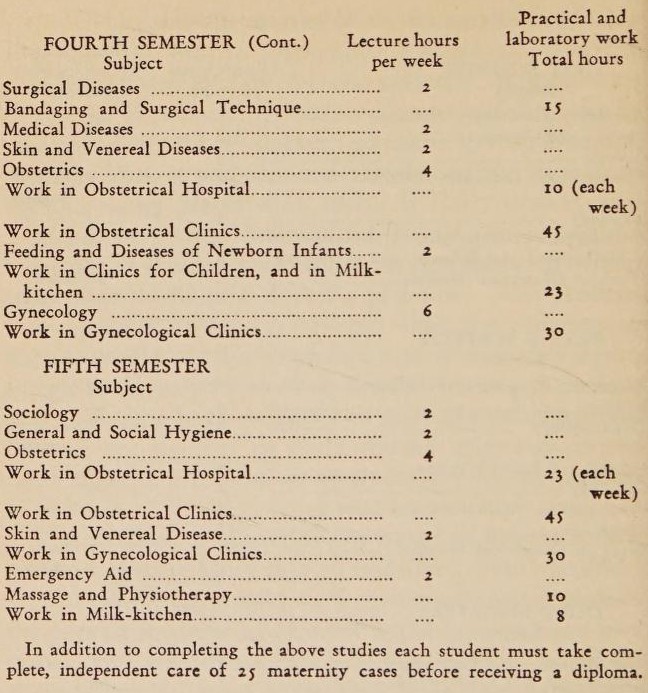
A schedule of their course is given on pages 155 and 156, from which it can be seen that they do receive a good education in preparation for their special work. In connection with this course the Russian midwives get considerable training in conducting prenatal and infant welfare clinics and in methods of general health propaganda, as it is emphasized throughout their whole course that they will be in an exceptional position as teachers of hygiene.
To Americans the whole question of qualified midwives is new, but to Europeans it seems to solve the problem of proper care for the majority of maternity cases. In all normal deliveries the midwife is able to take the place of both doctor and nurse, giving a service which is efficient and economical, whether she is paid by the individual family as is usual in Italy, France, and England, or by the State, as in Russia. In almost all countries, it is at present inevitable that many deliveries take place without a doctor’s presence. The Russian Commissariat of Health realized that the number of doctors would not for years be so great that they could expect to do obstetrical work for the whole population; therefore they have prepared to raise the standard and increase the number of their trained midwives as the most efficient state aid to mothers and babies possible to provide.
The problem of education for nurses in Russia is on a different footing from that of midwives. The latter had always existed in Russia on a semi-professional basis—the present institute in Moscow is the heir of a pre-war school for midwives—but of the trained nurse in the professional sense there were very few before the war. There were Sisters of Mercy belonging to semi-religious orders, some of them aristocratic and highly educated women, but their nurses’ training had more social than scientific discipline. During the war several courses were given preparing women for work in army hospitals, and many of these developed through experience into excellent surgical nurses, but regular training schools connected with hospitals with well rounded and well supervised courses in nursing have never existed. The general attitude toward nursing, moreover, was not such that would induce women to undertake the work unless under some religious motivation. Nurses who did not wear the uniform of some order were not apt to receive very courteous treatment from the hospital staff or the public at large, and it is true that they were often not the type of women to command much respect. The more independent career of feldsheritza or midwife was open to all ambitious and intelligent girls. The hospital patients suffered from the lack of good nursing care, but usually neither they nor the doctors treating them had ever known what this might mean. Many doctors can still be found who declare that they would rather run a hospital without nurses. The leaders in the Commissariat of Health, however, have all traveled outside of Russia, and having seen something of modern nursing in other countries, desire to introduce it into Russia. Training courses for nurses have been started rather chaotically by enthusiastic medical men in various parts of the country who have seen the goal without always knowing the route thither. As a result, many of these courses are really miniature medical courses with most of the art of nursing omitted. To us it seems almost ridiculous to plan the curriculum of a nurses’ training school and not to have a single nurse present at the planning conference, yet that happened last year at Moscow. As a result of the conference, however, there was worked out a more or less standardized course for nurses’ training to be carried out under the joint supervision of the Commissariats of Education and of Health.
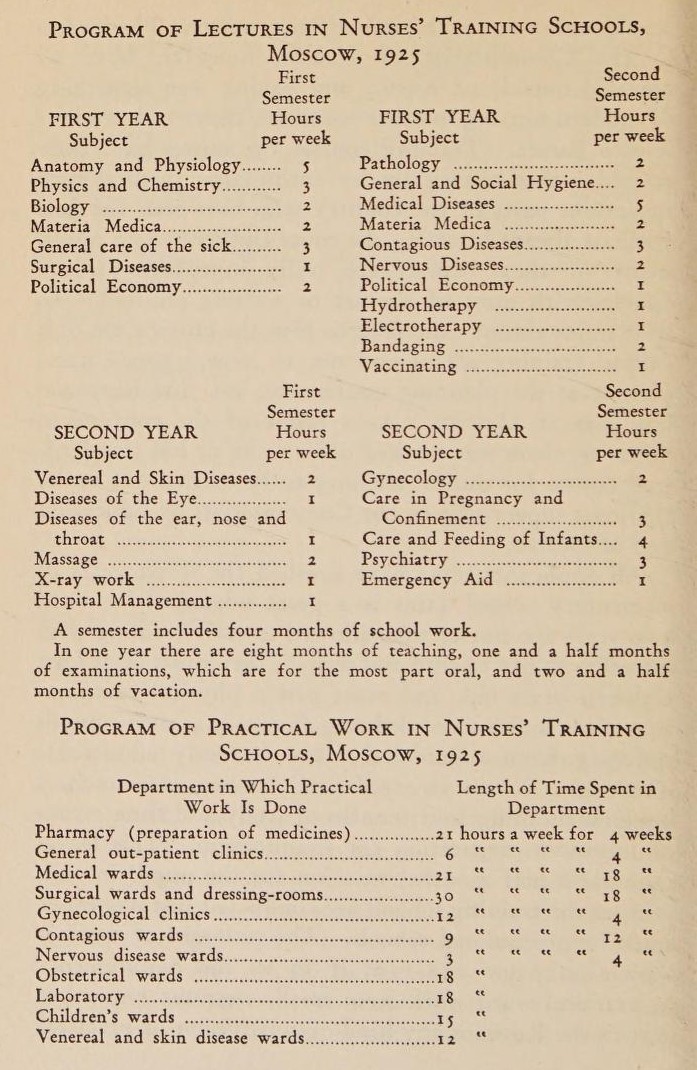
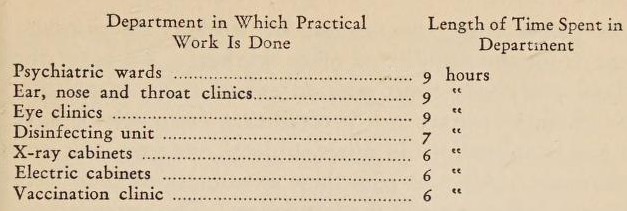
All applicants must have finished the seven years of elementary school (this is a great advance, for until two years ago nurses were allowed to start training with the mere ability to read and write), they must be at least eighteen years old, and must pass a physical examination (this is also a decided step forward, as many pupils suffering from tuberculosis were formerly admitted). The course covers two years of two semesters each, a semester meaning four months of study and three weeks of intensive preparation for examination. This leaves two and a half months’ vacation for the pupils in each year, as the training schools are conducted just like other trade or professional schools. The program of work is shown on pages 158-159; if to us the requirements in practical ward work seem small, we must remember that to the Russians any kind of supervision of practical work is quite new. In fact they announce with the solemnity of a new discovery that henceforward all nurses’ training schools ought to be connected with hospitals or some institution where practical contact with ill patients may be obtained.
Their curriculum and academic standards may still seem to us backward, but there is a side to their nurses’ training which we would do well to observe closely. The young women who come up to Moscow from the provinces to take the course are terribly in earnest about the health work of the nation and their place in it. Without having any recognized religious stimulation they have a real missionary spirit that many of our indifferent young student nurses might well copy. Self-government in their dormitories does not have to be urged upon them. Forty girls, utter strangers to each other, may be thrown together one afternoon in a barn-like barracks, and by evening they will have achieved a weekly schedule of cooperative housekeeping duties, and a series of house rules that would do honor to any headmistress. The following paragraphs are taken from a report written by a student nurse in Moscow:
“From the very remote places of Russia there come young girls and women sent to the course by the gubernia and ooyzed health departments and other organizations…The nurses vary greatly in regard to their social origins and position but still the greater percent comes from the families of workers or peasants, next from the families of office workers. To enter the school everybody must pass an examination in politics, and those who have not a certificate from school have to pass examinations in other subjects like grammar and arithmetic. All who pass these examinations then have to come before a medical commission. The entrance age is restricted from eighteen to thirty-five years. Marriage has no significance in this connection and would not be a hindrance in entering the school. All the girls lodge in the dormitory of the school where they have rooms provided with the necessary furniture, as tables, chairs and beds, and where they are supplied with bedclothes.
“Lectures begin every day except holidays at nine in the morning and continue until four in the afternoon, with one hour for lunch. After four the nurses are free from obligatory work and can use the rest of the day at their own discretion, either in preparing for the next lectures, or for additional work in the different sections of their social clubs; i.e., in physical culture, choral singing, dramatics, or in those of a political nature, as trade unions and political economy groups.
They can receive visitors until ten o’clock in the evening in their rooms or in the reading room where there are always newspapers, magazines, a radio set, chess and checkers. The nurses take their meals either in restaurants or they cook for themselves. The cleaning of their rooms, their laundry and other housekeeping work must be done by the nurses themselves.
“During the year there are holidays in the winter of two weeks and in the summer of two months; most of the student nurses spend their summer holiday at home or in villages where they help to carry out the campaign for day-nurseries for the babies of peasant women. Almost all student nurses are members of the trade union of medical workers. Representatives of the students are also members of the School Council and of the Educational Program Commission, where they have the right to take part in the discussions and decisions on all questions of an educational character. The student nurses take part in social welfare work too. Many of them are members of the Communist Party or of the Young Communists.”
XVIII. Taking Health to the People
“THE worker’s health is the responsibility of the worker himself” is an excellent slogan, but anyone who has had experience in health education will realize that powerful catalytic agents are necessary to stir up that sense of responsibility. This is especially true in Russia where so many household customs and religious traditions combine with illiteracy to block personal and social hygiene. No matter how enlightened may be the policy of the Commissariat of Health, it is to the masses of the “dark people” that it must appeal or it is of little value. And here is where that flair for propaganda which so many visitors have noticed in present-day Russians comes to assist the health officials. Every device of advertising is turned to the business of selling health.
The exhibitions are the most ambitious and most universal means of attracting attention; Moscow has some of the best health exhibits in the world. The posters are especially beautiful, many of them having been executed by well-known artists. Wax modeling is carried out in meticulous, almost too realistic detail. Old engravings, copies of Renaissance pictures, are used to illustrate the history of child welfare or industrial hygiene.
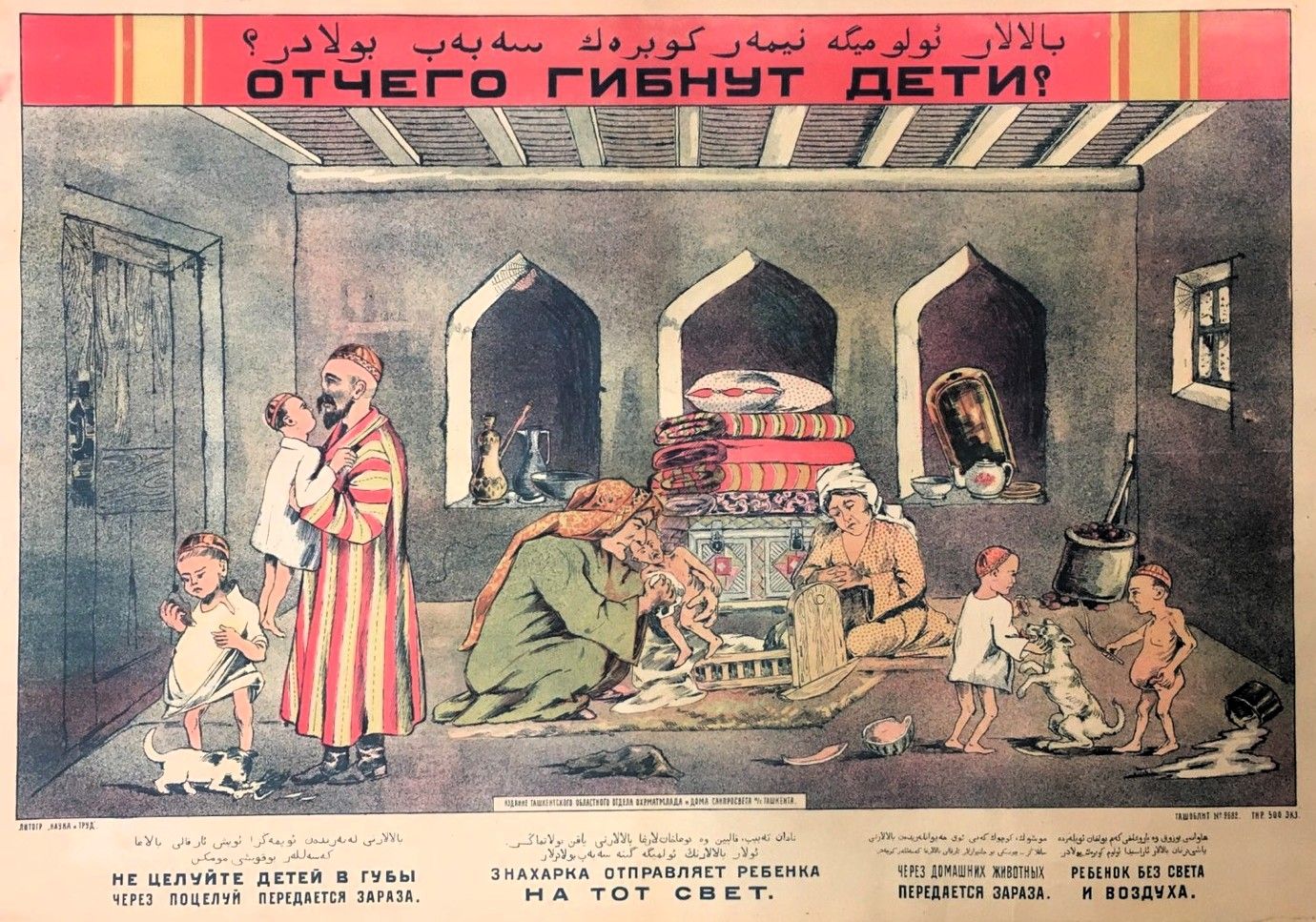
Statistics are presented in arresting diagrams. The juxtaposition of the “Right Way” and the “Wrong Way,” of “Before” and “After” is made so striking and so apt that the dullest intellect must grasp the meaning. Most important of all, the officials who have arranged these exhibitions do not feel that they may rest after the material is in place and the doors thrown open; on Sundays and other holidays excursions of peasants from the country and of workers from the factories (student groups come on week-days) are brought to the exhibits, and painstakingly conducted through the rooms by guides, usually medical students or doctors who are assigned this duty as part of their social service. Many of these visitors cannot read or write but they are practical and intelligent, and it is most interesting to watch their careful scrutiny and final understanding of some picture touching on their own lives. For those who live too far from the large cities, all of which have their own collections, the central Commissariat has arranged traveling exhibitions. The largest of these are in railway cars which are switched onto sidings at small stations and give several days’, sometimes several weeks’, entertainment to the peasants of the neighborhood. Moving picture machines, magic lanterns, lectures, little plays trained quickly from local talent by the personnel in the car, posters (the outside of the actual railroad car itself is brightly painted into health posters) and literature for home reading are some of the methods used in this sort of propaganda. Very often exhibitions are connected with the traveling clinics sent out by several of the Bureaus of Health; the tuberculosis, venereal, malarial, etc. Many districts in Russia, however, are far from a railroad and to them still more condensed exhibitions are sent by means of automobiles, horses, camels and reindeer. The radio has become a great instrument for propaganda in Russia and the Commissariat of Health uses it continually, but for work among the peasants it finds the posters and lectures of a traveling exhibit more effective. Many of the health posters have been enlarged and put up on bill-boards in the cities; there are always some in the railroad stations and parks.
Although this active propaganda for health cannot fail to attract people’s attention, it is probable that the greatest effectiveness of the Commissariat comes from the daily contact of the masses with a dynamic health program. More than three-fourths of the Russians are people living in small villages in the country. Their houses, animal sheds and barnyards are still built and maintained after the fashion of their forefathers, but down in the village reading-room, a sort of social center which has appeared almost everywhere within the last ten years, are several disturbing pictures on the wall. On holidays and winter afternoons many of the younger people drift in and read, often with amusement, that one should sleep with windows open, and sink one’s drinking water well somewhere else than most conveniently to the cattle trough, and that the ever-present malaria comes from a mosquito and not from God as a punishment to this evil generation. And then an ex-soldier, who may be reading in another corner, tells them that these things are so, that he has traveled much and learned the truth; and the next few hours are given over to reminiscences and to forecasting of the future of Russia, with electricity in every house, and water out of hydrants, and tractors. Nor is progress only for the adolescents. The following description of the introduction of a child welfare station into a steppe village was written by one of the Quaker workers who helped to open it, but the consultation is now being conducted by the local health department:
THE CONSULTATION FOR BABIES IN SOROCHINSKOYE, SAMAARA, RUSSIA.
“What is this confiscation the Quakers are arranging for us?” a fat peasant woman asked her neighbor, as they pushed their way toward the door of the crowded lecture room.
“Confiscation? Much you understand,” said her neighbor scornfully. “Confiscations are only for the bourgeois. We are going to have some kind of a consultation.”
“But what is it—a consultation?” asked a pale, worn-looking woman, leaving another animated group to join the conversation. “I listened, and I listened to every word the Quaker-doctor said, and now the lecture’s all over, I don’t understand anything. I thought they would give us payoks [rations] of food or clothing, at least,” she went on without stopping to take breath. “But there isn’t a word of that at present. Only, says she, bring your children to this consultation to be weighed.”
“I think,” the fat woman tried to interrupt her.
“To be weighed,” she repeated, drowning out all opposition in a flood of words. “We know all about this weighing. In the Children’s Home the American nurse weighed the children every month. Every one knows the Americans are crafty people. They can invent anything you like. It was plain as day to them that the Children’s Home managers would be cheating, and so they found a way to catch them. If the children gain in weight, all right—the American food is inside them. If they lose, it means the goods are in the manager’s pocket.”
“Very well,” an indignant voice chimed in, “very well, but why do they want to weigh our children? They don’t even promise us payoks. Band if they did, are we the enemies of our own, to steal from their little mouths?”
“O, Lord, what a trial,” sighed a gray-haired woman with a sharp wrinkled face. “Until now they were curing but the sick children, bless their souls for the good work. But today she says, don’t bring the sick ones—the clinic’s the place for them; bring the well ones before they get sick. Now they’re invented curing well children. Oh, what a temptation.”
“And that’s true,” agreed the neighbor, while the crowd laughed and exclaimed approvingly. “It’s a device for leading the people astray. When they give quinine pills for the fever—that’s as it should be. And the nurse, Lord give her good strength, cured all of mine from the scabies. With her own hands she put some kind of mess all over their bodies, and washed them three times in the bania. It turned out better than the babka’s mixtures, and nothing to pay. Now anyone would rather go to the clinic than to the babka; but this consultation is all rubbish.”
“Yes,” said the gray-haired woman, “there’s a consultation for you. The lady-doctor wants to tell us how to bring up our children. And she herself unmarried, and never had a baby, I daresay.”
“And she says don’t give him the pacifier,” the fat woman burst out indignantly. “Don’t swing him. Only feed him every three hours. You can’t give him the breast without watching the time,” she went on in an injured tone. “That would be a fine thing. There’s the way to drive your man out-of-doors.”
“The Lord be with their consultations, let them leave us in peace,” agreed another. “It’s just a loss of time for the woman and a cold in the head for the babies. Let those go who have no work to do.”
Having settled the question of the consultation to their own satisfaction, the women finally drifted out of the lecture-hall and scattered to all corners of the village.
Half a year later the Sorochinskoye Consultation, in spite of its inauspicious beginning, had over two hundred babies as regular visitors. Now the mothers fully understood the meaning of the word and came gladly on the appointed days. At nine o’clock on one of the consultation mornings the bright, sunny waiting-room Was an animated scene. On the walls were hung gay posters in oil-colors, the work of a local peasant artist. Below them, on the low benches, the mothers had settled themselves with their babies to carry on lively conversation. At the moment they were watching a mother who was proudly teaching her baby to take his first steps.
“Come along, Vaska,” she urged. “Soon we’ll be walking along the street on our own two legs.”
“Oh, what a fine little bridegroom,” exclaimed another woman. “Look out now and pick yourself a bride. See what beauties we have—a regular show. Well, take your choice, young man.”
And certainly even a hardened child-welfare worker would have found it difficult not to fall in love with these babies, as they lay in their clean dresses, without caps, wriggling and kicking their little legs and cooing rapturously in their mothers’ arms. All the mothers seemed to know each other and there was a lively interchange of experience in bringing up of the young, and of boasts of the wonderful progress made by each particular baby. Here, apparently, the women of the village felt themselves united on the common ground of love for their babies and care for their health and growth.
“Has yours been on the scales yet?” asked a woman in a ragged sheepskin coat, of her neighbor.
“Of course. The nurse weighed him before you came,” she answered proudly. “He gained almost half a pound. Here, you can see it written down in my little book, if you can read. I suppose it’s because I began to feed him gruel, as the doctor told me.”
“And mine hasn’t gained this week. There’s a trial and sorrow with him. No diarrhea. And the Lord knows I keep all the rules. I must ask the doctor what it is…”
Just then all attention centered on a new mother who had come to be registered for the first time. She was a young woman in a fine plush coat, the baby in her arms wrapped tightly in a thick shawl. Seating herself shyly on the edge of a bench, she unwrapped the shawl and displayed a thin little creature in a many-colored woolen cap, tightly strapped into a motionless bundle. Awakened by the bright sunlight in his eyes the baby burst into a strident wail. The mother, with the facility of long practice, caught him up and began to rock him desperately, swinging her whole body back and forth and patting him in rhythm.
“Sh-sh-sh-shut up—will you shut up—sh-sh-sh,”’ she chanted.
As a result of this soothing process, the baby howled still louder, gasping for breath and straining every muscle of his little body. At once the contagion spread to other children, and in an instant the pleasant quiet room was turned into a bedlam of wails and screams.
“Stop rocking him,” shouted one of the mothers above the din. Take off his bonnet and unwrap him. What kind of a babka told you to keep him bundled up that way in a warm room, poor little fellow?”
The new-comer looked about distrustfully and, taking a rubber pacifier out of her pocket licked it carefully and stuck it in the baby’s open mouth. A murmur of indignation rose from the assembled mothers.
“Show her the picture,” called someone from the back benches, “The doctor will give it to her as she did to us the first times.”
One of the women, with a virtuous air, rose and pointed to a poster at the front of the room. On it were sketched two babies; one with a cap on its head, a pacifier dropping from its mouth, tightly bound in a blanket; the other happy and smiling, with uncovered head, and hands and feet free to kick and wriggle.
“Well, look at it,” continued the virtuous mother. “Which is better, I ask you?”
The new-comer in her embarrassment looked uncertainly from the picture to the babies lying unwrapped on their mothers’ knees.
“I suppose if they won’t let a baby in like this,” she said after a moment’s hesitation, “I might as well unwrap him. Let them have their way.”
Meanwhile in the doctor’s office next door, the work was going on as usual. On a padded table covered with clean white rubber sheeting, lay two naked wriggling babies, each the image of the other.
“Now you can dress them,” said the doctor, turning to the mother, a thin, mild-faced young woman, almost a girl. “I congratulate you. Your little girl is getting on finely, and the boy will soon catch up with her. If you carry out my orders as well in the future, your twins will be the prize babies of the consultation.”
“I don’t know how to thank you,” said the young mother with tears in her eyes. You know, they are my first ones. For three months after their birth I suffered for them with all my soul. First I gave the breast to one and then to the other. I rocked them, I walked the floor with them. I never slept a night through, until at last I saw blue circles before my eyes when I walked on the street. Sometimes it got quite dark before me and I almost fell.”
“That was just before you came to us?” asked the doctor.
“Yes,” she answered, “one of the neighbors told me that consultation babies didn’t cry and weren’t sick, so I thought it wouldn’t hurt to try. Then you taught me how to feed them and gave me the little bottles of milk from the kitchen. And I bathed them and unwrapped them, and everything seemed to change. Now I put them to bed together at night and they lie the same way until morning.”
“My heart is glad for them,” she said as she gathered the twins up from the table, one on each arm. “And thanks to you I feel like a human being again.”
The nurse and doctor stood watching her as she made her way through the next room to the admiration of the other mothers, and rejoiced together over this living picture of the triumph of the consultation. In some villages the manor-house of the former landowner has been made the social center for the neighborhood and here there may be recreation grounds with football and croquet of a Sunday afternoon, and perhaps in the morning a visiting doctor from a town fifty miles away will hold the weekly clinic. He may bring a notice someday that the village is to vote for three people who will be given a free excursion to the city to spend a holiday at the health exhibition there. When these representatives return they will be expected to make a public report of what they have seen—the private reports will be much more spirited and reach almost as wide an audience.
***
In the winter—for in the summer the peasant is busy night and day in his fields—a traveling health exhibit may come to the village for a week’s stay. The town hall or the schoolhouse will be filled with bright posters. In the afternoons one of the women visitors, a nurse or a doctor, will give demonstrations in the proper ways of dressing, bathing and feeding a baby and on household sanitation. Perhaps a woman’s club will be organized if there are any leaders evident among the peasant women, for it is out of the enthusiasm of these rural women’s clubs that day-nurseries and infant-welfare stations have been known to emerge. In the evening there may be a moving picture shown (perhaps the first to have come to this village), or there may be a lecture on how to escape malaria, or there may a mock trial where tuberculosis is found guilty of manslaughter, or the local children may have been quickly trained to give a toothbrush drill or to dance a Defiance to Dirt. The entire village will crowd into the hall, most of it spitting a continuous stream of the husks of sun-flower seeds, the stench from home-cured sheepskin coats will be almost intolerable to the city visitors—but a whole new set of ideas will have entered into the next year’s conversation of that village.
The approach of the health department to the city workers is easier. Not much is being done yet to effect his home living conditions, as the cities are very overcrowded and a house-building program is very expensive. Certain of the smaller industrial cities, however, show some progress; in the oil regions near the Caspian Sea the State Oil Trust has built many new houses for its employees, and in Ivanova-Voznesensky, a textile center, there is a suburb known as “the English village” where about one hundred acres have been laid out in two to three family brick houses with little individual gardens, all grouped about a central schoolhouse and cooperative store. Unfortunately they are not very popular with the workers, who have been used to the old barrack-like tenements. Separate family kitchens are said to be expensive in fuel, and, what is worse to a Russian, lonely and unsociable; the rooms are little and prohibitive of that wide hospitality which all Russians like to extend. In short it seems probable that the Russian model house must be designed by the Russians themselves.
And so it is at their clubs and in their schools, rather than in the home, that the appeal of the health forces is made. The eight-hour working day is in itself one of the most powerful health agents; then there is the new idea of sanitation inspection in factories and of personal health examination of the worker. The provision of sanitoria, and weekend and vacation rest homes for those recommended as needing them, the day-nurseries where women workers may bring their babies and where instruction is given continually in child care, the factory restrooms where there is almost always a “corner health exhibit” arranged by the health commission of the factory, on which most of the workers serve in turn—all of these factors directly affect the daily life of the city worker. Athletic recreation clubs’ are also being introduced into the scheme of the workers’ lives for the first time. Football and tennis and a cindertrack and some parallel bars and rings may make up the entire equipment, but it is something new for the Russian worker to be invited to share in such recreation in his leisure time. In addition to the athletic director, a doctor is always on the staff of each of these centers, and physical examinations are given to all the members, followed by suggestions as to prohibited and recommended activities.
Of course not all the industrial workers are reached by the health forces; many of the tuberculous can find no night sanitoria, sanitary standards within the factories are still lower than in this country and athletic clubs are still to be counted by tens instead of by thousands, but a beginning has been made toward establishing a healthy body as a new ideal worthy of attention.
XIX. Conclusion.
It is obviously inappropriate to use the word “Conclusion” as the title to any chapter dealing with the activities of the Russian Commissariat of Health. It is only during the last few years that it has been freed from the crushing obligations of war and famine and pandemic diseases; the work by which it ought to be judged has been only started. One can speak of tendencies and programs more authoritatively than of accomplishments, although the preceding pages have offered considerable proof of accomplishments. But an institution need not be apologetic if, instead of action, it brings new ideas to the world. And if, in addition to these new ideas, it can furnish enough of their results to be evidence of their economy and practicability in action it has made a real contribution to the science of administration of the world’s work. This contribution I believe the Soviet Commissariat of Health to have made. Its influence on medical work within Russia is already very real; its influence in other countries awaits their better acquaintance with it.
Its most far-reaching result within Russia has been to change the emphasis and ideals of medical education and of the medical profession as a whole from laboratory research to practical service. There are many people within the country and outside of it who think of this change as a distinct loss and backward step. But the Russian officials have no antagonism to academic research—the State Scientific Institutes are a visible proof of the encouragement given to research if it is not made an end in itself—it is only that they feel the present medical situation in Russia needs workers in the field rather than in the laboratory, and most people who have lived or traveled in Russia will agree with them. As a practical realization of this ideal, there are more practising physicians per capita of population in Russia today than at any other time in her history.
The next most important work of the Commissariat of Health within Russia has been the creation of a system which will bring a standardized and free health service to every citizen of the country. This system is already in operation in industrial centers and is gradually reaching out into more isolated districts. Many types of medical institutions which before the Revolution, if they existed at all, were available only to the wealthy, are now open to those whose physical condition most needs them. Here also service is the point emphasized.
The third great addition of the Commissariat to the health work within the country has been the introduction of health education as an essential part of the work. Before any unusual reduction in the mortality and morbidity rates comes, the cooperation of the masses of the people in improving personal and social hygiene must be secured. This dynamic crusade for positive health is quite new in Russia.
Some of the practical institutions which have been created to meet various medical needs are new only in Russia; in other cases they are really unique experiments which people from other countries may study with interest. Examples of the latter class are the night sanitoria for workers, the legal consultations connected with child welfare centers, the diet dining rooms conducted by medical clinics, etc.
If one turns to the larger contribution which the Commissariat of Health may have for other countries, one thinks in terms of social and administrative experimentation, rather than of scientific research. And this perhaps is what other countries most need. Our popular magazines, for example, are full of discussion of the prohibitive cost of adequate medical attention in this country. Louis Dublin, of the Metropolitan Life Insurance Company, writes in Harper’s for November, 1927:
“Large numbers of middle class families pay their bills, but chafe under what they generally consider the unjustifiably heavy cost of medical service. Only the very rich can afford a serious sickness without concern over their medical bills. Everywhere within and without the medical profession there is the feeling that something is seriously wrong with the economics of medical service. Neither doctors nor patients are satisfied with the present situation…The best estimate of the aggregate cost of sickness in the United States is over two billion dollars a year; the same total as for public education.”
Russia’s nationalized health system offers one solution neither more revolutionary nor more expensive than our public school system. We may not care to adopt this solution but it can do no harm to watch it. Automatic, universal health insurance with its inevitable insistence on preventive medicine in industry and in leisure time is another stimulating idea. The Medical Workers’ Union as a method of promoting cooperation among co-workers in a hospital from the laundry to the laboratory is an interesting thought for our personnel managers to ponder upon. All of these principles of Soviet medicine are a challenge to individualism in medical work, and a bias in favor of individualism, if it persists, must be overcome before an open-minded examination of the more significant Russian experiments is possible.
Of all the professions medicine is the most consciously international in its source of inspiration and achievement: Germany and Austria, France and England, Japan and America have each contributed to the common fund of medical knowledge, and each has taken from that “und some portion which it needed and could use. Russia also has her contribution. It would be a pity if an unscientific, stubborn pride prevented our recognizing it. One day an American woman was being conducted through the various departments of one of the State scientific Institutes by its director. He was speaking to her in the beautifully correct French of the old-time Russian aristocrat. For almost two hours he had shown her the many-sided modern work being carried on in she old buildings and had glowed with pride as he told of experimental research and of education in certain phases of hygiene. Thinking to show her appreciation the American visitor exclaimed, “What a wonderful work you Communists are doing here!” The little man drew himself up proudly to answer, “Madame, there ire ninety-two doctors connected with this Institute and not one of us is a Communist.”
When it is a question of service in the saving of lives and the prevention of suffering the Russian doctors nave decided that politics shall not matter. Can we ignore the contribution that springs from such a spirit?
PDF of original book: https://archive.org/download/healthworkinsovi0000anna/healthworkinsovi0000anna.pdf

