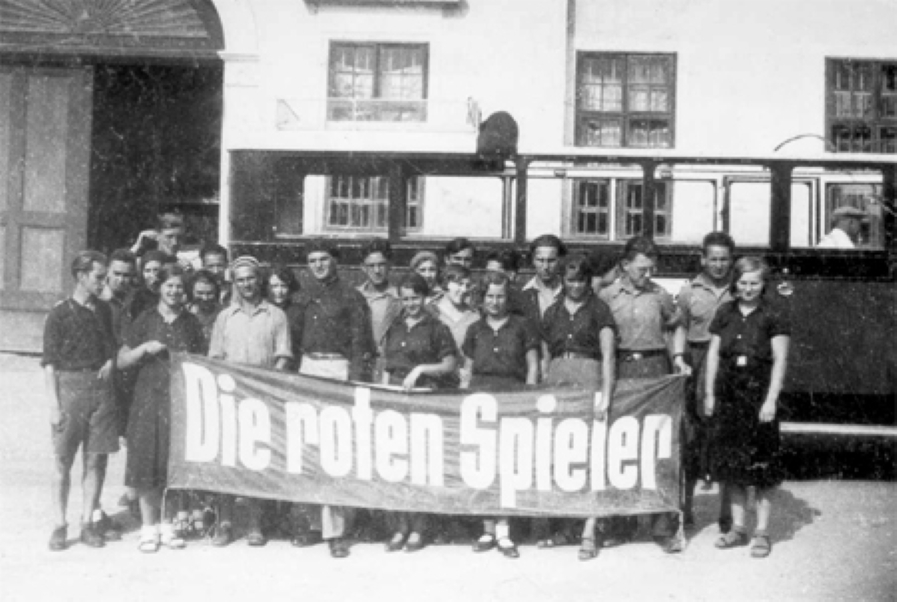
An evening spent at the Cabaret der Arbeiterschauspieler of Berlin’s Neukölln neighborhood in the last months of Weimar.
‘Workers’ Cabaret’ by Arthur Dour from Workers Theatre. Vol. 3 No. 1-2. January-February, 1933.
Cabaret der Arbeiterschauspieler, Berlin workers’ cabaret, in the Neukoeln district.
You find yourself in a huge casino liberally daubed over with elephantine middle-class nudes; opposite the entrance a stage with flimsy curtains decorated with smeary Harlequins and Colushines throwing roses.
But the proscenium is draped in red. Against the entire length of the walls are red streamers lettered in white. They read “Down with culture-reactionaries.” Theatre is a weapon.
The hall is very large, there seen to be thousands of chairs and tables, dozens of waiters running back and forth with steins of beer; the hall is packed with people, all young–there seem to be only young people in Germany nowadays.
A large place, a large purpose–but your impression is still general. Tour impression is still general. Your eyes shift to the stage.
A dozen lads with banjos sit cross-legged at the edge of the stage; the thundering banjos make the casino tremble. Does your impression grow sharper when you recall the burst of shouting in the street only half an hour before! The Nazis came electioneering into the workers’ district, that was why the shouting started; it would have gone badly with the Fascists if the police had not rushed in. (The police move fast in Berlin; in the workers’ district they cruise in a motor truck eight at a time.) In an instant the police were at the corner, hands at holsters. You didn’t stay to see more. Nobody stayed. Move on, comrade, your friends tell you, there may be bullets.”
Very likely there may be bullets, in Weukoeln and Wedding. The comrades will show you, in a back street thick with Communist flags, the very places at which the barricades were erected in 1929, the roofs where the police stood their machine guns. Thirty workers were killed in Wedding before the May 1st celebration ended.
So, the workers do not like the Schutspolizei in their bluebottle uniforms.
And the “Schupos do not like the workers. It is especially the young workers, like those playing the banjos this evening, whom they dislike. The police do not describe them as workers. Young loafers with nothing to do but to collect their eight marks weekly dole, louts who hang around their Communist locals planning mischief.” Then the real trouble starts, the business-like German police will no doubt dispose of the young men first–that’s good police strategy.
But the police will not allow things to go that far, of course. They will forbid things to go that far; the police department is very busy forbidding things these days. It has forbidden Agitprop performances. The Agitprop troupes continue to perform illegally.
But the performance tonight must limit itself to something the police consider legal. The program is by the Junge Volksbuchae affiliated with the Workers’ Theatre League, affiliated in turn with the Workers’ International Relief. They offer a revue–a history of the German theatre; you watch this history unfold in song and dance, in rowdy burlesque.
To start with, an eye-watering drama of love and marriage, of virtuous womanhood exposed to vile seduction, a German spice-cake of loud emotions served in the style of that prince of entrepreneurs, Max Reinhardt…The audience roars.
But it roars still loader at the next tableaux, the old Volksbuehne, that socialist theatre, municipally endowed, which ten years ago played Toller’s defeatist “Masemenech” and today finds nothing better to put on then that stale whimsy, Molnar’s “Lillian.” Heralded by a pink flag that looks suspiciously like a whore’s chemise, the troupe moans and rolls its eyes in unison toward heaven, dances neo-Hellenic tragedy and prances idealistic aspiration. It brings back to mind the social-democratic banners you have seen on which were embroidered in golden letters: Our weapons are spiritual. With those same spiritual weapons, no doubt, Karl Liebknecht and Rose Luxemburg were murdered.
The curtains open quite casually for the third part of the program. Ancient history is past, it has come time for the theatre of the present and future, the new young Volksbuehne.
You look expectantly. But there are no actors visibly posing on the stage. Only comrades in blouses standing around, kidding each other good-humoredly, horse-playing. Only gradually this byplay takes on theatrical form–party comradeship and workers theatre are one inseparable activity; these young people have a mood that is new in the history of the theatre–an easy playfulness; but back of that, instant defiance.
Casually, good-humoredly, the actor-workers fall into a rhythm of simple movements that convey the beat of huge machines–a pantomime–they work: now another, they stand in line for dole; now another, grimly humorous, they sleep six in a bed for lack of room. They talk swiftly as they go along; with megaphones they seize upon the audience. They usher in a troupe of Sports Club members; let the audience see that a new race of workers is arising in Germany, prepared in body and mind. Their songs take the audience by the shoulders; strange how they get out of a banjo the heavy crass rhythms of big machines.
Now you begin to see that the level of this performance has been rising almost without effort, like a tide. The tide carries you, as it carried you in the Lustgarten, where the Communist anti-war demonstrations filled the immense plaza; an ocean of people, red armbands, red banners, the international symbol of hammer and sickle. The red tide overflowing from the USSR into Germany–Communism strong in the German seaports, a Communist majority in Berlin–the German proletariat is awake.
Listen to the singing on this stage:
“Our leaders are Marx and Lenin
Agitatoren, Propagandisten,
Zeigen wir Klassen-Warheit
Unere Lehrer und Fuehrer eind Marx und Lenin.”
Listen to the voices singing: the song grows, spreads to the audience:
“Let them but threaten the Soviet Union–
We have an answer ready
Und richten sie die Gewehre
Gegen die Sowjet Union,
Dann russien rote Heere
Zun kampf sur Revolution!”
The New Theatre continued Workers Theater. Workers Theater began in New York City in 1931 as the publication of The Workers Laboratory Theater collective, an agitprop group associated with Workers International Relief, becoming the League of Workers Theaters, section of the International Union of Revolutionary Theater of the Comintern. The rough production values of the first years were replaced by a color magazine as it became primarily associated with the New Theater. It contains a wealth of left cultural history and ideas. Published roughly monthly were Workers Theater from April 1931-July/Aug 1933, New Theater from Sept/Oct 1933-November 1937, New Theater and Film from April and March of 1937, (only two issues).
PDF of full issue: https://www.marxists.org/history/usa/pubs/workers-theatre/v3n1-n2-jan-feb-1933-Workers-Theatre-yale-mf.pdf
 Revolution's Newsstand