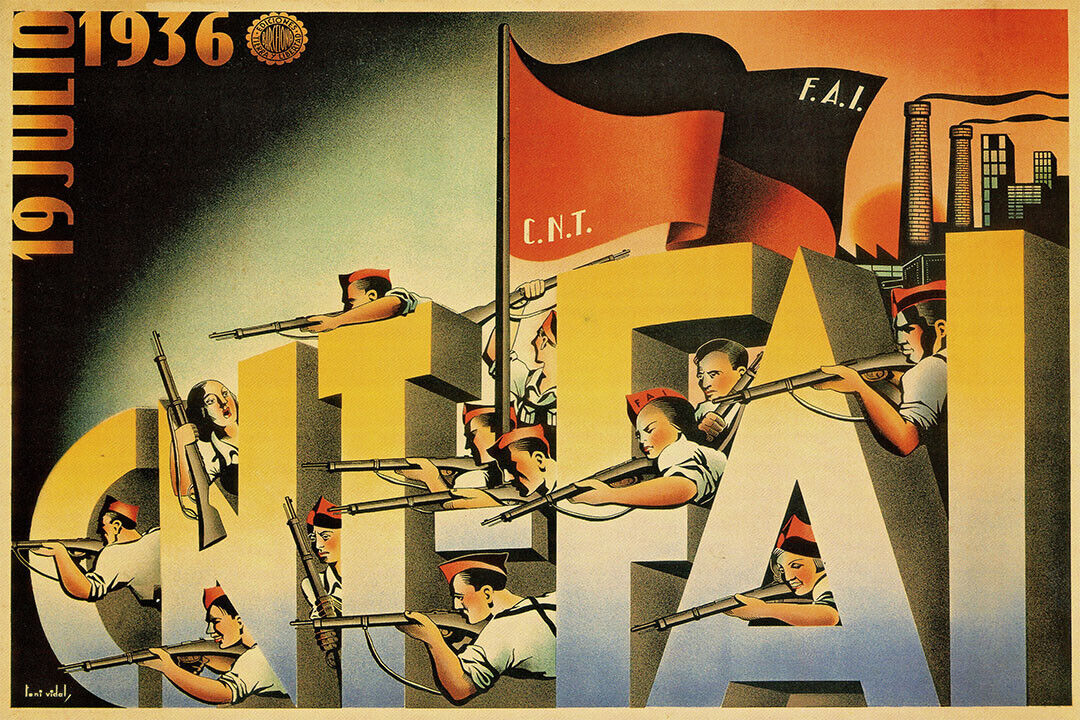
Weeks after the Spanish Revolution confronted the fascist coup-makers, the United Libertarian Organizations introduces English-speaking readers in the U.S. to a central force leading the resistance, the C.N.T.-F.A.I., in the inaugural issue of their newsletter published on the the unfolding Civil War.
‘The Role of the C.N.T. and the F.A.I. in Spain’ from Spanish Revolution (U.L.O. New York). Vol. 1 No. 1. August 19, 1936.
If there is any event that can bring about a rediscovery of inner strength on the part of organized labor and the libertarian elements of the world, it is the grand struggle against Fascism now being waged in Spain. This struggle can be best supported by comrades living abroad by vigorously combatting the lies of the reactionary press and by keeping the public opinion of the world informed as to the true course of events in Spain. After the unresisting defeat of the labor movement in Germany the effect of the heroic battle of the Spanish workers, peasants and intellectuals against the Fascist bandits is that of a refreshing thunderstorm. It is the first time since Fascism made its appearance in Europe that the entire population of a country gave such a spirited resistance to the imminent danger. That is why the example of those struggles is international in its significance, far transcending: in scope the frontiers of one country.
The desperate struggle is the common cause of all movements that do not want to fall under the bloody yoke of Fascism. Yet one must single out the surpassing promptness of action shown by the C.N.T. and the F.A.I. which from the very beginning imparted a momentum to the struggle enabling it to banish the bloody spector of Fascism from the gates of Spain. It was the plan of ‘the plotting militarists to seize all the important places by a strategy of surprise which would render inevitable the fall of Madrid. The most important link of this plot was the crushing of Catalonia, the fortress of the revolutionary labor movement of Spain, so as to cut off the Capitol from all the larger cities. Catalonia is the center of Spanish industry and also the most highly developed province in respect to culture and material resources.
The fall of Barcelona, the largest city of Spain, would have rendered impossible any prolonged resistance to the Fascists. That is why General Goded flew in haste from Majorca to Barcelona in order to lead the revolt in person.
But the vigilance of the C.N.T. and the unexampled bravery of its members frustrated those plans at the very beginning. In a few days the so-called “rebels” were utterly defeated. The victory of the workers in Barcelona led to the quick suppression of Fascist revolts in Taragonna, Lerida and Matare and the liberation of the entire Catalonian province from the Fascist hangmen. The workers militia in Barcelona soon comprised 18,000 men, of whom 13,000 belonged to the C.N.T. and F.A.I.; 2000 to the Socialist trade union U.G.T. and 3000 to the parties of the People’s front. Apart from that Barcelona also equipped an army of 8000 men, all of whom belonged to the C.N.T. and who, under the command of comrades Durutti and Oliver, set out for Saragossa in order to wrest the city from the bands of the Fascists.
There are so many fables circulated by the foreign press about the aims of the C.N.T. and the F.A.I. that it is necessary to give our readers a clear picture of those two organizations.
We, of course, cannot go right now into the history of the long and glorious struggles kept up by those organizations, or of the persecutions to which they were subject. That would fill up volumes. For the present we will only dwell upon the ideological significance of this movement and keep in close view the working out of this ideology in the tactics of these organizations.
The “Confederacion Nacional del Trabago” (C.N.T.) was founded in 1910 and within a short period came to embrace about 700,000 organized workers in all parts of the country. The organization, however, was only new in name, but not in its tendencies and methods. The history of the Spanish labor movement is shot through with long periods of reaction during which the movement could lead only an underground existence. After each such period the movement was organized anew. The name changed, but the aims remained the same.
The first labor movement of Spain arose in Catalonia in the year of 1840 where in Barcelona trade unions were organized by Munts, a weaver. The Spanish government tried to suppress this movement, having sent for that purpose to Barcelona General Zapatero, one of the darkest reactionaries of most sordid memory. In June, 1855 a great general strike broke out in Catalonia which developed into a full rebellion. The workers wrote upon their flags: Associacion o Muerte (Solidarity or death). The rebellion was bloodily suppressed, but the movement continued its underground existence, having finally extorted from the government the right of free association.
This first labor movement was influenced by the ideas of Pi y Margal, the leader of the Spanish federalists and a disciple of Proudhon. Pi y Margal was one of the most important savants of the country, a great and all-embracing mind whose works exercised the greatest influence upon the development of the libertarian ideas of the country. His political ideas had much in common with those of Thomas Paine, Jefferson and other representatives of the English-American liberalism of the first period. He wanted to reduce the power of the state to a minimum and to gradually supersede it by a socialistic administration of the economy.
After the founding of the first International, the principles of which found their way into Spain, thousands of workers joined the new movement, having enthusiastically adopted the anarcho-syndicalist ideas of Bakunin to whom the majority of Spanish workers remain loyal to the present day.
The C.N.T. has grown out of those traditions and forms the continuation of the former movements. In contrast to the anarchists of many other countries, the anarchists of Spain based their activity from the very beginning upon the economic organizations of the workers. A “pure and simple” trade-unionism never existed in Spain. The aim of the C.N.T. is two-fold. Under capitalism, the organization seeks to raise the material and cultural level of the working class by means of direct action and education of the masses. The proper aim of the C.N.T. is the establishment of a new society based upon libertarian socialism. It is against any form of “State capitalism” and aims at a society of free communes united into a federation based on the common interests of economic and spiritual life. The C.N.T. is against any form of dictatorship, seeing in it only an institution for the suppression of the cultural life and the natural development of society.
The C.N.T. is not just an association of industrial workers like the trade unions of the other countries. It united within its ranks the syndicates of peasants, agricultural workers, white collar workers and intellectuals. If we see today the peasants rising in arms and fighting side by side with the workers against Fascism, this is a brilliant result of the great educational work done by the C.N.T. and its predecessors. The men and women of the C.N.T. understood that a social transformation without the help of the peasantry and the intellectual workers is an impossibility.
The same principles of federalism and free agreement represented in the ideology of the C.N.T. also underlie the practical work of the organization. It knows no trade-union bureaucracy and it furthers the self-reliance of the syndicates and its members. In the smaller syndicates which cannot get along without paid officials, the latter are only elected for one year and draw the same remuneration as the workers of the respective trades. Thus there are no material contrasts between the officials and the workers. Even the general secretary of the C.N.T. is subject to the same rule. This is an old tradition that has never changed since the First International.
This leads to a high development of personal initiative of every individual member. Upon comparison of the technical organization of the C.N.T. with those of the trade-unions of other countries the first may appear to be somewhat primitive in character. But as against that the movement of the C.N.T. created a spirit and brought up an active element of fighters the equal of which cannot be found elsewhere. Spain is the classical country of solidarity action. The narrow craft spirit which extends to one’s trade only, which is so frequently found in other countries, is unknown in Spain. One does not find it even in the Socialist trade-unions (the U.G.T.). One hears less about class consciousness in Spain, but the workers are firmly bound to each other by links of solidarity and the living spirit is of more value than a lifeless organization technic. In Germany this technic was developed to its utmost, but when Hitler came, millions of workers did not raise as much as a finger to avert this catastrophe. And therein lies the difference between both types of organizations.
The C.N.T. never went into any alliances with political parties. In time of danger it was always ready to fight alongside of other organizations. But it adheres to its specific attitude and does not give up any of its independence. But it does attempt, and this with especial success during the last period, to come nearer to the workers belonging to the Socialist trade unions. The success of that policy is especially striking in cases where the workers of the Socialist trade unions opposed their political leadership, as was the case with the miners of Asturias. The C.N.T. undertook many a successful action together with the workers of the U.G.T. At the last congress of the C.N.T., taking place in Saragossa in the month of May, the delegates warmly supported the idea of forming an alliance with the U.G.T. for the purpose of common defense and attack. The present close cooperation of both organizations in the struggle against Fascism will render their relations even friendlier than now.
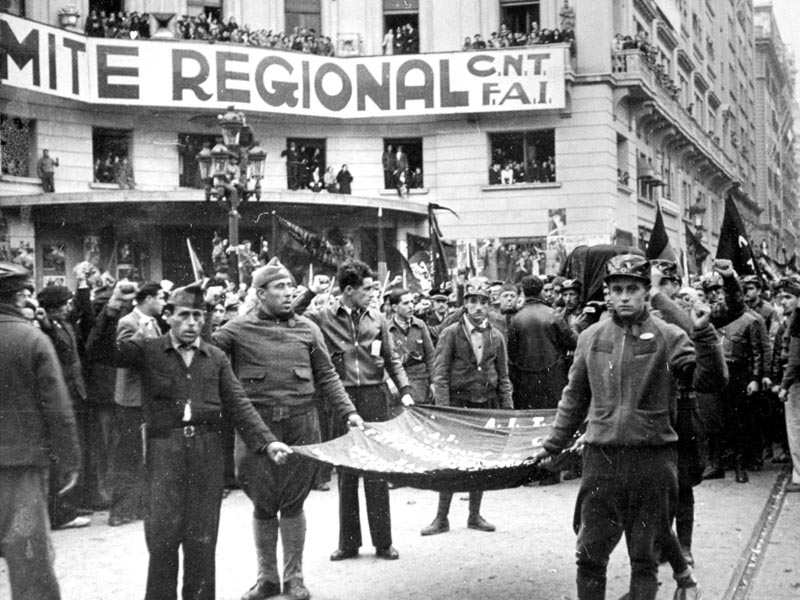
The C.N.T. has been a tremendous factor in the spiritual and social history of Spain. It could not be suppressed in spite of the dreadful persecutions heaped upon it for a number of years. In the shaping of the coming social order of Spain, the C.N.T. will surely play a great and impressive role, its influence extending far beyond the organization proper. The communist deputy Jesus Hernandez, the editor of the communist paper, “Mundo Obrero” made the following declaration a few days ago: “It is absolutely false that the present workers’ movement has for its object the establishment of a proletarian dictatorship after the revolution has come to an end. It cannot be said that we have a social motive for our participation in the war. We communists are the first to repudiate this supposition. We are motivated exclusively by a desire to defend the democratic republic established on April 14, 1931, and revived last February 16th.”
This declaration may puzzle the communists of other countries. But Hernandez knows that the Spanish masses are not enthused about the dictatorship idea and that the communist movement forms only a small minority, split, in addition, into three factions. We know also that the Communist party is not strong enough to be much of an obstacle to the aims of the C.N.T.
As to the “Anarchist Federation of the Iberian Peninsula” (F.A.I.), there is no difference in principle between it and the C.N.T. Both organization work close together. The F.A.I. is an organization which aims to uphold the anarchist traditions in the Spanish labor movement. It consists of a great number of young active comrades who are always ready to place themselves in, the forefront of the social struggle. Every member of the F.A.I. is a member of the C.N.T. and belongs to its most active fighters. Both publish a great deal of literature and run large publishing houses. Apart from the daily papers–“Solidaridad Obrera” in Barcelona and “C.N.T.” in Madrid–those two organizations publish about 35) weeklies and five monthlies. This alone shows the strength of the movement and the extent of its influence upon workers and peasants. Added to which there are a number of autonomous unions who stand outside of the C.N.T., but who are greatly influenced by the former, even sending delegates to its conventions.
The proletariat of the world which follows now with so tense an interest the gigantic struggle of the Spanish revolutionists against Fascism must come to realize that the Spanish events cannot be judged from a purely party point of view. The movement of every country possesses its own definite character, rooted in its traditions and the historical development. The labor movement is not a church, recognizing only one doctrine of grace. All the talk about a “united front” or “people’s front” is not worth a straw if we don’t learn to respect the opinions of others and not to judge them from the narrow point of view of one’s party doctrine.
The terrific struggles now going on in Spain are a sign of the times. Now the question is of repulsing an enemy who threatens the very basis of culture and threatens to hurl humanity back into barbarism.
Germany, Italy and Austria are bloody warnings and let us see to it that the lessons of the heroic example of Spain should not be lost.
Spanish Revolution (not to be confused with the POUM supporters’ paper of the same name, time, and look) was the English-language twice monthly journal of the United Libertarian Organizations (ULO) from 1936 until 1938. The paper was initiated by Spanish C.N.T. delegates in New York City to support the anti-fascist revolutionary syndicalists of Spain. Editorship was collective, with the ULO including the Jewish Anarchist Federation (Freie Arbeiter Stimme), the Russian Federation (Dielo Trouda), the Vanguard group, several IWW locals, a Spanish language federation (Cultura Proletaria), and Carlo Tresca’s Il Martello.
PDF of full issue:

