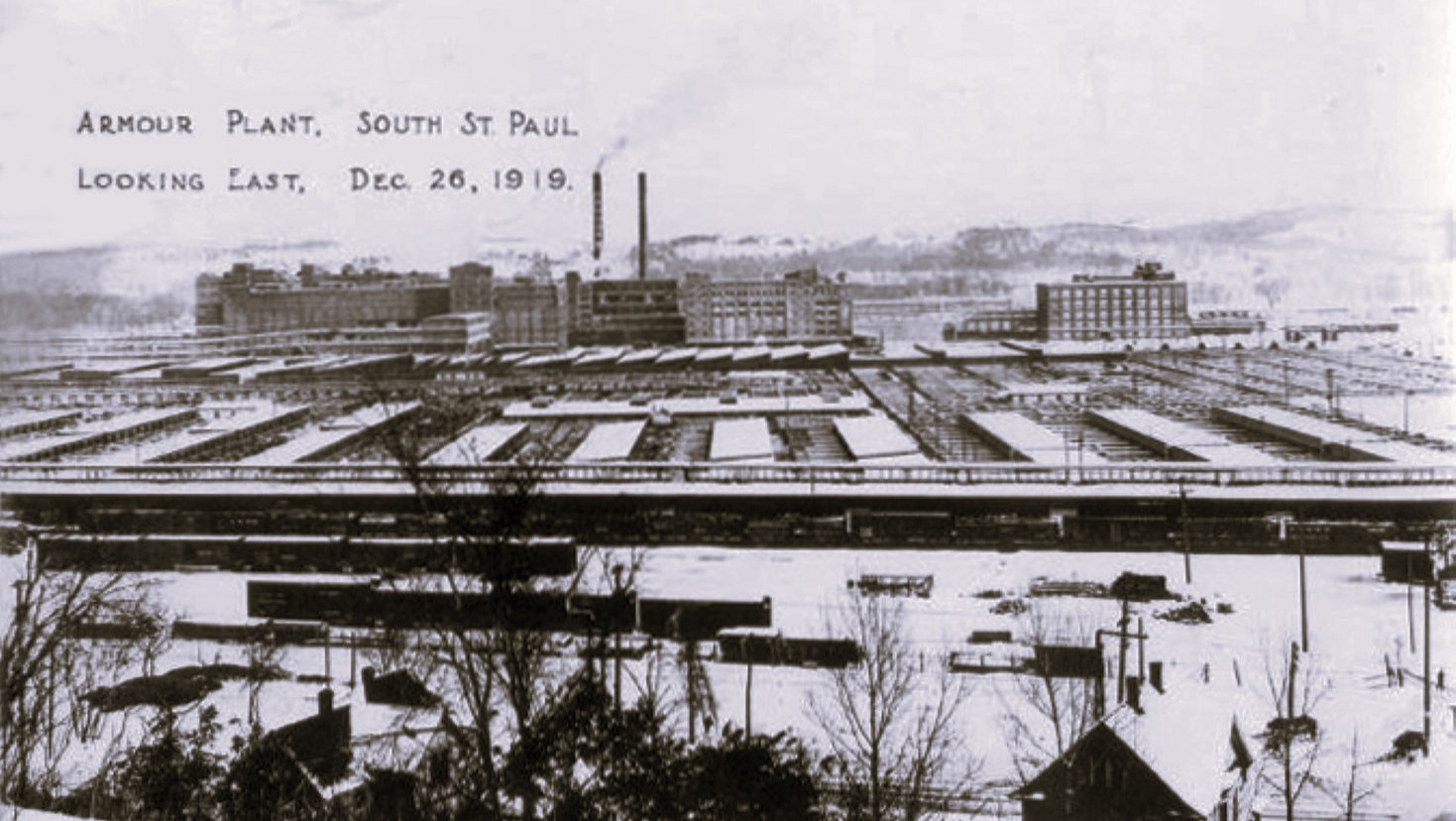
A Communist Party District leadership ( No. 9; Minnesota, Wisconsin, Upper Michigan, parts of Iowa) engages in some self-criticism over the first substantial T.U.U.L.-led strike in their area, a Packing House Workers Industrial Union strike against Armour meats in St. Paul, in the context of 1933’s ‘Open Letter.’
‘Lessons of the Packing Strike’ from Party Organizer. Vol. 7 No. 1. January, 1934.
(Resolution of Party Fraction, Adopted By District Buro, District No. 9)
THE Armour Packing strike was the first big strike struggle in a basic industry organized and led by the Party and T.U.U.L, in the district. It was an expression of the widespread radicalization of the workers, and the growing disillusionment in the Roosevelt program and the N.R.A., which has resulted in the strike wave throughout the country, and the beginning of the first struggles in the packing industry since 1921. The beginning of strike struggles in the district (Austin, South St. Paul, Minneapolis, Duluth), and the perspective of increasing struggles in the immediate future make it all the more necessary that the lessons of the Armour strike be thoroughly analyzed by the Party, and the necessary conclusions drawn.
The building of the Packing House Workers Industrial Union into a mass union was the result of serious persistent concentration and the correct development of partial struggles for a period of more than a year, and in recent months since the issuance of the Open Letter was given close attention as a district concentration task by the District Committee. The building of the Union, however, was marked by a number of shortcomings and mistakes which had been on numerous occasions sharply criticized by the District Buro, and had a direct bearing on the shortcomings evident in the strike itself. Firstly, the class struggle program of the Union was not brought out sharply enough, especially in its relation to the capitalist state. Secondly, the hesitancy and in some cases resistance to bringing the Party forward and to the building of the Party, made it easier to bring in the “red scare’, and to allow company agents and other disruptive elements to carry on propaganda for the A. F. of L. or for an “independent” union. Thirdly, the failure of the Section to give any leadership or establish any contact with the work in the packing industry, and thereby failing to mobilize the Party for this concentration task and for preparations for struggle. Fourthly, a tendency at the beginning to “soft pedal” the attack on and exposure of the N.R.A. Some of these shortcomings were partially, but not entirety, overcome before the strike, but the major weakness remained, that there was no active functioning Party unit in existence before or during the strike, to which fact many of the other shortcomings can be traced.
Strike Preparations Neglected
Although the possibility of a strike in the fall had been discussed for several months, and the spontaneous walkout in September against the firing of Union members made it more evident that a strike was inevitable, no real organizational preparations for the strike were undertaken by the Party until almost the last minute, while in the Union itself a certain indecisiveness and vacillating tendency on the part of some leading comrades delayed the preparations for the strike considerably, and gave some disruptive elements in the Union an opportunity to organize a struggle against Party and T.U.U.L. leadership. This lack of preparation was an especially serious matter, when it is considered that the strike was conducted against a powerful Packers’ Trust, with a bitterly die-hard anti-union policy such as the steel and auto bosses have; also that while there were sporadic struggles in the packing industry throughout the country, we had no functioning national union to establish connections between the different centers and spread the struggle. Although the National Conference of the Union was held when these struggles had already begun, it was not utilized as a means of mobilization and preparation for strike struggles.
Our first plan was to organize struggles simultaneously in all the plants. But when it became evident that the uneven growth of the Union made this impossible, the tactic adopted was to concentrate on one plant, with the perspective of spreading the struggle to the other plants. While this tactic was undoubtedly correct, it developed a tendency to neglect too much the other plants. The result was that whereas in Armours our Union had the majority of the workers, in Swifts the A. F. of L. became stronger than we were, and in Cudahy we had hardly any foothold. This weakness played a decisive role in the defeat of the strike.
The strike itself actually involved about 1,000 workers of the 1,500. 700 registered for picket duty at least once, while the active force that maintained the picket lines was never more than 200-300 after the first day of the strike. An important factor was the neutralization of important departments of the killing floor, consisting of A. F. of L. members, the majority of whom favored staying out as long as there were picket-lines, in spite of the open policy of the A. F. of L. leadership to break the strike by sending scabs and strikebreakers through the picket-lines.
Unable to Spread Strike
It was obvious from the beginning that the strike could not remain effective for very long if the Swift workers were not called out. This was due to the difficulty of maintaining picket-lines covering several miles, day and night, and the impossibility of identifying Armour ‘scabs who were filtering through the Swift entrance by mingling with the Swift workers. Our policy from the beginning was to try and get a strike vote taken by the Swift workers at the earliest possible moment. A Swift mass meeting was held on the same night the Armour strike was called, but it showed that we were in an extremely weak position in Swifts, and that there was practically no sentiment for strike among the Swift workers. We worked hard to build up strike sentiment within a few days in Swifts, and we succeeded in calling four days later a big mass meeting of Swift and Cudahy workers; here, too, we encountered great resistance to calling a strike, especially calling a sympathy strike without even presenting demands, but we succeeded in getting a Swift committee elected to present demands, with power to call a strike. In the next four days, Swift and Cudahy carried on such a campaign of terror and intimidation in the plant as to cow even the most militant workers, and at Swifts the committee was terrorized, the answer to their demands was postponed, until they refused to take the responsibility to call a strike. At both plants, hundreds of workers were persuaded to remain in the plant day and night, by threats and intimidation, and would have been prevented from leaving if a strike was called. This campaign of terror succeeded so well, that at the third Swift mass meeting, the workers felt it would be useless for a small minority to go on strike, and the sentiment was almost unanimous against going on strike, but to wait for settlement of their demands. The sentiment of sympathy for the Armour strikers was nevertheless shown by the financial support voted by the workers.
The refusal of Armour & Company to negotiate except through arbitration (which the strikers rejected), spread a defeatist mood among many of the workers, who have had no traditions of struggle nor organizational experience in recent years, and the feeling grew among them that if Swifts did not join them, all was lost. For several days, the sentiment for returning to work was only checked by the hope of Swifts joining the strike. Actually, after one week the strike was still effective, as the 300 scabs in the plant were not from the important departments, and could not operate the plant; the newspaper propaganda, however, that the plant was operating with 800 scabs who remained in the plant day and night, had a discouraging effect on the workers. The Strike Committee therefore decided that if the final Swift mass meeting did not take a strike vote, an Armour strikers’ meeting would be called next day to decide whether the workers were willing to remain out longer, or whether we should make an organized retreat.
Strike Committee Repudiates Party
Before this could be accomplished, however, a well-organized offensive against the strike started, beginning with the arrest of the leading comrades, the police smashing the picket-lines, and the newspapers proclaiming that the strike was over. We were caught completely unprepared, and the attack was helped along by a few company agents in the Strike Committee winning over the weaker and vacillating elements in the committee to sign a statement repudiating the Communist leadership, in the hope that this would gain some concessions for the strikers. The fact that immediately afterwards, the Strike Committee members were made to realize the mistake they had made, and all of them withdrew their signatures and repudiated the statement, did not stop the company agents from carrying out their original plan of announcing in the press that the Communists were repudiated, and the damage was done. With the majority of the workers thus tricked or driven back to work, it was considered advisable on the eighth day to officially call off the strike, in order to prevent the victimization and isolation of the best and most militant elements of the Union in the plant as much as possible, and to put up a fight against discrimination.
The attitude of the police and local authorities, and of the Farmer-Labor leaders, was one of hostility masked with pretended sympathy, which misled many of the strikers. The experience of the Austin strike sell-out, however, made the strikers, firm against arbitration, and hostile against any efforts of the Farmer-Labor leaders to ‘settle’ the strike as could be seen by the hostile reception Congressman Shoemaker received on the picket-lines. The policy of neutrality or hypocritical “sympathy’ was exposed, however, in Mayor Mahoney’s open attack on the strikers as “chiselers’’. Governor Olson played a more clever role, however; in answer to demands that he intervene with the militia, Olson’s attitude was that he was satisfied the local authorities could break the strike without his intervention. The workers on strike received in a few days a valuable class education which shattered many of their previous illusions.
The question is raised whether it was correct to call the strike, in view of our many evident weaknesses. The strike was necessary and inevitable. It grew out of a whole series of partial struggles previously developed, and it was clear that either we should choose the proper moment for the strike during the busy season, or a strike would be forced upon us by an open attack on the Union by the company during the slack season, when mass lay-offs take place, and our Union would have been smashed. Our failure to act would also have given a weapon to the A. F. of L., as we have always stressed that our Union was one of action and struggle in contrast to the A. F. of L.
Shortcomings and Mistakes
What were some of the outstanding shortcomings and mistakes in the conduct of the strike:
1. Improper organization of the strike so that the leadership would have better contact with the rank and file. Failure to hold regular strike meetings, due to the constant danger of scabs breaking through when pickets were withdrawn at any time of the day or night. This made it possible for hundreds of demoralizing rumors to be circulated, by the A. F. of L. and company, without being sufficiently combatted.
2. Unpreparedness for the terror. Although we knew that an attack could be expected, we were not prepared for it when it came. Also, insufficient combatting of the illusions among the strikers about the so-called “friendly neutrality” of the police and the deputies.
3. Insufficient isolation of disruptive elements. Some company agents were openly exposed at the very beginning of the strike, but were not sufficiently isolated.
4. Slowness in mobilizing the Party and mass organizations to support the strike. Food and funds came in so slowly, that if the strike had lasted another day, the strikers’ kitchen would have had to close down. Insufficient mobilization in St. Paul of the unemployed to help picketing.
5. Although the “red issue’ came forward at the very beginning of the strike, the Party moved very slowly to counteract it. The Party statement was delayed until it was too late to distribute it, and the Daily Worker distribution was not organized properly and could have been much more effective. The fact that we had no functioning Party unit made it more difficult to counteract the propaganda that the Communists were ‘outsiders’, and we could not depend on Communists who were strikers to give leadership to the Strike Committee when the arrests took place.
6. Our previous failure to work inside the A. F. of L. union to build an opposition there and develop the united front, resulted in our almost complete isolation from the A. F. of L. workers, which could have played an important role in strengthening the strike. This can also be traced to our not having a functioning Party unit.
7. The Party leading fraction in the strike was not sufficiently connected with the Twin Cities sections; the District Buro met only once during the strike, and should have had at least one more meeting during the crucial period in the last few days. The sections outside of the Twin Cities hardly reacted at all to the strike, until it was nearly a week old.
Tasks of Union and Party
It is inevitable that the defeat of the strike, and the discrimination and lay-offs in the plant, create difficulties and pessimism in the ranks of the workers. Against this defeatist attitude we must carry on the most vigorous struggle in the Union and the Party. The strike has created a solid militant core in the Union, and consolidated the best elements more closely to the Party, and brought some of them into the Party. The A. F. of L. has more openly exposed its strikebreaking role to the workers, and our Union must thoroughly expose them and win workers away from them. The possibility for building the Union, even though under greater difficulties, still exists and must be fully utilized. In one plant, the Union is still nearly 100% organized and has won some raises in pay. We must undertake the task of rebuilding the Union in the concentration plant, based on the most militant elements, and weeding out the company agents. Meetings of department representatives of the plants must be called. The Union must undertake a real struggle against discrimination, and for relief of laid-off and blacklisted workers. Partial struggles must be developed in the plants. An unemployed movement must be organized. Educational activities must begin, including forums, classes, and the continued issuance of the Union paper. Mass meetings must be organized on the lessons of the strike, and the statement of the Union on the strike must be given mass distribution, Increased efforts must be made to draw workers into the Party, and to establish a functioning Party organization in the packing plants, and strengthen the Section leadership and include some workers from the plants; this is the only guarantee that the same mistakes will not be repeated again. Close contact must be established between the Section leadership and the work of the Party and the Union in the packing industry, which will remain the chief concentration point of the District Committee, which will review the carrying out of these tasks at regular intervals.
The Party Organizer was the internal bulletin of the Communist Party published by its Central Committee beginning in 1927. First published irregularly, than bi-monthly, and then monthly, the Organizer was primarily meant for the Party’s unit, district, and shop organizers. The Organizer offers a much different view of the CP than the Daily Worker, including a much higher proportion of women writers than almost any other CP publication. Its pages are often full of the mundane problems of Party organizing, complaints about resources, debates over policy and personalities, as well as official numbers and information on Party campaigns, locals, organizations, and periodicals making the Party Organizer an important resource for the study and understanding of the Party in its most important years.
PDF of full issue: https://www.marxists.org/history/usa/pubs/party-organizer/v07n01-jan-1934-Party%20Organizer.pdf

