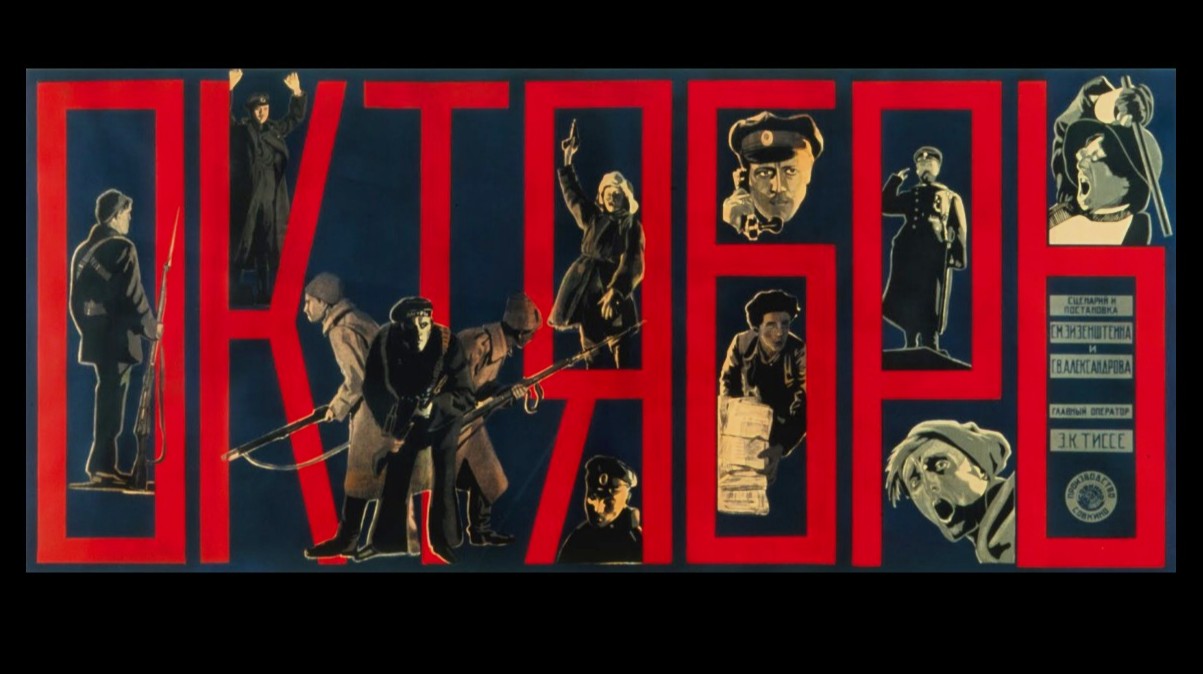
In this essay Freeman surveys the extraordinary effervescence of Soviet cinema in its first decade with a look at its origins in agitprop work during the Civil War, the different schools of film making, and the organization and training of the film industry. It includes a substantial statement by Eisenstein written specifically for this collection. All students and fans of Soviet film will find this of interest.
‘Soviet Cinema’ by Joseph Freeman from Voices of October, Art and Literature in Soviet Russia. Vanguard Press. New York, 1930.
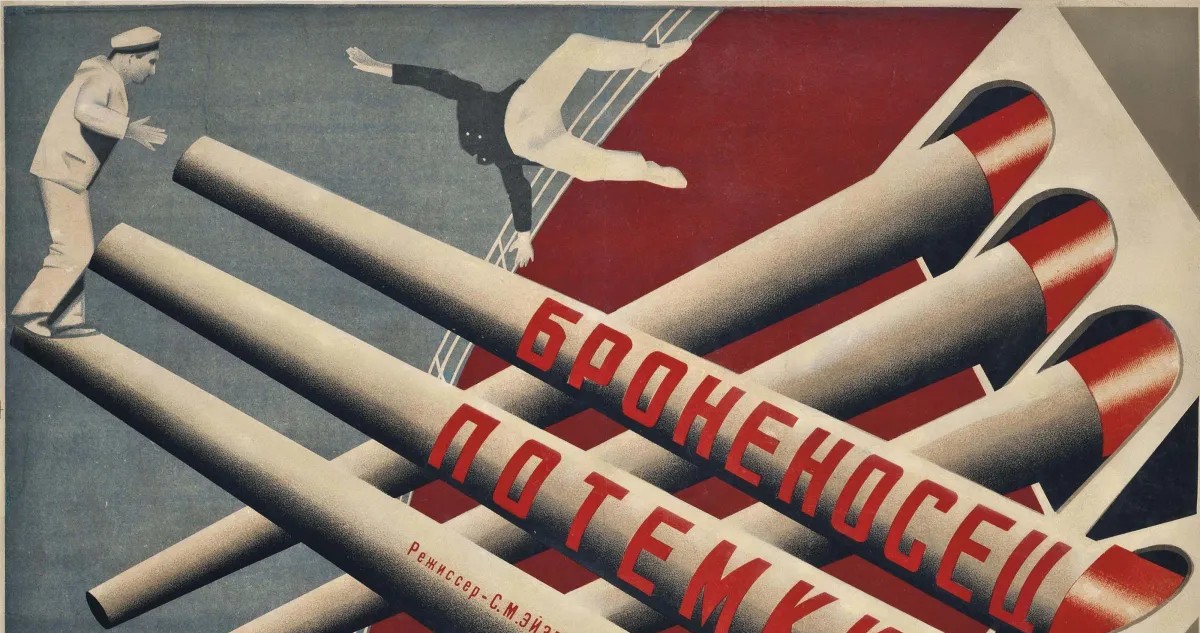
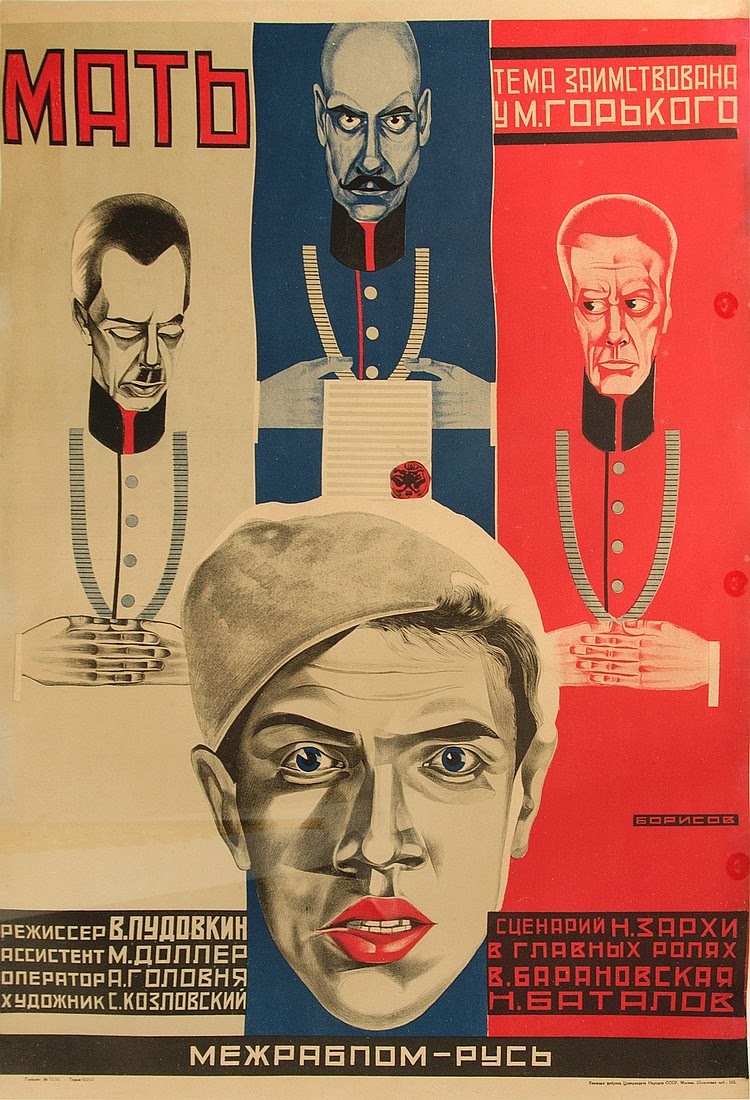
In the summer of 1926, Mary Pickford and Douglas Fairbanks returned to the United States from Moscow and gave the American press enthusiastic interviews about the Soviet cinema. They were especially impressed by Pudovkin’s Mother and Eisenstein’s Potemkin, declaring the latter to be the finest movie they had ever seen anywhere. This was the first news the general American public had about film development in the Soviet Union. Up to that time, only one or two minor Russian films, like Polikushka, had circulated in the United States. However, in the fall of 1926, Potemkin was exhibited in New York, and the public had its first real view of Soviet film achievement. The critics were unanimously enthusiastic. They felt that by American standards the picture lacked “entertainment value”; some of them were a little uncomfortable under its propaganda; but all recognized the arrival of a new force in the art of the film.
The film magazine Motion Pictures Today quoted Douglas Fairbanks as saying, “The Russians have a more advanced understanding of the science of motion and movement than any other picture makers in the world. I had the privilege of going to school—picture-wise—in Russia.” The same magazine carried an article by one of its editors saying: ” Potemkin is an astonishing photo-play record of a historical event and it would be received by the American people as an interesting story…The great merit of the picture lies in the understanding by its director of movement. There is more movement in this picture than in any motion picture we ever saw. There are scenes of great beauty. There is a fidelity to detail. There is a dramatic rather than a theatrical handling of the big situation.” Even trade journals sceptical of the “entertainment value” of Potemkin admired its achievement as cinema art. The Exhibitors’ Daily Review, commenting on the picture’s technical exposition, said “its maintenance of pace is masterful; its panoramic pandemonium is dramatic.”
The daily press echoed these expressions of enthusiasm. “The best piece of movie filmed to date,” declared the New York Sun of August 19, 1926, “is in Potemkin, the Russian film…It hasn’t one solitary saccharine hero or heroine…It is shot so excitingly and with such visual imagination that you are yelling at every turn of the screw and every rattle of the chains…that is cinema!” The New York Telegram said Potemkin “is so great a piece of work that its effect must be felt by the motion picture makers.”
In 1928, New York had an opportunity to see Vsevolod Pudovkin’s film The End of St. Petersburg. Once more the critics burst into superlatives. The Times said “one feels sometimes as if this film were a remarkable news reel of the Russian revolution.” Pudovkin’s film, like Eisenstein’s two years before, was declared to be the best picture of the season. “Of all the motion pictures playing in New York,” the World critic said, “The End of St. Petersburg is easily the most vigorous, heroic, and in many ways the finest…Its characterizations are superb, its movements exquisite, its cinema work a positive delight…I have not seen war scenes more vividly, more piercingly photographed…An atmosphere of realness, of tragic grandeur such as I have seldom found in any picture.” The Sun characterized the film as a “tribute to the genius of its makers.” As in the case of Potemkin, the critics emphasized not only the artistic merits of Pudovkin’s picture, but also its propaganda aspects. One critic (Evening Telegram) attempted to analyze some of the causes which contributed to the power of Soviet films: “These great, blistering, blazing movies are made by Sovkino, which is a nice way of saying the Soviet government itself. They are a national concern, and when one of these young, vigorous directors wants the Red Army, the Red Army picks up its rifles and marches. The directors have carte blanche for people, technical equipment, buildings and entire walled towns. This of course accounts for their uncanny reality and completeness.”
Since these enthusiastic comments, more than forty Soviet films have been shown in the United States. A reaction followed against what one critic called “the cult of the Russian film.” Some people made the discovery that while some Soviet films were very good others were very bad, that is, that the Russian film, like that of every other country, had its failures as well as its successes. No one, of course, knows this better than the Russians themselves. In March, 1928, the Communist Party of the Soviet Union called a conference on the cinema at which delegates from all parts of the country, representing party organizations, youth groups, government departments, trade unions, schools, social organizations and the press, thoroughly threshed out the pluses and minuses of the Soviet film. What is most interesting about this discussion is the auspices under which the conference was held and the point of view from which cinema questions were discussed. Here, as in the party conference on literature, purely technical questions, such as lighting, montage, etc., were left to the technicians and the sociological aspect of the film was given primary consideration. The Soviet film directors are intensely interested in technical questions; in this field they have both learned and contributed much. Here, however, we shall chiefly consider the social aspect of the Soviet cinema, because it is in its purpose and contents that it most differs from the cinema of other countries.
AIMS OF THE SOVIET FILM
Soviet leaders have emphasized that the two important respects in which the Russian film differs from that of other countries are: first, that it is state controlled, and second, that its purpose is not commercial but educational. At the beginning of the Revolution, Lenin urged the possibilities of the film as an educational factor, and insisted that the contents of films must be determined by the propaganda department of the government as well as the commissariats of education of the various Soviet Republics. As in the case of the other arts, the first consideration of the Soviet film is the education of the workers and peasants towards a new society. Lunacharski relates that Lenin told him many times that “among the instruments of art and education, the cinema can and must have the greatest significance. It is a powerful weapon of scientific knowledge and propaganda.”
Lenin’s words contain the key to the character of the Soviet film. At a time when many intellectuals, hampered by literary traditions, looked on the film as a vulgar form of amusement, the Soviet leaders saw in it the art of the machine, age and, more especially, the art of the masses. “Where the millions are,” they said, “there serious politics begins”; and the cinema was an art which could be intelligible to millions of workers and peasants unaffected by poems, novels or theatres. In a country like Russia, with vast distances to be covered, with many levels of culture, some of them quite primitive, an art which could reach everybody was bound to take first place. They also felt that art, especially a mass art like the cinema, was particularly important in a period of transition, when one form of civilization was dying and another being born; and while they attempted to socialize poetry, painting, fiction and the theatre, they saw in the cinema an art which was already social in its nature, which enabled them to reach the widest number of workers and peasants. The movie was to be primarily an instrument for the cultural advance of the people toward Communism.
SERGE EISENSTEIN
The new art of the cinema and the new themes created by the October Revolution required new artists. The Soviet movie director is, with some exceptions, himself a child of the Revolution. In this respect, Serge Eisenstein, director of Potemkin, Ten Days that Shook the World, and Old and New, the Soviet director who until recently was best known outside of Russia, is to some extent typical.
Born in Riga in 1898, Eisenstein began his career as an architect and engineer. As a student in St. Petersburg he became interested in Freud; later he began to study Marx. This was the usual evolution of a young intellectual in Russia. But in 1917, came the October Revolution. A year later Eisenstein enlisted in the Red Army, doing field fortifications for the Bolshevik forces. In 1920, he acted in some of the theatrical companies playing for the Red Army at the front. In the autumn of the same year, he was demobilized and went to Moscow where he joined, for a time, the Proletcult Theatre, for which he staged his first play based on Jack London’s The Mexican. The following year he worked with the LEF group, particularly with Meyerhold, but he soon broke with the theatre altogether and devoted himself to the cinema. In 1924, he turned out his first mass movie The Strike. It was in this film that Eisenstein first attempted to combine Marxian ideas, Freudian psychology and some conceptions about reflexology he had learned from Professor Pavlov with experiments in screen photography. I have not been able to see The Strike, but when I was in Moscow in 1926, Eisenstein described to me part of his method: in order to evoke in the spectator a feeling of horror at the sight of soldiers shooting down strikers, he alternated this scene with inserts of a butcher slaughtering an ox. He did not intend this as mere symbolism. The two scenes were unrelated in time, place or action; they were intended to be related psychologically; Eisenstein’s aim was to have the death of the ox stir the spectator to a state of pity and terror which would unconsciously and automatically be transferred to the shooting of the strikers.
In Odessa in 1923-24, Eisenstein and his assistants completed Potemkin. This film was intended originally as part of a larger film dealing with the 1905 Revolution; it remained, however, a fragment, complete in itself, dealing with the revolt of the Black Sea fleet. Potemkin was an epic whose hero was no individual, but the mass; whose action moved not in the domain of private life but in history; and whose technique—stark, economical, monumental—was commensurate with its theme. If the average Russian worker or peasant was confused by the intricate debates about proletarian fiction or poetry, or the relative merits of the Fellow Travellers and the Constructivists, here was an art which he could claim as his own; he understood its symbols without difficulty, and its theme was his own story, his first big struggle for emancipation.
“Potemkin”
The Black Sea cruiser on which the action of the film opens is a miniature Czarist Russia with its sweating sailors and arrogant officers. The sailors refuse to eat their meat ration because it is rotten with maggots; the lying ship’s doctor studies the maggots through the microscope and cynically approves the meat. Still the sailors refuse to eat it. This assertion of their human rights is mutiny. The cruiser’s commander orders the more rebellious sailors shot; but when the order to fire is given, the members of the firing squad refuses to shoot their comrades; the sailors’ patience has broken under inhuman treatment; they turn on their officers, throwing some of them overboard. In the battle between the aristocrat-officers and the worker-sailors, the leader of the sailors is killed. The sailors, now in complete command of the ship, steam into the harbor of Odessa and take the body of their leader ashore. The city is profoundly stirred. Hatred for the nobility animates not only workers but also middle-class people. Down the broad marble staircase leading toward the harbor come men and women, old and young, workers and intellectuals, bringing food to the sailors whose revolt expresses their own aspirations. Suddenly from behind the smiling crowd, the Cossacks come, tall, in straight rows, with bayonets fixed and rifles levelled. The steady implacable march of the boots and rifles down the broad staircase, more than anything else in the film, perhaps, reveals the inhuman power of Czarism. The Cossacks fire, almost without moving, into the crowd, indiscriminately; an elderly lady who has just been waving to the heroic sailors looks startled; her eyeglasses crack; blood crawls down her cheek; she collapses; others rush headlong down the staircase, terrified; a wounded mother releases her grasp on a baby carriage which helplessly bounces down the long flight of steps. Still the boots and bayonets come marching implacably. The rebel cruiser steams out toward the Black Sea fleet, prepares for surrender and death, the other ships of the fleet hoist the red flag: the whole fleet joins the revolt.
Into this bare story Eisenstein crowded scenes and faces which conveyed the sweep of the 1905 epic, giving to millions of Russian workers and peasants, and to such foreign countries where the censorship was not too stupid, a glimpse into a mighty historical movement and into an art which had gained stature and power by moving beyond the boudoir and the cabaret.
The next film which Eisenstein completed was Ten Days that Shook the World, done in 1927, for the celebration of the tenth anniversary of the October Revolution. Set on a wider stage this film told the story of the Revolution which succeeded where the revolution in Potemkin failed. Here, again, there is no individual hero, not even Lenin—the hero is the mass. But in Ten Days Eisenstein wanted to go further; he tried to combine all the various forms of cinematography which have so far been developed—the emotional picture, the historic chronicle, and the absolute film.
Potemkin and Ten Days were both shown in the United States and started what some American critic has ironically called the “cult of the Prussian film.” It is true, perhaps, that the Russian film has suffered as much from some of its friends as from its enemies. Certainly the Soviet movie director has no blind worship for his creations, or thinks he has said the last word in this new art. Since this volume has been based on the policy of letting the Russians, wherever possible, speak for themselves, explaining their aims and purposes directly instead of having them filtered through interpreters second, third and even fourth hand, Serge Eisenstein was asked to contribute to this book his views on the Soviet film. Though his remarks repeat to some extent what has already been said, they are published here as a reflection of the Soviet attitude toward the film.
EISENSTEIN ON THE SOVIET FILM
“Imagine a cinema which is not dominated by the dollar; a cinema industry where one man’s pocket is not filled at other people’s expense; which is not for the pockets of two or three people, but for the heads and hearts of one hundred and fifty million people. Every motion picture affects heads and hearts, but as a rule motion pictures are not produced especially for heads and hearts. Generally motion pictures are turned out for the benefit of two or three pockets; only incidentally do they affect the heads and hearts of millions.
“This is the state of affairs throughout the world. Suddenly a new system arises. A cinema is created, based not on private profit but on popular needs. Such a cinema may be hard to imagine; it may even be considered impossible; but one has merely to study the Soviet cinema, and one will see that it is not only possible, but has already been achieved.
“To achieve such a cinema, however, certain prerequisites are necessary. Commercial competition must be eliminated. Big pockets must not devour little pockets; big fish must not be swallowed up by still bigger fish. The simplest way to arrive at such a state of affairs would be to destroy the big fish and deprive the bigger fish of their food, and to unite the little fish in innumerable shoals with common interests.
“In 1917, something like that took place in Russia. The fat individual whales were terrified by a vast collective whale composed of little fish. The fat individual whales fled through all the seas and oceans; while the herd, 150 million strong, which for centuries had been oppressed by a small body of masters, suddenly became master of itself; the immense collective master of an immense collective enterprise. Everyone protected and continues to protect his own personal interest; but the amusing part of it all is that these interests need not collide with the interests of one’s neighbor, for the simple reason that all these personal interests are directed toward one goal. There is no longer a mutual destruction of energy and power; instead, there is a tremendous accumulation of collective energy for the benefit of all these interests.
“These interests are class interests, the interests of that young proletarian class which took power into its hands in 1917. This class is a single organism based on solidarity, collectivism and collaboration. It realizes that if all are to be fed, there is no worse way of attaining it than by throttling one’s fellow worker. Hence, this class abolished the system of throttling one’s neighbor and established a system of healthy collaboration. This class realizes that when the general interests of all are satisfied, the individual interests of each are satisfied. In the place of individual competition there has been substituted planned collective construction. This was the intention of the victorious working class, and its highest expression was achieved in social centralization and monopoly. These form part of the indestructible basis of the first Soviet state; they were attained by concentrating productive forces and implements in one organizing centre. There can be no regularity of supply without system; there can be no system without centralization and monopoly. Rationalization is unthinkable without the participation of the masses in every aspect of work and construction whose goal is the satisfaction of the interests of the working masses.
“Every cook should govern”
“A Soviet poster, showing the figure of a woman in a red shawl, carries a phrase by the ‘Utopian’ Lenin. Every cook should be able to govern. This is the teaching of the leader Lenin; and every cook in the Soviet Union realizes that she must know how to govern. What is more, she does govern. As a delegate to the Congress of Soviets, the Women’s Congress, the Party Congress, the trade union, she rules, improves and corrects the policies of her government. These corrections are necessary, for where can there be more errors and unexpected situations than in this new and unprecedented social structure? In the workers’ and peasants’ State, which is one organism, there must be on the part of the people the most vigilant attention, control and concentration of the State’s creative energies. For if there are errors and inaccuracies in one section, if a single part is defective, the whole apparatus suffers. If in one region of the country the grain harvest fails, this calamity does not enrich some speculator in a more fortunate region; the crop failure is rather a tragedy for every worker and every peasant homestead, whose interests all merge in the general interests of the state.
“But the country of the Soviets is not yet a paradise; it is surrounded on every hand by more or less un¬ friendly neighbors. The fat whales driven away in 1917 anxiously await an opportunity to strike a blow at the new social structure. This state of affairs gives our art, like our politics, a peculiar character. Centralization and monopoly determine the organizational method of the cinema in the Soviet Union, and the dictatorship of the proletariat determines the militant and ‘aggressive’ character which differentiates our culture generally from other cultures, but more especially our cinema from the cinema of other countries.
“Lenin said: ‘The cinema is the most important of all the arts.’ We firmly believe this. The innovations of our cinema in form, organization, and technique have been possible only as a result of our social innovations, as a result of our social order and the new modes of thought it has stimulated. In art innovations are not produced at will; they are dictated by new social forms. The apprehension of the social order is the high goal toward which artists proceed slowly and mathematically, attaining it only after great effort. An art corresponding to the social order develops according to the laws of natural selection; an art which is unsuited to the social order in which it seeks to function suffers greatly; on the other hand, a social system which is unsuited to our highest conception of art should be swept away.
A CENTRALIZED CINEMA
“Nowhere except in the Soviet Union does the cinema benefit by a unification of three forms of centralization. These are, the centralization of economic production, the centralization of ideology, and the centralization of method. As in other countries, the Soviet cinema is one of our leading industries, and organizationally it is conducted like other branches of our socialized industry. Both the production and the sale of Soviet motion pictures have been centralized. At present, for example, Sovkino controls all foreign sales through its representatives in those countries which have trade relations with the Soviet Union, as well as all business connected with the purchase of motion picture equipment and machinery. It also controls the entire purchase and sale of foreign films in the Soviet Union. It controls 60 percent of the domestic market in the Soviet Union, monopolizing the entire production and sale of Soviet films with the exception of the autonomous republics, such as the Ukrainian and Georgian films. Sovkino also controls a large number of motion picture theatres throughout the Soviet Union and handles 25 percent of the sales to those theatres which it does not control. The cinema organizations of the autonomous republics, while acting independently and exercising a monopoly within their own national boundaries, have close business relations with Sovkino. It is to be hoped that in the future there will be a still further concentration of the cinema industry, which will unify the various cinema organizations into one state monopoly. Such a unification will make the cinema one of the strongest of Soviet industries, and will eventually lead to a change in economic control. At present the cinema is under the control of educational and political institutions; when completely unified its economic administration should logically be handed over to the Supreme Economic Council.
“Centralization of production is the first stage toward a highly unified cinema. At present we are also developing the second stage: the centralization of ideology. We are convinced that the cinema is intended not for mere entertainment, but for general cultural and social aims. These aims should be pursued without any element of private interest or private gain. The cinema is partly an industrial undertaking, and partly an art. The commercial and economic aspects of this art must be completely subordinated to the social and cultural tasks set by the Revolution of 1917. The plan for completely unifying the industrial side of the Soviet cinema makes it possible to establish not only the economic but primarily the ideological dictatorship of those organs established by the workers for the protection and propagation of those ideas for which they fought.
ART AS A WEAPON
“The Soviet cinema aims primarily to educate the masses. It seeks to give them a general education and a political education; it conducts an extensive campaign of propaganda for the Soviet State and its ideology among the people. These aims are pursued by all the arts in the Soviet Union, guided by the agitational-propaganda section of the Central Committee of the Communist Party. The Soviet cinema, specifically, works under the direction of the People’s Commissariat of Education and the Supreme Council of Political Education. With us ‘art’ is not a mere word. We look upon it as only one of many instruments used on the battlefronts of the class struggle and the struggle for socialist construction. Art is in the same class as the metallurgical industry, for example.
“In the Soviet Union art is responsive to social aims and demands. One day, for example, all attention is centered on the village; it is imperative to raise the village from the slough of ancient custom and bring it into line with the Soviet system as a whole; the peasant must learn to see the difference between private ownership and individualistic survivals on the one hand, and cooperation and collective economy on the other.
“SOS!
“The seismograph of the Party apparatus notes a vacillation in this section of Soviet life. At once, all social thought is directed toward it. Throughout the country the press, literature, the fine arts are mobilized to ward off danger. The slogan is: ‘Face the Village!’ The smitchka, the union of proletarian and poor peasant is established. Opponents of Soviet aims are ousted. The strongest propaganda guns are put in action; there begins a bombardment on behalf of socialist economy. Here the cinema plays a big role.
“Again, attention may be concentrated in another direction. There has been a break with a foreign country. War seems imminent. Defend the Soviet Union! Every form of art cooperates with the country in clarifying the situation. What shall we defend? Our achievements, our all—not the private wealth of a few individuals or financial concessions in the colonies or recently seized markets.
“The Soviet cinema and theatre can hardly keep pace with the new social orders issued every day by the people carrying out tremendous social tasks. There is no time to reflect, to present the situation ‘objectively’ through art. It is a neck to neck race between the cinema and the newspaper. For instance, the campaign for grain sowing begins. Motion pictures dealing with the most suitable kinds of grain must be rushed to various parts of the country. Motion pictures impressing the necessity for sowing selected seeds must be exhibited in the villages again and again. The peasant must be shown that crops can not improve as a result of religious processions and prayers for rain.
“The twentieth anniversary of the 1905 revolution arrives. The Soviet cinema must reproduce that stirring year. The workers must know the history of their past, when the proletariat of St. Petersburg and Odessa sacrificed their lives for freedom. Or the tenth anniversary of the 1917 revolution comes. The great fighters who participated in the ‘ten days that shook the world’ are passing away; the towns which were the centres of the Revolution of November 7 are changing. The events of those days must be accurately recorded by the cinema while there are still living eye-witnesses. Posterity must have a photographic reproduction of the great Revolution, a living textbook for the inspiration of other generations.
“As for history ‘in general,’ that is a sweet idealization of bourgeois historians. The ‘great’ and ‘illustrious’ personages of the past ruled the fate of millions according to their limited views. They were ‘gods’ invented out of whole cloth. It is time to reveal the bunk about these paid romantic heroes. The concealed traps of official history must be exposed. We want to know how the social basis of these fabulous figures, glorified by hired scholars in the interests of their class and their descendants. Ivan the Terrible as a personality in the manner of Edgar Allan Poe will hardly interest the young Soviet worker; but as the creator of the linen trade, the Czar who enriched and strengthened Russia’s economic position, he becomes a more interesting figure. The story of Ivan the Terrible should go on to tell how he became absolute monarch, head of a dominant aristocratic class; it should tell of the struggle among the higher classes of society, how they became weakened. On this basis the story would be nearer reality and of more importance than a fantasy about a mephistophelian figure, a Czar who was a wild beast. The merchant-Czar, what could be more concrete! Recall our recent ‘first landlord,’ Nicholas II. In a motion picture lasting an hour and a half all the years of tinsel, falsehood and deception are dispersed.
SOVIET MOVIE THEMES
“The Soviet cinema, then, is a cultural instrument serving the cultural aims of the Soviet state. In our country the leaders of the cinema do not sit around discussing whether or not the public wants sea films; or that movie fans are crazy about costume films dealing with the eighteenth century; or that it is too soon to change the program to a new wild west film; or that it has been a long time since there have been South Sea island films and they would now be a great novelty; or that the ‘Big Parade’ continues to hold the interest of the public and there must therefore be an increased production of war movies. In the Soviet Union a discussion of proposed films is not carried on with both eyes on the box office. If it is planned to produce a photoplay dealing with the life of the Soviet youth, the cinema directors talk the matter over with the Young Communist League, which is the leader of the Soviet youth. The object of the film is to clarify various problems in such a way that it will arouse discussion and thought among the young people of the Soviet Union. Love films are not produced for the mere purpose of exciting the audience, but to throw some light on sexual relations, on the new moral code which has taken the place of the old.
“The cinema handles other living problems in the same way. There are themes on every hand. The government is carrying on a campaign for the reduction of prices by lowering the cost of production through efficient methods. We call this ‘rationalization’; but we do not wish to impose rationalization by force. It must come through understanding. The situation must be made clear; the masses must be made enthusiastic about it. A fascinating theme for a movie. Again: the local and central economic institutions are too rigid. Bureaucracy interferes with socialist construction. This weakness must be attacked either satirically or tragically or both. The cinema must show how the tragedy of the small man is caused by the inflexibility of the credit apparatus. The cinema finds another theme in nepotism. Some responsible workers have an overdeveloped family feeling; they introduce relatives and friends into the institutions where they work. Such preferences are forbidden by Soviet law. The wife may live with her husband, but she cannot serve under him in public office. Regulations for obtaining positions are established by the trade unions and labor exchanges; and the cinema assists in impressing the evils of nepotism on millions of spectators. In this way the Soviet film is an integral part of the entire cultural apparatus of the country, which is directed toward a better life for all.
“Occasionally, someone makes the mistake of trying to improve the commercial aspects of a film to the detriment of its educational aspects. Organized Soviet society meets such attempts with the most merciless criticism and the fiercest attacks. Dispute follows dispute. Conferences are held. The matter is discussed at provincial and national congresses, and finally the Communist Party institutes an official discussion on the cinema which results in definitely laying down a correct policy. We realize that every ideological or tactical institution is primarily based on organized society, and, as in the nervous system, every part effects the whole.
“The internal organization of our cinema industry is like that of other Soviet industries. All workers connected with the cinema industry, in whatever capacity, belong to a trade union, to the Photo-Cinema Section of the Union of Art Workers. Every cinema unit, like every Soviet factory, has its factory committee, elected by the workers of the unit. The factory committee is the vigilant defender of the workers’ rights, especially of those rights which they secured through the October revolution. The factory committee is the centre of social life in the factory. One of its jobs is to conduct regular discussions on film production. These discussions are attended by every kind of worker in the industry, and everything is considered which in any way pertains to the enterprise. Nobody is omitted, from the director to the janitor, from the costume-maker to the ‘star.’ Before such meetings of all the workers in his unit, the director reports on the plan of work for the coming year. At the end of a year, the workers make a strict examination of his report and of the actual work accomplished. The manager of the laboratory reports on possible innovations. The director of the cinema is called to order for exceeding the financial estimates of a film or for the misdeeds of its hero. All the workers participate on the appraisal of a new film, each on the basis of his specialty.
CARL LAEMMLE AND THE CARPENTER
“I should like to see how Von Stroheim would reply to the attacks of the youngest critics on excessive expenditures for the Wedding March; or Griffith listening to the tailors pointing out that the Birth of a Nation does not sufficiently establish the economic basis of the Civil War; or Carl Laemmle explaining his balance sheet to carpenters, painters. In our country that is what every movie director must do; and under our conditions I cannot imagine a healthier or more useful system. These tailors, assistants, carpenters and painters represent those countless tailors, assistants, carpenters and painters in whose interests, and in whose interests alone, the film is made and released. Every penny superfluously spent is the workers’ penny; it is a loss which his enterprise and his factory sustains. In addition to serious criticism from the members of the factory committee, the movie director has to submit to criticism in caricature and satire in the factory’s wall newspaper. Such wall newspapers are found in every factory and office throughout the Soviet Union. They are published by the factory committee and express the immediate views of the workers in the enterprise.
On a small scale, the factory committee reflects the structure of the cinema industry as a whole, from the chief regulating committee and the estimating department of the Commissariat of Education, which controls the ideological and economic plans of the cinema industry as a whole, to the Workers and Peasants Inspection, that strict ultimate censor which controls the ideological and economic aspects of all Soviet enterprises. One solution we have arrived at already: the Soviet film serves the mass of people, their interests, their organizations; it is the expression of the collective strivings of various organized units. Specialists, directors, cameramen and scenario writers realize that they are the voice of this collective mass demand. Hence the Soviet film has real life; hence it expresses the true spirit of the people and the essence of the epoch. Soviet films are based on Soviet life; whether they deal with the new moral code, the workers’ family or films celebrating historical events and requiring the collaboration of thousands of people, they are true to life. They must be true to life. This was impressed on me in the making of my own films, beginning with Strike and ranging through Cavalry, Potemkin, Old and New and Ten Days that Shook the World. The Soviet scenario writer and film producer must draw his material from living sources. If the scenario deals with family problems, they must get in touch with the Women’s Section, that department of the Communist Party which specializes in work among women, which knows most about what is being done for mothers and children. If a film is to deal with historical subjects, the director gets in touch with local and central historical associations which specialize in collecting material about the Revolution, with the Association of Old Bolsheviks, with the Association of Ex-Political Prisoners, with the Communist Academy and so on. If the theme deals with village life, the director obtains invaluable material from the Commissariat of Agriculture, from the trade union of agricultural workers and similar bodies. Through these organizations, and under their leadership, the movie director obtains the cooperation of every organized body which knows anything about the theme of his film. He has at his disposal as advisors and actors those who personally participated in historical events; organizations of specialists; newspapers and magazines specializing in the subject of the film. All these collaborators in the making of the film meet and express opinions; material is collected; the most important fact about the theme of the film are placed at the directors disposal. Throughout the making of the film the director works in the closest cooperation with these organizations. This contact with the life of the Soviet Union is carried even further. The scenario is taken directly to the people. A scenario dealing with the new relations in the workers’ family is discussed at factory meetings and out of their own experience the workers make extensive alterations. A scenario dealing with farm problems is submitted to agricultural experts; biologists revise scenarios where cattle-breeding is described.
“This system pervades the whole Soviet cinema. We are opposed to ‘constructing’ sets. Our system is different from Hollywood’s. If we need a factory for a film, we do not have to ‘construct’ one; we go to an actual factory; we believe that a faked factory can never reproduce the atmosphere of a real one. When I turned out Ten Days that Shook the World, I needed the Winter Palace in Leningrad; I preferred to transplant the production of the film to this dead palace, rather than make it in the comfortable atmosphere of a studio. The damp cellars and the rats of the real palace helped us in our work, so that on the screen we were able to reproduce with complete accuracy the milieu necessary for our film. Furthermore, in making this film three or four thousand organized workers participate in it as actors depicting the mass shooting in the streets of Petrograd in July, 1917. No rehearsals were necessary; the workers know too well just how it was done. Thus the film was the product of an immense collective effort, in which thousands of experts and workers participated, and whose contributions were shaped according to the individuality of the director. This is one of our methods of work; and developing it we are moving to the third and last centralization necessary for the cinema: the centralization of method.”
OLD AND NEW
A concrete instance of the ideas contributed here by Eisenstein: in the spring of 1927, I talked with the director of Potemkin in Moscow about the film he was then working on, since released under the title Old and New. Eisenstein described the origin of that film as follows:
“When I had finished Potemkin, the Soviet Union was face to face with two burning questions: events in China and the development of the Soviet village. The Chinese workers and peasants are going through a life and death struggle for freedom. There was a profound need for fighting movies. Perhaps for the first time in history, the film can become as terrible a weapon as a hand-grenade. There on the battlefield where the fight was going on, is the real place of that art which stands in the front ranks of battle—the art of the film. For all art is only a means, an instrument, a method of struggle.”

Eisenstein’s original plan was to turn out a gigantic Chinese film in three parts. He was unable to carry out this plan for technical reasons. There remained the theme of the Russian village. For more than a month Eisenstein and his assistants studied the problem of the Russian village. They visited model farms, interviewed the editors of peasants’ newspapers, the People’s Commissariat of Agriculture, the trade union of agricultural workers, the institutes of experimental biology, the agricultural schools, the peasant cooperatives, the poor villages. This was followed by weeks of wading through newspapers, magazines, theses, reports, and government statistics. Eisenstein’s purpose was not to produce a film which would give the spectator placid scenes of country life or a romantic idyll of the farm. Instead of merely enchanting the spectator, the proposed film was intended to grip him with the iron hands of reality, to compel him to face one of the most important problems in the life of the country. The film was to make him conscious of the work of the Communist youth in the villages, the activities of various cultural organizations among the peasants, the peasants’ correspondents movement, the cooperatives, the new Soviet family life, the movement for the emancipation of women from primitive customs, the struggle against the rich peasants, and the industrialization of the village.
The movies of Western Europe,” Eisenstein said, carry on propaganda for patriotism and the honest travelling salesman; they erect monuments to the unknown soldier. We must make our vast audiences fall in love with the daily work of the peasant. We must acquaint them with cattle and tractors. The tractor is vital in the building up of the Soviet Union, it is the real hero of my new film.”
For a guide to unify the unlimited material afforded by the changing life of the Russian village, Eisenstein went to the theses of the Fourteenth Congress of the Communist Party of the Soviet Union which formulated the general line of economic progress. This line was the collectivization of economy and the industrialization of the village. It became the central theme of Old and New. He considers it the first film based on peasant material, dealing in a vivid way with problems of great political and social importance.
“The official terminology of theses, resolutions and decisions,” Eisenstein said, “come to life on the screen in herds of fat cattle, in the movement of harvesters and tractors in warm stalls, in the opening of the earth under the spring snow.” A little later he added: “Does America know about the extraordinary struggle on our ‘peace front’? About the heroism of the first attacks of the pioneers of the agricultural revolution? Many Russian cinema theatres are now showing Buster Keaton’s comedy Three Epochs. My new film, Old and New, illustrates Lenin’s analysis of the ‘five epochs.’ It shows the five stages of economy which exist side by side today in the Soviet Union. We have still primitive economy, handicraft economy, and private Capitalism side by side with state Capitalism and Socialism. The stone age lives side by side with the latest achievements of science and social organization, and, what is most remarkable, we are building in all five epochs at once.”
VSEVOLOD PUDOVKIN
Not all Soviet movie directors, however, produce impersonal epics, even when they deal with the same material as went into the making of Potemkin or Ten Days. Vsevolod Pudovkin, depicting the October Revolution in the End of St. Petersburg, attempted to show not only how the war and the revolution affected various social classes, but with considerable pathos, how they affected a peasant, who through the storm of this period develops from an ignorant lout into an intelligent revolutionary worker. Here, too, however, the “hero” is not an individual, but a type, and though he has a definite personal character, he transcends that until he becomes not merely a peasant but the peasant. Pudovkin’s film, like Eisenstein’s, differs from West European and American war films because there is an ending to which the Soviet movie director can work—a non-existent factor in the West. The western movie (or novel) can describe the horror of war, the heroism and demoralization of individuals; usually the story is told from the psychological angle—as a rule, from the viewpoint of a bitter and disillusioned intellectual; the story can end either in the death or the homecoming of the hero; to the profound problems which war raises there is no answer; the pious reviewer of the novel or movie can only hope (in the press, far away from the work of art he is reviewing) that the novel or movie will contribute something toward the “movement for the abolition of war.” In the Soviet Union the movie director need not rely on such pious hopes in the press; he need invent nothing; for the war was followed by the collapse of a social order, by a realization on the part of the masses of what the real origin and nature of war is, and by the gigantic struggle for a society in which war will be impossible. An Eisenstein or Pudovkin can create a film in which the hero is every soldier, regardless of his “fatherland,” every worker, every peasant.
Furthermore, the social revolution has made it possible for an Eisenstein or Pudovkin to treat the struggles of nations and classes realistically. When the peasant boy in Pudovkin’s End of St. Petersburg leaves the farm to seek work in the capital, it is not for adventure’s sake, but because there is not enough food on the farm. When the workers at the Lebedev munition plant strike, it is not because they are “bad people,” or “foreigners,” or victims of “outside agitators,” but because they are over¬ worked and underpaid. The mass is not romanticized, either, for here we see the strike leader’s wife dreading a strike—because her children are hungry; and the peasant betraying his friend, the strike leader—because he is ignorant. But the peasant learns; the city and the factory transform him into a proletarian with a proletarian’s mind; he rebels; he invades Lebedev’s office and smashes the furniture and shakes the munitions manufacturer like a puppy. The World War breaks out. We see it first as the propaganda-drugged civilian sees it: the horror ahead is hidden by flowers, the boom of the distant guns is drowned by the blare of brass bands. The war goes on. Bodies disappear in the mud; shells burst and men drown in flooded trenches. It is impossible to tell whether they are German or Russian, for from the Soviet viewpoint it makes no difference—they are all workers dying in a war for the interest of their masters. And here, too, Pudovkin can tell the truth: scenes of battle-horror alternate with scenes on the stock exchange where Lebedev is making money on the rise of munition stocks. The rapid alternation of scenes at the front and at the stock exchange, workers in uniform being blown to pieces and gentlemen in derby hats bidding on munition shares, is perhaps the finest war record in the history of the film. But Pudovkin goes further: the war affects not a few “heroes”—not a sergeant, corporal and lieutenant making wise cracks, drinking in Paris cafes and making love to pretty girls—but the entire mass of people. Food grows scarcer; there is no bread; children are hungry; the strike leader’s wife is organizing the working women and the men in the trenches wonder “what are we fighting for”? (Could this question, which must have agitated millions of soldiers on both sides of the war, be flashed on the screen in a West European or American film?). The Russian people rebel—the first Revolution of February, 1917. Kerensky appears with a flower in his hand. (In this flash Pudovkin epitomizes a man and a historic period, a leader whose brief unstable power was decorated with flowered speech.) But the war continues. Men are still caught in barbed wire; shells continue to burst; hunger increases; the workers are restless, and to the Kerensky regime, as to that of the Czar, the strike leader is a dangerous person. Troops come to arrest him but he escapes to the front where he speaks words of truth to the soldiers. Kerensky arrives in an automobile; he orders the strike leader shot (here Pudovkin summarizes the actual relations between the Kerensky regime and the working class); but the peasant boy, now a leader among the soldiers, halts his comrades and urges them to go on to Petrograd and help the revolting workers (and here Pudovkin in a brief scene summarizes a historic process in which a revolution was made by an alliance of war-weary workers and peasants). The attack on the Winter Palace begins and the film ends with the fall of the city into the hands of Bolsheviks.
ALEXANDER ROOM
The new era affected every aspect of life, and Soviet films are by no means confined to historic chronicles.
Bed and Sofa, a film by Alexander Room, is sociological, like the others, but it deals with the private life of individuals in the transition period through which the Soviet Union is passing, and stresses states of mind as well as the objective world which evokes them. Room, like Eisenstein, is a Freudian and a Marxist. Bed and Sofa might have been sub-titled Love, Marriage and the Housing Shortage in Moscow. The film opens with a crowded room in the morning. (*See Bryher: Film Problems of Soviet Russia, pp. 71-83.—Pool: Riant Chateaus Territer, Switzerland.) Husband and wife are in bed together. A cat wakes them. The husband snatches it up and plays with it. It is obvious that despite his youth he is a settled married man who sees more life in the cat than in his wife, whom he takes for granted like the furniture or the room. It is obvious, too, that the wife realizes she has ceased to be a human being to her husband; she is bored with her household duties, with the tiny, overcrowded room in which they live. The husband is unaware of this; he rushes off to work. He meets an old acquaintance of his, a printer from the provinces who has just arrived in Moscow and is looking for a room. It is hard to get a room (the population of Moscow has doubled since the Revolution while houses are built slowly) . “We have no room, but we have a sofa”: the husband invites his friend to a room which was already too small for himself, his bored wife and their cat. The wife is shocked and angry; she will now have to cook and clean for another man; besides, by inviting his friend, the husband showed his lack of regard for their privacy. The printer, realizing the trouble he has brought into the household, tries to make up for it in various ways; he helps in the room; he brings small gifts.
Suddenly the husband is called away; the printer takes in the situation at once and offers to leave, but the husband begs him to stay, which he does–with the inevitable result. The wife and the printer take an airplane ride around Moscow; life is exciting for her once more; she and the printer become lovers. Suddenly the husband returns; absence has made his heart grow fonder and he comes bearing gifts. The lovers are upset; they hardly know how to tell him what has happened; finally he understands of his own accord and goes out into the city to find a place to sleep. But the Moscow housing shortage makes it impossible to find a place to sleep; it begins to rain. The husband goes home for his coat and clothes; the wife is upset; she is torn between her old habits and her new love; she realizes it is raining and in Moscow it is hard to find a place to sleep; she points to the sofa; the husband decides to stay; the three are now imprisoned in the one tiny room. Subtly antagonistic, the two men play chess; the wife, her nerves on edge, watches at the window; the evening is tense; no one dares to be the first to suggest that they go to bed. The husband finally goes out to buy food; when he comes back the two others are in the bed and the sofa is ready for him. He shrugs his shoulders and goes to sleep. Days pass, and the wife becomes ill; she is going to have a child. Who is the father? No one knows. Under certain conditions it is legal to have an abortion in the Soviet Union, and the wife takes out the necessary papers.
It is at this point that the Soviet attitude toward art places its stamp on Room’s film. It is possible that a woman in these circumstances would not have wanted to have a child; but Soviet art, as we have seen, must not only portray people’s wishes; it must also carry a “social message,” i.e., it must convey the wishes of the collective; the Soviet Union, while legalizing abortion in certain cases, wishes its women citizens to have children; much like other countries everything possible at this stage of development is done to facilitate the having of children, and women are encouraged to do so. Hence Room’s film, at this parting of the ways, shows the wife arriving at the hospital; she looks out of the window and sees a child playing with a doll; she rushes out and takes a train to the country; she is going to have the child. Though this ending may come as a disappointment to some spectators, it does convey the Soviet idea that the personal relations of the parents are nothing compared to children and their future.
“The Village of Sin”
A similar motif animates The Village of Sin, directed by a woman, Olga Ivanovna Preobrazhenskaya. This gifted director, born in 1885, passed through the theatre, working under Stanislavski, Nemirovitch-Danchenko, Meyerhold and Tairov before she went into the cinema; she began to act in the movies in 1913, and started work as a cinema stage manager in 1915. In The Village of Sin, a tyrannical peasant, whose son is fighting at the front, seduces his daughter-in-law. The son Ivan is about to return from the front, and Anna, the helpless daughter-in-law, is thrown out of her home with the baby; she does not know where to go. But the war is over and the Revolution is changing Russia; soon a children’s home will be built in the village. The peasant’s daughter Vassilissa encourages Anna, “take care of yourself and the baby till the children’s home is ready—we live in the new Russia.” Ivan returns from the army; he sees the baby and raises a storm; Anna is terrified and runs out to the stream; she drowns herself. The family brings her body back to the house and sits staring at it; but Vassilissa enters and takes the baby; it is the living that are important, not the dead; above all it is the child who must be protected. Vassilissa walks with the baby into the children’s home.
Here a problem which in western countries is left to the people involved is affected by a new social order where children are not private property but members of the community which places their interests first. The old tyrannical father is not only a villain to be hated merely because he is personally monstrous, or “understood” because “human nature is broader than any moral code,” but primarily an ignorant peasant—a type produced by a patriarchal system which the Soviet authorities are seeking to destroy; the child born out of so primitive a situation is not to be left to chance or some philanthropic institution but is to join the other children on an equal footing under the direction of the community.
Bed and Sofa and Village of Sin have been highly praised in western countries where they have been shown; in the Soviet Union, however, they were severely criticized as not representing the true Soviet viewpoint. It is in these diametrically opposed reactions to the same films that the divergence between Soviet and western culture can be seen most clearly. To the Soviet critics, both films appeared to deal with accidental rather than fundamental aspects of city and country life; and it is the norm rather than the deviation that Soviet art seeks to portray—above all, the positive and creative forces in the country. Indeed, speakers at the Party conference on the cinema referred to above pointed out that it is in portrayals of everyday life that the Soviet film is weakest.
Since the film is looked on primarily as a political and cultural instrument, the Soviet directors undertook first to record the history of the Revolution for the rising generation. The beginnings of the Russian labor movement were shown in features like Palace and Fortress and Stephen Khalturin; the struggles against Nicholas I in the early part of the nineteenth century were shown in films like Decembrists and The Union of the Great Cause; classic figures like Czar Ivan the Terrible, Pushkin and the Ukrainian poet Taras Sevchenko were portrayed in historical films bearing their names as titles. The revolutionary movement of the first decades of the twentieth century were dramatized in films like Potemkin, The Ninth of January, His Excellency. Logically this led to the events of the October Revolution, depicted in Ten Days, The End of St. Petersburg. In addition to history, Soviet directors filmed literary classics by Pushkin, Tolstoi, Gogol, Turgenev, Gorki and others; and contemporary novels such as Cement by Gladkov and the Roaring of the Rails by Kirchon. It was only in the past few years, at the close of the civil wars and the beginning of the period of construction, that the Soviet film turned to contemporary life. Yet films of daily life formed a small part of the general output. Thus in 1926, the Moscow and Leningrad studios turned out thirty-two films of which twenty-three dealt with pre-revolutionary times, five with the civil wars, and only four with contemporary life; and some of these were criticized because they were still tainted with a middle class viewpoint.
THE EVOLUTION OF THE SOVIET FILM
The weakness of many films dealing with daily life is partly due to the conditions under which the Soviet cinema developed. The early days of the Revolution absorbed the energies of the Russian people in military and political struggles, and for some time the government was unable to devote much attention to the cinema. Prior to the Revolution the Russian film industry was in private hands. Four companies, with a total capital of twelve million rubles, controlled most of the industry. These were Hanikov and Company, Yermoliev and Company, the Russian Film Company, and Kharitonov and Company. A number of small private concerns were also engaged in the production of films. The Czarist government kept aloof from cinema production until the World War, when it organized the Skobilev Committee which turned out a number of patriotic propaganda films of the most reactionary nature. Ninety percent of the pre-revolutionary private production of films was concentrated in Moscow, with only two studios in Petrograd and scattered studios in Yalta, Odessa and Kiev. By the end of 1917, following bourgeois revolution in February, and Bolshevik revolution in November, more than seventy percent of the films shown in Russia were native products, and only thirty percent imported. The increased production of native films was stimulated by the lifting of the censorship by the February Revolution, while the importation of foreign films was reduced by the war.
In 1918, the Soviet government organized, under the jurisdiction of the Commissariat of Education, a Cinema Committee, which produced the first revolutionary film at Petrograd. This film, called The Bond, was produced amidst the chaos and disorganization of the civil war and with extremely limited technical means; but it managed to convey to Russian audiences the necessity of cooperation between the revolutionary proletariat and the intellectuals.
The first half of 1918 witnessed an acute struggle between the revolutionary workers engaged in the cinema industry and the old private owners, backed by their stars, directors and managers. This struggle between the owners and workers in the cinema was merely one incident in the acute class struggle through which the entire country was passing. As in other industries, the owners of the film industry resisted all suggestions of nationalization, resorting to threats and sabotage. The Union of Cinema Workers replied by organizing a Cinema Commission; while the Moscow Soviet compelled the private owners to submit to an inventory of the industry. This struggle continued for almost a year amidst civil war and the blockade by the imperialist powers which disorganized the industry of the country.
At this time, the struggle against the counter-Revolution was the supreme task of the young workers’ and peasants’ Republic, and the encouragement of the Red Army was of primary consideration. The Soviet government began to produce special agitation reels, called agitkas, for the battle front. Their purpose was not only to inspire the Red soldiers to fight for the Communist cause, but to educate them so that when the civil war was over and they returned to their factories and villages, they would be better able to participate in the building up of a new civilization.
The films turned out during the civil war period played a tremendous role in the development of the Soviet film as a whole and laid the basis for a new type of cinema art. Concentrating of necessity on agitkas and news reels, the Soviet Union developed the latter to an extent unprecedented in cinema history. The period of civil war and war communism was rich in material. Cameramen found not only dramatic but significant material on every hand—on the battlefront, in the factory, at the Communist congresses, in the villages. Only now is it possible to estimate the enormous historical, social and artistic importance of the news reels taken at this time, especially during the latter days of the civil war. No country, and no revolution, has so rich a chronicle of important events. In 1927, for the tenth anniversary of the Bolshevik Revolution, these news reels and film chronicles were edited and the new generation of Russians was able to see a photographic account of the last days of Czarism, the February Revolution, the Bolshevik Revolution, the workers and peasants laying the foundations of the world in which they now live.
On August 27, 1919, a government decree signed by Lenin, nationalized the Soviet cinema industry and placed it under the control of the Commissariat of Education. The same year three agitation films were turned out primarily for the Red Army, but also for the workers’ clubs. These were: The Comintern’s Struggle for Happiness; The Forest Brothers; and the Proletarian Island. At the same time, the workers’ cinema committees organized the “automobile film.” Motor trucks travelled through the streets of Petrograd and Moscow showing news reels of the latest events; these “automobile films” were also part of street parades, mass spectacles, etc. The automobile film eventually was sent out into the provinces. Among the more important news reels which travelled through the country were those showing the sessions of the second Comintern congress, the Congress of the Peoples of the Orient and later the third Comintern Congress.
During 1917-21, in addition to news reels and film- chronicles, the Soviet cinema turned out about one hundred agitkas. Many of these films, though primarily agitational in purpose, showed artistic merit. They dealt with the famine, the war with Poland, the struggle against the counter-revolutionary armies of Petliura, Makhno, Denikine and Wrangel, aspects of the new life of the country, and changes in social standards. Technically these films were rather poor; the Soviet Union, surrounded by the cordon sanitaire of the imperialist powers, was cut off from raw film and motion picture machinery; nevertheless these agitkas managed to have considerable energy, feeling and simplicity.
One of the best of these films was produced in Petrograd in 1921, under the title Infinite Pity. It showed the sufferings of the Russian people during a severe famine aggravated by blockade. Another film of this period, The Miracle, was based on the life of Russia under Czar Nicholas I. Both these motion pictures were directed by Gliebov-Putilovski, of the Sevsapkino group of Petrograd. The same group also produced two big films, Father Serafim and There is No Happiness on Earth.
With the introduction of the New Economic Policy in 1921, and the establishment of diplomatic relations with West European countries, the Soviet industry began to import a number of German films as well as much needed technical equipment. The Soviet film industry was able to establish new branches, and to expand its work. An epoch of reconstruction opened, and the Soviet film could turn to new themes. Young directors and cameramen, trained in the taking of news reels and agitkas, were equipped with a technique created out of necessity. The news reels and agitkas developed such men as Eisenstein, Kulishev and Vertov and such cameramen as Tisse, who photographed Potemkin, Ten Days, and Old and New. These men, compelled by their isolation from Western Europe for five years to find an original technique, were rooted in the new reality and learned to transmit this reality imaginatively on the screen. They were compelled by circumstance to avoid the trite and to find a film technique that would approach the richness and variety of the new life.
ORGANIZATION OF THE FILM INDUSTRY
In 1923 the Commissariat of Education took steps to reorganize the Soviet film industry, concentrating it under the control of Goskino (the State Cinema). By 1926, a number of units were at work in various parts of the country. Sevsapkino (abbreviation for “Northwest Cinema”) with studios in Leningrad, produced features and educational films and conducted an Institute of Screen Art, a school of film mechanics, a central film depot, and a laboratory. In addition, it controlled eighteen movie theatres in Leningrad. During 1924, it produced 289 features, thirty educational films, and thirty-five comics. Many of these films dealt with the history of the Revolution. The 1905 revolution furnished the themes of such films as The Ninth of January, Palace and Fortress, and Their Destiny. Other films dealt with the October Revolution, such as Red Partisans, which dramatized the struggle against Kolchak in Siberia; and Behind the White Lines, based on the war with Denikine in Novorossisk and Rostov-on-the-Don. Sevsapkino’s pictures of contemporary events of that period included Infinite Pity (the famine of 1921) and For the Soviet Power. This unit also distributed in the Soviet Union a number of American and German films.
Under the decree nationalizing the cinema, Goskino, the central organization, obtained the right to all locations, studios, and theatres throughout the country. It took over a disorganized apparatus, on the ruins of which it built up an efficient one. It proceeded to apply the basic principle that the film must respond to the social needs of the day; it sought original scenarios, and new, well-trained directors, cameramen and actors. It opposed attempts to compete with the films of Western Europe and the United States, urging instead that the Soviet film reflect the life and aspirations of Russia. It urged that the film should show the life of the Soviet workers and peasants, and the customs of the numerous tribes and nationalities within the country. Goskino laid great stress on educational films and news reels, and in the first half of 1924, in addition to twenty-one features, it turned out twelve fortnightly and six monthly news reels, six films showing industrial processes, six dealing with the life of the minor nationalities within the Soviet Union, and thirty educational films ordered by various State enterprises. Goskino’s outstanding feature film in 1924 was Eisenstein’s Potemkin. Earlier in the year it produced The Strike, Eisenstein’s first film. A satirical film called The Extraordinary Adventures of Mr. West Among the Bolsheviks poked fun at the wild stories then current in the Western press about Soviet Russia. In the following year, Goskino’s production included Abrek Zaour, filmed in the Caucasus and dealing with the struggle of the Georgians against Czarism.
During 1921 and 1922, before Goskino absorbed them, two minor units turned out some interesting films. Kino-
Moscow (Moscow Cinema) which was engaged chiefly in distributing films, produced Pugachov, a historical film dealing with the eighteenth century peasant revolt; while Kino-Sever (Northern Cinema) in Leningrad produced two comedies, one of which (Three Comrades and One Invention) was shown in the United States. This unit also filmed Constantin Fedin’s novel, Towns and Years, described in the section on literature.
The Proletcult movement, which was active in literature and the theatre, had its own cinema unit called Proletkino, organized in 1923. Its films were based, to a large extent, on events of the October Revolution, such as the End of Kolchak and the Struggle for the Factory. Among other things, it filmed Libedinski’s novel A Week and produced a serial in six parts called The Spark Becomes a Flame. Two of its features, Kerim’s Daughter and the Mussulman Girl, were based on the struggle for the emancipation of women in the Soviet East.
At the same time Mejrapom, a workers’ relief organization known in English-speaking countries as Workers’ International Relief, had its own cinema unit, known formerly as Mejrapomruss and now as Mejrapomfilm. Its films have covered a wide variety of subjects. Under the direction of Protozanov it screened Aelita, a novel of revolutionary events by Alexei Tolstoi. Its historical films include Ivan the Terrible (shown in the United States) and Stenka Razin, based on the seventeenth century peasant rebellion. Its gifted director Jelabouiski produced two comedies, one for children (The Red Nose) and one dealing with Moscow street life (The Girl Who sells Mosslprom Cigarettes). Gardine, another of its directors, produced two films based on the life of aviators (Four and Five and Bird of Steel). A number of educational films produced by this unit showed the operations of the textile, coal, metal and other industries. Mejrapomruss absorbed one of the oldest of Soviet units, Russ, which was organized in 1917, and until its absorption in 1920, produced a number of films, many of them based on novels such as Merezhkovsky’s Peter and Alexis, Tolstoi’s Polikushka and Pushkin’s work.
The so-called minor nationalities had their own cinema units, of which the best, perhaps, is the Ukrainian cinema (WUFKU) organized in 1921. It was this unit which produced Taras Shevchenko and Two Days. The cinema of the Tartar republic (Tatkino), established by the Commissariat of Education in 1924, specializes in news reels and distributes the films of other Soviet producing units to workers’ clubs and village organizations. The Georgian republic had a unit (Gruzkinpom) with a studio in Tiflis. It has turned out some of the most original films in Soviet Russia, due partly to the colorful scenery and rich national traditions of Georgia and partly to the gifts of its manager Bek-Nazarov and its director Perestiani. Similarly, the Soviet republic of Azerbaidjan, with its capital in Baku, has its own unit (Azkino) established in 1922, to counteract the flood of objectionable films coming in from Turkey. Its films deal largely with local history and contemporary life. Thus The Virgin’s Tower is based on an old legend about the tower which stands in the main square of Baku, facing the Caspian Sea; Kerim the Brigand, on events in the feudal period of Azerbaidjan’s history; The Execution of Twenty-Six Communists, on the period of British occupation when the British shot the city’s leading communists. Black Blood, an educational film, shows the workings of the oil industry. Gosvoyenkino, a unit which has since been absorbed, for a time produced pictures dealing with the Red Army and Navy; it was under the control of the Commissariat of War.
With the economic advance of the Soviet Union, the government reorganized the film industry, centralizing it in an organization known as Sovkino (Soviet Cinema). There are throughout the Soviet Union, at this writing, about fifteen producing companies, the most important of which are Sovkino in Moscow, Mejrapomfilm of Moscow, WUFKU of the Ukraine, Goskinprom of Georgia, Belgoskino of White Russia, Turkmenkino of Turkmenistan, Uzbekgoskino of Uzbekistan, Azgoskino in Azerbaijan, Armenkino in Armenia, and Chuvashkino in the autonomous Republic of Chuvash.
However, in the cinema, as in other fields, Soviet life changes rapidly. The Five Year Plan adopted by the Soviet authorities calls for further centralization and reorganization of the film industry. The Soviet cinema is only about eight years old. In this brief period it has made striking progress. From twelve feature films, turned out in 1922-23, the production of Soviet films has risen to ninety-eight features and seventy-three educational films in 1928. Prior to the Revolution there were in Russia only 3,300 movie theatres; by 1928, this number had increased to 8,500. It is characteristic of Soviet life that the largest number of movie theatres (thirty-six percent) are located in workers’ clubs; twenty-nine percent are travelling outfits, fourteen percent are rural theatres and only twenty-one urban commercial theatres. However, only one percent of all commercial theatres are in private hands; of the remaining ninety-nine percent, forty percent are operated by trade unions, thirty-five percent by the Commissariat of Education, twenty-one percent by other government departments, and three percent by Sovkino itself. The Five Year Plan now calls for doubling the annual production of films, for a comparatively small increase in commercial theatres and a large increase in cinema theatres located in workers’ clubs, villages and schools. It is planned that at the end of five years eighty percent of all the workers’ clubs will have cinema theatres of their own. Special emphasis will be placed on educational films, which hitherto have met with severe criticism in the Soviet Union because they stress external processes and do not go far enough in showing the full social implications of the subjects dealt with.
These shortcomings of the educational film have existed despite the emphasis on such films by the Soviet authorities. An intensive campaign is now being carried on to improve the cultural and artistic qualities of such films, and if one may judge by Turksib great headway has been made in that direction. Soviet educational films are, in part, produced for specific organizations, such as the Supreme Economic Council, the Central Union of Consumers’ Cooperatives, the Council of Trade Unions, and various departments of the central government and the governments of the individual republics. The difficulty with Soviet educational films, as with those in other countries, has been that they were either dull or jazzed up in story form, losing in accuracy what they gained in excitement. Experiments are being carried on to combine accuracy with entertainment. Educational films which have been produced in the past deal with the industrialization of the Soviet Union, the oil industry, the film, radio, aviation, the army and navy, electrification, and construction. Other educational films have dealt with “the lust for drink,” “the fight against fatigue,” “accident prevention in the mines,” “the care of cattle,” “love in nature” (reproduction among cattle, insects and water plants), expeditions to distant parts of the Soviet Union, and filmed marionette shows for children such as The Overthrow of Czarism and the Tenth Anniversary of the October Revolution.
TRAINING MOVIE WORKERS
Like the Soviet theatres and Soviet literature, the cinema industry has organized the training of directors, actors, cameramen, and electricians on a large scale. In addition to the Institute of Screen Art in Leningrad, mentioned above, there is the Moscow School of Cinematography with more than 400 pupils, who receive not only training in their art but a general education in politics, sociology, literature and so on. One of the points most stressed in the training of Soviet cinema workers is film cutting.
“The Russian director, [Mr. Kenneth Macpherson, the British film critic, observed in the Close Up of September, 1928] makes a profound and exhaustive study of the new art of cutting which has grown up in Russia alone, and which is unique in the world of the cinema. The basic principle is never to repeat the same shot twice, and never to prolong any scene, whether a street with people, or a closeup, or swift action, one moment longer than is necessary to convey the meaning to the spectator. This meant that instead of about four or five hundred cuts in the film there may be anything from a thousand to four thousand. The brisk, virile and stimulating effect thus achieved goes far in assisting the power of the subjects chosen. As an example I will cite a moment from Eisenstein’s Ten Days, of a soldier firing a machine gun, the most astonishing effect was achieved by cutting alternately from a closeup of the soldier’s head to the spitting gun, with the rapidity of the actual familiar crackle of the machine gun. The impression was so swift as to almost baffle the eye, and lasted about one second, but the feeling of deadliness and death, and the harsh splutter of the gun were as vivid as if someone had actually turned a Maxim on the auditorium. It is then to the achievement of such effects as this, that the intensive study of film cutting is devoted; not to produce something brilliant and impressionistic, rather to give realism and the reaction of an actual participant. One often reads of the camera being used as an eye. The Russian method uses it not as an eye, but as a brain. It darts surely and exactly from one vital thing to another vital thing. Its penetration is acute and deep, and very rarely (in its best films never) led astray by side issues or sentimentality.”
A COLLECTIVE ART
The Soviet cinema has developed a number of amateur organizations which cooperate with the cinema workers and the Commissariat of Education in developing the quality of the film. Side by side with the Association of the Revolutionary Cinema (ARK), organized in Moscow in 1924, and consisting of movie directors, managers, actors and technicians, there exists throughout the country branches of the Society of Friends of the Soviet Cinema (ODSK), to which anyone may belong. The ODSK cooperates with the cinema industry in various ways. It criticizes films before they are released; it draws attention to new films; and assists in extending the travelling cinema. In the winter of 1926, for example, I was present at a joint meeting of the ODSK and ARK in Moscow, which discussed a new film called One Sixth of The Globe, directed by Vertov. This gifted director is the leader of a tendency in the Soviet cinema, calling itself the “Cinema Eye,” which seeks to develop the possibilities of the news reel as an art form. The Soviet film Shanghai Document, directed by J.M. Blokh, which was recently shown in New York, is an example of this school’s work. Avoiding invented plots, the Vertov group attempts to convey ideas and action through a dramatic combination of photographs of actual life. One Sixth of The Globe was such a dramatic survey of the Soviet Union, showing cotton picking in Turkestan; the life of tribes in the arctic circle; harvesting in the Ukraine; industrial expansion in Kharkov and Leningrad; political events; and, by contrast, swift interpolations of life in Western Europe. These shots of actual life were woven into a stirring development toward a central point: the Soviet Union building Socialism. When this film was shown to’ the members of the ODSK and ARK, Vertov and his chief cameraman first explained their objective and, after the film was over, listened to criticism. From the floor, cameramen and actors pointed out technical flaws, while workers and active Communists discussed the ideology of the film. One young Communist described the effect of the film on an audience of peasants in a village near Moscow, and transmitted some of the questions they asked. Many of the criticisms and suggestions were adopted by the director and the film was modified accordingly.
FILM METHODS
Vertov, incidentally, has done more, perhaps, than any other director to raise the news reel from mere reporting to an art. Opposed to the theatrical film on principle, Vertov goes about the streets to surprise human beings in characteristic and revealing movements, filming them often when they are not aware of it. To him, films with actors, sets, and plots are not real; he will not even call himself a director; he is merely the “author-superintendent.” For, while the director works from an invented scenario, Vertov detects his “story” in actual life. He is anxious not to disturb people in their unconscious movements; he will resort to all kinds of tricks in order to photograph them without their knowledge, so that he may get actual life as accurately as possible. He is thus the enemy of those films which seek to arouse pre-determined emotions. In The Man With the Movie Camera, he seeks to strip the film of all illusion by showing not only actual scenes from life but also showing the cameraman filming them and the continuity editor joining the strips together.
This method is carried even further by Esther Shub, who makes no shots herself, but sees things, points with her fingers, and fits scenes together into a more or less unified whole. Odds and ends of daily life, photographed at her order, are ingeniously put together in films of great historic value.
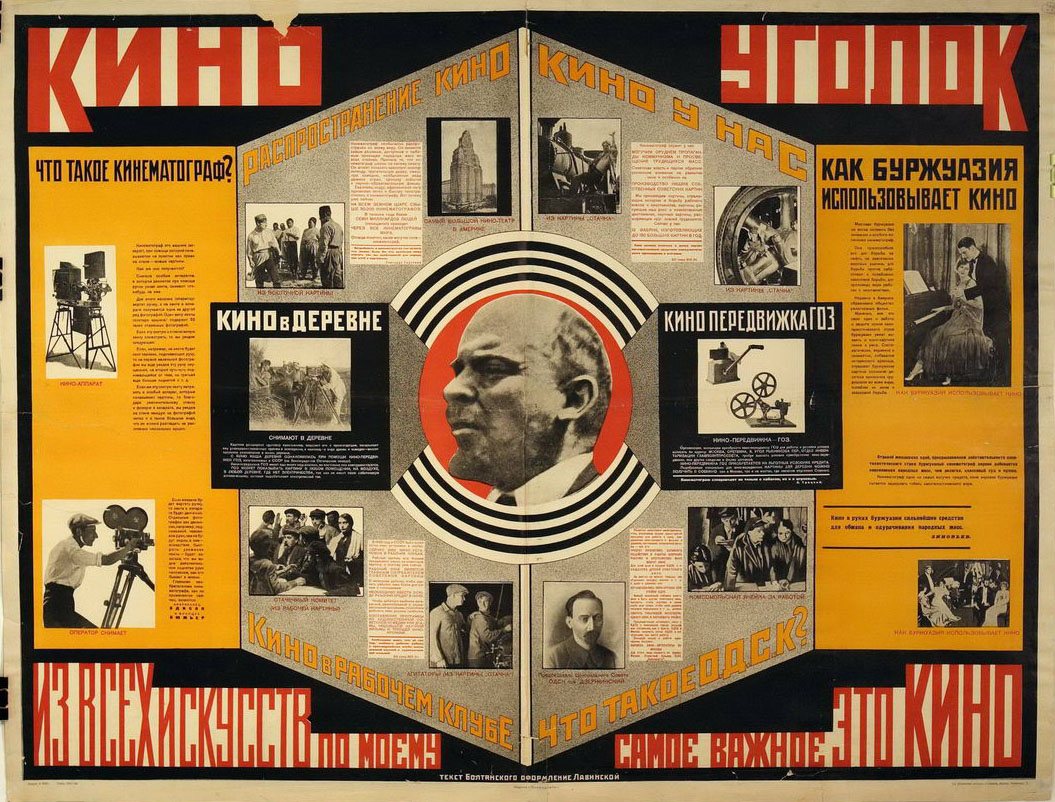
In sharp contrast to this naturalism is the work of Traubey and Kozintzev, two young directors connected with the FEKS Group (“factory of eccentricism”), whose film The New Babylon has been shown in the United States. They claim to base their technique on the grotesque but exact eccentrics of the circus, on the balance of acrobatics. They repudiate all realism; the plot of their films is startlingly at variance with the setting; the characters behave unexpectedly. Beginning with mere eccentricity and oddity, the FEKS groups has brought to the Soviet cinema fresh viewpoint and original conceptions.
The leading Soviet cinema directors, however, are the formalists, headed by Kulishev, whose film By the Law was worked out in the spirit of an algebraic formula, seeking to obtain the maximum of effect with the minimum of effort. Among the formalists is also Eisenstein, who gets his effects by eccentric parody and the “pathos of heroism”; and though he will reproduce historic scenes with accuracy, he will not hesitate to introduce a puppet of Bonaparte as a commentary on Kerensky in order to carry out his chief purpose—to force his audience to think logically, possibly to be moved to action.
The method of Pudovkin, director of Mother and The End of St. Petersburg, is a mixture of Eisenstein’s tendencies with those of Kulishev, one of the older Soviet directors. He omits the irrelevant and retains only that which he considers absolutely essential for his effects. But he is interested in more than external objects; he seeks to photograph the world as it appears to different characters, and he manages to convey his own attitude to the objects he photographs.
The All-Union Association of Proletarian Writers (VAPP), which fights for its own conception of proletarian art in literature, has in the cinema been critical of the formalists, urging greater concentration on bringing out effectively the role and aims of the working class in the evolution of society toward Communism.
The technical achievements of the Soviet cinema are not within the scope of this brief survey. From the cultural viewpoint it may be said that in this art, the most important for mass education, the Soviet Union is working toward a fusion of esthetic and educational qualities which will help to inform the minds and stimulate the imaginations of 150,000,000 people toward a great social goal.
PDF of full book: https://archive.org/download/voicesofoctober0000unse/voicesofoctober0000unse.pdf

