An orientation documents from the Profintern for its adherents in India given at a time of increasing class and national struggles.
‘Tasks of the Left Wing in India in Fighting British Imperialism’ from the Daily Worker. Vol. 6. Nos. 151, 153 & 154. August 31, September 3 & 4, 1929.
No one acquainted with conditions in India can deny that the very air is electric with revolution against British imperialism. The following analysis correctly estimates the forces at work and outlines the tasks of the Left Wing trade unions of India, on which falls the principal burden of leadership in the struggle which will profoundly affect the whole world and certainly the workers of the Pacific area. It is therefore important that all adherents of the P.P.T.U.S. familiarize themselves with the following estimation by the Executive Bureau of the Red International of Labor Unions of the tasks of the Left Wing unions of India, which estimate will undoubtedly deeply influence future struggles. Editor.
I. The present economic and political situation in India is characterized by an ever-sharpening development of the class struggle. The ruthless oppression by British imperialism, the intensified exploitation by British and Indian capital, the appalling working conditions and unemployment have brought about strong resistance on the part of the working class of India. A new period in the national revolutionary independence movement of India has begun. A period of broader, deeper and more determined than ever before working class struggles against British imperialist subjugation and capitalist exploitation. A period of anti-British imperial mass struggles in which the proletariat is the leading and deciding factor.
The present-day revolutionary struggles in India have found expression in the recent and last year strikes and mass demonstrations. The main characteristic features of these are as follows: (a) The strikes are taking place mostly in the textile mills, railway shops and the metal works. The miners and plantation workers have not been affected by the strike wave while the transport workers were partly involved. However, since last summer the present strike wave has risen higher than all the preceding ones in India. It now begins to spread to inland cities and native states and to affect also the meat remote and backward sections of the proletariat; (b) the strike committees are being elected by and from the rank and file or from the striking masses; (c) the strikes are greatly accelerating the differentiation in the labor movement as well as in the national independence movement; (d) the strikes give birth to revolutionary trade unions (Girni Kamgar Union, etc.), stimulating their steady growth as well as it inspired the rank and file with self-confidence and urged it on to independent working class action; (e) the strikes are of extremely long duration and are fought by the masses with steadfastness and great self-sacrifice. In In these struggles the Bomby textile workers (Girni Kamgar Union) are the leading and most advanced section; (f) the strikes are being organized and led mostly by the Left Wing trade unions, and by the rank and file of the reformist trade unions apart from and against the will of the bureaucrats; there have been also spontaneous or unorganized strikes; (g) the strikes are frequently lost. First of all, due to armed suppression by the British authorities; secondly, due to sabotage and treachery of the reformists; thirdly, because the strikes are not coordinated and extended in scope but rather remain isolated and confined to local battles; (h) the strikes begin mostly as economic fights, primarily against rationalization enforcements, but, nevertheless, they often assume political character; (i) last but not least, there have been also clear-cut political mass actions of great importance. Particularly the recent protest strike against the arrests of the Left Wing trade union leaders and the mass demonstrations in Bombay and Calcutta marching under the banner “Long Live the Soviet Republic of India.” These are all sharp expressions of mass activity, rapidly growing strength, political maturity and revolutionary outlook of the Indian proletariat.
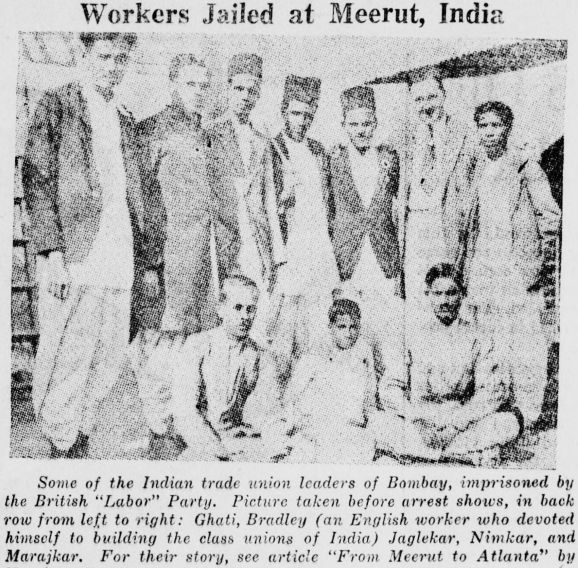
II. The British Imperialists, alarmed by the rapid revolutionization process of the Indian proletariat, the slow but sure awakening of the peasantry, resulting in a new rising wave of the national movement of India, have launched a campaign of white terror against the labor movement all over, the country. The streets of the industrial centres, especially in Bombay are deeply drenched with workers’ blood, Hundreds of millions land Left Wing trade unionists are thrown into prisons. The labor press has been suppressed. The officers of the Left Wing trade unions and the All-India Workers’ and Peasants’ Party have been ransacked. The strikes are being crushed by military force and hundreds of strikers killed. Compulsory arbitration is being forced upon the workers. Strikes of transport workers are outlawed. Likewise solidarity and political strikes are forbidden. Financial assistance to Indian striking workers by the proletariat of other countries is not permitted. Foreign-born revolutionaries are deported. This is the practical meaning of the recently promulgated “Public Safety Bill’ and the “Trade Disputes Act.”
Further, armed clashes between the Moslems and the Hindoos or the massacres of one native group of people by another on religious grounds, are being systematically instigated and provoked by the British spies and police. At the same time, the British imperialist agents are trying to bribe and organize the Moslem workers as strikebreakers and play them against the Hindoo workers in the class struggle. All this is aimed at splitting the labor movement and stemming the revolutionary tide in India. The same bloody policies and massacres will continue to prevail during the present so-called Labor Government. Ramsay MacDonald, Tom Shaw, Henderson & Co., being lackeys of British Imperialism, will be just as ruthless in crushing strikes, smashing revolutionary labor organizations and arresting militant workers as were the Tories with Baldwin and Chamberlain at the head.
Native Capitalist Betrayal.
The nationalist bourgeoisie menaced by the “red spectre” of the national revolutionary independence movement, by the rapidly approaching wave of the Indian national revolution under the hegemony of the proletariat, are deserting and betraying the struggles for national independence. The nationalist bourgeoisie have accepted the treacherous Scheme of the “Dominion Status for India,” and are compromising most shamelessly with the British imperialists at every turn and occasion.
Furthermore, the national bourgeoisie, if they are not officially and openly calling for the white terror of British Imperialism, yet are not fighting against it. In fact, the native bourgeoisie in supporting the enactment of the “Trade Disputes Bill” practically have helped to pave the way for the reign of British imperialist terror. Likewise, its lukewarm attitude and passivity in the face of the present offensive of British Imperialism is nothing but additional link in the long chain of treacherous actions which points to the passing over of the national bourgeoisie to a position of counter-revolution.
III. The brutal oppression of the toiling masses by British imperialism, the rationalization drive of British and Indian capital, the throwing out of work of hundreds of thousands of proletarians, and the rising of revolutionary spirit and fighting endurance among the toiling masses has resulted in a general sharpening of the class struggle, This in its turn, has brought about an intensified vacillating policies and half-measure activities within the ranks of the “Left” nationalists, J. Nehru, Bose, Chairman Lal, etc., the agents of the nationalist bourgeoisie in the labor movement, and to a whole line of class collaboration and social-imperialist actions by the trade union bureaucracies of M. Joshi, Bakhale & Co. the agents of British Imperialism.
Thus M. Joshi, Bakhale & Co., are sparing no efforts to prevent strikes against the British as well as against the native exploiters. They are sabotaging the strikes and trying to persuade the workers to enter upon the road compulsory arbitration and class collaboration. In addition to this M. Joshi, Kirk, Shiva, Rao, etc., are campaigning for the expulsion of the Left Wingers from “their” trade unions consciously splitting and weakening the fighting forces of the Indian proletariat. They in unison with British imperialists, and their agency–the General Council of the British TU Congress–are striving for annihilation of the Indian Left Wing trade unions and revolutionary political organizations. Moreover, M. Joshi, & Co. are not only “working hard” to smash the militant labor and peasant organizations in India, but are even making an attempt to disrupt the united front of the trade unions in the whole of the Far East.
In close cooperation with Bunji Suzuki (social-imperialist in Japan), Albert Thomas, and other lackeys of imperialism, they are scheming to undermine the Pan-Pacific Trade Union Secretariat. They are calling in opposition to the P.P.T.U.S. an “Asiatic Labor Conference” in Bombay next year. The Indian reformists, the Japanese social-imperialists, the Chinese counter-revolutionists, etc., are feeling keenly the spreading influence of the P.P.T.U.S. and the R.I.L.U. in the trade union movement in their respective countries.
The reformists of all shades know well that an affiliation to the P.P.T.U.S. means the intensification of the class struggle, the coordination and strengthening of the trade unions on the Pacific, the tremendous advancement of the national revolutionary movement. Consequently, this means a counter-attack against imperialism, capitalist exploitation, and the throwing into oblivion of the reformists. Hence, the calling of an “Asiatic Labor Conference” for the establishment of a social-reformist or counter-revolutionary “Labor” Centre in the Far East. Hence, the welcome of the British imperialists to such a “labor” Conference in India. Hence, the blessings of the Geneva “Labor Office,” the General Council of the British Trade Union Conference, the Amsterdam International, and other agencies of the bourgeoisie. This also explains why the General Council of British Trade Union dares to attack and slander so viciously the striking and suffering textile workers of Bombay.
Although J. Nehru, Bose, Chaman Lal, etc., do not sabotage strikes taking place in the British-owned factories and enterprises, they, however, do everything possible to prevent strikes in the textile mills, metal works, etc., controlled by Indian capital. This was particularly evident during the strike of the metal workers at Jamshedpur last year. Therefore, wherever British imperialist domination and foreign capitalist competition to the national bourgeoisie is taking place J. Nehru, Bose, etc., are not in opposition to strikes. Of course, not for the benefit of the workers’ interests but that of the national bourgeoisie. But insofar as the national bourgeoisie or Indian capitalist exploitation is concerned, Nehru, Bose, etc., are calling upon the workers to submit and not to strike.
Moreover, time and again the reformists of all shades (from M. Joshi to J. Nehru) have been cooperating against the Left Wing trade unions. This was glaringly demonstrated by the fact that J. Nehru undertook to run for the chairmanship of the All-India Trade Union Congress last year against the Left trade union candidate. And all owing to the support of M. Joshi & Co., J. Nehru was elected by a small majority. Undoubtedly, in the final analysis both types of reformist differ from each other mainly in phraseology but little in deeds.
It is also quite evident that J. Nehru, Bose, Chaman Lal, etc., being the exponents of the interests of the nationalist bourgeoisie within the labor movement, are, hindering in every possible way the proletariat in its struggle for the hegemony of the national revolutionary independence movement of India.
Some Mistakes
IV. Although the Left Wingers proved to be brave fighters in the workers’ struggles, have gained wide influence and confidence of the masses, have organized many revolutionary mass unions (Girni Kamgar, et) and factory committees, have led strikes and mass demonstrations, etc., nevertheless, they have committed mistakes some of which we should mention here.
First of all, the Left Wing fails to draw a sufficiently sharp ideological line between itself and the nationalist reformists of the J. Nehru type, thus failing to prove to the masses: (a) that the nationalist reformists are sacrificing the interests of the workers for the interests of the nationalists bourgeoisie; (b) that they are cooperating with the Right Wingers (M. Joshi & Co.) in order to undermine and disrupt the Left Wing trade unions; (e) that the nationalist reformists should be discarded as labor leaders.
Secondly, owing to this ideological confusion our comrades do not always initiate and lead the mass struggles but rather find themselves at the tail end of developments. Thus the great Indian Railway Strike was postponed time and again though the workers pressed for the strike call. A great Indian Railway Strike at that time, combined with the simultaneously going on strikes of the South Indian Railway and the Bombay Textile Workers, would have been a strike of far-reaching effect and consequences.
Thirdly, the application of the united front tactics by the left wing in India was utterly wrong. For instance, during the Bombay textile strike last year the left wing leaders, even though the striking workers were opposing it, agreed to form a strike committee with the right wing bureaucrats on a fifty-fifty basis, and practically turned over the strike leadership to the labor traitors with the result that the strike was lost. At the same time the left wing leaders signed an agreement jointly with the right wing bureaucrats that the disputed questions shall go to arbitration as proposed by the capitalists. Evidently, our comrades failed to grasp the significance that the united front must not be effected from the top but from below, namely, that real assistance to the striking textile workers can only be rendered by the rank and file of the trade unions, or the working masses in general. Our comrades failed to grasp sufficiently clear that no reformist leaders or bureaucrats should be tolerated in strike committees or agreements should be signed jointly with them The failure to emphasize that the united front rest be effected from below and not from the top is also contained in the Trade Union Resolution adopted by the All-India Workers’ and Peasants’ Party Conference in December, 1928.
Fourthly, a no less serious shortcoming is that the left wing does not always consolidate its ideological influence organizationally. Thus, the left wing had strong influence, in the Tata steel strike, the Liliah strike, etc., but failed to entrench itself organizationally with the result that the petty bourgeois politicians are in control the organization.
Lastly, a still more serious shortcoming is that the left wing trade unions are insufficiently coordinated and connected up under centralized leadership, and effective struggle against imperialism and reformism is impossible.
Therefore, in view of the current situation, the most important tasks of the left wing trade unions in India are as follows:
The strikers must be better prepared for, coordinated, the wide masses attracted and direct leadership undertaken by the left wing. Under no circumstance variating leaders and reformist or right wing bureaucrats should be elected or tolerated in strike committees.
The strike demands should be discussed and popularized among the masses. For the success of the strikes it is absolutely necessary that the unorganized masses, the workers in industries not yet or slightly affected by the strike wave, such as transport, mining, plantation workers, etc., should be more and more drawn into the strikes. The strikes must not only be widened in scope but also deepened in content.
Preparing Strike Action.
“The general strike is an extremely powerful weapon, which the trade union movement must not shrink from using,” states correctly the Trade Union Resolution of the All-India Workers’ and Peasants’ Party Conference of last year. However, in the propaganda for and preparation of the general strike the left wing should formulate clear-cut demands and thoroughly explain to the masses that the general strike is a political strike a revolutionary mass struggle. The leadership of the general strike must be entirely in the hands of the militant workers and the left wing, and no reformist leaders (from Joshi to J. Nehru) should be admitted in the leadership of the strike.
The central as well as the local strike committees must not attract but rather eject all vacillating elements from their ranks. The strike leadership should not lose initiative and should not drift into defensive position. The strike committees and the striking masses must not accept or believe the empty promises of the British imperialist government or its agents. Finally, in connection with the general strike propaganda and preparations the left wing must remind and explain to the masses the treacherous actions and role of the British reformists, the General Council of the British Trade Union Congress in the general strike of England, 1926.
The practice of electing large strike committees by the striking workers and their active participation in the conduct of the strikes as, for example, is being done by the Girni Kamgar, should be further encouraged, and large strike support committees of non-striking workers organized. The strike support committees should not limit themselves only to the collection of funds, but also it must make wide propaganda, arrange meetings and mass demonstrations for the support and encouragement of the strikers, etc. The strike committee as well as the strike support committees should strive for contact with the peasants in order to obtain food supplies as well as to draw the peasants into the revolutionary struggle.
The defense groups already formed should be extended. Care against provocateurs should be exercised in the selections of the guards.
Organize the Unorganized.
No effort should be spared in organizing the unorganized, especially in the key industries. Steps should be taken to organize the young workers, and the women workers in the trade unions on an equal footing with adult and male workers. No less stress should be laid on the importance of organizing trade unions for agricultural laborers and plantation workers.
The organization of factory committees and shop-delegate conferences should be stressed more determinedly than hitherto. The factory committees and the shop delegate conferences should be coordinated and united under centralized leadership. The left wing control of the factory committees and shop delegate conferences will accelerate the development of the every-day struggles as well as the struggles of a political nature. It will also create a broad and favorable basis for the growth of the left wing trade unions.
The already existing left wing trade unions, like the Girni Kamgar Union, though having developed from an organization of 500 to 65,000 within a short space of time should nevertheless be further expanded and consolidated organizationally and ideologically. A drive for increased membership of all left wing trade unions should be carried on systematically and energetically. The left wing, particularly during strikes and other mass activities, should strive strenuously to crystallize its influence into definite organization.
New unions should be set up where none exist, or where it is impossible to use the old unions because of complete reactionary control. It is also important that in all industrial towns Trade Councils should be established. At the same time the amalgamation of scattered or parallel trade unions into industrial unions under militant leadership must be pressed forward. However, in the campaign for trade union unity and industrial unionism the left wing should emphasize that the unification should be based strictly upon working class basis and fight against reformism.
The recent amalgamation of the Jute Workers’ Union of Bauria and the Jute Workers’ Union of Bengal, as well as the amalgamation of the two competing or parallel unions on the Great India Railway, is highly commendable indeed. Special attention should be paid without fail to the transport workers. It is particularly necessary to make timely preparations for the maturing railway workers’ strike. It must be brought clearly before the masses that while at the present time the capitalists have centered the attack upon the textile workers, that, subsequently, the onslaught will be made upon the transport workers.
Workers’ Democracy.
The old bureaucratic system of appointing functionaries, delegates, and other officials in the trade unions, should be done away with and substituted by workers’ democracy–a system of election from and by the rank and file. It is of paramount importance that the bourgeois intellectuals and politicians, occupying leading positions in the trade unions should be thrown overboard and in their stead militant workers elected. In addition to that the center of gravity of the trade unions should be transferred to the factories, that the so-called residential branches of the trade unions (branches organized where the workers live but not where they work) should be reorganized upon shop and factory basis, and interwoven with the factory committees and shop delegate conferences.
However, the organization of new unions, etc., does not exclude, but rather calls for more intensified propaganda and organizational activities of the left wing within the reformist trade unions. The left wingers must formulate strike and other demands for the rank and file and foster the fight for workers’ democracy within the reformist trade unions. The left wing should, above all, win over the masses. Nor does this mean that the left wing should give up the fight within the All-India Trade Union Congress. On the contrary, our comrades should make timely preparations for the coming Annual Congress and should take up a much sterner attitude towards the social-reformists (M. Joshi, Bakhale & Co.) and nationalist-reformists (J. Nehru, Bose, Chaman, Lal, etc.), than was the case at the Annual Congress last year. Without delay the left wing should launch a systematic and persistent ideological campaign against social-reformism. The treacherous character of social-reformism must be exposed at every turn and occasion. Not less persistently and sharply the left wing should criticize the nationalist-reformists, like J. Nehru, Bose, etc., as the exponents of the interests of the nationalist bourgeoisie within the labor movement, as absolutely unfit and unreliable elements to lead the labor movement. In this campaign we must not limit ourselves just to ideological criticism, but must also expose the reformist leaders before the masses by concrete facts. The united front proposals by the left wing should be always directed to the rank and file of the reformist unions, in order to build up a solid united front from the bottom. Upon such a united front basis a nationwide campaign against class collaboration, the “Trades Disputes Bill,” the “Public Safety Bill,” as well as against the Whitley Commission, and against the mass arrests must be immediately intensified.
Expose Reformists.
The campaign against class collaboration and reformism should be interlocked with a sharp attack against the Ramsay MacDonald government, against the General Council of the British Trade Union. Congress, the Amsterdam International, the Geneva “Labor Office,” and the “Asiatic Labor Conference” scheme. It is of paramount importance to persuade the working masses and peasants of India that no illusions should be entertained in regard to the MacDonald cabinet. Ramsay MacDonald & Co. will at all times serve and preserve the interests of the United Kingdom or British imperialism, ruthlessly persecuting and aiming to destroy the revolutionary independence movement of India. The so-called Labor government will trample upon the sentiments and rights of the colonial peoples. It will, likewise crush strikes as well as smash left wing trade unions, etc.
At the same time the fight against participation in the “Asiatic Labor Conference” is one of the left wing’s immediate tasks. Simultaneously the popularization of the program and aims of the R.I.L.U. (Red International of Labor Unions) and the Pan-Pacific Trade Union Secretariat should be the order of the day, and immediate affiliation to the R.I.L.U. and the P.P.T.U.S. fought more energetically than ever before.
An educational campaign based upon the decisions of the Fourth Congress of the R.I.L.U. should be launched, the leading cadres of the left wing increased and elevated ideologically. We should stress the necessity for the establishing of workers’ sols, a left wing press, and the publication of pamphlets, written specially for the Indian workers. In a word, a systematic and energetic training of workers for leadership is extremely essential.
It goes without saying that the left wing cannot coordinate its activities and expand without having a consolidated organization and an authoritative center. Hence, the pressing need for an all-embracing left trade union conference. It is imperative, therefore, that the Girni Kamgar Union Executive should undertake to call a preliminary conference composed of representatives of the largest left wing trade unions to work out a plan for an all-embracing left wing trade union conference, namely, a conference embracing the representatives of all the left wing trade unions, minorities and factory committees and shop delegates. It is advisable that the all-embracing left wing trade union conference should be preceded by conferences locally and industrially.
EXECUTIVE BUREAU OF THE R.I.L.U.
Moscow, June 12, 1929.
The Daily Worker began in 1924 and was published in New York City by the Communist Party US and its predecessor organizations. Among the most long-lasting and important left publications in US history, it had a circulation of 35,000 at its peak. The Daily Worker came from The Ohio Socialist, published by the Left Wing-dominated Socialist Party of Ohio in Cleveland from 1917 to November 1919, when it became became The Toiler, paper of the Communist Labor Party. In December 1921 the above-ground Workers Party of America merged the Toiler with the paper Workers Council to found The Worker, which became The Daily Worker beginning January 13, 1924. National and City (New York and environs) editions exist
PDF of full issue: https://www.marxists.org/history/usa/pubs/dailyworker/1929/1929-ny/v06-n151-NY-aug-31-1929-DW-LOC.pdf
PDF of issue 2: https://www.marxists.org/history/usa/pubs/dailyworker/1929/1929-ny/v06-n153-NY-sep-03-1929-DW-LOC.pdf
PDF of issue 3: https://www.marxists.org/history/usa/pubs/dailyworker/1929/1929-ny/v06-n154-NY-sep-04-1929-DW-LOC.pdf

