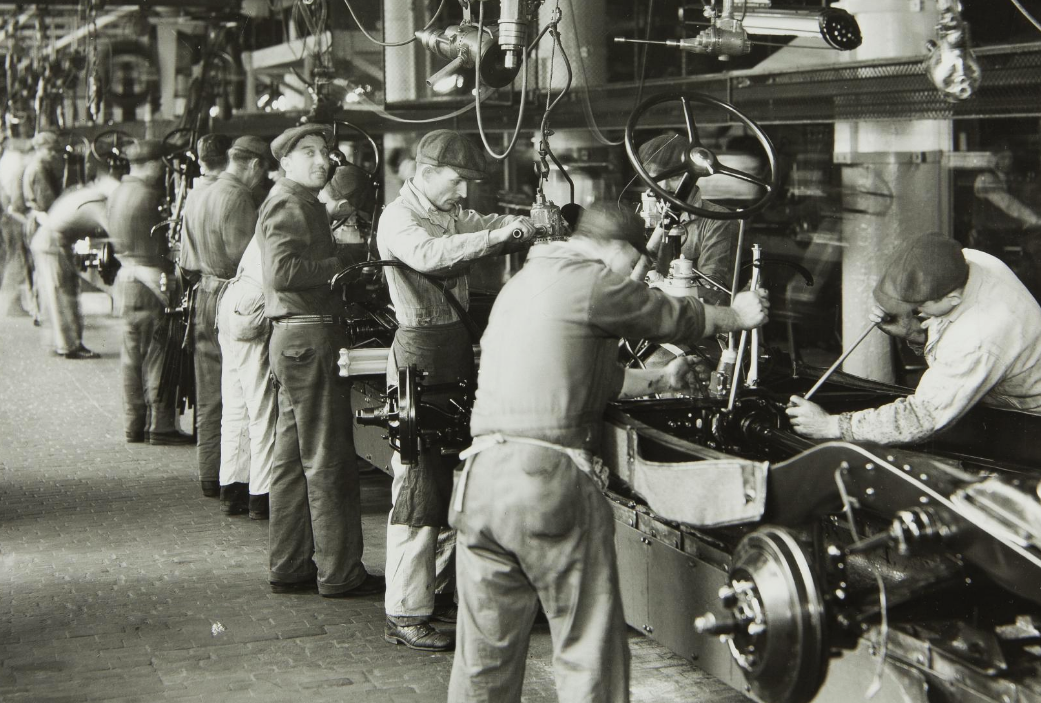
Robert Cruden, working the midnight shift at a Detroit Ford plant, on the on the fear of it coming and the hopelessness when it happens. A layoff during the Great Depression.
‘Lay Off: Ford Factory’ by Robert Cruden from New Masses. Vol. 6 No. 9. February, 1931.
For days the rumored layoff had hung heavily on us, a pall of gloom. What little talking we had done, we stopped. We cut out the few extra steps we took when we went to get stock. We worked feverishly and silently at our machines, working furiously in a flash of hands and steel, sending up production—12 pans, 13, 13J/2 pans. 13 pans of push rods—6,075 a day, 760 an hour, 13 a minute. And on we worked like this, night after night, rushing ourselves out of jobs, our hands and levers falling and rising in a phantasmagoria of speed, speeding ourselves out of jobs, night after night.
The night when the layoff began started quietly enough. True, the street cars had been filled with morose, work-worn men whose grunting monosyllables were all about the layoff—but we young ones had become accustomed to that after a week of it. Indeed, some of us dared to hope that the rumor was just a rumor, nothing more.
The men coming off the afternoon shift had nothing to say. That was good. As usual, we worked furiously until lunch-time at 3:30 a.m. Then for fifteen minutes we gobbled bread and swallowed milk and congratulated ourselves that, “Nuthin’ doin’ tonight.” The steady stamp, cling, clang of a hundred presses to the back of us accompanied, “No layoff, no layoff.”
About four-thirty, when all of us were working in a semi-conscious daze, three bosses appeared. Shouting arose. A worker, waiting for stock, had been fired. His pleadings and explanations only angered them. Fifty feet off, amid the roar and crash of presses and machines, we could hear them, “Get your time, get your time.”
They passed us up. We were working at a mad rage, our eyes glued on our machines, our feet rooted in a square foot of ground, our bodies flexing in furious rhythm as hands and levers rose and fell in a crazy dance of speed. Up went production, 13 1/4—14 pans. Would it never stop?
Dawn was breaking when our own boss came up. He passed directly to the old man who was inspecting the stock from our machines.
With a pounding heart I turned to watch. The boss was speaking to the man in a hangdog manner, his eyes on the ground and his feet shifting nervously. As the worker listened he did not move. His lips trembled, but he did not speak. His eyes hardly observable under the steel spattered glasses he wore, were glazed and dilated. His hands jerked and fumbled at the gauge. His body seemed to me to suddenly bend under a nameless, terrible burden. The boss spat tobacco juice out of his mouth, clapped the man on the shoulder and strode off.
For a few moments the old, gray-haired worker leaned up against his work table, piled high with small glistening pushrods. He looked at them, wiped off his hands clumsily with a dirty rag, and then hobbled off to the coat rack. I did not see him ring out. I was too busy making up my lost production.
By a quarter after eight we were out waiting for street cars. The tension which broods always over the midnight shift was intensified that morning. We stood around smoking, some snarling in impotent anger, most of us just standing, staring in a heavy lifeless way at the morning sky, lunch boxes hanging empty from arms which labor had killed in the night.
My brain was a ball of fire, running wild. I did not think. The layoff had begun. The idea came rushing through my head, rending my weary brain in agony. I wanted to shriek, to shake my fists at that monstrous killer, to howl to the world to stop it from devouring me. But a street car came. We ran, hitting and kicking in an animal rush for seats.
Home. Too hungry to sleep, too tired to eat. I passed food mechanically from plate to mouth as I passed steel rods from pan to machine. Questions, words, gossip burst in on me from another world in which there were no steel devouring machines, no mad rushes for street car seats. In surly mumbles I answered, hoping against hope that the chatter would cease. But like the machines, it was deathless, running on forever—words, words, words.
It was two o’clock when I woke up. Although the shades were drawn I saw that summer sun was high in the afternoon sky. It would be so warm, so free, to be out in the sun—the thought crawled through my brain—and LAYOFF. With all the impact of a fly-wheel set loose the idea crashed into my consciousness. For some moments I was awake, my eyes wide and fearful. But then I was asleep again, sunk in the sodden sleep of the workers on the midnight shift.
When I woke up again it was half-past seven. Nine and a half hours’ sleep! I felt pleased. Usually I was fortunate if I snatched but a few hours’ rest—radios, children, salesmen, neighbors fighting, provided too much competition. I smiled at the thought—and LAYOFF. With the relentless bore of a drill press it cut into me. Thought went long ago—all that I could feel in my head, in my body, was a dark void…
The cars were death houses that night. Hope was being killed in every man who rode them. No one slept. Few of us spoke. But though silent, apart, one single word united us—LAYOFF. It kept pounding through our heads, pounding with the monotonous, flattening regularity of a punch-press. The cars rolled through the night. We sat and stared in agony, knowing not who would go next…
Men were coming away from the time clocks. We did not need to see the slips of paper clutched in their gnarled hands. Feeling, hope, emotion had ebbed from them. With faces white and drawn they marched in stolid step to the timekeeper. The big guns had gone into action. These were among the first victims.
In our section of the plant, the snipers picked us off. The wholesale layoff had not yet affected our gang, but individuals were being fired on the slightest pretext. And so, hidden behind machines, planted in the toilet galleries, dashing to and from gang to gang, the snipers picked us off. A man stopped to clean acid from his shoe—a service man got his number. A grinder stood aside to wait for stock—a superintendent got him. All night long we furnished prey for nervous bosses and shifty-eyed service men. The layoff was in full swing.
When we went out in the morning there was a long line of men drawn up before the pay-office. Like stricken beasts, they stood in dumb pain, their eyes glazed over with hopelessness. I shivered. I too would soon be standing in that long line of silent, hopeless men.
The New Masses was the continuation of Workers Monthly which began publishing in 1924 as a merger of the ‘Liberator’, the Trade Union Educational League magazine ‘Labor Herald’, and Friends of Soviet Russia’s monthly ‘Soviet Russia Pictorial’ as an explicitly Communist Party publication, but drawing in a wide range of contributors and sympathizers. In 1927 Workers Monthly ceased and The New Masses began. A major left cultural magazine of the late 1920s to early 1940s, the early editors of The New Masses included Hugo Gellert, John F. Sloan, Max Eastman, Mike Gold, and Joseph Freeman. Writers included William Carlos Williams, Theodore Dreiser, John Dos Passos, Upton Sinclair, Richard Wright, Ralph Ellison, Dorothy Parker, Dorothy Day, John Breecher, Langston Hughes, Eugene O’Neill, Rex Stout and Ernest Hemingway, Artists included Hugo Gellert, Stuart Davis, Boardman Robinson, Wanda Gag, William Gropper and Otto Soglow. Over time, the New Masses became narrower politically and more journalistic in its tone.
PDF of full issue: https://www.marxists.org/history/usa/pubs/new-masses/1931/v06n09-feb-1931-New-Masses.pdf

