As the famine in Russia subsided, two events in the Fall of 1923 transformed International Workers’ Relief from one whose sole focus was to assist Russia into one made to help working class people struggling in a number of conditions. The first was the Great Kantō Earthquake and Massacres of Korean and Chinese workers, and Japanese radicals beginning on September 1; the second the economic crisis in Germany in which real hunger plagued working class districts, and led to the failed ‘German October.’. Willi Münzenberg speaks to both below.
‘The International Workers’ Relief Comes to the Aid’ by Willi Münzenberg from International Press Correspondence. Vol. 3 Nos. 69 & 70. November 1 & 8, 1923.
The International Workers’ Relief and the Relief Action in Aid of Japan By Willi Münzenberg (Berlin).
The International Workers’ Relief came into being as a organization of international proletarian solidarity at the time of the famine in Russia. Its energetic help, rendered possible by the readiness for self-sacrifice shown by the whole proletariat, saved hundreds and thousands of lives, and was the first magnificent proof that the workers of the world do not regard international solidarity merely as an accepted tenet, but that they are prepared to bring actual proofs of readiness for self-sacrifice.
The Japanese working class rendered excellent aid in this international relief action. Despite all suppression on the part of the Takahashi government, the Japanese proletariat did its best to collect money for the starving Russian workers and peasants. Workers and poor peasants, artists, writers, musicians, all offered their services to the Japanese auxiliary committee of the International Workers’ Relief, and the self-sacrificing action of the Japanese workers resulted in the collection of the sum of 30,000 dollars for the starving workers of Russia.
When news of the frightful earthquake reached Russia, the Russian workers unanimously felt that the moment had come to repay the help sent them by the Japanese proletariat during the famine in Russia, and to repay it with more than interest.
The Russian proletariat is daily expending large sums for the alleviation of the misery in Japan. The International proletariat encounters great financial difficulties in ameliorating the consequence of the earthquake for the Japanese working people, for the general economic situation is unfavorable. But provision must be made to bring help where it is most needed.
The Executive Committee of the International Workers’ Relief has appointed a commission to deal with the collections being made for the Japanese working people. This commission regards the following as the most immediate imperative tasks the various countries:
1. Special committees are to be formed everywhere by representatives of the various labor parties, trade unions, cooperatives, intellectuals, and artists who are ready to work for the proletarian relief action in order that the organization of the Japanese Relief may be taken energetically in hand.
2. The committees are to conduct extensive propaganda work for the Japanese Relief. The public, especially the working class, is to be enlightened concerning the consequences of the earthquake for the Japanese workers.
3. Funds are to be collected at once, in part by means of agitation at meetings and in the press, in part by personal agitation. The Youth organizations, the women’s committees, the local organizations of the various parties, can render excellent service in this work. The auxiliary committees are to issue collection sheets, and to provide for the public acknowledgment of all sums sent in.
4. The various auxiliary committees are to enter into immediate communication with the Japanese Relief Committee of the International Workers’ Relief in Berlin, and to send to these headquarters all material relating to the Japanese Relief action.
The Foreign Committee of the International Workers’ Relief assumes that every worker is thoroughly aware of the enormous importance of this relief action. Even though the difficulties in the way of rendering, aid to Japan are very obvious, still we must not forget the old Russian proverb which says that: “H everyone in the village gives but one thread, the naked will have a shirt to cover him.”
We must prove that despite the thousands of miles distance separating us from our Japanese comrades, we none the less recognize the necessity of further maintaining the Japanese labor organizations, and of alleviating the hard fate of the workers of Japan, crushed by the frightful earthquake which has visited their country.
***
Relief for Japan organized by the International Workers’ Relief
A short time ago an appeal was published by the Red International of Labor Unions, in which the working class was called upon to lend rapid and energetic aid to the Japanese population suffering through the earthquake. The action taken by the Red International of Labor Unions has now been united to that of the International Workers Relief, and the executive of this latter body resolved, at its last session, to put its apparatus at the service of the Japanese proletariat condemned to such suffering by this natural catastrophe.
The appended appeal to all workers, peasants, and toilers throughout world has already been crowned with success. The funds collected already amount to a sum of 15,000 dollars:
“The undersigned Committee, which came into existence in 1921, was formed to mobilize working-class aid to the Russian Workers and Peasants’, then heavily menaced by the Volga Famine.
“By the aid of world-wide support of the Working Masses of all countries, this Committee succeeded in carrying through Relief Measures on a large scale, more than 40,000 tons of foodstuffs, medicines, and other goods necessary for relief purposes being imported under our care into the Famine territory.
“At the moment, this relief campaign is still being continued, and Food Stores, Clothing, and other materials are supplied by us to the Children’s Homes and educational institutions in Russia.
“At the same time the Committee is controlling several large agricultural and industrial undertakings in Russia, and in this way helping in the regeneration of the economic life of the Workers’ Republic.
“It is now some months since actual famine conditions in Russia have been wiped out. Russia is on the way to recovery–but there is another land which in its turn has been visited by a most formidable natural catastrophe.
“The seismic disturbance in Japan has transformed its chief cities into heaps of ruins, killing thousands of men and women, and leaving millions without shelter and in misery. As at the time of the Volga Famine, the whole World hastens to help the victims of this frightful disaster.
“The Japanese Government, supported by help from many sources, has organized a large-scale relief action. In England, America, and other countries, committees and relief organizations have been formed for this purpose.
“But it is especially the Japanese working class on whose shoulder’s falls the greatest burden of this distress and misery. In view of these facts, and in accordance with our principles of relieving distress and feeding the starving without distinction of religious or political belief, the undersigned Committee decided fo organize a great international working-class campaign to accomplish the first and most urgent task of supplying Food, Clothing, and other relief to the Workers and Peasants of Japan.
“We have no doubt that our appeal will meet with the same whole-hearted and generous response from all sections of the Labor Movement as in the Famine period of 1921-2 The crisis of a whole nation in imminent danger demands immediate assistance.
“Laboring masses of all countries unite in this work of ng aid to the suffering Japanese Workers and Peasants. Signed on behalf of the International Committee of the Workers International Relief: Helen Crawfurd, E.T. Whitehead (England), Upton Sinclair, J. Davis (U.S.A.), Clara Zetkin, Kathe Kollwitz, Prof. Eltzbacher, Dr. Alfons Paquet, Pref. Oesterreicher, Erast Taller, G.G.L. Alexander, Edwin Hoerule, Paul Scholze, Willi Münzenberg, Max Barthel, Theodor Liebknecht (Germany), Anatole France, Vaillant-Couturier, Henri Barbusse, André Marty (France) Henriette Roland Hoist, Edo Finnien, J.W. Kruyt, J. Brommert (Holland), Martin Anderson Nexo (Denmark). Ture Nerman, Lindhagen, Z. Höglund (Sweden), S. Sievertson (Norway). J. Mattias, Pasteel (Belgium), Prol. Forel, F. Platten (Switzerland), Smeral, Kreibich (Czecho-Slovakia), Prof. Grasia det. Misiano (Italy).”
***
The International Proletariat Hastens to the Aid of the German Working Class By Willy Münzenberg.
All over the world a mighty solidarity movement has begun for the support of the German workers. The International Workers’ Relief has issued an appeal calling upon the workers of the whole world to form Relief Committees at once, and systematically to collect funds in aid of the starving German working men and women, children, and old people. The appeal refers to the great wave of solidarity which swept over the international working class at the time of the famine catastrophe in Russia in 1921, and calls upon all productive workers to carry through the present action with the same energy and enthusiasm as was done in aid of the starving Russian workers and peasants. The appeal points out that the German famine differs from the Russian in not being the result of a natural catastrophe, but of the complete dissolution of German economics and the complete bankruptcy of the capitalist economic system in Germany. It is accordingly the more important and the more necessary that the international working class comes to the help of the victims of this collapse.
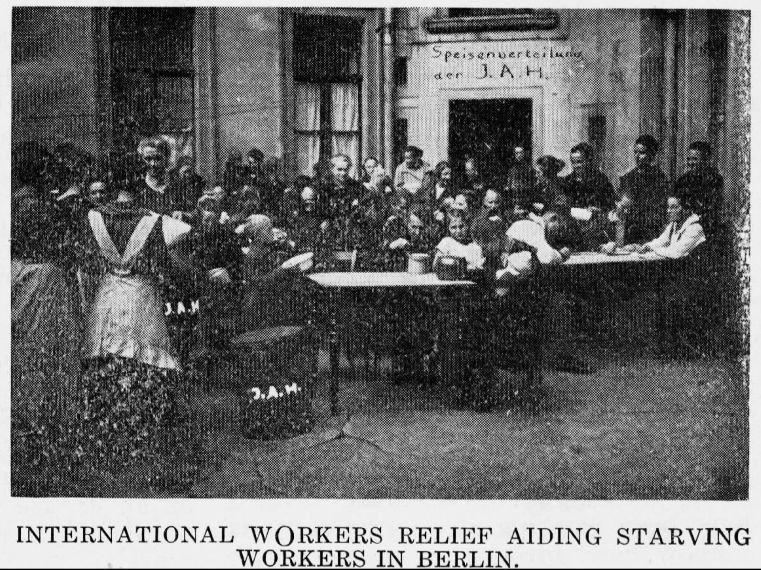
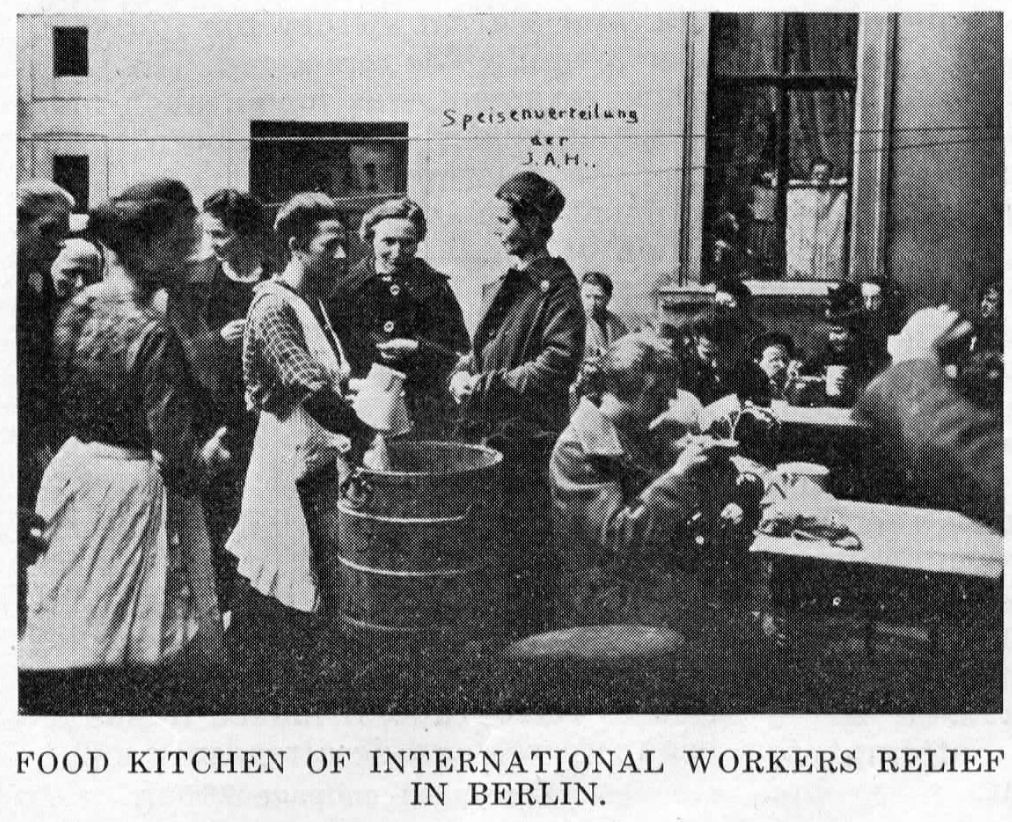
The appeal made by the International Workers’ Relief has not fallen upon deaf ears. Relief Committees have immediately been organized in all countries, and have already begun actively the work of collecting. The Russian Comrades are especially zealous. The workers and peasants of the various Russian towns and villages are competing with one another in the endeavor to repay with interest the fraternal help received from the international working class in the year 1921. Thanks to this immediate response to the passionate appeal of the International Workers’ Relief, it has already been possible for the Central Committees of this body to distribute 200,000 hundredweight of corn, chiefly Russian rye, in the most needy industrial centres of Germany. 40,000 hundredweight was placed at the disposal of the Saxon Workers’ Government for distribution to the unemployed and destitute, 15,000 hundredweight have been sent to Thuringia, and at the same time the International Workers’ Relief has organized the distribution of food to 3000 working women daily in Berlin. The famine relief movement of the international proletariat, thus begun by these first actions of the International Workers’ Relief in aid of the German working class, is to be greatly extended within the next few weeks. The German working class will receive fresh courage from the consciousness that it does not stand alone in the struggle, but is supported by the working class of all countries.
International Press Correspondence, widely known as”Inprecorr” was published by the Executive Committee of the Communist International (ECCI) regularly in German and English, occasionally in many other languages, beginning in 1921 and lasting in English until 1938. Inprecorr’s role was to supply translated articles to the English-speaking press of the International from the Comintern’s different sections, as well as news and statements from the ECCI. Many ‘Daily Worker’ and ‘Communist’ articles originated in Inprecorr, and it also published articles by American comrades for use in other countries. It was published at least weekly, and often thrice weekly.
PDF of issue 1: https://www.marxists.org/history/international/comintern/inprecor/1923/v03n69[45]-nov-01-1923-Inprecor-stan.pdf
PDF of issue 2: https://www.marxists.org/history/international/comintern/inprecor/1923/v03n70[46]-nov-08-Inprecor-loc.pdf

