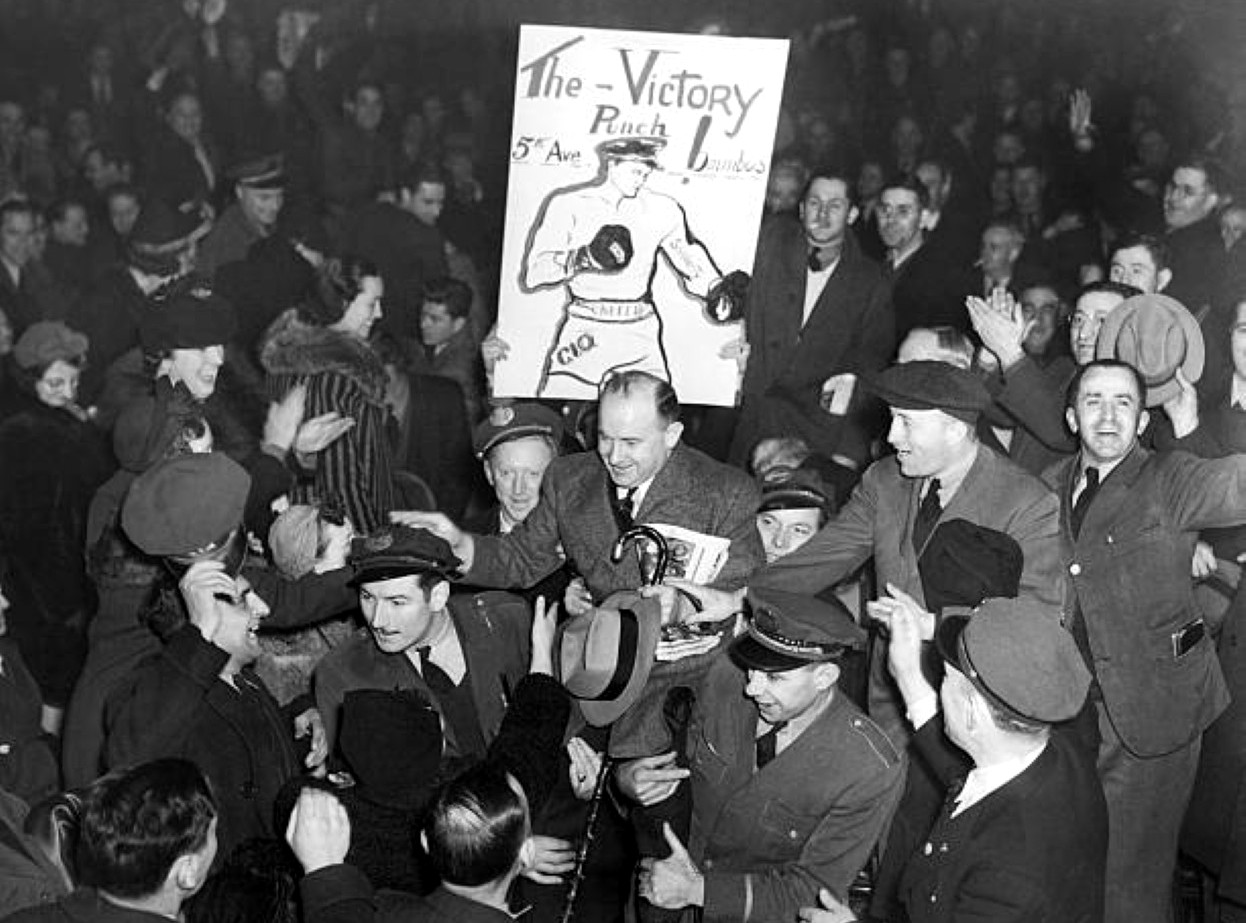
One of the most important union in the U.S. today seemingly started small. Of all the ‘new unions’ built by C.P.-affiliated activists in the early 1930s, the Transport Workers Union, begun at the end of that period in New York City during April, 1934, was arguably its greatest success. Today New York’s Local 100 has 44,000 members while nationally the T.W.U. has around 140,000. As an industrial union it took in all the employees and was in direct competition with A.F.L. and company unions. Growing quickly, the T.W.U. was a leading force of the C.I.O. Named as a nod to Jim Larkin and James Connolly’s Irish General Workers and Transport Union, the union was formed by Irish repair shop activists associated with Clan na Gael, many former I.R.A. guerillas like the legendary Michael Quill, and T.U.U.L. organizers on the subways like the author below. Within a year it had its first strikes, with in three, it won recognition and unified the workers into a 40,000 member force in city politics.
‘Subway Men in Revolt Against Co. “Brotherhood”’ by An IRT Subway Worker from New Militant Vol. 1 No. 6. January 19, 1935.
What has happened to the subway workers who two years ago took a 10 percent wage cut with out a squawk?
The company “Brotherhood” has turned out to be not so hot, after all!
The men on the subways of New York City are now engaged in organizing a union of their own, an independent union which will take in all who are employed in passenger transportation in the entire city.
From 1905 the subway men have tried many times to better working conditions and get more pay. Sometimes it was through company unions, sometimes through the A. F. of L., and at other times through no organization whatever. Several times they went out on strike, but without proper preparation or leadership. They were sold out by their leaders, Cochrane of the I.R.T. company union, who threw three or four hundred motormen on the street to look for other Jobs, and by Shea of the Amalgamated, who collected the dues and disappeared.
Company “Brotherhood”
Subway workers are forced to be- long to company unions. On the I.R.T. this union is called the “Brotherhood of Interborough Rapid Transit Co. Employees.” This organization never did anything for the men as a whole, but the delegates take up individual grievances If a man is punished by suspension, the delegate of his local may try to get the time cut down. Or if a man is fired, he may get back to work in two or three weeks, or get transferred to a different department. But when the company wants to put over anything on the men, it is done through the same delegates.
One afternoon, in December 1932, the men were going to their locker-rooms to wash up after work. They saw in the evening papers the announcement that they had voluntarily voted themselves a 10 percent cut in wages, ($2,750,000 annually) and that the I.R.T. Company thanked them heartily. They had not heard anything about the cut. It was the trusty delegates who had done the dirty work.
Another Example
Another example was the famous, or rather infamous Pension Plan of July 1934.
It seems that there were and still are several hundred old employes and company officials who are getting from $4,000 to $50,000 and even $60,000 per year each, and they were old enough, or almost old enough to be retired on a pension. These few hundred men, although forming a very small percentage of the total number of employees (16,500) take up an enormous percentage of the total pay-roll, due to the fact that they average five to ten times the yearly earnings of the regular subway worker.
How could the company pension off these men, and pay them any considerable percentage of their regular salary without it costing an enormous sum of money?
The answer was simple: Make the younger men pay for it.
And after eighteen months of discussion, the arguments boiled down to something like this:
Murray, the receiver, speaking: “But won’t the men see through it? Won’t they refuse to pay?”
Keegan, the President: “The men will see through it, but they will not refuse to pay into the Pension Fund. Why? Because we will tell them it is voluntary, and they know what that means. We still have the old reliable Brotherhood delegates. If there is opposition among the men we will send the delegates over the road and they’ll put it over.”
Putting It Over
Sure enough, it was done just that way, but with different results from those expected by Murray and Keegan. In the first place, many of the men were signed up without knowing what it was all about, especially in the track dept. This caused plenty of trouble later. in other places, many were told by their supervisors or foremen that they had to sign or get out; this happened in the turnstile dept. “Skunk” DeWyrall told the men working in his department that they must sign the pension or get fired on the spot. These are among the most miserably paid men on the whole road, and the worst treated. Even so, seven of them refused to sign at first, and only signed when forced to. One refused to the last, and was fired.
When the period of “voluntary” signing was over, one foreman had gone to the hospital with a “possible skull fracture”, and it had become necessary for a couple of delegates to bring their dental work up to date, and a couple of Brotherhood officials “fell” down a stairway. In all there were two thousand men who refused to sign the Pension. Most of these were sticking together in small groups of ten to twenty or thirty, making it a little more difficult for the boss to fire them.
What had happened to the men who two years before had taken a 10 percent cut in pay without a squawk?
Next week I shall tell why this spirit of rebellion is spreading among the subway workers. Two years ago perhaps the most cowed group of workers in New York City, the subway workers are fast becoming ready for organistion.
***
‘Two Young Men Start Subway Union Rolling’ by An IRT Subway Worker from New Militant Vol. 1 No. 7. January 26, 1935.
What has happened to the workers on the subways? Last week I told of a new spirit among the men. They are organizing a new union, a genuine union, in opposition to the company union!
Two years ago they took a 10 percent wage cut. They took it lying down.
But then (and this is the story):
After the cut the cost of living started to go up and the men began to get more and more “sore”. Five or six months went by and one day two ambitious and optimistic young men got some of their friends together, and started a union of their own, in opposition to the Company Brotherhood.
It was so easy to get the first few dozen members that they thought that in a few days they would have the whole road organized, “just like that”. It was not as easy as that; but they stuck to their task, and by the time the Pension fake came up there were several hundred men in the union, and several hundred more knew all about it, and talked to others about it, and a new feeling was beginning to get into all the men.
The subway workers began to feel that maybe if they tried they could get somewhere. They were so “sore” about the pension graft, added to their other grievances, that they started flocking into the new union by the hundreds.
The Two Men
It was about this time that the two men who had started the union were found out and promptly fired, but it was too late. The company was forced not only to stop firing men for joining the union, but it has agreed to take these two men back. In what capacity was not stated by the company, but if the union continues to grow there is no doubt whatever that they will get their old rating and pay. (Since this was written word comes to us that they are already back at work at their old pay.)
The name of the union is the “Transport Workers Union”, and in case there are any who now wish to join it but are afraid of being fired, we respectfully refer you to any one in the station department, and they will verify the following story.
The Man Defied Them
About five weeks ago, a man was being followed by “beakies” day and night, they even slept on his doorstep so as to be able to follow him to work the next day; he got tired of this and finally got up in a meeting of the Company Brotherhood and announced that he knew he was being followed and spied on to find out if he was an organizer for the Transport Workers Union, and to settle the question, he stated that he WAS an organizer and had application cards with him at all times if any one wanted to join. This man is still working. Station department men take notice! We might also add the following: The second month after the company pension graft was started the union was growing so fast that the Company got scared and published an emphatic statement to the effect that the pension was REALLY voluntary, and anyone who wanted his money back could get it; all he had to do was to ask for it. Three thousand five hundred men asked for their money back and got it. All who were forced to join, and those of the track department who were fooled into joining before they knew what it was all about should get their money back, and can–with no questions being asked.
The New Agreement
Now comes the working agreement for the new year (1935) to decide what pay and hours the men will have. There are 16,500 men, and there are about 16.499 different working rules, ratings, wage scales, working days etc. Many men work 12 hours a day, seven days a week. Many work 10 hours a day, six days a week, and so on. Some of these men have been working nights for years and years. There are over 4,000 men working underground in New York seven days a week on one subway alone–the Interborough Rapid Transit.
The new agreement provides the same wages as now, but with an eight hour day, instead of 9, 10 or 12 worked at present. Those already working eight hours, will receive one half of their cut back, and those who were working 12 hours, will receive their entire 10 percent cut back, and a 10 percent raise in addition, to repay them for the four hours per day which they will lose when the 8-hour day goes into effect. The seven-day week is still in effect.
The men are plenty sore about the whole thing, as they expected the return of the 10 percent cut. Some locals of the Brotherhood had passed resolutions instructing their delegates to demand the 10 percent back, and an additional 10 percent on account of the rising cost of living. More than half of the men, the lowest paid group, get nothing whatever from the agreement. The better paid men, those already on eight hours, get one-half of their cut back, but the lower groups get nothing except a reduction in hours from nine or ten to eight.
Men Stirred Again
The men all over the road are getting stirred up again, and there is a steady stream of them coming into the union once more.
This is only the start. Worse times are coming. While wages remain the same, the cost of living continues to go up and up.
What are the men going to do? How can they support families on $20.04 to $24.80 per week?
What will happen? There can be only one answer: The men will continue to join the Transport Workers Union until it is strong enough to demand-and get an increase for every man who is now getting less than a living wage. A man cannot support a family, and live like a human being in New York City today on less than $30 per week.
The Company would like for the men to forget about the wage cut, and to accept the present ratings as permanent, as the “basic” rate. The men, however, will never forget. I think I can say this for every worker on the line.
The New Militant was the weekly paper of the Workers Party of the United States and replaced The Militant in 1934, The Militant was a weekly newspaper begun by supporters of the International Left Opposition recently expelled from the Communist Party in 1928 and published in New York City. Led by James P Cannon, Max Schacthman, Martin Abern, and others, the new organization called itself the Communist League of America (Opposition) and saw itself as an outside faction of both the Communist Party and the Comintern. After 1933, the group dropped ‘Opposition’ and advocated a new party and International. When the CLA fused with AJ Muste’s American Workers Party in late 1934, the paper became the New Militant as the organ of the newly formed Workers Party of the United States.
PDF of full issue: https://www.marxists.org/history/etol/newspape/themilitant/1935/jan-26-1935.pdf
PDF of full issue: https://www.marxists.org/history/etol/newspape/themilitant/1935/feb-02-1935.pdf

