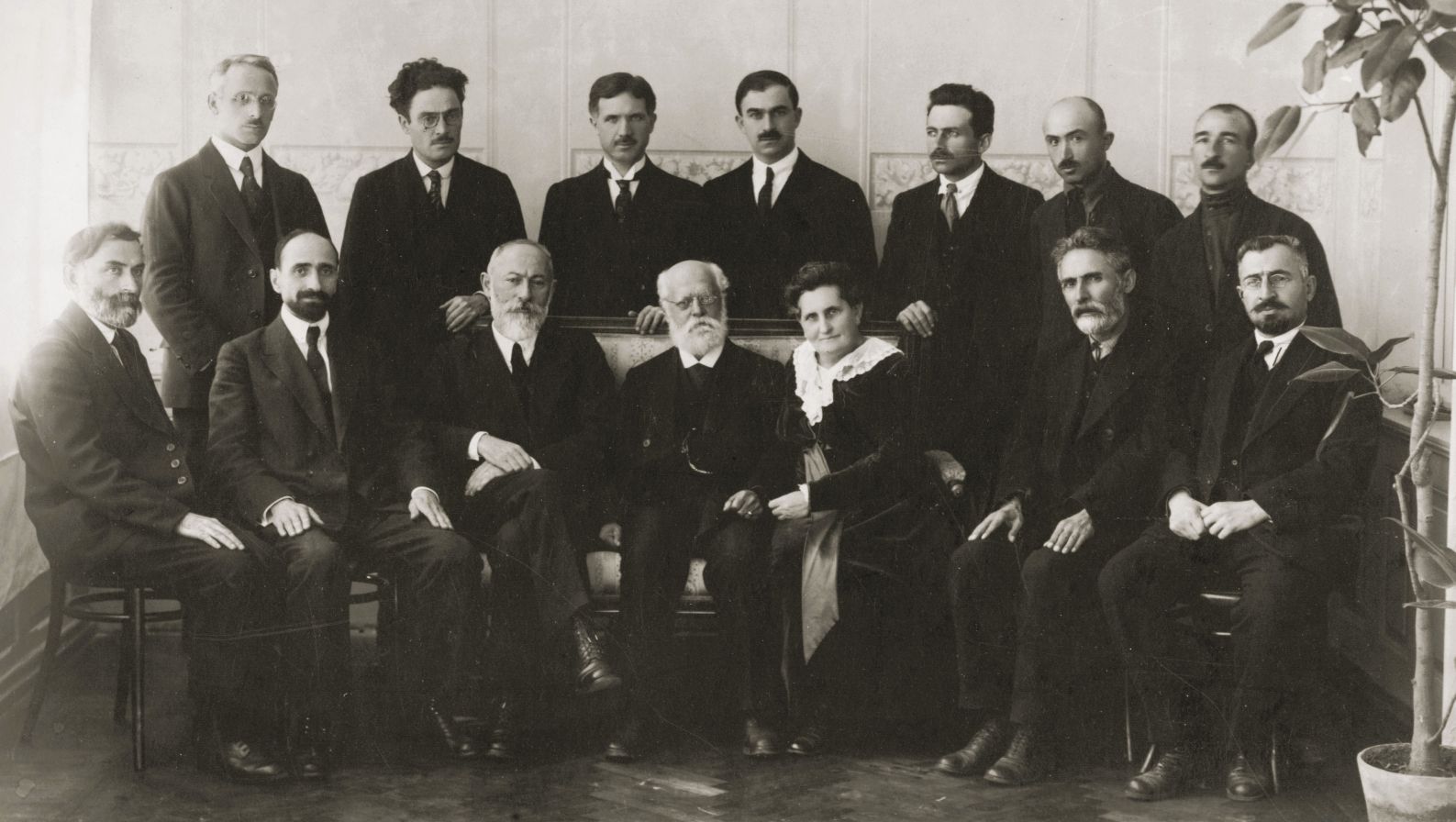
Posing internationally as a kindly Social-Democratic alternative to nextdoor’s Bolshevik barbarism, the short-lived Menshevik Georgian Republic was also shopping for an imperialist protector and loans from Western finance capital to beholden themselves to when they invited Karl Kautsky and a delegation from the Socialist International to visit Tblisi in August, 1920. Karl Radek, with a couple of remarkably well crafted sentences, comments as was his wont.
‘The Same Old Story’ by Karl Radek from Soviet Russia (New York). Vol. 4 No. 3. January 15, 1921.
THE Batum correspondent of Pravda describes in a very humorous way the entrance of Messrs. Vandervelde, Huysmans, and Kautsky, the latter with his inseparable Louise, mounted on an ass, in a country where there blossomed not only speculators (of the political-economic variety), semi-socialism, and a rathskeller democracy, but also the luscious grapes of Kazbek and Kachetia, of which Mr. Huysmans—and no doubt rightly—speaks with such enthusiasm in his farewell letter. Apparently, Huysmans, through affection for his Flemish ancestors, was unable to renounce his love for these charms. You may gather out of the Georgian press quite an accumulation of the most amusing sketches from this visit. For instance, picture to yourself the situation of the unhappy Kautsky, with his whole staff, deserting water-logged Germany and decaying France, like a Sancho Panza, and seeking in the Caucasus, like another Jason, a land ready to greet the “enthusiastic” Second International. Or, picture to yourself the entire usurious press of Georgia placing a wreath of laurel on the aid pate of the honored teacher of the Second International, and repeating with tears in its eyes the words: “Behold how Georgia has separated from the barbarous Muscovites and attained contact with European culture.” But even if we might admit that the honored theoretical mummy of the Second International, in spite of his chronic stomach trouble, has weathered the storms of the Black Sea, on his voyage to Georgia, merely in order to secure a moral repose after all the mix-up of that cursed European trouble, with its imperialism—which is only the consequence of an incomprehensible error on the part of capitalism— and with its thrice cursed Communism, which has its origin in the crass ignorance of the workers and the evil character of Lenin—we can nevertheless by no means make the concession that either M. Renaudel, or Minister Vandervelde, or Thomas Shaw, the courageous pioneer of the Parliamentary Committee of the British Labor Party, went to Georgia merely for the sake of the Kachetian grapes, no matter how greatly they may admire the latter, from what follows below the reader will learn what these gentlemen were really looking for in Georgia.
The Geneva Congress of the Second International declared itself opposed to military intervention in Soviet Russia on the part of the Allies. Simultaneously, however, it expressed its opposition to the alleged Soviet imperialism, which was said to be annexing independent countries, such as Azerbaijan. When Azerbaijan was occupied by the English, the leaders of the Second International displayed not the slightest interest in the affairs of that country, aside from the fact that the police agency at Baku was administered by worthy British trade unionists. Only after the Tartar usurers, the party of the Musselman bourgeoisie, was overthrown, and the oil stocks and oil tanks of Baku had fallen in the hands of the workers of Baku, who, in spite of the difficulties of the situation, made every exertion to supply the Russian workers with oil, only then did Shaw learn of the existence of Azerbaijan And it was only then that the Second International began to take an active interest in their affairs.
The trip of the delegates of the Second International to Georgia coincides with the negotiations between the British Government and that of Georgia on the subject of a loans to the latter. Georgia can give but little security for this loan. Its deposits of brown coal are very insufficient in the opinion of the British financial world, and the British Government asks as a substitute that Batum be leased to it. The British need Batum as a base against the Turkish rebels, and as an outpost for the conquest of the Caucasus, and, above all, of the Baku region. Once they have Batum in their hands, the British imperialists hope to destroy the center of Bolshevist and Communist agitation in the Near East, and simultaneously to cut off Soviet Russia from its oil wells.
It is clear that so extended an operation cannot be undertaken without some political “excavations”, and precisely this work was done by the delegates of the Second International. Some of the members of the delegation, such as Kautsky and Debroukere, are unconscious tools, while others, such as His Excellency Vandervelde, M. Renaudel—no one knows who paid the expenses of his trip to Poland—and Mr. Shaw are well known political agents of England.
How did these gentlemen go to work to carry out the criminal game of the British Foreign Office? They spoke not only as admirers of Georgian independence and democracy as opposed to the barbarous Soviet regime, but also as defenders of Georgian independence against the encroachments of the United States.
It will be recalled that shortly before the arrival of the Delegation of the Second International, the American Secretary for Foreign Affairs (Secretary of State) sent to Georgia a long note directed against Soviet Russia, and also against the British policy of splitting up Russia. While British capitalism is engaged in the effort of cutting off Russia from its border states, which served either as commercial gateways to Russia, such as Latvia and Esthonia, or which united Russia with the Near East, so much desired by England, as is the case with the Caucasus—American capitalism on the other hand would like to keep Russia intact in order to be able to exploit the country uniformly through its trusts, American capitalism has accepted the idea of a separate Poland and of an independent Finland, for these countries have all represented a certain military power, but is decidedly opposed to the independence of the small border states. Secretary Colby’s note disturbed the Georgian Government considerably. Messrs. Tseretelli, Giordandi, and other, who grew up in the struggle against the separatist tendencies, of course advocate the independence of Georgia only in so far, and for so long, as Russia shall remain in the hands of the working class. Should Russia tomorrow have a capitalistic government, they would immediately fall upon the breasts of the Kuchkovs with tears of joy while Mr. Gegechkory, in his answer to Colby’s note, in the columns of the Tribuna of Rome, proves that Russia, by failing to fulfill the obligations assumed toward Georgia, has thus annulled the treaty of unity voluntarily undertaken with Georgia; the party organs of the Georgia Mensheviki swear that they are separatists only through compulsion, not through their own desire. But aside from the reasons impelling the Georgian Mensheviki, who have otherwise always been good Russian patriots, now to come out for the independence of Georgia, they would for the present like their independence to be recognized by the Allies, since it would be very difficult for them to obtain a loan without such recognition. Now that the English Government, with the approval of the Georgian traitors, is about to lead a new attack against Soviet Russia through Georgian territory, and intending, with the approval of the Georgian Government, to occupy Batum, it sends out the gentlemen of the Second Intonational to Georgia, and thus transforms a burlesque donkey journey to the source of the Kachetian wine into a skilful political intrigue.
The esteemed delegation of the Second International plays its role without a hitch. It shakes its fist at Soviet Russia, even rages against Soviet imperialism, and simultaneously declares to Georgia that the Second International, in whose ranks there are ministers of the Entente, will defend Georgian liberty and Georgian independence. (See Renaudel’s speech in Tifliskoye Slovo, September 21).
This declaration is intended to smooth up the matter raised by Colby’s note. We have before us the preparations for an agreement between the Georgian Mensheviki and British imperialism, under the banner of the Second International. The Second International is simply continuing its old policy. During the war it served, with its various parties, as a channel through which the belligerent governments of both camps might influence the working classes. With the victory of the Allies it became an agent of their influence and spread among the masses a belief in Wilsonism. Now the Second International has been transferred to London, and has become a tool of the British policy. It would like to conceal this fact with pacificistic and democratic phrases, but then, even Lord Curzon is a pacifist, an adherent of democracy, not to mention Mr. Lloyd George, who literally oozes pacifism whenever he gets ready to deliver a speech. Those who are surprised by this new role of the Second International know very little of the world situation. While it opposes the dictatorship of the proletariat, the Second International must support bourgeois democracy against this dictatorship. The leading power in Europe is now England, which knows better than anyone else how to veil the dictatorship of capital in democratic phrases, and therefore Lloyd George is a Messiah for Messrs. Huysnjans, Vandervelde, and the other brethren of the Second International. On his suggestion they will now go out to prepare the soil for the attacks of British imperialism. Their journey to Tiflis was only the first step on this road.
Soviet Russia began in the summer of 1919, published by the Bureau of Information of Soviet Russia and replaced The Weekly Bulletin of the Bureau of Information of Soviet Russia. In lieu of an Embassy the Russian Soviet Government Bureau was the official voice of the Soviets in the US. Soviet Russia was published as the official organ of the RSGB until February 1922 when Soviet Russia became to the official organ of The Friends of Soviet Russia, becoming Soviet Russia Pictorial in 1923. There is no better US-published source for information on the Soviet state at this time, and includes official statements, articles by prominent Bolsheviks, data on the Soviet economy, weekly reports on the wars for survival the Soviets were engaged in, as well as efforts to in the US to lift the blockade and begin trade with the emerging Soviet Union.
PDF of full issue: https://www.marxists.org/history/usa/pubs/srp/v4-5-soviet-russia%20Jan-Dec%201921.pdf

