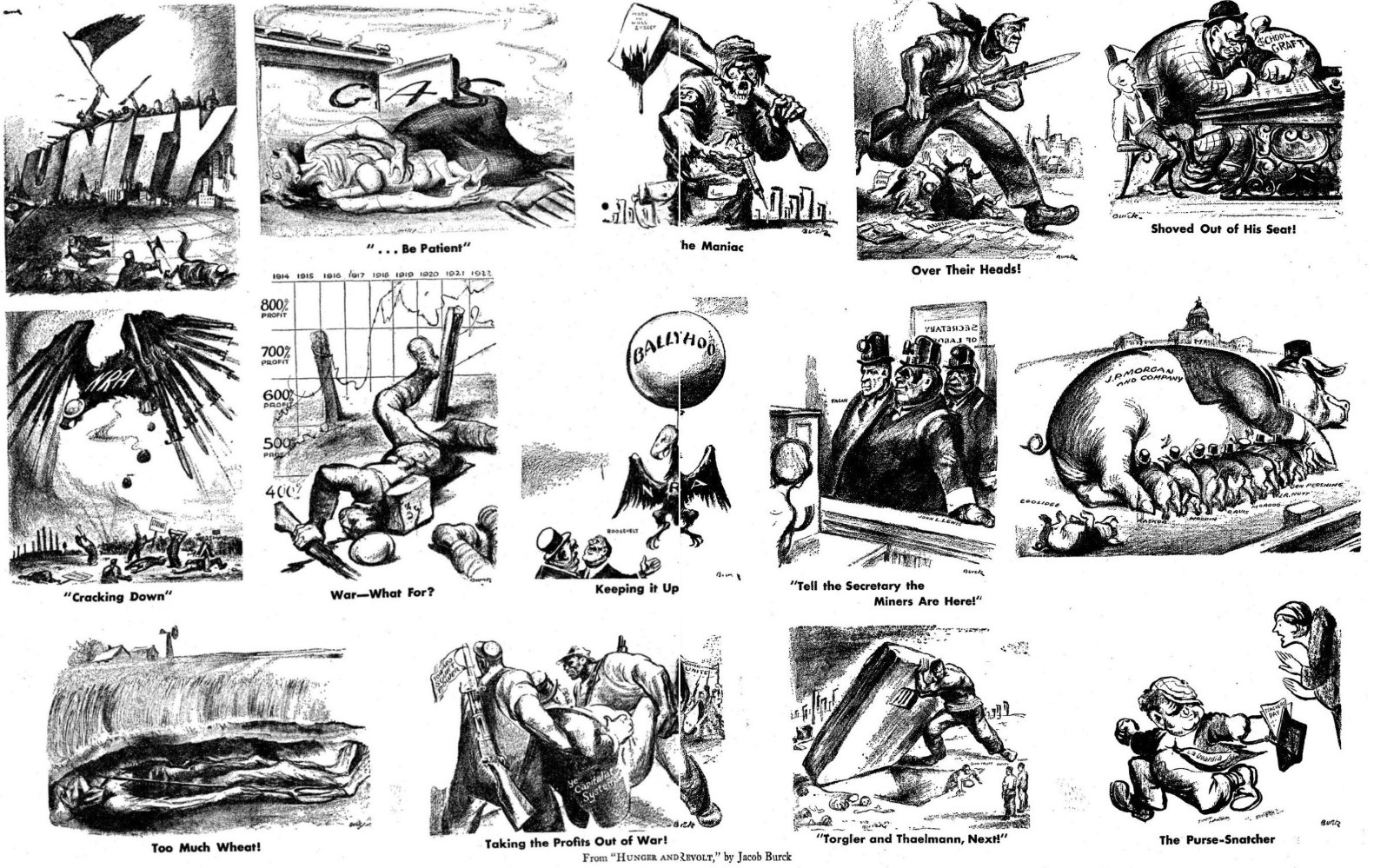
The illustrators and cartoonists for the Communist Party press like the Liberator, New Masses and Daily Worker, were central to creating a whole working class political culture, with art playing a leading role in communicating radical ideas. Just a few of the great artist contributing include Adolph Dehn, Fred Ellis, Robert Minor, Russel T. Limbach, William Gropper, Art Young, Hugo Gellert, Maurice Becker, Lydia Gibson, H.J. Glintenkamp, Hay Bales, Don Brown, William Siegel, K.A.Suvanto, and the wildly prolific Jacob Burck, whose collection of over 120 works, Hunger and Revolt, is reviewed below.
‘Jacob Burck’s America’ by Stephen Alexander from New Masses. Vol. 14 No. 10. March 5, 1935.
HUNGER AND REVOLT, by Jacob Burck. The Daily Worker. $1.
WE were arguing the relative merits of bourgeois and revolutionary cartoonists. There was no question of content…we were all in agreement on that…but my friend was contending that Rollin Kirby was superior to Burck in draftsmanship and composition. I was amazed at his taking such a position because he himself is particularly strong in both of these qualities. I pointed out how Kirby virtually admitted his technical poverty by the frequency and extent to which he deserted drawing for lettering. But no use. We each stuck to our respective opinions. I decided to collect a month’s work by each man and compare the two sets for my own satisfaction. I selected from each group the cartoons which I considered “good drawings,” irrespective of content, trying insofar as it is possible, to be completely “objective.” I found an even greater margin of superiority for Burck than I had expected. He had over three times as many “good ones” as Kirby.
I cite this personal incident not merely to assert Burck’s superiority to a Pulitzer-Prize-Winner bourgeois cartoonist–you don’t have to be good to be better than Kirby–but to emphasize the point that Burck’s cartoons are in the great tradition of satiric art.
Until the comparatively recent appreciation of Daumier’s genius as evidenced in his hundreds of daily satiric drawings, there has been a snobbish attitude in this country on the part of “fine” artists toward caricature. When they didn’t consider it beneath their notice they looked down on it as a “low” form of art. This derived in part from the nature of the class the gallery-artist served, and in large measure from the deplorably low standard of satiric drawing that has existed in this country until recent years. In Europe, notably in France and pre-Nazi Germany, the art of satiric drawing has had at long and rich development which created an honorable tradition and thus gave the form high critical standing. In the Soviet Union. today men like the Kukriniks enjoy the prestige of truly great and honored artists, the foremost satirists in the Russian art world. Our own development in this respect has lagged behind that of Europe but within the last ten or fifteen years a great change has been taking place, and not the least has been the substantial development of American revolutionary caricature. Today even strongly anti-radical art critics have paid their admiration to the work of our revolutionary caricature. Today even strongly anti-radical art critics have paid their admiration to the work of our revolutionary cartoonists. Some of the high-hat galleries, and even a few museums, have decided that their stuff is “art.”
Although the bourgeois critics have also recognized his outstanding ability, Burck’s work needs no gallery-ballyhoo. It has far better and sounder justification. It has won its deservedly high place by supplying the day-to-day needs of the revolutionary working-class for a clear, fighting, and inspiring art.
Burck’s cartoons are tremendously popular with both workers and intellectuals. They combine amazingly fertile imagery with keen political understanding, and a swell sense of humor. When Burck ridicules an oily-mouthed politician he “does him in.” LaGuardia, “The Purse-Snatcher” is not only pictured in his true role, cutting teachers’ salaries in this case, but is made such a comic fat-boy sneak-thief that nobody can help laughing at him. And when Jacob Burck shows Roosevelt’s ballyhoo, a gas balloon, holding up the plucked-crow-of-an-N.R.A. it gets a good hearty belly-laugh. You never saw a funnier and more bedraggled bird. And what he does to Morgan, shoving the other kids aside as he rolls his big dollar hoop, helps our digestion and does Morgan’s no good, I’m sure. Burck can also express the most profound tragedy. When, for example, he depicts the starved farmer, dead in his own wheat field, he gives us a powerful dramatization of the capitalist paradox of increasing mass starvation and misery in the midst of plenty. This is one of the finest of his many excellent drawings. His versatility is shown in numerous ways. Not only in the variety of imagery and mood, but also in the different kinds of compositions. He can either fill the whole space, or “spot” his design around, focus it in a single point, or balance it symmetrically or diagonally.
And any review of these drawings should consider the pressure and speed with which. they have to be turned out. No time to study and revamp your idea-improving a weak corner here and a bad spot there or to refine your drawing by successive changes. William Gropper, who knows at first hand the conditions under which the daily cartoonist must work, was surprised at the number and quality of these drawings. Having made a previous collection and selection of my own, I was not so surprised at the amount of “pay-dirt” they have yielded. And The Daily Worker should be congratulated for putting out a splendidly designed and printed job in this book.
Abler men than I have already given these cartoons the praise they deserve for the living record they make of our time. A series of brilliant forewords have been written for the sections, into which the book divides. But I want to take this opportunity to say a few words about Burck’s cartoons and “the American scene,” so much bandied about these last few years. A school of artists and critics, led by Benton and Craven, are whooping it up with increasing intensity for “American Art.” “Interpret America……turn your back on all these damned furriners who would pollute our pure American soil…See America first, last, and all the time, and see nothing else,” they say in substance. And their exponent of “100 percentism” in art has given us his idea of the American scene in a series of murals in the Whitney Museum. When you examine them you find a chaotic agglomeration of unrelated, disorganized, St. Vitus-like aspects of American life. A prizefight, a dance hall, a revivalist preacher, etc., etc., all scrambled together with only one meaning…AMERICAN LIFE HAS NO MEANING. LOOK AT IT BUT DON’T TRY TO FIGURE IT OUT.
Well, Burck has given us the American scene also. But he has given us a very different one from that of the “100 percenters”. He has shown that below the apparently chaotic, meaningless surface of the tabloid version of America there is meaning and sense. And he has not erected any chauvinistic wall around his America. He has shown us America in relation to the rest of the world, and so given us a more scientifically correct picture of it. He has not indulged in the obscurantist putting-on-of-blinders that characterizes the “100 percent” school. Burck’s cartoons are as truly American as Ring Lardner’s writing, or a World Series between the Giants and the White Sox, but they are more than that, too. They are a powerful force in remaking America.
The New Masses was the continuation of Workers Monthly which began publishing in 1924 as a merger of the ‘Liberator’, the Trade Union Educational League magazine ‘Labor Herald’, and Friends of Soviet Russia’s monthly ‘Soviet Russia Pictorial’ as an explicitly Communist Party publication, but drawing in a wide range of contributors and sympathizers. In 1927 Workers Monthly ceased and The New Masses began. A major left cultural magazine of the late 1920s to early 1940s, the early editors of The New Masses included Hugo Gellert, John F. Sloan, Max Eastman, Mike Gold, and Joseph Freeman. Writers included William Carlos Williams, Theodore Dreiser, John Dos Passos, Upton Sinclair, Richard Wright, Ralph Ellison, Dorothy Parker, Dorothy Day, John Breecher, Langston Hughes, Eugene O’Neill, Rex Stout and Ernest Hemingway, Artists included Hugo Gellert, Stuart Davis, Boardman Robinson, Wanda Gag, William Gropper and Otto Soglow. Over time, the New Masses became narrower politically and more journalistic in its tone.
PDF of full issue: https://www.marxists.org/history/usa/pubs/new-masses/1935/v14n10-mar-05-1935-NM.pdf

