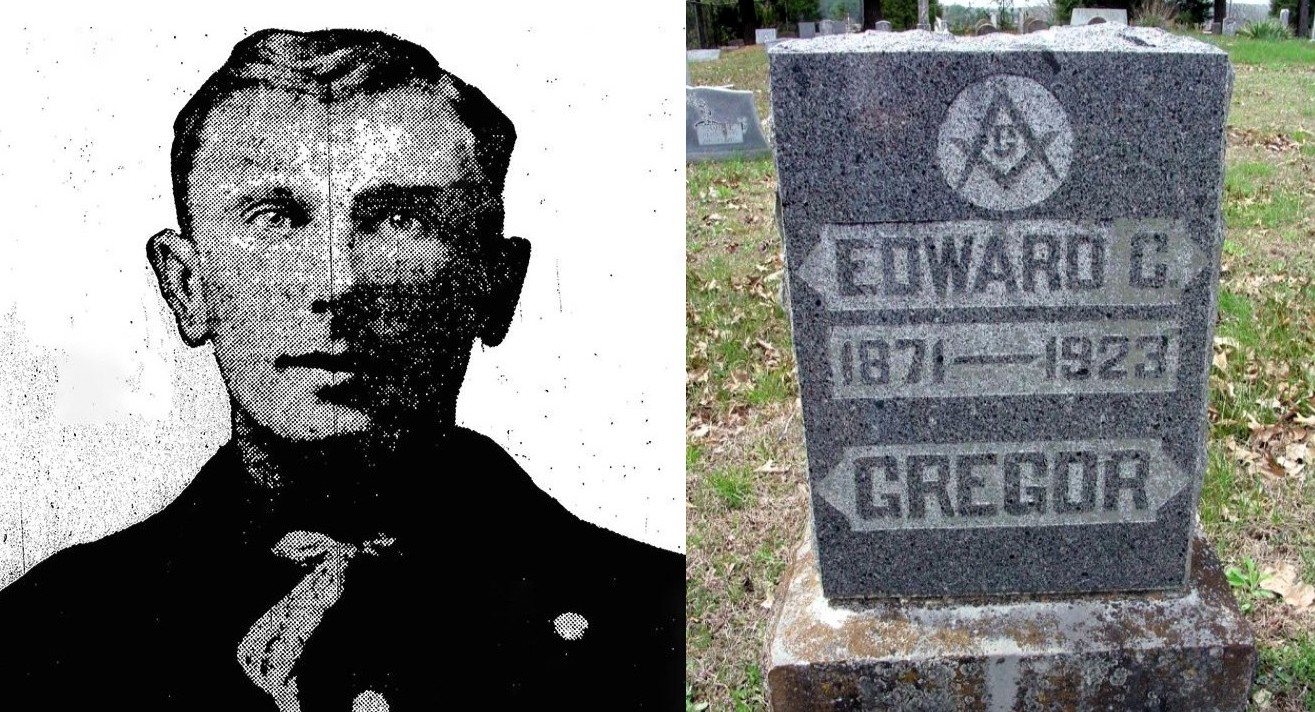
Several hundred striking shop workers striking against the Missouri and North Arkansas Railroad in Harrison, Arkansas were violently rounded up and with their families deported to Missouri in January, 1923 by the local government/Klan/businessmen, who also took union organizer Ed C. Gregor from jail and hung him from a nearby railroad bridge. Those behind the raids were well-known, and immune with no charges ever being made in the lynching.
‘How They Hanged a Railroad Striker in Arkansas’ from Justice (I.L.G.W.U.). Vol. 6 No. 40. October 3, 1924.
The story of the futile attempts of a minister of the gospel to apply the teachings of Jesus in a midst of mob rule is movingly told in a book just published by Rev. J.K. Farris, of Wynne, Arkansas. It is a vivid first-hand picture of the bloody week in January, 1923, when a so-called “Citizens Committee” crushed the strike of the Missouri and North Arkansas Railroad workers at Harrison, Arkansas, by raiding houses, attacking men and women alike, driving strikers out of town and crowning a day of rioting by lynching E.C. Gregor, a former railroad striker.
The Rev. Mr. Farris was appointed to the Methodist Church at Harrison in December, 1922. The strike, which had begun in February, 1921, when the railroad tried to force the workers to accept lower wages, had been on for almost two years. Trains were being manned by scab crews, a violent open shop campaign was being waged, and the air was tense with hostility between the strikers and the Harrison merchants. As a minister who had for thirty years earnestly tried to live up to the doctrines of his church, Rev. Farris declared his neutrality and did his best to perform his pastoral duties among union and non-union families alike.
The railroad management did all in its power to enlist him against the strikers, as it had already enlisted the other ministers in the town. The confidential secretary of the railroad attorneys, who was also secretary of Mr. Farris’ church, used all her powers to win him over to the open shop cause. Farris, however, insisted that the message of Jesus knew no divisions.
Incidentally, the railroad seemed to have strange prophetic powers. This confidential secretary warned Rev. Mr. Farris that “things were going to reach a climax before long.” Another person with oracular powers was a stranger in Harrison whom Mr. Faris calls Brother Mack. The past history of this gentleman is shrouded in mystery. He came into town at the beginning of the strike. He divided his time between “praying beautifully in public” and sitting in at the secret conferences of the railway management. This mysterious stranger warned Mr. Farris that “Harrison will soon be in possession of an armed mob coming from other counties to clean up the town and get rid of the strikers.”
The mob, as he predicted, came on January 15. Strikers were rounded up, beaten and arrested. The home of a former striker who had found another job in another town was riddled with bullets. This man, E.C. Gregor, was locked up with other prisoners in the court house. For some strange reason which no one has ever explained, the sheriff who was detailed to guard Gregor, left him sleeping at the court house while he took all the other prisoners to the town jail. At dawn a mob drew up in two automobiles, dragged Gregor to a railway bridge and hung him.
That same morning the mob broke into the home of a Harrison capitalist who had committed the crime of furnishing bail for a striker, and flogged him in his nightshirt while his wife and children, [] the end of the week, after a ruthless reign of terror directed by Harrison’s best citizens, the town was cleared of strikers, and the leader of the mob was able to boast that “the union a now dead in Harrison and the M. & N.A. is a scab road forever.”
A few hours after Gregor was hanged, a coroner’s jury found that the victim had met his death at the hands of “parties unknown.” Shortly afterward, when every last striker had been hunted out of town, a legislative investigating committee gave the respectable citizens of Harrison a clean bill of health. In return the respectable citizens of Harrison gave the legislative investigating committee a banquet.
In the end Mr. Farris, who tried never to let “hatred, passion or prejudice” come into his life and who had so earnestly tried to live the gospel of Jesus without taking sides in the industrial war at Harrison, needed all the faith he had, for his reward was to be ousted from the Methodist Church of Harrison, not for taking the side of the strikers but for refusing to take the side of the railroad. Neutrality had cost him dearly in material terms; he is now a pastor without a church.
On the other hand, Brother Mack who stood high in the councils of the railroad management and knew all about the armed mob in advance and wore his white badge with the other strikebreakers, this gentleman of mysterious antecedents is now a full-fledged Methodist preacher in charge of a congregation. God works, it has been said, in a mysterious way. So do railroads.
The weekly newspaper of the International Ladies Garment Workers Union, Justice began in 1909 would sometimes be published in Yiddish, Spanish, Italian, and English, ran until 1995. As one of the most important unions in U.S. labor history, the paper is important. But as the I.L.G.W.U. also had a large left wing membership, and sometimes leadership, with nearly all the Socialist and Communist formations represented, the newspaper, especially in its earlier years, is also an important left paper with editors often coming straight from the ranks radical organizations. Given that the union had a large female membership, and was multi-lingual and multi-racial, the paper also addressed concerns not often raised in other parts of the labor movement, particularly in the American Federation of Labor.
PDF of full issue: https://www.marxists.org/history/usa/pubs/justice/1924/v06n40-oct-03-1924-justice.pdf

