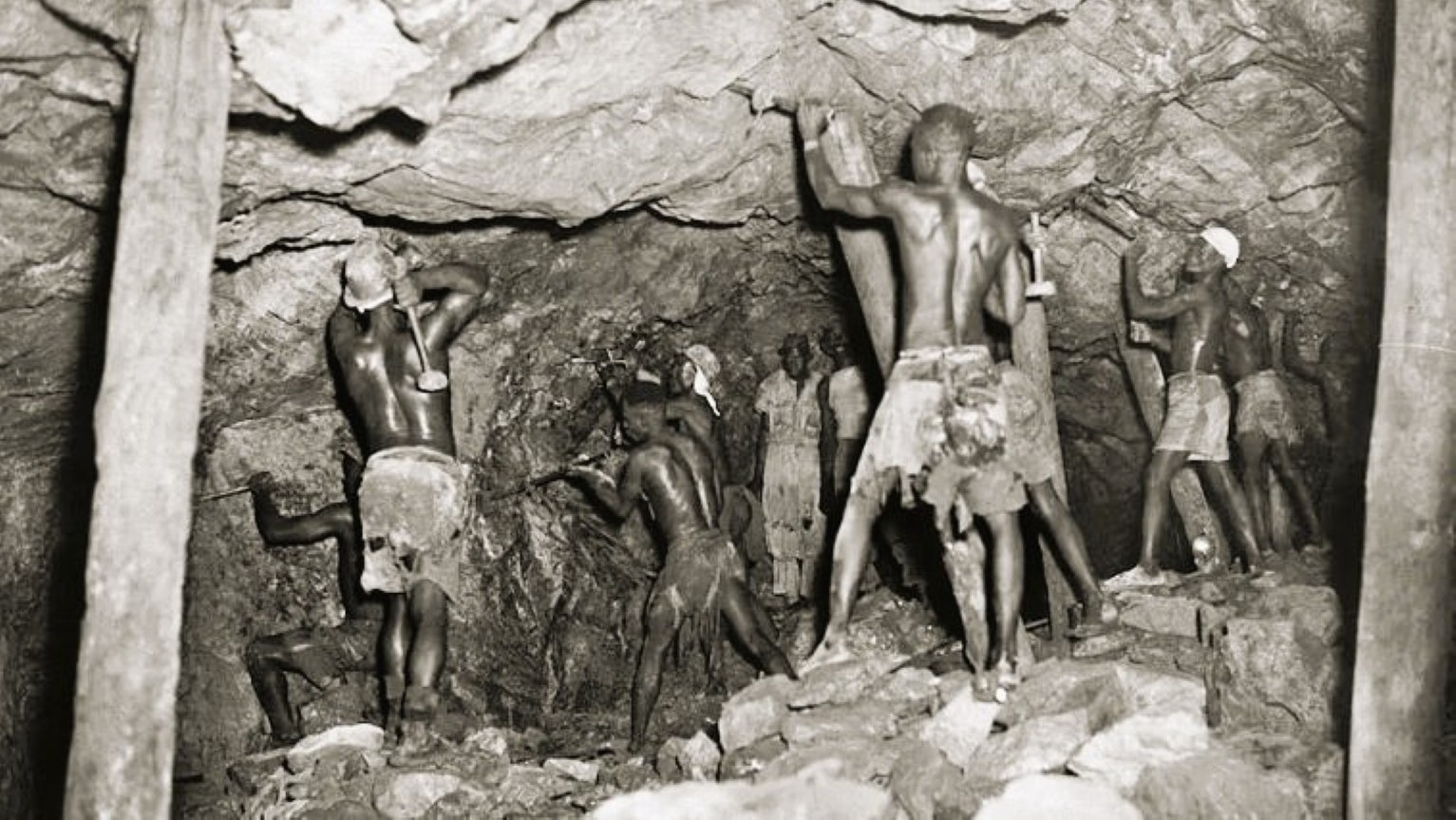
An official death toll, already extraordinarily high, is certainly too low. The hellish exploitation in the Empire’s South African mines.
‘Negro Miners in South Africa’ by James Warren from Negro Worker. Vol. 2 No. 5. May, 1932.
In dealing with the conditions of the mines in South Africa, it becomes imperative first of all to show the peculiar conditions which the imperialists have created in order to ensure for themselves a source of adequate supply of labour.
South Africa is primarily an agricultural country; but with the development of its chief industry, mining, the predatory imperialists have put into operation a policy of dispossessing the toiling masses of the means of subsistence, and the creation of a standing industrial reserve army of labour. The natives were robbed of their land, being left with small and unfertile strips of land hardly adequate to accommodate a fourth of their population. These strips of land are the so-called reserves.
Repressive laws are passed by parliament, annually prohibiting the lease of land to native farmers and squatters. Numerous imperio-feudal taxation laws add misery and degradation to the existing intolerant conditions. Under these circumstances intensified by military measures the natives are compelled to work for low wages; they are indentured on long term contracts–nine or twelve months–cut off completely from their families until the termination of these contracts, given rotten food and forced to live in filthy, stinking and over crowded compounds.
The peculiar forms of capitalist exploitations of the native miners, stand unique in history compared with any other miners in the capitalist world. In spite of the high daily accident and mine phthysis which affects enormous numbers every year; no compensation benefit exists. As soon as signs of phthysis are discernable on a native worker, the doctor immediately orders his discharge without giving him a hint about the sickness and no compensation. Hundreds are killed, entombed and mutilated annually but nothing is given them or their dependents. Those who are maimed, are thrown out of work and thus become the burden to their dependents.
The Government official statistics gives us the following figures of natives killed and injures in accidents: 1929 killed 793, injured 8,356. For 1930, killed 872, injured 9,253. But when we look at these “official” figures and take the concrete situation, having the knowledge of the daily events in the mines, then we conclude that something is radically wrong with them. Furthermore the “official” statistics does not give us the actual death rate other than of accidents as if people were not dying yearly by the hundreds, as result of the rotten, scanty food and bad sanitation. How about the diggings? Did the government not introduce again its dipping system: “in order to save the native people from the perilous disease?” If so, where are the “official” figures? (In South Africa, the system of dipping is not only applied to animals but also to the native people.) The working day is from twelve to fourteen hours of absolute hard labour with some one standing with a whip behind; brutally kicking and cursing them. The law recognizes no skilled native. He may be as skilled as the white workers but the laws of the Union of South Africa, by its notorious Colour Bar denies him the right of being skilled. Regardless of the fact that he performs skilled work, his wages remain the same as that of a common labourer. The native miner is used for boring the hard rock underground with a jumper and hammer, which owing to the awkward conditions in which the labourer has to work, lying on his back the whole day in the water pouring above his face, is not only exhaustive but also physically dangerous. The drillers are supposed to be paid per piece of twelve inches at the rate of sixpence. But if one fails to drill three holes his ticket is marked loafer (zero) in which case he forfeits his day’s wages.
With the introduction of modern drill-bore, which is noted for efficiency, when the workers are being speeded-up and the work more and more intensified, the “gang” has been reduced considerably. The drillers of yesterday are today strolling up and down the streets of the mining towns seeking not only work and bread, but also for a place to sleep.
Not satisfied with these methods of exploitation, the capitalists introduced a new system of robbery: a system of deferred payment by which a major portion of the native workers’ wages are held back and invested in the banks in the interest of capitalists who draw huge interest from it. This system of pay is known to the whole state machinery, from C.I.D. Police to magistrate. This system is ruinous to the native workers since they can never get the exact amount kept back from their wages.
The exploitation of the native workers in the mines has been supported by chauvinistic cries of “white supremacy” of the bourgeois politicians and labour aristocrats. The labour aristocrats in the mines have consciously assisted the exploitation of the natives; they act as overseers driving the “boys” for the highest labour output. While the wages of the white workers in normal times have increased from 21 to 25 shillings those of the Negro workers have fallen from 2,6d to 1,6d per day. The standard of living of the white workers was kept up at the expense of the Negro workers by means of the so-called civilized labour policy, a policy of super-exploitation of the imperialists and the social fascists in the colonies. The Civilized labour policy originated from the so-called pact of Colonel Cresswell leader of the South African Labour Party and General Hertzog leader of the Nationalist Party and now Prime Minister of South Africa. This policy was formulated after the 1922 upheavals, by the social fascists and nationalists against the South African Party then in power. The essence of this policy is to “employ white men at white men’s wage” in all enterprises and drive all the “n***s out of industry”. A demagogy to further divide the black and white workers.
The year 1930-31, exposed to the white workers of South Africa the real meaning of “white supremacy and civilized labour”; namely that it was a smoke screen for attacking the standards of both white and black workers. That with the deepening economic crisis, all round economy, short time, wage cuts and dismissals take the place of “white supremacy”. Only then did the white workers in the mines begin to realize that the real “menace” to their livelihood was not the black workers but the imperialists. The workers are daily thrown on to the scrap-heap. The mines are resorting to short-time some are closing down the shafts and in some extreme cases recourse has been had to one shift only. The coal-miners in Natal are facing starvation, and the lives of our “prosperous” diamond diggers in Namaqualand, Port Nollforth and the Western Transvaal are threatened, while the native workers are hardly able to earn the miserable pittance of 5- a week. Even the report of the chairman of “De Beers”, one of the largest diamond mines in South Africa and perhaps the richest in the world expresses alarm.
The conditions of the black miners are worse than ever before. The imperialists mine magnates in South Africa are carrying on a big campaign for substantial wage-cuts and other economy measures at the expense of the workers, especially Negro workers. The African Federation of Trade Unions, the South African section of the R.I.L.U. is mobilizing the workers against the offensive of the capitalists. The reformists trade union bureaucrats, in this situation, are assisting the employers in this offensive. The workers are learning that they cannot place any faith in these fakirs who will not fight for their interests. The Red Trade Unions on the other hand are proving their devotion to the cause of the working class are becoming the real leaders of the economic struggles of the workers.
First called The International Negro Workers’ Review and published in 1928, it was renamed The Negro Worker in 1931. Sponsored by the International Trade Union Committee of Negro Workers (ITUCNW), a part of the Red International of Labor Unions and of the Communist International, its first editor was American Communist James W. Ford and included writers from Africa, the Caribbean, North America, Europe, and South America. Later, Trinidadian George Padmore was editor until his expulsion from the Party in 1934. The Negro Worker ceased publication in 1938. The journal is an important record of Black and Pan-African thought and debate from the 1930s. American writers Claude McKay, Harry Haywood, Langston Hughes, and others contributed.
PDF of full issue: https://www.marxists.org/history/international/comintern/negro-worker/table.htm#:~:text=25-,James,Africa

