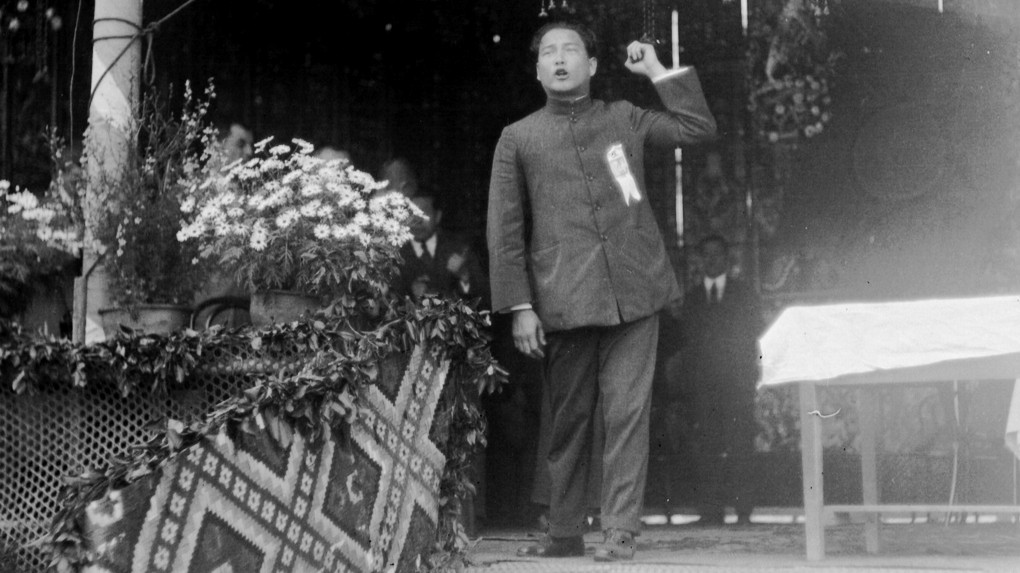
An original history of a turning-point in the Chinese Revolution, the July 15 Incident, written by a participant from the scene at the time. I wish I could further identify the author, ‘Sz toh-li’ more than to say he is from Wuhan and on the leading Bureau of the Red International’s Pan-Pacific Trade Union Secretariat. The First United Front, stemmed from an agreement in January, 1923 after negotiations between Adolph Joffe and Sun Yat-sen formalizing cooperation between the Soviets and the K.M.T., to provide technical, educational, diplomatic, and most important, military assistance to the Kuomintang. A Chinese Communist Party was not itself a factor in January, 1923, having some dozens of members in the country, and largely students. After Sun Yat-sen’s death in early 1925, a rising national and class struggle, often combined, saw an explosive growth of the workers’ movement and new Communist Party. The development of a strategy for this now significant Party was largely determined in the Comintern, and would be influenced by the many struggles occurring in the International and the Russian Party during the mid-1920s.The cooperation with an increasingly powerful Communist faction, courting peasant uprisings no less, was not what many in the Kuomintang signed up for. With the subsequent growth to dominance of a KMT Right under Chang Kai-Shek. A confrontation was going to come. Following his success against the warlords in the Northern Expedition, Chang Kai-Shek murderously turned on his allies. In April, 1927, his Nationalist Army approached Shanghai against the militarist clique in control. Communist and Left KMT forces staged an uprising in the city to wrest control before the National Army entered. When it did enter the city, it shot down its former allies by the thousands and the KMT formally split between Left and Right. The Left KMT regrouped in Wuhan, including members the Communists, and set up a rival Nationalist base. However, on July 15, 1927 the Left KMT Wuhan government, under military pressure from Chang, again turned on their Communist allies purging them from the government and outlawing them. The alliance had turned to total war. In August the Comintern facilitated the removal of C.P. leader Chen Duxiu, who was blamed for the failure of the Comintern’s own policy of working within the Kuomintang, and promoted a new leadership around Qu Qiubai. That new leadership was tasked with organizing a series of uprising,s which would culminate that December and be known at the time as the Canton Commune. Simultaneously, the Nanchang Uprising, and, under Mao’s leadership, the Hunan peasantry launched the Autumn Harvest Uprising . All were crushed, with the crimes against the heroic, short-lived ‘Canton Commune’ as thorough and brutal as those done to Paris in 1871. However, Mao’s column would survive, retreating to the mountains where many urban militants would join him. The Chinese Revolution would change definitively, as the original strongholds of the Communist Party among workers in the coastal cities shifted to the rural interior and a peasant-based movement, becoming the First Civil War.
‘Whither Wuhan?’ by Sz-Toh-Li from The Communist. Vol. 6 No. 6. September-October, 1927.
(Hankow) Hankow, China, August 1, 1927.
THREE months ago Wuhan was still the centre, the heart of nationalist-revolutionary China. Wuhan was the only centre that could boast the support of the masses, the toiling masses of the workers and peasants—the decisive factor in every revolutionary movement. Three months ago Wuhan could easily be distinguished from Canton, where Li Chi Hsin, the reactionary tupan inaugurated his bloody dictatorship and anointed himself with the best blood of the Cantonese proletariat and peasantry. Three months ago Wuhan could also be distinguished from the military dictatorship of Chiang Kai Shi who came to the fore as the champion of the big bourgeoisie and the feudal elements of China, who were willing to compromise as easily with the Northern militarists as with the imperialist powers. Three months ago the voice and authority of the Wuhan Government commanded the fear if not the respect of even the most venomous enemies of the Chinese Revolution. At home the reaction dared not raise its head; abroad the imperialist powers were already beginning to reconcile themselves to the idea of the permanence and stability of the Nationalist Government. Three months ago the Wuhan Government still enjoyed the unqualified support and solidarity of the international proletariat and of the exploited peoples throughout the world. The First Workers’ Republic, occupying one sixth of the globe and representing a mighty revolutionary nation of 140 million workers and peasants, lent every ounce of their phenomenal energy and revolutionary fervor in support of the Chinese Revolution and of the Wuhan Government. Three months ago the workers, peasants, soldiers and students, and even the merchants were taught by the propagandists of the Kuomintang that the Chinese revolution constituted an integral part of the World Revolution. Wuhan, as the heir of Red Canton, promised fairly to become the second Mecca of the World Revolution. Labour delegations and trade union representatives from the imperialist and colonial countries came to revolutionary China to see for themselves what profound changes were taking place in awakening, giant China. The Wuhan Government, as formerly Canton, became an asylum for the oppressed and persecuted of all the colonial and semi- colonial countries: Hindus, Koreans, Javanese, Filipinos, Formosans, etc. Three months ago the first International Workers’ Delegation, composed of representatives of the working class of the three major imperialist countries, was still on the territory of the Wuhan Government, acquainting itself with the work and progress of the revolutionary forces of the new China, especially with the condition of the toiling masses and their organizations, The Trades and Peasants’ Unions. This the International Workers’ Delegation could then do freely, for the Trades and Peasants’ Unions were free and strong and thriving without any hindrance on the part of the reactionary forces. The social revolution was beginning to shoot its roots deeply into the soil freshly tilled by the political revolution. The agrarian revolution was beginning to sweep certain sections of Nationalist territory with its mighty waves. Three months ago, representatives of over fourteen million trade unionists of China, Korea, Java, U.S.S.R., England, U.S.A. and France met in Wuhan at the Pan-Pacific Trade Union Conference, whose first word was spoken in condemnation of imperialist invasion of China, and whose first appeal was to the workers of the Pacific and of the whole world to come to the active support of the Chinese Revolution. As with the International Workers’ Delegation, so at the Pan-Pacific Trade Union Conference, representatives of the Kuomintang and of the Nationalist Government made grandiloquent declarations about the decisive role played in the revolution by the Chinese proletariat, the peasantry and the Trade Unions; they declared solemnly that never, NEVER would the Nationalist Government deceive or betray the workers and peasants. Shortly after the Pan-Pacific Conference, there was convened, also in Wuhan, the IV Trade Union Congress of the All-China Labour Federation. Representatives from all parts of the country, even from provinces still in the hands of the Northern, Southern, Eastern and Western militarists and reactionaries, gathered in Hankow, reported on the condition of the workers in the various sections of the country, and, breathing inspiration from the revolutionary atmosphere of Wuhan and from the revolutionary experience and militancy of the Chinese proletariat and its leadership, they jointly adopted momentous decisions which were to acid-test their own strength and the revolutionary character of the Nationalist Government. Here too, eloquent representatives of the Nationalist Government and of the Kuomintang assured the delegates that the two main moving forces of the revolution were the workers and peasants, and that the Nationalist Government would and could never betray the interests of these two classes which constituted the mainstay of the Chinese Revolution.
TODAY the Wuhan Government is no longer revolutionary.
It is completely in the hands of what may be called the Nationalist Militarists. No ingenious confusion on the part of Wong Ching Wei or any one else can deceive us. Today the Wuhan Government cannot by any stretch of the imagination be distinguished from that of Li Chi Hsin or that of Chiang Kai Shih. How could it be? The trade unions have all been raided and rummaged in true Chang Tso Lin fashion by Nationalist troops under omnipotent reactionary generals. Not a single trade union is open today in the Wuhan cities. The trade union leaders are either under arrest (if not executed) or have been forced to flee. Martial law is the order of the day. Strikes are forbidden and trade union organizers are outlawed. Every movement for the improvement of the condition of the workers is branded as Communist and is punishable by death. The trade and peasants’ unions in the Hunan, Hupeh and Kiangsi provinces have been destroyed and many leaders and active workers executed. Reaction reigns supreme and has become brazenly daring. Wuhan today is stifled with posters and proclamations issued and distributed by the reactionaries, calling for the complete destruction of the trade unions. The leaders of the All-China Labour Federation and the Hupeh General Labour Union are being hunted down like criminals. Proclamations by the Government, the Military Council and the counter-revolutionary garrison commander offer big rewards for the denunciation and arrest of labour leaders and strike agitators. Only the other day the Chairman and two Secretaries of the Wharf Coolies’ Union were arrested by garrison troops on the charge that they were instigating the workers to a general strike. Executions of workers and active trade unionists take place daily in Wuhan. Many of the most active arsenal workers of Hanyang have been executed. The “People’s Tribune” of August 5, carries the following news item: “Wang Fang Hsin, a reactionary, was executed by order of Wuhan Garrison Headquarters on Wednesday (Aug. 3). He was discovered to have plotted for a general strike…” The “Hankow Herald” of the same date reports that on Aug. 3, about ten former workers of the British Cigarette Co., being officials of the B.C.C. Workers’ Union, were arrested and handed over to garrison headquarters, charged with instigating local labour to a general strike. (They have probably met with the same fate). The “People’s Tribune” of Aug. 11, reports that twenty-five “communists” including the Chairman of the Kiukiang General Labour Union were executed in that city by order of the Nationalist Government.
Does all this not recall the days of Sun Chuan Fang in Shanghai or of Wu Pei Fu in Hankow? The cynicism of the Wuhan counter-revolutionaries surpasses the morbid bestiality of a Mussolini. When the Italian Fascist Generalissimo murders trade unionists and revolutionaries, he at least does not charge the victims with being reactionaries and counter-revolutionaries. The Wuhan executioners on the contrary, murder the trade union leaders and revolutionary workers on the charge that they are reactionaries(!). This is of course intended to deceive the working masses. But the workers will not be deceived. They know their leaders and will avenge them in no uncertain manner.
With the closing of the trade unions, the labour pickets have been disarmed, arrested or driven away. And here enters an- other characteristic feature into the new reaction of Wuhan. The newspapers of Aug. 11, report that armed corps of “labourers” have been organized under the auspices of the Labour Department of the Kuomintang for the purpose of “protecting the workers against the plots of the revolutionary labour leaders”…Judging from the experience of the Chinese working class in Canton, Shanghai and elsewhere, there can be no doubt but that these “armed labour corps” are a new edition of Fascist bands organized for the purpose of disrupting the labour and peasant movements. On this score, as on most any score, the Wuhan Government may without hesitation shake hands with Chiang Kai Shih and Li Chi Hsin.
Not only the trade unions, but the Kuomintang is also being “reorganized” from top to bottom, and the henchmen of the militarists are put in control everywhere.
Today the Wuhan Government cannot claim the support of the workers and peasants or of their organizations. How could it, when the workers and peasants are oppressed and every movement suppressed, their leaders executed, and the organizations destroyed by irresponsible soldiery? Today all the corrupt elements, all the feudal landlords, the gentry, and all the militarists on Nationalist territory are drunk with their temporary triumph. Today the Northern militarists are strengthened and the imperialist powers encouraged to play their old game of oppressing the Chinese people unhindered by the vigorous and determined, revolutionary nationalist movement of a few months ago. Today the Wuhan Government cannot claim the sympathy of the international working class, for the simple reason that by its rapacious acts directed against the labour movement, it has sunk to the level of Chiang Kai Shih, Li Chi Hsin and Wu Pei Fu. Today the Wuhan Government no longer enjoys the solidarity and support of the First Workers’ Republic of the U.S.S.R., because it would indeed be demanding or expecting the impossible to expect the revolutionary working class of Russia to lend its support to a government which crushes the labour movement and executes its labour leaders. Today Wuhan is no longer the asylum it was for the persecuted revolutionaries of other oppressed countries. Revolutionary Hindus, Koreans and Javanese are as unsafe as they are in the domain of Chiang Kai Shih or Li Chi Hsin, who two months ago had arrested two Javanese delegates to the Pan-Pacific Trade Union Conference. Today even the speeches of the same eloquent confusionists who but two months ago prattled about the Chinese Revolution being an integral part of the World Revolution, and the Nationalist Government ever betraying the interests of the working class and peasantry…yes, even their speeches are not the same…And their deeds are definitely counter-revolutionary.
HOW THE COUP STARTED.
IT started with the blood bath in Hunan, where the labour and peasant movements were very strong and highly developed. For fear of the agrarian revolution, the reactionary militarists in the province decided to crush the labour and peasant movements. The trade unions and the peasants’ unions were literally destroyed. Hundreds of workers and peasants were executed. This on the territory of the Nationalist Government, under the very nose of the Central Kuomintang. There could be no mistake about it: the Nationalist Government was in the grip of the reactionaries. General Tang Shen Chi, the boss of Hunan Province, was the self-appointed “investigator”, judge and executioner. What he dictated the C.E.C. of the Kuomintang “approved”. The atmosphere was systematically poisoned with cries, slogans, posters, articles, speeches and manifestoes reeking with accusations of “infantile sickness of the labour and peasant movements”, “immature action”, “undesirable elements leading the workers and peasants”, “nihilism and anarchy as opposed to Sun Yat Senism”, etc., etc. “Public Opinion” was being prepared for the counter-revolutionary coup. The masses were to be deceived.
On June 30, the last and closing session of the IV. Congress of the All-China Labour Federation took place. During the same night the A.C.L.F. headquarters were raided by garrison troops and everything destroyed or stolen. Then the pickets were disarmed. The Nationalist Government and the Kuomintang did nothing to restore order, except issue a few manifestoes with barren phrases about “protecting the workers and peasants”. This was only a manoeuvre intended to deceive the masses. In the instructions issued by the C.E.C. of the Kuomintang on July 7, we find such pearls as: “…Because of the defective organization of the trade unions and peasants’ unions, no capable leaders appear, and because of the lack of capable leaders, the existing organizations are bad (exact wording of General Tang Shen Chi’s ‘recommendations’ to the Government)…The peasants and labourers are illiterate and therefore the unions are easily manipulated by a few persons…Taking advantage of the situation, undesirable elements have gained access to the unions and have tried to carry out their selfish plans”(!)…This mind you, was only one week after the IV. Trade Union Congress, at which the representatives of the Kuomintang and the Government spoke of the leading role of the trade unions in the revolutionary movement and of the asset of revolutionary trade union leaders. Compare these sweet words with those in the manifesto of the K.M.T. (see People’s Tribune of Aug. 3) regarding its new labour policy: “…The motive of the Central K.M.T. in correcting mistakes committed by peasants and labourers is to lead such movements into their proper channels and place suitable persons in lead of such movements in order to ensure their rapid development…” How stupid and shortsighted to believe that a party like the Kuomintang which has in its ranks so many merchants, militarists, gentry and petty bourgeois elements, should force their “suitable per- sons” on the Chinese trade unions and peasants’ organizations, to “lead them into proper channels”…No! The workers and peasants will reject such encroachments in an unmistakable manner.
THE THEORETICIANS OF REACTION.
HEN follows a series of confusion injections by such eloquent confusionists as Wong Ching Wei, in the form of a series of articles dealing with the K.M.T. and the masses, and the land problem and the class struggle, and the U.S.S.R. and China and Capitalist countries, and everything under the sun except the burning question whether the destruction of the labour and peasant movements—which was going on while Mr. Wong Ching Wei was writing his articles and pronouncing his speeches—and the wholesale execution of labour and peasant leaders, were what he, the self-styled apostle of “pure Sun Yat Senism” considered to be in accordance with the principles of Dr. Sun. It is typical of this self-styled heir of Sun Yat Senism that he defines the National Revolution simply as “the struggle of an oppressed people against imperialism”. More than that he does not see and does not want. The social revolution does not exist for him. The class struggle to him is a crime (!) Let the toiling masses, the workers and peasants be good and help the Chinese bourgeoisie beat imperialism in order that it may itself have the monopoly on exploiting the Chinese working class and the peasantry—and Mr. Wong Ching Wei will thank them. (See “People’s Tribune” of Aug. 8 and 9).
The height of confusion and learned stupidity is reached in another series of articles published during the same period of preparation for the reactionary coup by Kou Meng Yu, the Minister of Education, Mr. Kou throws the terrible bugaboo of Nihilism into the discussion, and quotes Dostoyevsky himself…and Bakunin and even Marx…in an effort to prove that the present actively revolutionary labour and peasant movements in China lead to Nihilism which is opposed to Sun Yat Seism.
The trio of petty bourgeois theoretician and ideologists of “Nationalist Revolution” is completed by Sun Fo, Minister of Communications, who also ventures into theoretical discussions (read: justification of the reactionary coup) which furnish a splendid shield to all the dark forces at present operating at Wuhan. Mr. Sun Fo who seems to have learned mighty little from his revolutionary father Sun Yat Sen, poses as attorney-general against the masses. He accuses the masses of no less a crime than “the illegal usurpation of political power” from the Kuomintang and the Government. “…The great responsibility for the illegal activity of the people(!) falls upon the shoulders of persons who are leading the mass movement. In order to avoid such a crisis and the defeat of the Revolution, we must get rid of the misrepresentations of the theory of Nationalist Revolution…” (See “People’s Tribune July 15). Indeed the gods must laugh to hear this self-satisfied and vainglorious son of a great man accuse the masses of “usurping political power”. The masses! With what contempt these little pups who were brought to light by the same masses he now despises, speak of the masses! As if the masses of workers and peasants who constitute the overwhelming majority, perhaps 95% of the population, could “usurp” anything! Between the masses and Mr. Sun Fo it is not difficult to find the usurper…
In another “theoretical” article (“P.T.” of July 20), entitled “The only way for the Nationalist Revolution”, Mr. Sun Fo points out three possibilities: Fascism, Bolshevism or Sun Yat Senism. He pretends to reject the first of these. But let us ask our complacent theoretician whether the destruction of the labour movement and the execution of labor leaders is nearer to Fascism than it is to Sun Yat Senism. Or does Mr. Sun Fo so understand the three principles enunciated by his father–that he could shelter the counter-revolutionary labour policy of the last few months under the label “Pure Sun Yat Senism”?
THE PRACTITIONERS.
WITH such ideological preparation, the events which followed came as no surprise to anyone. With three such ideologists standing intellectual-guard to the out-and-out militarists who first wrecked the labour and peasant movement in Hunan (the hated reactionary General Ho Chen of the 35th Army), every obstacle seemed cleared away for them in Hankow and in the Wuhan cities. General Ho Chen becomes garrison commander of Hankow. He orders his soldiers to raid and destroy all the trade unions in the city. (For a complete list of trade unions so dealt with see statement of Hupeh General Union in “People’s Tribune” of July 23). The trade union leaders are forced to flee; they are hounded by the soldiers and spies of Ho Chen, who apes his intellectual masters mentioned above and also indulges in theorizing on National Revolution. In an open proclamation (see “Hankow Herald” July 19) General Ho Chen asks a series of questions and gives the answers to them: “…Is the mission to break all the national systems, eliminate all classes and to establish a socialistic order—National Revolution? No! National Revolution has for its object the overthrow of imperialism, emancipation of the people and the establishment of an independent state…Why should we then place under the revolutionary banner all the anti-humanity and anti-national practices, systems and thoughts such as advocating prostitution, overthrowing moral teachings, beating down the learned class, overthrowing the system of merchants, supporting local rascals and overthrowing all family conceptions. In another manifesto issued to his troops Ho Chen gives a long list of crimes committed by the labour leader:— “ancestral temples confiscated, executions, posters urging women to forsake their husbands, students slogans denouncing their own parents, chaos, anarchy, grave tombs removed…and the preaching of the class struggle…” This manifesto ends with the slogan: Support Wong Ching Wei, Sun Fo, Tang Shen Chi, support Buddhism and Confucianism.”
We congratulate Messrs. Wong Ching Wei, on Meng Yu and Sun Fo on the splendid results of their tutorship.—The militarist Ho Chen who has the lives of hundreds of workers and peasant on his conscience, and the super-militarists of the same type (Tang Shen Chi & Co.) are now the honourable executors of the will of Dr. Sun—as Messrs. Wong Ching Wei and Sun Fo understand and interpret it. Woe to that national revolution which depends on practitioners such as Ho Chen and such theoreticians as the trio above mentioned!
There is one phrase in Ho Chen’s proclamation which gives away the whole show: “Preaching the class struggle” That is precisely where the dog lies buried…It is not because temples have been confiscated or prostitution advocated, or women urged to leave their husbands (how familiar all these stupid accusations sound to those who are conversant with the counter-revolutionary press which vituperated in the same manner about the Russian Revolution), no—it is not because the labour movement and the labour leaders threatened to “break up the family” (how familiar again!), but it is because the revolutionary labour movement of China did not abandon the class struggle, that the reactionaries of all colours and shades found themselves together in the cause of exterminating the revolutionary labour and peasant movements. That is where Mr. Wong Ching Wei and Ho Chen and Sun Fo and Kou Meng Yu and Tang Shen Chi and Chiang Kai Shi and Li Chi Hsin and all the militarists and reactionaries and brief-holders for the bourgeoisie find themselves under the same quilt dreaming like dreams.
THE VOICE OF THE LEFT KUOMINTANG.
AMIDST this incessant cry of Bolshevism, Nihilism, Infantile Sickness, Mass Usurpation, Undesirable Labour and Peasant Leaders, and the idiotic “revelation” by the same Ho Chen of a “communist plot to kill all Chinese above 25 years of age who have not joined the Communist Party” (see “Hankow Herald” July 27)—a few fearless and clear voices may be distinguished, which give the lie to all these bugaboo cries and slogans and revelations. They are the voices of such personalities as Mme. Sun Yat Sen (member of the C.E.C. of the Kuomintang) and Tang Yen Tah (until recently Chief of the Political Department of the Nationalist-Revolutionary Armies).
No one has as yet accused Mme. Sun of being communist or bolshevik; nor Tang Yen Tah. Both Mme. Sun and T.Y.T. have resigned their posts and quit the Nationalist Government for reasons which are clearly set forth in declarations issued by them. It is characteristic of the state of mind of the “Saviours of the Revolution” of the new Hankow regime that the declaration of Mme. Sun was suppressed and the “People’s Tribune” of July 17 was confiscated by the military authorities because it carried the said statement. What is it that the new masters of Wuhan fear so much in the statement of Mme. Sun?
iSome members of the party Executive are so defining the principles and policies of Dr. Sun Yat Sen that they seem to me to do violence to Dr. Sun’s ideas and ideals…In the last analysis all revolution must be social revolution based upon fundamental changes in society; otherwise it is not a revolution but merely a change of government…As to the workers and peasants—these classes become the basis of our strength in our struggle to overthrow Imperialism…and effectively unify the country. They are the new pillars for the building of a free new China…Without their support the Kuomintang as a revolutionary party becomes weak, chaotic and illogical in its social platform…If we adopt any policy which weakens these supports, we shake the very foundations of our party, betray the masses, and are falsely loyal to our leader. At the moment I feel that we are turning away from the policies of Sun Yat Sen. Therefore I must withdraw until wiser policies prevail.
Mme. Sun says in so many plain words that the present policy of the Wuhan regime is a direct betrayal of the masses of workers and peasants. She speaks of the “social revolution” which necessarily involves the class struggle and deep-going changes in the social structure and the social relations of the country. This is unpleasant and jarring music to the ears of the reactionaries now in control of Wuhan.
Tang Yet Tah, in an article published in “People’s Tribune” of July 7, calls for a consistent struggle against reaction. He denounced the false cry of “excesses” and points to the necessity of basing the revolution on the masses. In his letter of resignation to the Kuomintang, Tang Yen Tah accuses: “…many have deserted the three principles”…He reminds that when Chiang Kai Shih started massacring the workers and peasants, he demanded a punitive expedition against the traitor Chiang. But now “…those who formerly favored the expedition—now prepare for surrender and compromise; those who formerly advocated the full protection of the interests of the workers—have started to massacre them.” He then proceeds to warn that if the anti-labour and anti-peasant policy is continued “the revolutionary significance of the K.M.T. will be lost and its power reduced to naught. The natural result will be that the Kuomintang will itself become counter-revolutionary…“…If in the expedition against Chiang Kai Shih we do not attack him from the standpoint of his feudalistic and counter-revolutionary actions, but as an individual, it will become a private struggle between militarists…The consequence will be a failure as in 1911”. It should be noted that Mme. Sun and T.Y.T. do not stand alone in their attitude.
The Wuhan Government today, though it still shouts a few hazy slogans against Chiang Kai Shek, does not and cannot seriously mean it, for what on earth distinguishes the bestialities and executions of Tang Shen Chi & Co. in Wuhan and Hanyang from those in Shanghai and Canton. What difference does it make to the Chinese worker whether he is murdered by the militarists in Shanghai or in Hankow; by Sun Chuan Fang, Chiang Kai Shih or by the order of Wong Ching Wei or Tang Shen Chi? What difference does it make to the Chinese peasant whether he is massacred by the reactionaries under Chiang Kai Shih in Kiangsi, Li Chi Hsin in Kwangtung or Tang Shen Chi in Hunan…(We shall therefore not be at all surprised if we hear very soon of a happy reunion of Wuhan and Nanking, of Wong Ching Wei and Chiang Kai Shih.)
Following upon the resignation of Mme. Sun and Tang Yeh Tah, came that of the Labour Minister who pointed out that the new masters of the Wuhan Government have hindered every move of his in favor of the working class. Sou Chao Ging is Chairman of the All-China Labour Federation. He is a true proletarian and famous for his splendid leadership of the Seamen in the Canton-Hongkong strike. He is a member of the Pan-Pacific Trade Union Secretariat, and he delivered the report on the situation of the Chinese Labour Movement at the Pan-Pacific Trade Union Conference. The Wuhan Government has already issued a warrant for his arrest and the arrest of Li-Li-San, Secretary of the A.C.L.F. We have before us the draft of various labour laws worked out by Sou Chao Ging, which were stranded and pigeonholed by the Kuomintang Executive. A new Labour Ministry has been set up, and what do we hear from it when it is inaugurated? In his inaugural address, the brand new “Labour” minister, a certain Wang Fa Chin, declared that the difficulty in improving the condition of the workers was entirely to blame on the “so-called leaders of the trade union movement”. He also spoke of an “unbridled” labour movement in recent times. The first act of the new Labour Ministry was directed against the workers and their trade unions. In a proclamation issued by this ministry in the beginning of August (see “People’s Tribune” of Aug. 4), we find the following shameless words: “…It has been learned from various sources that there are many reactionary (!) elements who have recently coined all sorts of rumors and have tried to instigate a general strike…Any labourer whose conduct is detrimental to public peace and order will be severely dealt with.” Such is the new “labour” policy of this new “labour” ministry.
CONCLUSION.
THE Chinese Revolution is not “over” as so many who wish it were, believe. The Chinese Revolution is on. It is not a passing wave; it is a deluge which, once started, will sweep away the last semblance of the old order of things. The main forces of the Chinese Revolution remain the proletariat and the peasantry. Against the united front of these two classes every reactionary and militarist will shatter his skull and the petty bourgeois intellectual worms who now theorize on “National Revolution without class struggle”, will die of starvation or consume their own vitals. The temporary bloody glory of the reaction, whether under the leadership of Chiang Kai Chih or Tang Shen Chi, are but passing episodes in the drama of revolution. No political power can last long without the support of the two mainstays of the revolution: the workers and peasants. The Chinese Revolution cannot be reduced to naught by ever so many decrees of the old or new militarists. The cry of Communism and Bolshevism and Nihilism cannot blind the workers and peasants to the fact that they are being oppressed, their organizations destroyed and their leaders executed. The bourgeoisie and all its auxiliary forces are scared to death by the prospect of the Revolution being accomplished under the leadership of the working class. It therefore suppresses the labour movement and “reorganizes” the trades and peasants’ unions. But Chiang Kai Shih and Li Chi Hsin were ahead of them in this respect…and Wu Pei Fu and Sun Chuan Fang, though they are not so well versed in the three principles of Sun Yat Sen, were even ahead of these. Their logic is common; their words are almost identical; their deeds are as drops of water alike unto each other; their methods are the same, their fate is the same—oblivion. The Chinese working class has advanced too far forward on the path of revolution to be driven back or crushed so easily for any length of time. The Chinese Revolution lives in the millions and tens of millions of exploited workers and peasants. Temporary reverses may take place. The final victory though, is assured, for once arisen, the giant proletarian and peasant classes will not be downed.
There are a number of journals with this name in the history of the movement. This was the main theoretical journal of the Communist Party from 1927 until 1944. Its origins lie with the folding of The Liberator, Soviet Russia Pictorial, and Labor Herald together into Workers Monthly as the new unified Communist Party’s official cultural and discussion magazine in November, 1924. Workers Monthly became The Communist in March ,1927 and was also published monthly. The Communist contains the most thorough archive of the Communist Party’s positions and thinking during its run. The New Masses became the main cultural vehicle for the CP and the Communist, though it began with with more vibrancy and discussion, became increasingly an organ of Comintern and CP program. Over its run the tagline went from “A Theoretical Magazine for the Discussion of Revolutionary Problems” to “A Magazine of the Theory and Practice of Marxism-Leninism” to “A Marxist Magazine Devoted to Advancement of Democratic Thought and Action.” The aesthetic of the journal also changed dramatically over its years. Editors included Earl Browder, Alex Bittelman, Max Bedacht, and Bertram D. Wolfe.
PDF of full issue: https://www.marxists.org/history/usa/pubs/communist/v06n06-sep-oct-1927-communist.pdf

