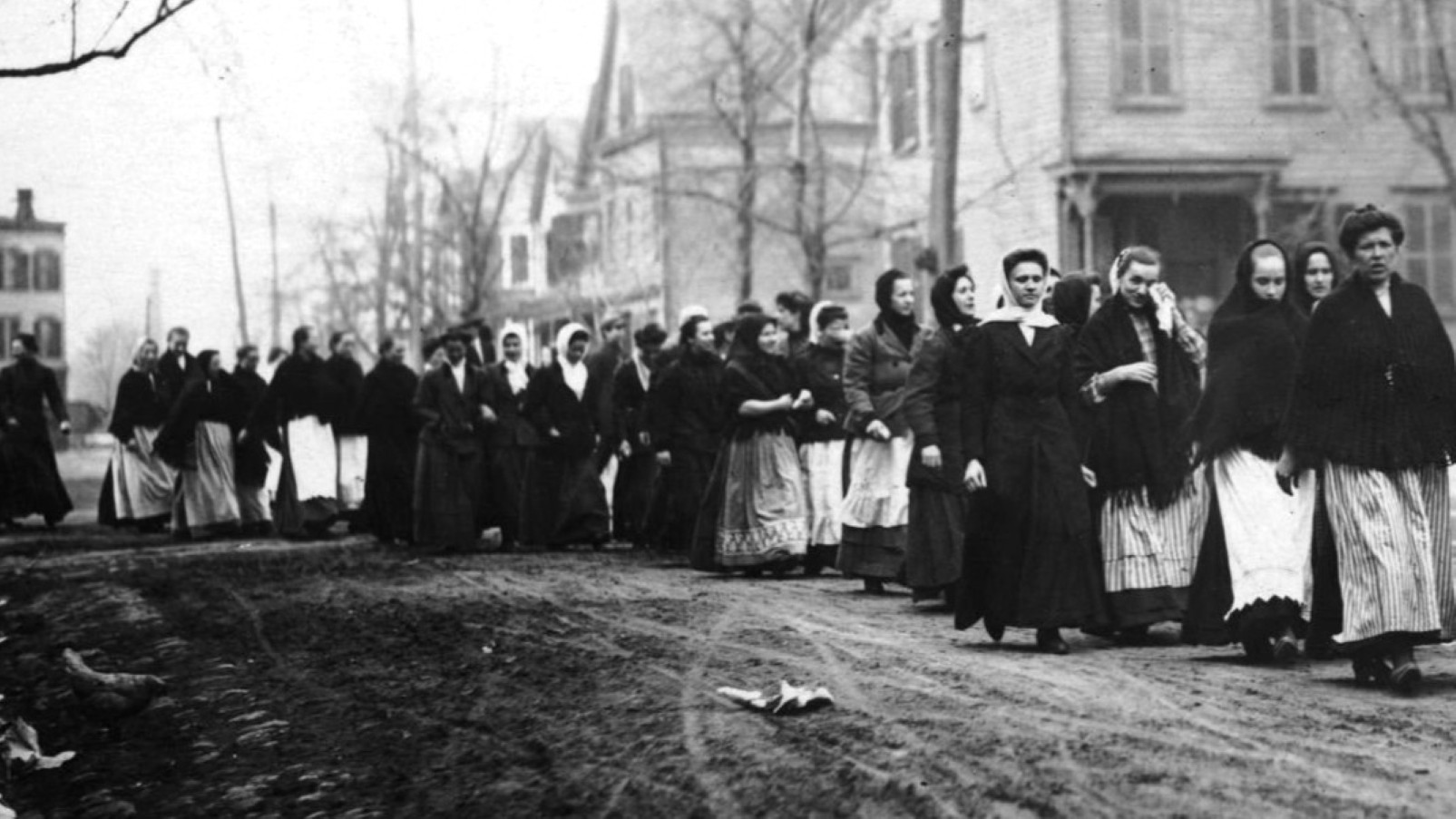
Further memories from Martin Russak placing himself in the social landscape of New Jersey’s storied silk mills.
‘Notes of a Weaver’ by Martin Russak from New Masses. Vol. 4 No. 12. May, 1929.
In those days not every worker could maintain a home of his own. The rent in our house on the hill was ten dollars a month, but even that could not be found, and it was no great shock to comrade Russak and his wife, upon their return from work one evening, to discover themselves locked out and all their earthly goods, including a tearful son, in the dirt under the old maple tree.
We took up new quarters together with my grandfather and grandmother in three attic rooms in the Negro section across the river. It was an inexhaustibly wonderful neighborhood. The little Negro boys made merry companions and highly desirable friends, being accomplished rascals, unbeatable fighters and masters of fascinating arts. Up the street was the Washington Market with its noise and bustle and Saturday crowds. From late Friday evening, all through the night until dawn, bulging wagons rattled over the street, bringing fruits, vegetables, produce, the farmer and his family, into town from Haledon and Preakness and Pompton Lakes for the Saturday market. Next door was the first of a row of blacksmith shops, with their clanging anvils, their flying sparks, their horses, their smell of manure and iron, their wide doorways thronged with tobacco-chewing loafers. Numerous saloons and hotels proclaimed themselves “The Farmer’s Rest,” “The Farmer’s Haven,” “Workingmen’s Home.” Two blocks distant was the notorious Ryerson Alley. It was a half-width street one block long, unpaved and without sidewalks and stores, a place of decrepit and mysterious houses. It was the one street we boys avoided. We had a secret fear of it. The idea of venturing into it after dark was fairly hair-raising. Coming home at dusk from kite flying on the Falls or adventuring along the river, you would make the long detour through Main Street to avoid Ryerson Alley.
Somewhere in this period I first began to work. Workers are often not able to remember just when they went to work. It comes about naturally, uneventfully; you simply find yourself working. School never interfered. You worked afternoons, evenings, all day Saturdays.
The coveted jobs were in the mills, as sweeper-boys or as enterers’ helpers, passing ends to the enterer in the process of harnessing warps. Such jobs were hard to get, and most of us sold newspapers on the streets of the town. Older boys controlled this business. They supplied us with papers and gave us a certain percentage of the money we brought back. It was possible for a boy to come home in the evening jingling a pocketful of coins that totaled anywhere from ten to twenty-five cents.
I was a skinny little fellow, timid, shrill-voiced, always running away from a fight, chased by the other boys from the banks and busy corners. I clutched my papers tightly and hurried off, looking for places where no one could object to my presence. I loved the great factories, their industrious din was music to me, all the grown-ups whom I admired with boyish intensity worked in them, and it was the common aspiration of all boys to work in them—perhaps in time to twist, weave, or warp those life-giving threads of silk that men so carelessly brushed from their trousers as they came out into the streets. I found myself in factory neighborhoods, haunting them with my papers. I discovered factory gates where one could catch the outward rush of workers and sell a bundle of papers in half an hour. But I had little success as a newsboy. Even when I could sell my papers, I would often sit on the curb and read them instead. My father had made a hungry reader of me at an early age.
On Saturday evenings a ceremony took place in our house. After a supper made notable by bread and chicken-fat and grandmother’s wonderful stuffed kidney, my father and I, in our cleanest faces and best clothes, paraded up Broadway to the Free Public Library. Here, talking in whispers, we scrutinized long rows of books until we had selected two volumes apiece. We had difficulty finding books that would please me. The books I took always told about wolves and elephants and unfortunate princes. They bored me. Once I asked for stories of strikes and revolutions, of workers and factories. My father laughed aloud.
“Mart,” he said, “nobody writes stories about such things, and if they did the Library wouldn’t keep them. The bosses that own the mills and cause strikes own the books and the libraries too. See all these books? They were written by the smart sons of bosses. If the sons of workers read and learn, they’ll perhaps write books for workers and workers’ children.”
When we got home he smilingly repeated the incident to my mother and grandfather. The old man patted me on the shoulder and spoke thoughtfully:
“Books are slow. We workers are way ahead of them. Books haven’t reached the factories and the strikes and the revolutions yet. In a couple of years we’ll surely have another strike for you.
And maybe—who can tell?—if you and all the other children help, we’ll have a revolution for you before you’re as old as I am.”
The New Masses was the continuation of Workers Monthly which began publishing in 1924 as a merger of the ‘Liberator’, the Trade Union Educational League magazine ‘Labor Herald’, and Friends of Soviet Russia’s monthly ‘Soviet Russia Pictorial’ as an explicitly Communist Party publication, but drawing in a wide range of contributors and sympathizers. In 1927 Workers Monthly ceased and The New Masses began. A major left cultural magazine of the late 1920s and early 1940s, the early editors of The New Masses included Hugo Gellert, John F. Sloan, Max Eastman, Mike Gold, and Joseph Freeman. Writers included William Carlos Williams, Theodore Dreiser, John Dos Passos, Upton Sinclair, Richard Wright, Ralph Ellison, Dorothy Parker, Dorothy Day, John Breecher, Langston Hughes, Eugene O’Neill, Rex Stout and Ernest Hemingway. Artists included Hugo Gellert, Stuart Davis, Boardman Robinson, Wanda Gag, William Gropper and Otto Soglow. Over time, the New Masses became narrower politically and the articles more commentary than comment. However, particularly in it first years, New Masses was the epitome of the era’s finest revolutionary cultural and artistic traditions.
PDF of full issue: https://www.marxists.org/history/usa/pubs/new-masses/1929/v04n12-may-1929-New-Masses.pdf
 Revolution's Newsstand