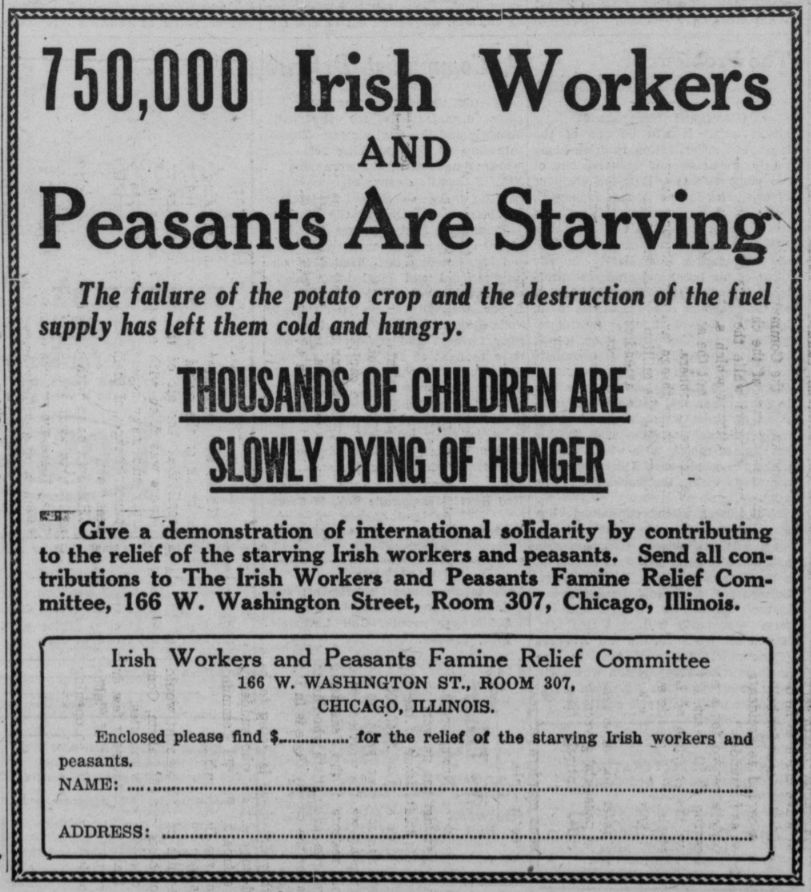
After expanding from its original mission in alleviating the Russian famine to help in Japan and Germany in the autumn of 1923, the next large international campaign of the W.I.R. was to assist the suffering from Ireland so-called ‘Forgotten Famine.’ Upheaval in the revolution and Civil War, a strike of English landowners, fuel shortages, extreme austerity by the counter-revolutionary Cumann na nGaedheal (modern Fine Gael) which cut farm laborers wages by 16%, and a poor harvest in 1924 all combined with others factors to to create famine conditions in the west of Ireland during 1925.
‘The Famine in Ireland and the Workers International Relief’ from International Press Correspondence. Vol. 5 No. 20. March 19, 1925.
Ever since 1689, when William of Orange as a nominee of the allied English feudal lords and of the English bourgeoisie subjugated the Irish peasants, Ireland has been an exploitation colony for English capitalism. Every exploitation colony must become a starvation colony. Starvation is a conscious means employed by the exploiters in order to keep down the broad masses, and before all the revolutionary elements.
Since its subjugation Ireland has never ceased to be a centre of revolutionary upheavals and struggles. This is a further reason why the exploiting class never thinks of doing anything to relieve the chronic starvation. And thus even now prominent persons in the Church and in the State assert that the inhabitants of the western districts of Ireland regarding whose sufferings resulting from the destruction of the potato and peat crop (the latter being their sole means of fuel) in consequence of unceasing rain, reports are appearing in the press it is true are living in misery, but that their present condition differs very little from their normal standard of existence. Robert Stewart who has visited the famine area on behalf of the Workers International Relief, reports of this “normal standard” as follows:
“If that which I saw in West-Donegal, in Kilbar and Teelin (places which are neither better nor worse than hundreds of other villages) is the normal standard, or approximates to the normal standard, then a crime has been committed here which should cause every responsible body and every responsible man in Ireland to go in sack and ashes…I have been used to poverty ever since I can remember, and I have often seen it in all its nakedness with us at home and in other countries. I have experienced times of severe industrial crisis and worked on many relief committees. I have participated in long strikes and know the hungry days of unemployment, but at no times did I see more miserable scenes, more hellish sufferings than in West-Donegal.”
Another cause of the Irish famine is the ruin of the small fisheries in consequence of the operations of the big fishing syndicates.
Following the appeal of the Central Committee of the Workers International Relief, which was directed to the workers of all the big countries and which followed an appeal of the English Committee of the W.I.R., a national committee was formed in Ireland including Jim Larkin, John Lawlor, member of the Dublin Trades Council, Vincent S. Atkinson of the Irish Labour League, Robert Stewart (Communist Party)) and Mrs. Skeffington.
Meetings have been arranged in the big industrial centres of England on behalf of the Irish Relief Work of the W. I. R. 350 Pounds, which have already been collected, have been distributed in the form of food and fuel. Collections have already been commenced in Holland. The United States have also promised assistance.
The gift of the Saxon district conference of the W. I. R. made a great impression upon the British workers, although this was very small as the industrial workers and the small peasants who contributed have very limited means. It was, however, the first proof of international solidarity which arrived in Dublin.
The German national committee and the Berlin Committee of the W. I. R. have sent 500 and 200 Marks respectively to the Irish W. I. R. committee as a proof of their solidarity.
May the workers in all countries follow these first examples of brotherly solidarity!
International Press Correspondence, widely known as”Inprecorr” was published by the Executive Committee of the Communist International (ECCI) regularly in German and English, occasionally in many other languages, beginning in 1921 and lasting in English until 1938. Inprecorr’s role was to supply translated articles to the English-speaking press of the International from the Comintern’s different sections, as well as news and statements from the ECCI. Many ‘Daily Worker’ and ‘Communist’ articles originated in Inprecorr, and it also published articles by American comrades for use in other countries. It was published at least weekly, and often thrice weekly.
PDF of full issue: https://www.marxists.org/history/international/comintern/inprecor/1925/v05n20-mar-19-1925-inprecor.pdf

