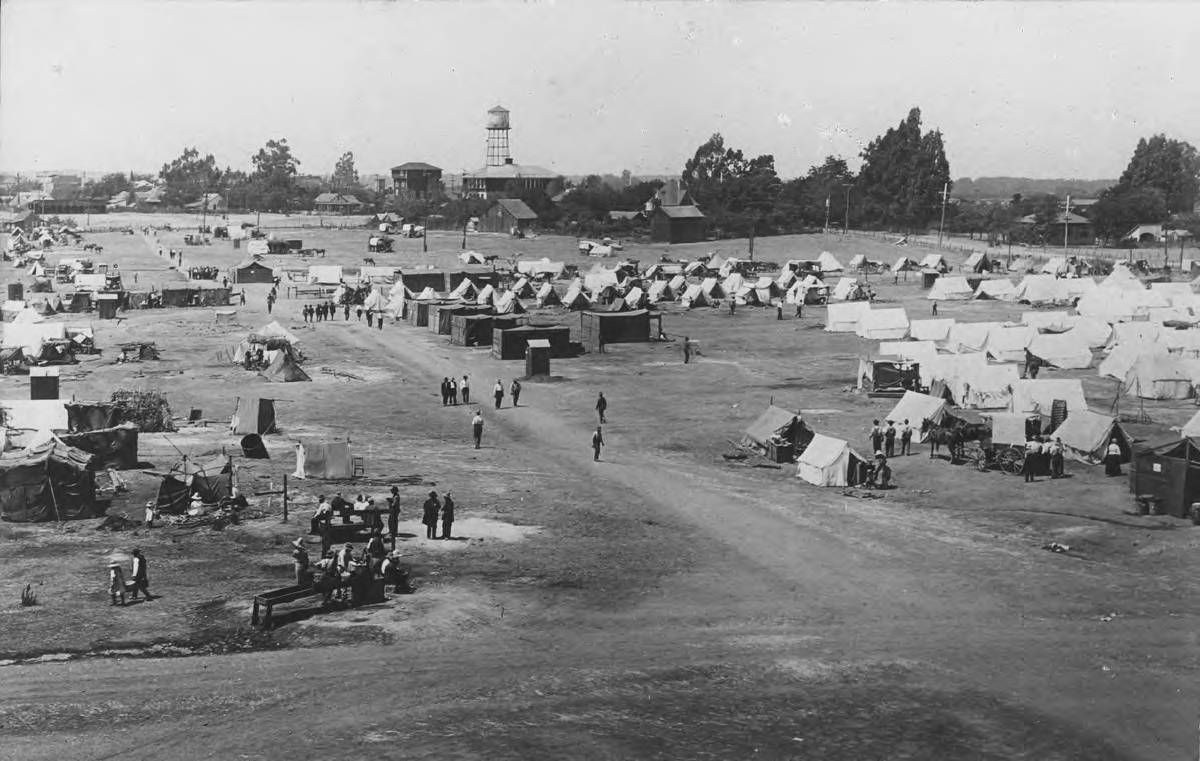
Hanson responds to the official report on the ‘Wheatland Riot’ in which unbearable pay and conditions in the Durst Bros.’ migratory hop pickers camp led to a I.W.W.-led strike during which a ‘riot’ saw four deaths and two men, Ford and Suhr, framed-up for murder and jailed for life. Hanson says the report was not necessary, the strike was precisely over the conditions its investigation ‘found’ and the workers already knew too well.
‘What Ford And Suhr Did’ by Nils H. Hanson from Solidarity. Vol. 6 No. 274. April 10, 1915.
With words, figures and pictures, The Commission of Immigration and Housing of California, is now bringing up its report before the legislature of said state. In various cities through the state it has established a Housing Exhibit, showing several hundred illustrations from different sources, such as labor camps, tenements and slums. Each exhibit contains more than four hundred pictures from the actual stern reality–or as near exactly as we possibly could expect from such a body of men.
Besides the pictures are the statements in words and figures about how it is, and how it could, or should be–with a very little effort from the powers that be. It even goes so far as to say that EXPLOITATION causes some of it, and that many workers are forced to live in crowded districts, etc., because the wages are too low…
However, it doesn’t say that the wages ought to be raised; all it wants is a law that is going to keep clean and healthy conditions, whether there are any wages at all or not. And so it suggests that those who can’t afford to live better than so, should in some way or other be helped by the state. It states that London spent more than nine million dollars on better housing for the poor–and other English cities as well. And it can’t see any reason why America can’t do likewise (and be up to date) and so restrict the increasing of crimes, immorality, horrors, disease and DISCONTENT among the workers. (If it goes just a little bit further, it will be as the workers in Sweden usually call that country: “A fortified poor house.”)
But ’tis a sad story, is it not? Just think of it, the higher ups are coming down to help the poor. Don’t weep, though it is awful. Yes, it is awful when they come out with a few of the facts about, “how the other side live.” It is awful that they should know this for instance:
Over 100,000 work and live in labor camps in California. Out of these are 2,656 women and 1553 children. Out of 942 camps inspected, the statistics from 872 show that there were no baths in 353, no toilets in 114, filthy toilets in 364, no screening in 305, overcrowded sleeping facilities in 330, manure piles near the kitchen in 246, inadequate washing facilities in 143. Further that there are 18,318 men working in such camps that were considered “bad” by the Commission.
More than half of those workers are immigrants, according to this board of investigators. Aud further it says that those people are used to such low standards of living that the State should teach them how to raise it, and live as respectable Americans. These are not the exact words but it is the meaning of the whole of it. “The roving migratory laborers carry diseases through the state. The state must protect not only those workers but all its citizens,” it states. “A sanitary camp means an increase in the willingness and efficiency of the labor,” it tells the employer. And after giving a few figures with which to prove it, it is added, “Therefore, it is not only to the interest of humanity, but to your own interest to have a sanitary and livable camp.”
And so about the crowded cities it comes with more sadness. It is sad for instance that they should come and tell us that 99 families live in one tenement house in San Francisco without a bath; that in one certain district of Telegraph Hill of same city 54 infants died in three years but only 4 in one year, after it was improved; that there were 42 cases of juvenile diseases in the crowded districts in Oakland–while only 5 in the great residence district; that Fresno has also 99 families in one congested building alone; that Sacramento has a cellar lodging, with 54 rooms without ventilation; that there is another underground cellar in Sacramento with 12 stall bedrooms without light or ventilation, and that one man died of consumption just after a flash-light picture was taken of the same.
Now, these are only a few gems picked from the whole of it. It IS terrible, is it not? May we rest assured that those investigators didn’t know it before just now–the last year or so. But don’t forget that it has issued an advisory pamphlet in which the very first words are: “On August 3, 1913, a riot occurred on a hop ranch near Wheatland. The Commission of Immigration and Housing after a thorough investigation of the causes which led up to the riot, determined that probably the most important contributary factor was the poor housing and sanitary accommodation afforded the workers. Further investigation made it clear that the Wheatland hop ranch conditions were not exceptional, but that similar insanitary housing conditions prevail pretty generally throughout the labor camps in the State.”
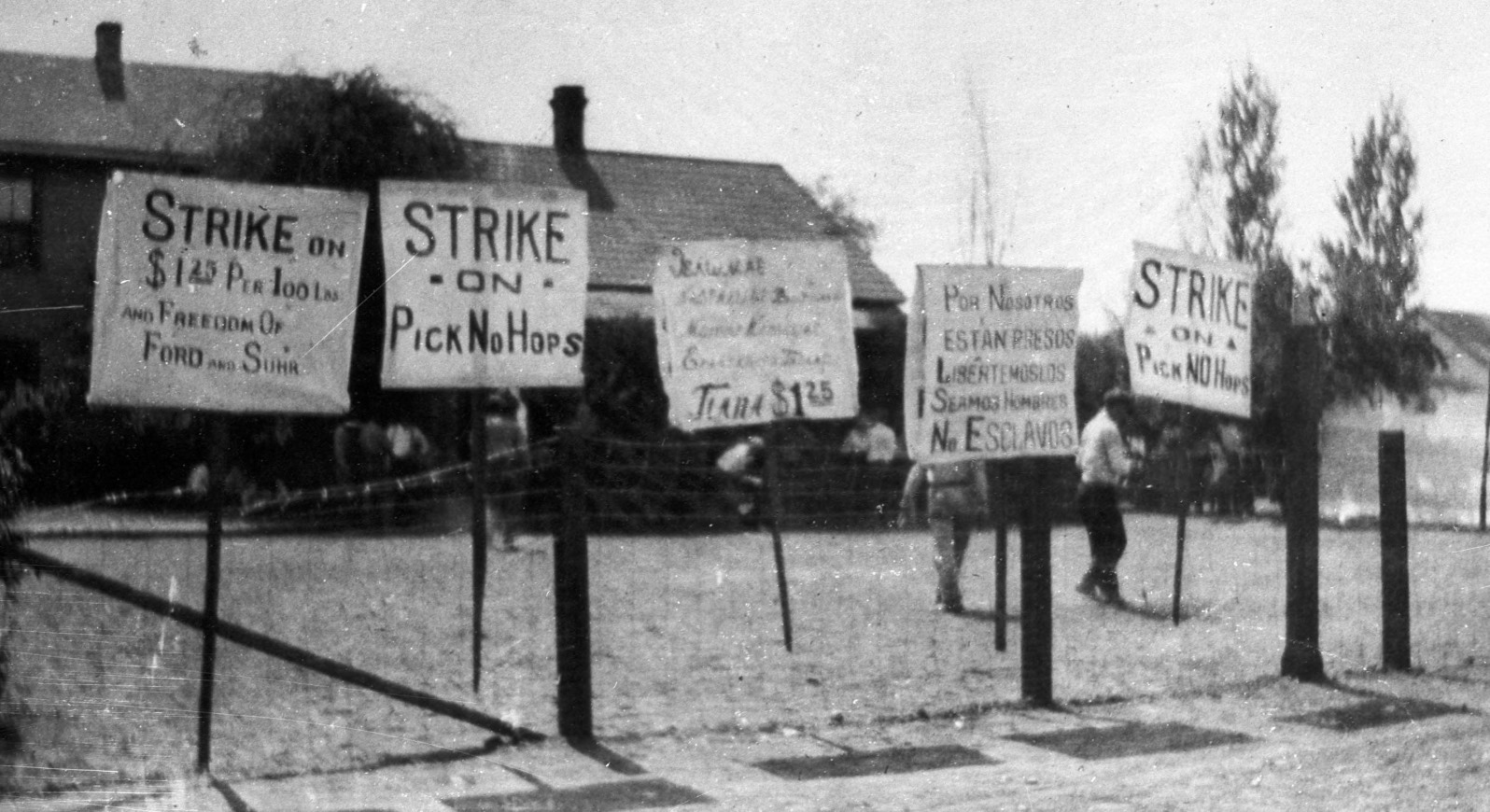
So here we have it. Now we can understand why all this investigation came about. Now we know why they are wiping their eyes with the backside of their fat and clumsy hands; and are beginning to wonder why immigrants as well as Americans keep such a low standard of living. Surely they didn’t see it before. Surely there had to be an organized force of workers to open up their eyes to all this misery existing on this sinful planet. It took organization to make them investigate. It took united hands to disturb them at their great festivals and monkey dinners. Yes, it took some “despised agitators” to make them think, investigate and make laws “improving” the “bad” conditions.
Didn’t they know it before the Wheatland hop strike? O yes! But it took action from the workers themselves to openly confess that it was so. In other words, it took the uniting of slaves, as it always has, and always will take, to make them sit up and take notice.
“Few employers of unskilled labor realize their loss through the ‘soldiering’ of discontented workers,” is another statement. “Petty strikes and a labor force continually quitting, both frequent products of bad camp’ conditions, often increase the cost of work beyond the profit. Suppose a camp of 200 men with a pay roll of $400.00 per day; if living conditions are bad and the sleeping accommodations make a reasonable night’s rest impossible, if the food is fly infested, and the toilets unclean and revolting, the men become disgruntled and dissatisfied and some become sick.” Another great discovery! Can it really be possible that those low-down imbeciles, those “roving migratory laborers” really shouldn’t like to eat flies, or sleep on the bare ground after a hard day’s work? It is doubtful. Surely it took some “investigators” to tell them so. Those immigrants, those men with such low standards of living, shouldn’t like to eat the meat from a cow that died of old age at fifty–and which it takes an axe to cut?…
About the crowded cities it says, “Give the workers a chance to live in a restricted residence district.” And out of the camps investigated, 283 have been reinspected, out of which 220, were improved, “and of them,” it says, “209 to almost ideal conditions.” (But say, do you believe it?)
So now it is investigated, so now we know, and soon everything will be O.K. We will eat with silverware, fatten on porterhouse, and sleep like princess, whenever we either work in a camp or live in a city in Cal. How lovely it all will be. It will be a pleasure to bathe in the everlasting sunshine, and very leisurely just work hard enough that we might get sufficient healthy recreation. There will be no reason to quit, and no reason to be discontented. And all this has the sympathetic state of the Golden West done for us. O yes, they try to make us believe that they have done something; but whatever little, and, comparatively very insignificant thing they might HAVE done–they had to see the bloody handwriting on the wall first before they did it. They had to see a protest from DOWN BELOW, which was made in the hop fields in Wheatland.
And those two men who organized this mighty protest, and went in front of the more than twenty hundreds of workers and demanded better conditions–are still in Folsom penitentiary. They were–as we surely all know–sentenced to life time imprisonment on a murder charge (which was never proven) but their real crime was that they organized the hop workers. Those two men, Ford and Suhr, are the ones who were the REAL INVESTIGATORS, and remember that they didn’t only investigate and live under such conditions, but they acted also and made thousands of others act with them. And the workers in return have shown their appreciation of what they did–by letting them go to PRISON.

When this is written the governor of Cal is having their case under advisement. He says that as yet he hasn’t had time to study it up. Oh no! Neither had the Commission time to study up about the conditions–before the workers made them do so. And any time the workers of Cal. (or America if you please) will show their strength it won’t take Governor Johnson (of pickhandle fame) five seconds to study the whole thing over and say what he thinks about it. Always remember that it is the ORGANIZED MIGHT that brings the goods. And also that, “cost what it will Ford and Suhr must be free.”
This summer will offer a splendid opportunity for using all means: legal or illegal be d; all that is done by the working class is never considered legal anyhow. Anything will be legal as soon as we have got the organized force behind to back it up with. Therefore, let us get that, and make the governor of California come to time and release those two men–who caused so much improvement of labor conditions all through the state. It is high time that those who are already reaping the benefit of it, would come out and show what tricks they have up their sleeves and so make another stir-up in this great glorious Golden West.
The most widely read of I.W.W. newspapers, Solidarity was published by the Industrial Workers of the World from 1909 until 1917. First produced in New Castle, Pennsylvania, and born during the McKees Rocks strike, Solidarity later moved to Cleveland, Ohio until 1917 then spent its last months in Chicago. With a circulation of around 12,000 and a readership many times that, Solidarity was instrumental in defining the Wobbly world-view at the height of their influence in the working class. It was edited over its life by A.M. Stirton, H.A. Goff, Ben H. Williams, Ralph Chaplin who also provided much of the paper’s color, and others. Like nearly all the left press it fell victim to federal repression in 1917.
PDF of full issue: https://www.marxists.org/history/usa/pubs/solidarity-iww/1915/v06-w274-apr-10-1915-solidarity.pdf

