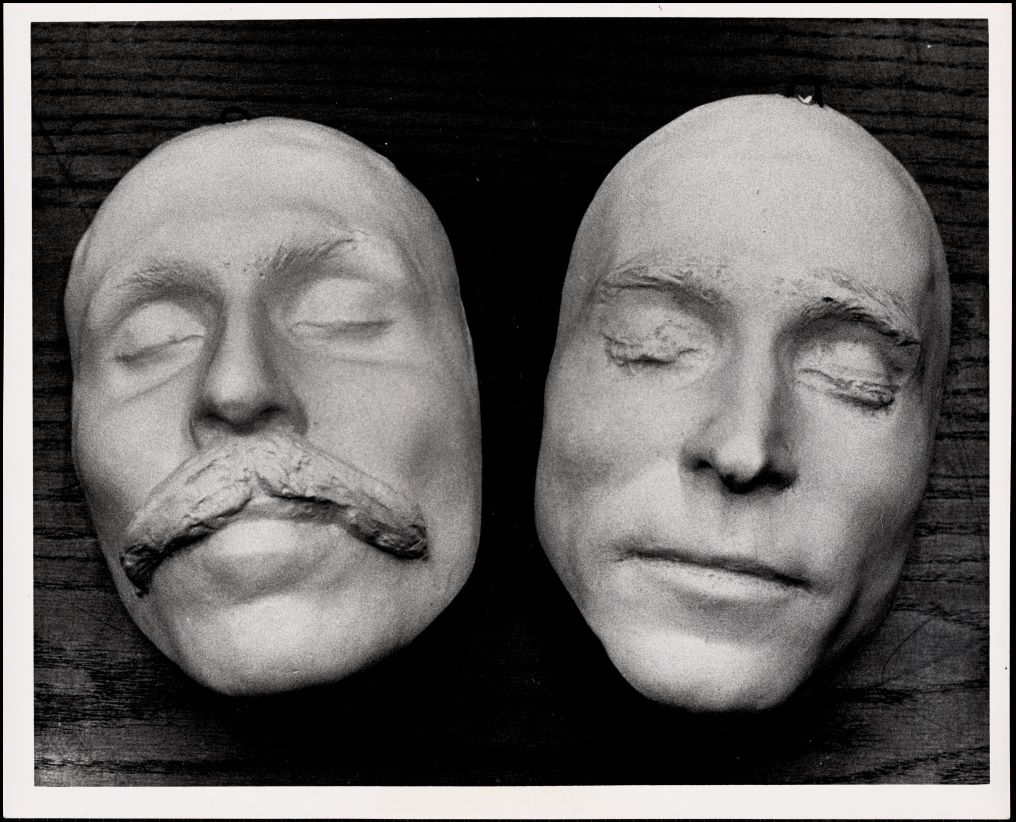
Immediately after the August 22, 1927 execution, the death masks of Sacco and Vanzetti were toured, with a wave of indignation, arriving shortly after in New York City where they were displayed in the East Side’s Stuyvesant Casino, Michael Gold was there.
‘On the Death Masks of Sacco and Vanzetti’ by Michael Gold from The Daily Worker. Vol. 4. No. 196. August 31, 1927.
STUYVESANT CASINO is just another of our East Side halls. It glitters with too many mirrors, is loaded with gilt, gewgaws and rococo Cupids, lyres, and wreaths; it is painfully stylish. The hall pretends like so many others to be a salon of Louis the Magnificent, but no one is really fooled by this pretense.
For the hardwood floor is covered with sawdust. There is a dingy barroom where dingy near-beer is sold. The plentiful gilt trimmings are covered with fly-specks, and just outside the door is Second Avenue, where the loud shirt-sleeved life of the workers prevails.
Clubs of Jewish and Italian gangsters hold their “social” dances in this hall. Wailing Jewish orchestras have played Bulgars and Kazatskys at many a Jewish wedding here. There have been rivers and oceans of democratic-republican speeches flowing here. Meetings, of Communists and socialists, too, and in many a strike of the needle trade workers this has been a strike headquarters, blue with smoke, and strewn with banana peels.
***
Today it has been converted, this hall of many changes, into a shrine of the East Side workers. The death masks of Sacco and Vanzetti are on view. For two days now about 50,000 workers-men, women and children-have passed silently with bared heads before the platform on which the masks are resting. There is a quiet, a reverence, a strange solemnity such as this raucous hall has never witnessed.
He also said “Long Live Anarchy.” He also said, “My love to my children, my dear wife.” He may have said other things, but they are not reported. He may have repeated the word of Cambronne; he may have looked beyond the walls of the execution chamber and beheld the vast army of capitalist judges, college presidents, governors, editors, ministers and millionaires, and flung at them the splendid word of Cambronne: Merde! It is not reported, but it is there in his last smile.
***
Vanzetti is serene. There is a beautiful calm on his long austere face. It is the peace of a dreamer who has not dreamed in vain. Vanzetti was a man filled with the poetry of the revolution. In his great heart there was all the pathos of the present, and the glory of the future. When he died, he was sure of the future. When he died, he was sure of the revolution. His blue steadfast eyes were filled with visions of the worker’s world. He needed no priest tempting him with a mythical heaven; he was his own priest, and prophet, and poet, and his heaven was not in the clouds, but on earth.
All his years of agony were not in vain. All his dark hours in the death-house were not in vain. He did not forgive his judges and jailors at the last; no, he never forgave capitalism. But he forgave the revolution which had chosen him for one of its martyrs; which had led him to the electric chair; he was sure it was not in vain.
***
The children stare at the two significant masks and go away thoughtfully. They will grow up and remember. And the workers who file by so solemnly will remember. And history will remember, and this crude, gilt worker’s hall will be remembered.
***
Six workers, men and women, stand constantly as a guard of honor on each side of the platform. They are dressed in vivid red blouses. There are any number of flowers, red roses and carnations, banked about the masks. These come from different unions and labor organizations. The smell of the dying flowers fills the room.
There is red bunting, and touches of black. There is a memorial sculpture, with a square worker’s fist jutting out of it. There is red everywhere-bright brave red of the revolution. And a dozen cops swing their clubs idly and lounge about, marvelling at this strange solemn atmosphere.
***
The workers go by slowly, staring thoughtfully at the masks. They come all day and night, some of them before going to work, others weary after a day in the shops. There are many school children, thousands of them. It is a spectacle for them; everyone on the East Side has heard of Sacco and Vanzetti, and they are curious.
There are almost a million people on the East Side, and it is safe to say the vast majority of them, even when not radical, have been stirred by the legal murder of Sacco and Vanzetti. They may not understand the broad issues involved, but with a sure proletarian instinct they feel the injustice meted out to two fellow- workers, two fellow-immigrants in the Promised Land. The children gaze with awe. They will talk about this many a day. They will remember these names, and when they grow up the dim seeds planted during these weeks will grow into something red and daring as this bunting.
The death masks are white and still under the stare of so many eyes. Sacco, in death as in life, has his scornful defiant smile of a brave worker. There was humor in this man; as he sat down in the electric chair he greeted the frock-coated dignitaries about him with a satirical: “Good evening, Gentlemen!”
The Daily Worker began in 1924 and was published in New York City by the Communist Party US and its predecessor organizations. Among the most long-lasting and important left publications in US history, it had a circulation of 35,000 at its peak. The Daily Worker came from The Ohio Socialist, published by the Left Wing-dominated Socialist Party of Ohio in Cleveland from 1917 to November 1919, when it became became The Toiler, paper of the Communist Labor Party. In December 1921 the above-ground Workers Party of America merged the Toiler with the paper Workers Council to found The Worker, which became The Daily Worker beginning January 13, 1924.
PDF of full issue: https://www.marxists.org/history/usa/pubs/dailyworker/1927/1927-ny/v04-n196-NY-aug-31-1927-DW-LOC.pdf

