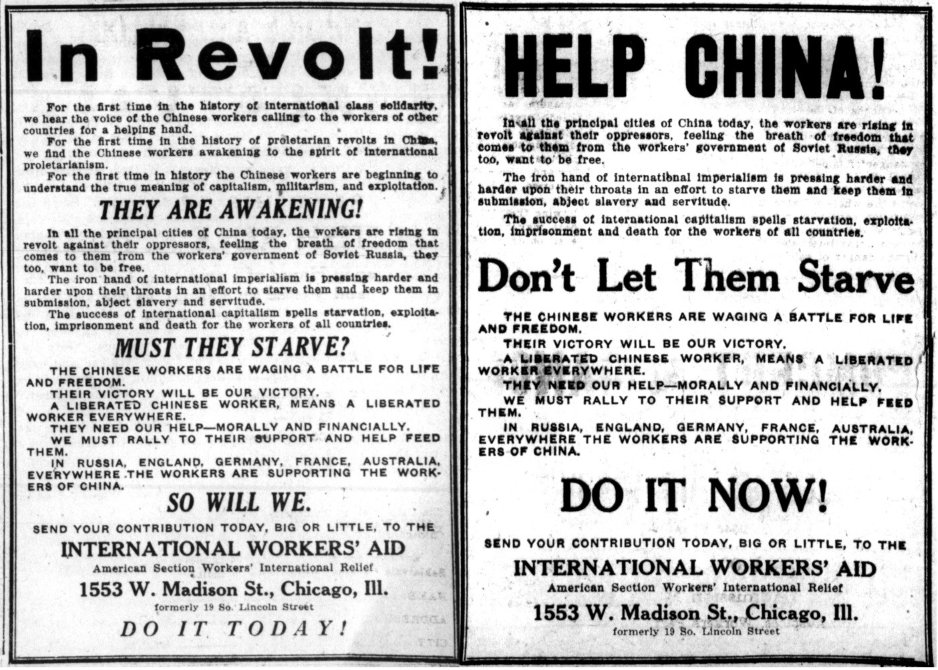
Following the Irish famine relief, the next large-scale international campaign of the now-named Workers International Relief (these names can be confusing–it was International Workers Relief, the U.S. section being called International Workers Aid for a while–not to be confused with Internal Red Aid, which is another story) was to provide support to relatively impoverished Chinese unions during their mass strikes in Hong Kong, Shanghai, and other cities. More than any other of the Comintern-initiated international organizations, the W.I.R. under Willi Münzenberg was independent of E.C.C.I. overview and control, being headquartered Berlin and Vienna, and while never hiding its ideology and affiliations, sought to raise funds and awareness in coalitions and through broad support. As was the case with China in 1925, it was not always successful.
‘The Chinese Relief Work of the Workers International Relief and the Shame of the Amsterdamers’ by G. (Berlin) from International Press Correspondence. Vol. 5 No. 74. October 15, 1925.
Right from the very beginning the Workers’ International Relief set itself the task of reaching beyond the circle and limits of Communist influence, to the broad masses of the workers and to the middle classes and intellectuals who sympathise with the revolutionary working class, in order to enlighten them regarding the events in China and to appeal for their support.
The first appeal, which was signed by eminent artists and writers and by means of which the WIR first brought to the knowledge of the Chinese workers that it had commenced a relief action on their behalf, was received as the most welcome news in China. The whole of the Chinese press gave prominence to the appeal. In Peking and Shanghai the appeal was posted up in the form of big placards on the walls and on the houses. At numerous meetings the appeal was welcomed by the masses with the greatest rejoicing. An immediate effect of the appeal was the numerous telegrams and messages from the Chinese strikers and also from the Railway Workers Union and other Trade Unions to the WIR. Of especial significance were the statements of the Peking professors who sent the WIR an enthusiastic message in reply, and appealed through the WIR to all mental workers in Europe and America.
In order to strengthen the ties which have been established, a delegation consisting of brain and hand workers is paying a visit to China, while on the other hand a Chinese delegation is to visit Europe under the auspices of the WIR.
In addition, the WIR has, in the course of a few months, held lectures in over 50 towns and in over a thousand localities on the life and the struggle of the Chinese workers. The campaign of enlightenment by word of mouth was effectively supplemented by a wholesale distribution of leaflets, illustrated papers, pictures, which have been published in various languages, including Dutch, German, English and Norwegian.
The attitude of the social democratic press in Germany towards these meetings as well as towards the events in China generally, is in sharp contradiction to the tremendous importance of this work of enlightenment regarding the situation and the condition of the Chinese proletariat. For months past the Berlin “Vorwaerts” only made use of the struggles and sufferings of the workers in China as material for sentimental articles in its literary columns, and when finally, after the China Congress of the WIR and under the pressure of public opinion, it dealt with China in a leading article, it only viewed it from the standpoint of the imperialist powers, without devoting a word to the role being played by the Chinese proletariat which is struggling for national and social freedom.
This shameful attitude of the “Vorwaerts” and of the German social democratic press was only an echo of the attitude of the II International, and before all of the International Federation of Trade Unions in regard of the question of relief for China.
In the middle of June last the WIR approached the Executive of the Amsterdam International with the proposal for a joint relief action for the striking workers in China. The Amsterdam Secretariat declared itself not competent to deal with the matter and postponed the decision until the session of the Executive on the 29th of June. But even this meeting of the Committee was unable to come to a decision and resolved to make inquiries in China as to whether help was desired and if so to what amount, and promised to announce its decision on the 17th of August.
In a telegram which was received by the Central Committee of the WIR from Peking on the 14th of August, it was stated that no official inquiry from Amsterdam had been received by the Chinese trade union Federation or any individual trade unions whatsoever, but that the Chinese trade unions had only heard through the press of the decision of Amsterdam to make enquiries in China. But all Chinese trade unions who had taken part in the National Conference of the Trade unions have urged the necessity of relief from foreign trade unions for the present strike movement. The organisations of the railway workers, seamen, textile workers and printers, sent telegrams to Amsterdam to this effect with the request for immediate help. The secretariat of the Amsterdam International has up to the present not informed its members of the receipt of these telegrams. These telegrams, which have been published by the WIR, prove that it was not necessary for the Amsterdamers to send inquiries to China as to whether help was wanted. The Chinese trade unions and workers had urgently begged for such help.
On the 16th August, when the press was full of the reports regarding shootings of Chinese workers, there was held in Berlin a Hands off China” congress convened by the WIR. The purpose of this Congress was to seek to gain the interest of broader bourgeois and intellectual circles for the struggle for emancipation of the Chinese people and for the Chinese relief action of the WIR. The Congress received hundreds of resolutions from trade unions affiliated to the ADGB demanding from Amsterdam the decision to take part in the united front in regard the question of the China Relief, and these resolutions were given expression in a telegram sent at the “last minute” to the IFTU. in Amsterdam embodying this demand.
On the 17th of August the Amsterdamers replied to the Chinese workers (Railway Men’s Union, Peking) with a No! We have no money left for you, organise yourselves in trade unions, we sympathise with you and wish you success in your struggle for freedom.
The WIR., which was an essential support of the Amsterdam-Moscow movement in England, where, in 1922, it was the first organisation which enlightened the English workers and labour leaders regarding the position in Russia, is now, in spite of the hate of the Amsterdamers and the II International, playing the leading role in the work of enlightenment regarding events in China.
International Press Correspondence, widely known as”Inprecorr” was published by the Executive Committee of the Communist International (ECCI) regularly in German and English, occasionally in many other languages, beginning in 1921 and lasting in English until 1938. Inprecorr’s role was to supply translated articles to the English-speaking press of the International from the Comintern’s different sections, as well as news and statements from the ECCI. Many ‘Daily Worker’ and ‘Communist’ articles originated in Inprecorr, and it also published articles by American comrades for use in other countries. It was published at least weekly, and often thrice weekly.
PDF of full issue: https://www.marxists.org/history/international/comintern/inprecor/1925/v05n74-oct-15-1925-inprecor.pdf

