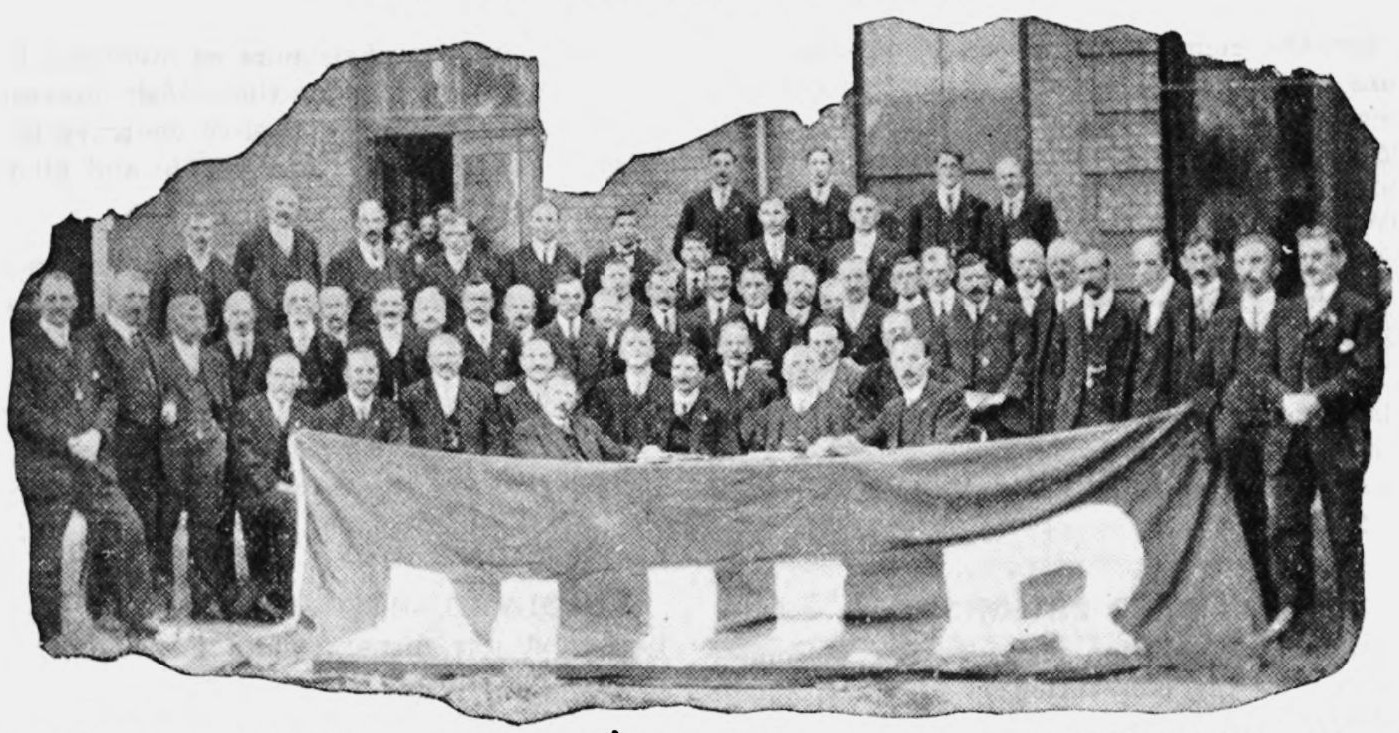
Much of the world, the U.S. included, had a wave of strikes and unrest in the aftermath of the First World War. Britain was no exception. George Hardy was born in England, active in Australia, New Zealand, and the U.S., working mainly as a stevedore, and was a veteran of the I.W.W. when he was elected General Secretary in 1920-1921 after serving a year in Leavenworth. Traveling as a delegate to the 1920 R.I.L.U. congress in Moscow, Hardy became a partisan of the Third International, joining the Profintern in 1921. One of its most important figures, Hardy served as General Secretary of the National Minority Movement in his native Britain and was liaison to China for the R.I.L.U. during the 1927 revolution.
‘General Railway Strike of Great Britain’ by George Hardy from One Big Union. Vol. 1 No. 10. December, 1919.
The greatest industrial conflict ever waged in the history of Great Britain has come to an end with a complete victory to the working-class, not only of Great Britain, for, had this fight been lost, it would have been an inspiring victory to the whole continental Bourgeoisie, who would have attempted a reduction of wages, as the railway companies through the government did attempt a reduction of the wages of the British railwaymen. The reply, through the National Union of Railwaymen, together with the Associated Society of Locomotive Engineers and Firemen, was a general strike.
At the outbreak of the war, the employers kept all workers at the pre-war wage as long as possible, until by pressure, they were forced to give increases, which were termed bonuses. The reason for giving money increase as a bonus is obvious, and the general strike just ended was planned and determined upon at the very beginning of the war by the employers. Equally determined were the workers, never to loose the money increase, and to make it a permanent wage. Attempts had been made since 1917 to make a permanent wage out of all monies being received. Always the government managed to manipulate the negotiations so as to have the question left in abeyance. In February 1919 the matter was still pending.
In August 1919, on threat of strike, the government agreed to make the bonuses a permanent wage for all locomotive engineers and firemen. Having prepared to fight the railworkers since the February conference and to use Lloyd George’s words spoken at a luncheon given in the Mansion House two days after the strike settlement, when he said, “As far back as last February the government realized that the crisis was coming, and under the home secretary they built up an organization to meet the situation. Taking this statement in conjunction with the settlement with the locomotive engineers and firemen one can only come to the conclusion that the attempt was made to satisfy one portion of the workers to be used against the larger group, organized in the N.U.R., who also has 50 per cent of the membership of engineers and firemen.
The A.S.L.E. and F. thought more of class solidarity than the increase, that could only be temporary at best, if the government could beat the lower grades, so they threw in their lot with the section hand. Thus the strike was a complete stoppage, engineer speakers announcing from public platforms, “We cannot run our engines on a crooked rail,” the implication was, they recognized the unskilled, no matter how low, just as essential to the railroad systems as the highest skilled man on the road.
The government’s preparations were a fact, for as soon as the strike began at midnight, Sept. 27, began to appear motor transport by road. This could at most be temporary, as the Transport Workers’ Federation has all these workers affiliated with the federation. As the days went past demands for action were demanded because each day the transport workers were becoming more enmeshed in the railway men’s fight. They were refusing to handle material intended for railways all over the country, and had the strike not ended, Oct. 7 was the date, all transport delegates would have appeared in London to decide on direct action, as Bob Williams wrote, who is secretary of the federation: “We of the Transport Workers’ Federation were willing and anxious to swing into line.”
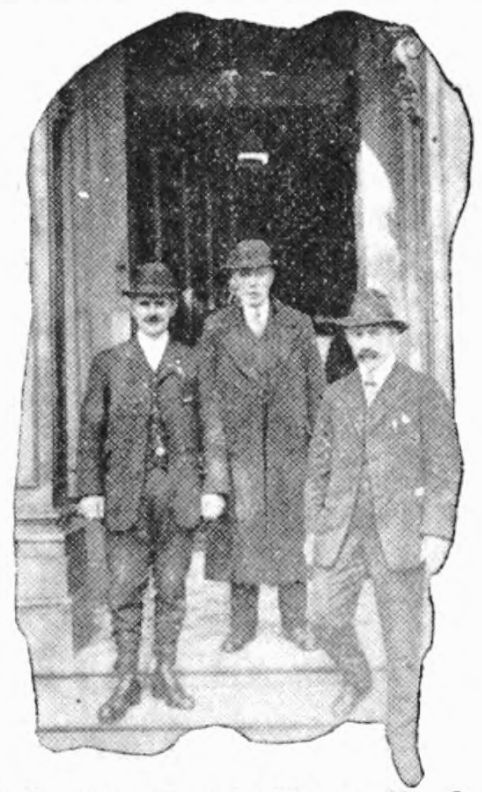
The above attitude did much to end this economic class struggle together with the messages of support, showing a readiness to strike in sympathy, sent in by nearly every union in all districts. The workers fully realized that if the railmen were forced to accept a reduction to pre-war levels, they also would have suffered the same fate. But, on the contrary, the government was forced from their position of reducing wages on Dec. 31, 1919, unto a position of accepting the present rates, as established wages until Sept. 30, 1920, with a minimum of 3 dollars, and a quarter larger than their previous “definitive” offer, providing the cost of living had been reduced to 110 per cent over pre-war prices at a year hence.
At the outset of the strike the Premier issued a statement that this was engineered by “a small anarchist gang.” This the workers smiled at and proved conclusively that if any anarchist gang existed it was on the side of government’s conspiracy against the workers. However, we can take for granted that most districts had all their economically educated men on the strike committee, but elected by the rank and file.
The following is a sample of the resolutions passed unanimously daily, “That this mass meeting of all railway men reaffirm their previous decision to stand together until victory is assured. Believing that the solidarity of the railway men has proved beyond all doubt the justice of our cause, it also proves the inability of the present government to do any real service to the workers, at the same time it has demonstrated its class rule in the interests of those who exploit the people.”
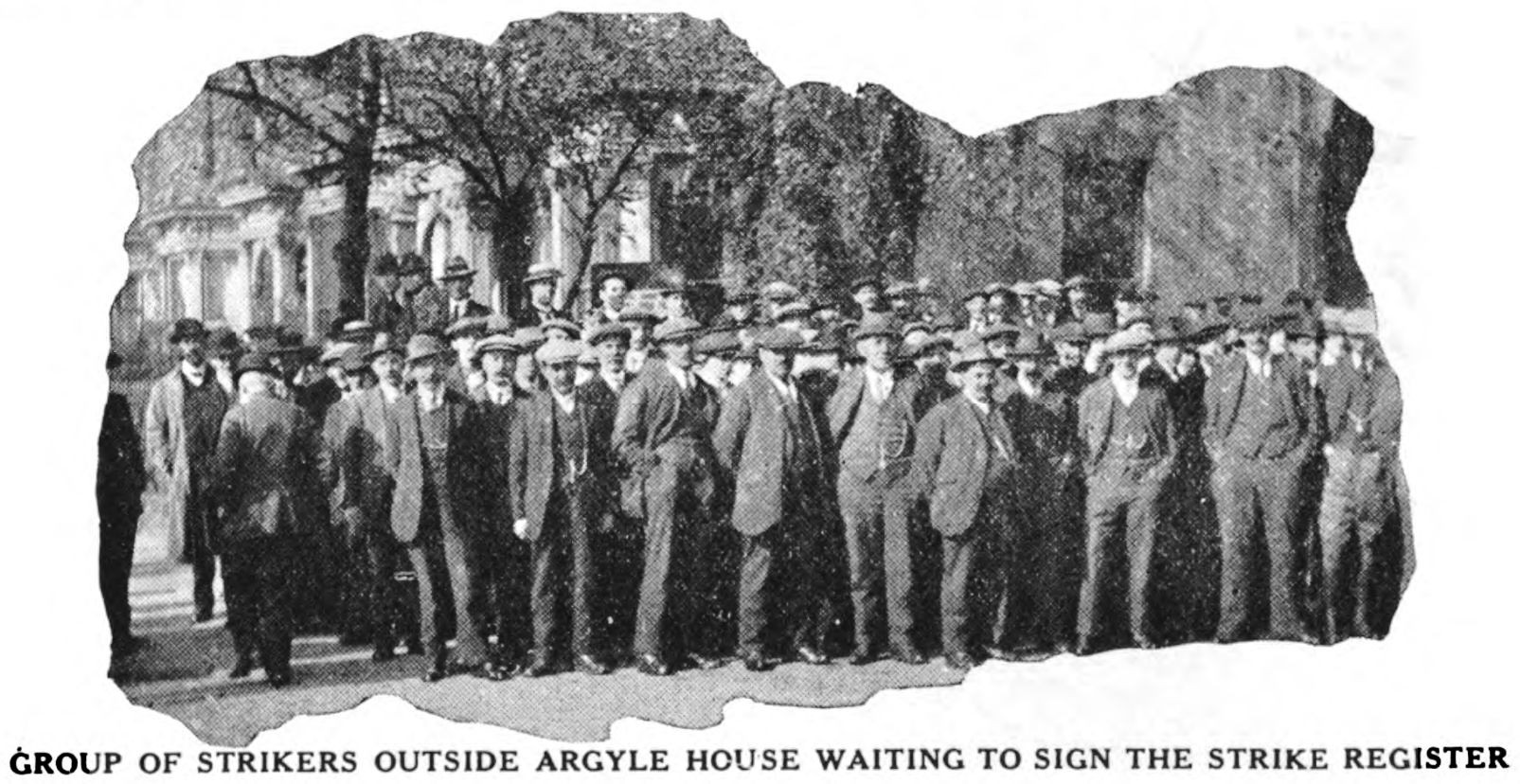
This strike was not a revolutionary attack against capitalism. It was purely a wage question. However, during the strike one would believe from the speeches made, together with the movement of troops into the large centers, that a revolution was pending but a few days. Notwithstanding all this there never was a more orderly strike. In Hull district in the large square where the mass meetings were held, speakers could be heard threatening to appeal to the soldiers if they were to be used in any way against the workers. The police were expressing their sympathy with the strikers. Daily the soldiers played football in the same square while mass meetings were in progress, having been forbidden to listen. This appeared to be one way of getting at least something that came from the platforms.
The prestige of the British government suffered a blow that it will never recover from. Lloyd George made all kinds of lying statements about “lightning strikes,” etc., at the onset of the strike. He afterward told he had been “preparing since February” and that “he was not fighting trade unionism.” The government also, stopped all back wages from being paid, in their endeavor to starve them into submission, all with no avail. Now, today in Great Britain industrial unionism as represented in the N.U.R. (National Union of Railwaymen) with the engineers and firemen in the sectional union throwing in their lot for the sake of their class, stands as a monumental power far greater than all the forces of the state even though they had eight months to prepare.
The same economic power, which is wielded by organized labor of Great Britain can, when it is ready, upset any government of the oppressors. This the government knows. And while we have some fine men at the helm, we have some very reactionary leaders. Fortunately, however, the district officials of the large unions have a thorough grasp of the conditions under which capitalism survives. This in the main is due to the education given out by the Central Labor College.
The college is an off-shoot of the Ruskin College, which, while being a labor college, were teaching bourgeois economics. A students’ revolt took place, when Prof. Dennis Hird supported the students and went over to the C.L.C., which teaches materialist history and Marxian economics. The miners, railwaymen and to some extent in the large centers the A.S.E. (Amalgamated Society of Engineers) run Central Labor College classes every week. This is the back ground of the grand demonstration of solidarity given during the rail strike. Classes in the large cities are given under the auspices of the District Councils of Railwaymen. The college will answer any question sent in by any class for correction or verification. It also may be noted, the C.L.C. is owned and controlled chiefly by the above unions.
The work being carried on is, as near to the I.W.W. propaganda as can be found anywhere and not be the I.W.W. In some distant future we will emerge from our apathy towards the exploiters, and with our well trained men will have sufficient ability to man industry for ourselves. Agitation has caused the troops to be withdrawn from Russia, because it took a revolutionary character, the desire being to allay it for fear a general strike would be brought about. Today, trade unionism (trade unionism in England does not mean craft unionism) has gained prestige—the government’s confidence has been shaken and the rank and file have learned they are the economic masters when they choose to act.
One Big Union Monthly was a magazine published in Chicago by the General Executive Board of the Industrial Workers of the World from 1919 until 1938, with a break from February, 1921 until September, 1926 when Industrial Pioneer was produced. OBU was a large format, magazine publication with heavy use of images, cartoons and photos. OBU carried news, analysis, poetry, and art as well as I.W.W. local and national reports. OBU was also Mary E. Marcy’s writing platform after the suppression of International Socialist Review, she had joined the I.W.W. in 1918.
PDF of full issue: https://www.marxists.org/history/usa/pubs/one-big-union-monthly/v01n10-dec-1919_One%20Big%20Union.pdf

