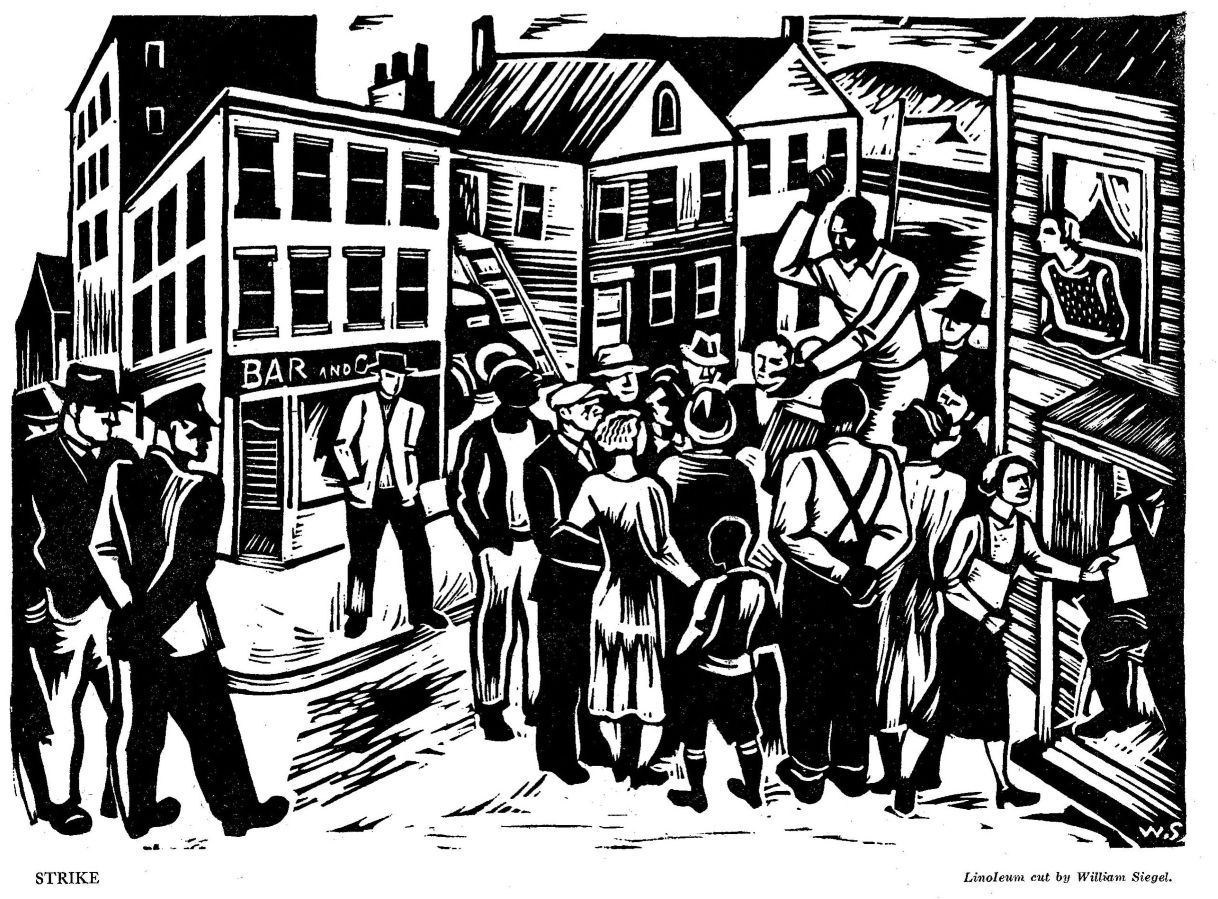
The fundamental question for the labor movement is always organizing the unorganized. A.J. Muste and the Conference for Progressive Labor Action spent much time thinking and acting on the problem. Here, Muste continues his long series on the topic.
‘Who Shall Organize— and How?’ by A.J. Muste from Labor Age. Vol. 19 No. 9. September, 1930.
An Analysis of the Progressive Policy
“ORGANIZE the unorganized” has been the foremost plank in the platform of progressive laborites. They have contended, in season and out, that aggressive efforts must be made to bring into the unions the masses of the workers in the basic industries which are now the strongholds of the open shop and the company union.
Certain requirements will have to be met by those who are to accomplish this gigantic task.
1. The task of organizing the basic industries must be approached with a sound philosophy of theory as to the basis of effective unionism. The American Federation of Labor nowadays for the most part makes the appraisal from the standpoint of the employer. It seeks to persuade him that he has nothing to lose and much to gain by organizing his workers into trade unions. It assumes and proclaims that there is no great divergence between the interest of the employer and that of the employe. We hold that no bona fide union can be built on that basis, any more than any present A. F. of L. union was set up in this way. For if it be true that between the boss and the worker, the profit-taker and the wage earner, there is no real divergence of interest, nothing over which to struggle seriously, then obviously the boss is right in his contention that an open shop or a company union is as good as a trade union. If, on the other hand, divergence of interest exists, if there is something the workers cannot get save by united struggle, then the only sound basis on which to build a union is the militancy, strength and courage of the workers. Then you have to go to the workers and urge them to organize for what they can get out of it in food, liberty and justice. Unless the A. F. of L. will again proceed on this militant basis, its day as an instrumentality for organizing the unorganized is done.
The Mistake of Radicals
On the other hand, radicals constantly, whether consciously or unconsciously, tended to make the mistake of trying to organize workers into unions primarily on the basis of subscribing to some social, economic or political creed, and there are radicals today who make the same mistake. On this basis, however, you can organize propaganda societies but not unions. Unions must include workers with varied viewpoints. The test of inclusion is employment in a given industry. The basis for organization is the workers’ sense of their immediate needs. The intelligent radical will be confident that once organized, workers will come to see the need for more and more fundamental measures and that they will have a chance to sharpen this insight.
2. A sound idea of the structure of unions in the basic industries is required. Industrial, not craft unions are needed, as everybody in theory agrees. It would be superfluous to mention the matter here, but for the very important fact that in practice A. F. of L. craft unions have not been willing to waive their jurisdictional claims in order, for example, that an effective campaign be waged in the automobile industry. If this position is adhered to, then again the A. F. of L. will have ceased to be an instrumentality for organizing workers.
Small Unions Preferred
3. An effective mill to organize is essential. Again, in theory, everybody in the Labor Movement has a wish that all workers may be organized. The wrath of certain labor leaders when they are accused of no longer wanting to organize workers is natural and in one sense sincere. They think they want organization for all. But when it comes to the point of taking in more members when many are already unemployed, many labor leaders frankly balk, though the unorganized may constitute a considerable percentage of the trade. When it comes to taking in the unskilled or semi-skilled, again many balk. There are, moreover, labor leaders who undoubtedly have thought it out that they would rather have small unions of comparatively conservative workers, easily controlled, than large unions composed of masses who would very likely not be amenable to control by the present leadership. Other leaders act on the same basis, though they have not thought the thing through.
In such a situation the effective will to organize is lacking.
4. Faith that the basic industries and that workers nowadays can be organized is necessary. That faith is lacking in many quarters and not only among conservatives. It is unnecessary to labor the point.
The Only Way
5. Only large-scale campaigns can accomplish the task. This, too, is sufficiently obvious. The steel or the automobile industry cannot be organized one worker at a time, or one department, or one mill, or even one firm probably.
This obvious fact has, however, many implications, which need to be carefully considered. It means that the group which organizes must be capable of careful advanced planning; must be informed on business conditions, shop conditions, workers’ psychology, etc. The research for an organizing campaign under modern conditions is a huge job in itself. It means that huge sums of money will be needed for the organizing work, unless so much enthusiastic volunteer service can be had, and since there are no indications that the official Labor Movement can command large sums for a united effort in some industry it is likely that this work will have to be done by those who can rally volunteers. In any event large sums of money will be needed for strikes. The Movement does not have and does not seem likely to establish a big strike fund. Again, therefore, it seems probable that the work must be done by elements who know how to dramatize issues and conduct large scale campaigns and who can appeal for funds effectively in an emergency.
Since a large-scale campaign is essential and violent opposition can be counted on, the workers must be aroused to determination and enthusiasm. That means a great deal of preliminary education. It means, sooner or later, spectacular mass appeals and so-called evangelistic methods. It means developing a definitely labor psychology in the workers, holding ultimate and inspiring ideals before them. All this in turn suggests that labor political campaigns ought to be carried on. In some cases this may be he only way in which the workers can at first be approached without being subject to victimization—and that workers must be won away from their allegiance to the boss’s parties as well as from his fake unions. At the risk of becoming monotonous, we repeat that unless the A. F. of L. and its affiliated unions are prepared to adopt some such course as this, they can no longer serve as agencies for organizing workers.
Where We Differ With Communists
At this point some one may interrupt with the remark that what we have been saying is not so different from the story the Communists tell, so why not join them in their effort to build “militant unions”? For the present our reply may be stated briefly and dogmatically. We do not believe that the plan of having the policy of unions dictated by the Communist or any other political party can work. In general, any social organization must make its own decisions. If it is a mere puppet with some one else pulling the strings, it will be a puppet and not a vital, efficient organism. Conditions in this country are not such that an American Union movement can be planned for us in detail and built from Moscow, London, Berlin, Rome, Peking or Timbuctoo. It will have to be in the main built and planned right here.
We are not at all sure that the Communist Party wants to build functioning industrial unions engaged in collective bargaining with employers. It is in a dilemma. If it is to confine itself to out-and-out revolutionary political activity, it cannot built unions which have to agree from time to time to certain compromises with the boss. If, on the other hand, it goes seriously into the business of building unions, it must sacrifice some of its revolutionary political activity. For the present, we believe, it prefers to be “revolutionary” and uses its union activity as another channel for agitation among the workers—which from its own standpoint may be good strategy or poor, but in either case the facts remain as they are. For much the same reason as just outlined, we doubt whether the Communists could build unions effectively if they wanted to. An agency which can perform one job well may for that very reason be unfitted for some other job. And where in recent years the Communists have had a chance, they certainly have not proved themselves masters at building or maintaining unions.
We disagree also with the Communist tactics of smashing so-called reactionary unions. Of course, occasions arise when a tree already dying has to be cut down and rooted out. In general the thing to do is to concentrate on building unions, not on smashing them. Many of them cannot be smashed, anyway. The notion that if you smash the International Ditch Diggers Union with ten thousand members and then organize five hundred of them into the Industrial Ditch Diggers Union which has a Communist preamble, you have done something great for the revolution, is childish. The propagandists of radicalism have to live with the workers and cannot change them overnight or by a wave of the hand. After this brief excursion, we may point out one further requirement for the group which is to attempt to organize in the basic industries today.
6. A sound collective bargaining policy is required. Putting it crudely, one group is for making agreements with the employer on the misleading ground that he and his workers have identical interests. Eventually this ends in total lack of aggressiveness in promoting the workers’ interests, in the false “conciliation” which permanently accepts a bad situation in which some men live only by the grace of others who control their destinies and the A. F. of L. becomes a cog in the Republican Party’s machine. An- other group wants life organized on an entirely new basis of cooperation. It draws the practical conclusions that you must never for a moment come to any bona fide agreement with the employers and that the quickest and only way to get a really new order is constantly to throw monkey-wrenches into the machinery of the present one.
A Pragmatic Policy
It is conceivable that both groups are mistaken; that we can distinguish between machinery, industry, technique and those who control these for private gain, and that up to a point at least one can seek to depose the latter without wrecking the former; that we can make collective agreements not on the basis of any false assumption that this is to the interest of the profit-takers as such or that in making agreements we accept the present economic system—capitalism, militarism, imperialism—as permanent, just or humane, but on the basis that in this way workers make tangible immediate gains in wages and hours and working conditions, and that if they and their leaders know what they are about, if they have not only unions but labor parties, cooperatives, a labor culture, they may go on to change their present status, to achieve justice and liberty as well as bread, to make a sane, warless and noble life for man on earth. This is not to say that working out such a policy is not a difficult and delicate task and it is not to assume that those who today control finance and industry are certain to permit important changes to happen peacefully. But nothing is to be gained by embracing a solution which seems simple but won’t work. And the fact that workers in America may some day in some situation resort to arms in defense of their legally achieved gains does not mean that they will or should make needless and amateurish experiments in violence today.
Who, then, will organize the workers in our basic industries? Who will scale this most powerful rampart of capitalism in the world? The answer is that primarily the impulse must come from the workers themselves. Unless they feel wronged and have the will and the courage to right the wrongs which they suffer, unless they aspire to a better life than is now possible to man, nothing will be accomplished.
But every one who has recently had any intimate contact with the workers reports that thousands of them have the spirit of revolt in them and the fervent desire to organize. Why do we see no greater result? Simply because every least indication of interest in organization any worker may show means discrimination, discharge, terrorization. The Supreme Court of North Carolina furnished us another lesson but a few days ago about this mysterious failure of American workers to organize when the sentences of strikers in the Marion and Gastonia cases were confirmed while the sheriffs and mob-leaders who terrorized and in cold blood killed strikers go scot free.
It follows that unless we are content to sit by and let black industrial autocracy dominate our basic industries, all workers and their friends must rally to the workers in these industries and give them every assistance in their effort to organize. Progressive laborites certainly will make every effort to help the workers in big industry to organize. They will try to inspire existing labor organizations wherever possible to such activity. But whether this is possible or not, they will carry on educational work awakening the workers to the needs and the possibilities of organization. They will advise as they may be able where organization efforts are launched. They will give aid in strikes or in lockouts.
The Conference for Progressive Labor Action has from the beginning been working along these lines. It will give much more attention to organization of the unorganized during the coming months.
“If This Be Treason”
It should be understood that we are trying to build unions, not to destroy them. We do not want to take workers out of the A. F. of L. but to bring them in. There are certain things we will not do, however. We will not descend to pettiness and refuse to help workers who are honestly seeking to organize or who are engaged in a conflict with the boss, simply because they do not happen to be in the A. F. of L. Surely they are more likely to be won for the Movement if it helps rather than ignores them. We will not keep still about the wrongs of unions, their betrayal of the workers, their refusal to accept them into membership, because the unions happen to be A. F. of L. unions. No man is called upon to outrage his conscience for the sake of conformity to a particular branch of the Labor Movement. Progressive laborites will not aid unions which seek to divide workers in basic industries into impossible craft divisions—never again, if they can help it, will they permit workers to be so divided. If the A. F. of L. should refuse to admit into its membership bona fide industrial unions of workers in any of the basic industries, progressives would still advise these workers to maintain their industrial organization, since the alternative under modern conditions would be no organization at all. If this be treason, it is not a case of progressives being traitors to the A. F. of; L. but of the A. F. of L. being a traitor to its own duty and responsibility.
Once again, it is time to cast aside our differences and to toil mightily to organize the masses of workers in the basic industries—skilled, semi-skilled and unskilled, regardless of creed, nationality or race—into militant industrial unions.
Labor Age was a left-labor monthly magazine with origins in Socialist Review, journal of the Intercollegiate Socialist Society. Published by the Labor Publication Society from 1921-1933 aligned with the League for Industrial Democracy of left-wing trade unionists across industries. During 1929-33 the magazine was affiliated with the Conference for Progressive Labor Action (CPLA) led by A. J. Muste. James Maurer, Harry W. Laidler, and Louis Budenz were also writers. The orientation of the magazine was industrial unionism, planning, nationalization, and was illustrated with photos and cartoons. With its stress on worker education, social unionism and rank and file activism, it is one of the essential journals of the radical US labor socialist movement of its time.
PDF of full issue: https://www.marxists.org/history/usa/pubs/laborage/v19n09-Sep-1930-Labor-Age.pdf

