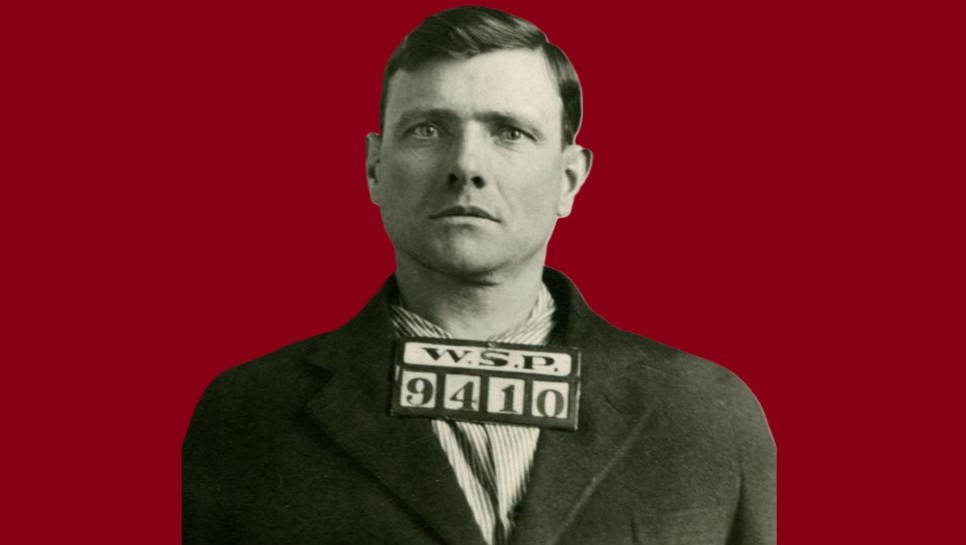
Born in the village of Scarriff, in Ireland’s County Clare, wobbly logger James McInerney died in Walla Walla prison from meningitis and neglect on August 13, 1930. Jailed for ‘murder’ in the Centralia fight which saw I.W.W. members defend their hall against American Legion thugs in a 1919 Armistice Day attack, resulting in the deaths of five reactionaries and the lynching of I.W.W. activist Wesley Everest,. One of seven who served at least a decade, McInerney, spent the final ten years of his life locked up for defending himself, his comrades, and his class.
‘Memories of James McInerney’ from Industrial Worker. Vol. 12 No. 34. August 23, 1930.
JAMES MC INERNEY IS DEAD
SEATTLE, Wash., Aug. 14. Fellow Worker James McInerney, one of the Class War prisoners died in the prison hospital at Walla Walla Wednesday morning, Aug. 13, at 8:21 of a complication of tuberculosis and spinal meningitis. He had been confined since the Montesano trial in 1919 for his part in defense of the I.W.W. hall from the attack by a mob of legionnaires on Nov. 11, 1919.
Fellow Worker McInerney was born in County Clare, Ireland. He was one of the passengers on the ill-fated Verona which was waylaid and fired upon by a broad-cloth mob on Nov. 5, 1916. He was wounded by a shot fired from the dock. When the conspiracy to raid the hall in Centralia was hatched, he was pointed out by one of the future mobites as “one of the damned I.W.W.’s we will have to run out of town.” He called the abusive individual to account personally and asked him if he had any personal grievance against him. Needless to say, he was not attacked. Later, after the mob had done its work he was tortured in the Centralia jail in an effort to make him incriminate his fellow workers. In spite of the torture and with the rope placed by the cowardly jackals around his neck torturing the flesh, he made his famous defi:
“You can go to hell!”
McInerney was murdered by the capitalist class. A man of magnificent physique, his confinement, and the eleven years of prison fare wore down his physical resistance and caused his death. His is the first death to occur among the eight men originally sent to prison. The others are still there.
***
Memories of James McInerney by The Spectator.
McRae, do you remember the Irish boy into whose eyes you could not look, who was on the dock at Everett on the 5th of November, 1916? The Irish lad that lay on the dock with a piece of lead in his body that had been fired by one of your gunmen?
The fellow that laughed at your kicks and curses, despite the intense suffering he was undergoing, and who, politely told you go to hell, when you asked his name? Surely you will recall him, for that scornful laugh of his must be ringing in your ears yet–
And, foreman Welch, you of logging camp fame, do you ever run your hand speculatively over your twisted jaw and call to mind the reason why it has that peculiar twist? Odd, wasn’t it, that a man of your hardboiled reputation should have had to have his jaw broken by a smiling eyed Irishman, before you could learn that it did not pay to call wobblies son’s of b–s? It was tough on you to be beaten by a man half your size, especially before the camp crew but you privately admitted that he was a real man. Too bad you were not man James McInerney enough to admit as much publicly instead of making that blathering statement that someday you would “get him.” Well–
Then, too, we wonder if you, F.B. Hubbard and Warren Grimm, as you lie in your graves, and if there be such a thing as an after life, if you can screw up sufficient courage to face the little fellow whose lips could smile while blue eyes remained cold and dispassionate. The fellow whom you pointed out one day on the streets of Centralia as one of those damned I.W.W. agitators that had to be driven out of the country. You know who we mean, the fellow who overheard your remark and turned to ask you if you had any grievance to settle with him and also asked if you would be so kind as to tell such grievances to him personally. Yes, it would be nice to know what you are doing now if there is a hereafter, for this Irish fellow is now–
Livingstone, Cormier, Churchill, McCrary, Russell and Wilson are your faces blanched to a chalky whiteness these days? Are your hands inclined to tremble when you talk about Tower Avenue? Are you thinking of that nice new rope that was tied around an Irishman’s neck on the night of November 11th, 1919? Remember, he was strung up there in the jail so high that the tips of his toes would barely touch the floor and he was left in that position throughout the entire night. And remember too, how often he was punched and kicked and cursed? Then there was that left eye that was swollen so badly that it was entirely closed and that funny space in his mouth where teeth had been knocked out and that nasty looking tear on his lower lip, made from the heavy boot. Then how odd he appeared in the gray light of the early morning after he had been cut down from his hanging perch; his head was twisted strangely to one side, the chin inclined in towards his chest. Surely, you must all remember those little things, but if you don’t you must of a certainty remember how you questioned him and demanded a confession from him for the crime you yourselves were most guilty of and of how he forced a grin and told you all to go to hell? Strange, isn’t it, how those little things stay with one and then after eleven years have passed they return with such force a to make one’s face turn white and one’s hands to tremble. But the Irish lad, he is not trembling, he–
And Mr. Wilson, you of the judicial frown and the black robe, is your heart rejoicing now? Do you feel that you have done your bit and in such a heroic way? Recall the letter you wrote one time about a little affair that happened in your town and of how you praised your heroes? Then recall, that fellow with the blue eyes and the strangely twisted head who watched you out of quiet blue eyes during that long trial in Montesano in the spring of 1920–well, that letter referred to him in part and that fellow took the illegal jolt you gave him with a smile and his eyes were telling you to go to hell, weren’t they? You played your part well and now that laughing eyed Irishman–well HE’S DEAD. Aren’t you glad, aren’t all of you glad? The thing you did not dare to do in those earlier years has now been accomplished and you all play- ed your part in bringing it about. I SHOUT AT YOU THAT YOU MAY HEAR, THAT YOU MAY DANCE AND SING AND PRATE ABOUT WHAT YOU DID TO THAT What, you WOBBLY. Don’t you wish you could have been there when he died? don’t? Oh, I understand. you are afraid those blue eyes would have smiled and the lips would have framed that stinging sentence, “GO TO HELL.”
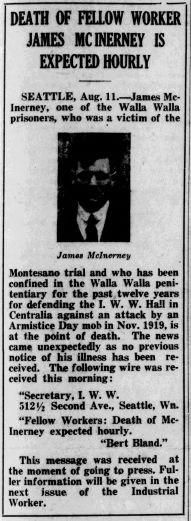
Yes, Jim McInerney is dead. His death was brought about by his confinement in Walla Walla penitentiary where he contracted T.B. as a result of the weakened condition he was in from the many beatings he had received at the hands and the behest of the lumber barons of Washington. Jim is dead and they rejoice but if a comparison was to be made of him and any of those who tortured him he would stand out as Messiah would alongside of a little red ant. He was a man, a fighter and true to his last breath to the ideals he cherished and believed in.
***
MC INERNEY A GOOD WOBBLY
Editor, Industrial Worker:
James McInerney, one of the eight buried alive in the masters’ dungeon, at Walla Walla, was one of the first well-read wobblies I ran across about 14 years ago, while we both slaved on the job for the Aberdeen lumber barons before the big strike. Mack was partly responsible for my “lining up” and my activity. I and my brother Walter V., now dead, both talked with McInerney in the Tacoma hall a few days before the Legion raid in Centralia. A firm, serious fellow worker is gone.
Harold Roland Johnson.
The Industrial Union Bulletin, and the Industrial Worker were newspapers published by the Industrial Workers of the World (IWW) from 1907 until 1913. First printed in Joliet, Illinois, IUB incorporated The Voice of Labor, the newspaper of the American Labor Union which had joined the IWW, and another IWW affiliate, International Metal Worker.The Trautmann-DeLeon faction issued its weekly from March 1907. Soon after, De Leon would be expelled and Trautmann would continue IUB until March 1909. It was edited by A. S. Edwards. 1909, production moved to Spokane, Washington and became The Industrial Worker, “the voice of revolutionary industrial unionism.”
PDF of full issue: https://washingtondigitalnewspapers.org/?a=d&d=IWW19300823

