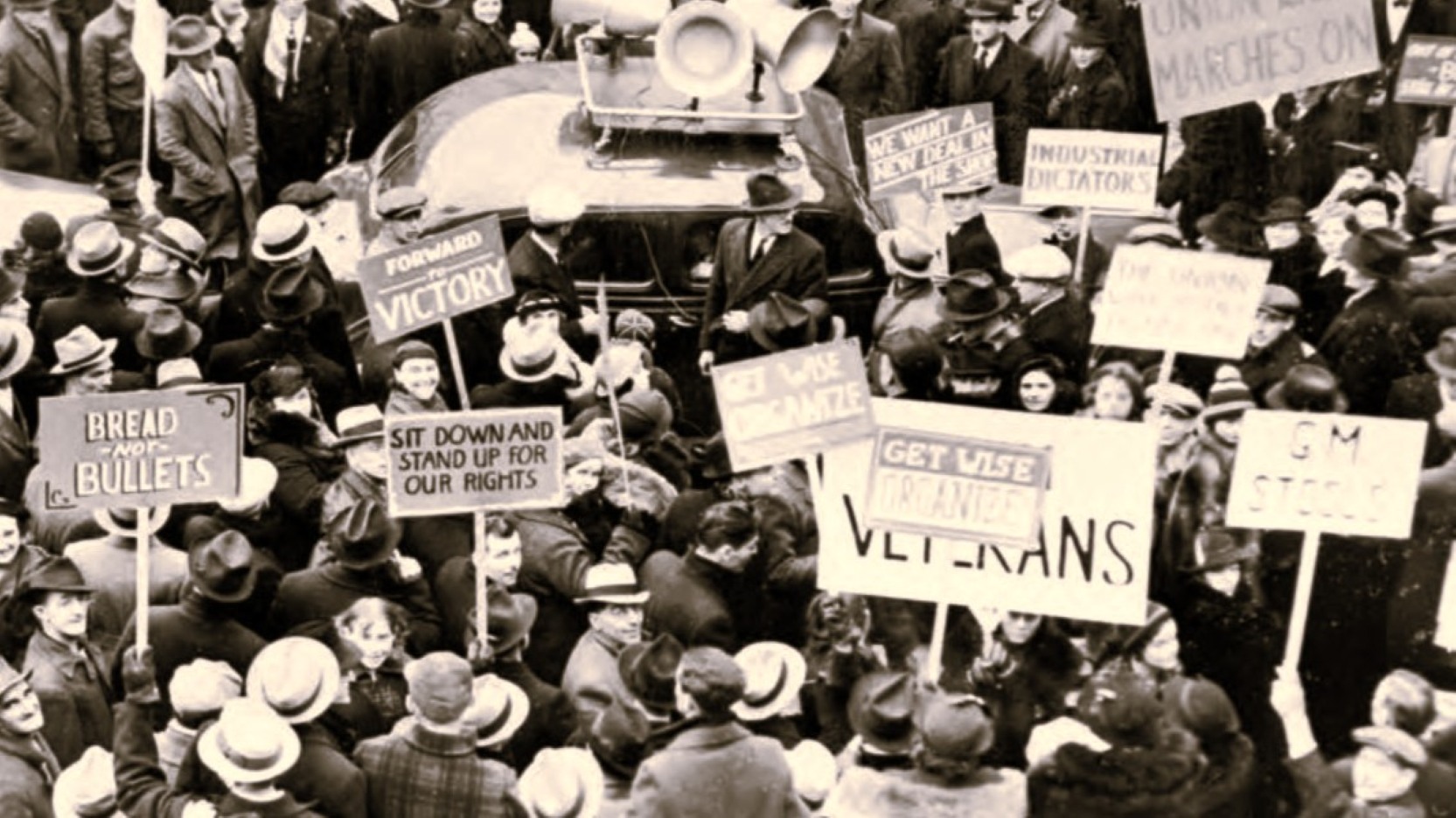
Detroit’s legendary radical labor lawyer, counsel for the U.A.W., Maurice Sugar’s status as a champion of workers was made with arguments like this, where he makes a popular legal defense of the sit-down strike.
‘Is the Sit-Down Legal?’ by Maurice Sugar from New Masses. Vol. 23 No. 6. May 4, 1937.
A well-known labor lawyer discusses the “property-rights” angle, and remarks that law cannot contravene popular will
LET us picture a street in the working-class neighborhood of a typical industrial city. It is night. In the shadows may be seen figures of men quietly and cautiously entering a worker’s home. Singly they file into the basement. It is pitch dark. All is quiet. Then a voice is heard in the darkness. It is the voice of a worker calling the meeting to order. It is a meeting of workers, employees of General Motors, let us say, to discuss plans for building their union, the United Automobile Workers of America. The meeting over, they file out in the darkness, None is able to identify another by sight.
This happened scores of times in the city of Flint, Mich., within the past year. Why was it necessary for these workers to meet in this manner? Because they had learned that the General Motors Corp. employed hundreds of spies to report upon their activities, and that once the corporation discovered that they were active in organizing a union they would be discharged and, with their wives and children, subjected to suffering and privation.
Members of the United Automobile Workers employed in the Ford plant meet in the basements of their homes in small groups of four to eight. Why do they do this? They do it because they are compelled to do it in order to prevent wholesale disclosure by Ford stool-pigeons, and the resulting loss of their jobs.
The Ford private police have searched the lockers used by workers, have gone through their coat pockets, opened their lunch boxes, and even peered between the slices of bread of their sandwiches, searching for union literature.
The Ford Motor Co. has taken movies of a parade of workers, scrutinized the film, and discharged employees whom they identified as on their staff. A foreman in the Ford plant was discharged because he was seen to have shaken hands with me at his father’s funeral. This is the “independence” of the workers which Henry Ford fears would be destroyed by unions!
The industries of this nation are literally riddled with spies and stool-pigeons. The Fisher Body plant in Lansing, Mich., was at one time completely unionized. Spies worked their way into the officialdom of the union. In due time all of the officers were spies; and in due time the entire membership of the union consisted of these officers only. As the result of espionage among the auto workers in Flint, in less than two years the membership of the local dropped from twenty-six thousand to one hundred and sixty-two.
The president of the Plymouth Motor Car Co. local of the United Automobile Workers has just been revealed as a Chrysler spy. Four months ago, while he was president, the local union consisted of sixty members. Within three months after his removal, the membership went to ten thousand.
Labor espionage is outlawed by the National Labor Relations Act. Even were it not illegal, can there be any doubt that this practice is vicious and reprehensible in the eyes of the entire people of the United States?
The corporations make use of political weapons, too, in order to prevent the organization of workers into unions. Recently, in the city of Dearborn, the Common Council, which does the Ford Motor Co.’s bidding, passed an ordinance designed to prevent the distribution of handbills among Ford employees. Under this ordinance, one is prohibited from distributing handbills unless he has paid a fee and procured a license. Look at a section of this ordinance: “No license shall be issued for the distribution of any circular (or) handbill…that contains obscene, immoral, scandalous, libelous, or treasonable: statements, or any statement the truth of which cannot be established to the satisfaction of the City Clerk.” The City Clerk of Dearborn refused a license for the issuance of a leaflet which referred to the speed-up at the Ford Plant as the “murderous speed-up.” I am not sure whether the ground for the refusal was obscenity, immorality, libel, or treason. It was probably treason.
AND NOW a great tidal wave of organization is sweeping the country. The workers have found a weapon which brings to them the possibility of procuring parity of power with their corporation employers. The urge which has been dammed up in the breasts of these workers has found release. One year ago, the membership of the United Automobile Workers in the city of Detroit was ten thousand. Today that membership is one hundred and seventy-five thousand. One year ago, the membership throughout the country was thirty thousand. Today it is three hundred thousand. And there are people who say that the sit-down strike is not justified! Such people, consciously or unconsciously, are accepting the ethical standards gf the “economic royalists” of the country.
During a strike some three years ago, I participated in “negotiations” with Mr. Edward Fisher, of the Fisher Body Co., and his associates. The “negotiations” consisted of Mr. Fisher reading the union demands out loud, and at the conclusion of each stating, “The answer to that, gentlemen, is ‘No.’” One of the workers pointed out to Mr. Fisher that he could grant the increased wage by the mere addition of two and one-half cents to the price of each car. Mr. Fisher’s reply was that nobody was going to tell him how he should run his business. He was right—then. But running through my mind at that time was the thought that the time would come when the workers in that plant would be telling him just a little about how that plant should be run in relation to their wages, hours, and conditions of employment. The time has come. And while I find myself incapable of harboring a feeling of revenge, I am frank to state that lately I have been feeling mighty good.
When in spite of the spy system, the blacklist, the terror, and the company union the worker succeeds in building his union, the employer further violates the law by refusing to talk to him. What a terrible thing the worker does then. He says, “So you won’t talk, eh?”—and he sits down!
That the sit-down strike is ethical follows both from its origin and its application. I might well content myself with arguing that what is ethical should be recognized as legal —and, in my opinion, such a position would be sound. But Jet us turn for a moment to another approach to the problem under discussion.
There was a time, during the period of industrial expansion, when a worker discharged from one job could more or less readily get another. That time is past. In this day of gigantic industrial monopolies, with our great army of unemployed, the worker has come to know that the loss of his particular job, or the loss of a job with a particular employer, may spell destitution. This explains the development of an “attachment” which the worker feels to his particular employment, or his particular employer.
Now let us see if there is not a logical basis for the claim which the worker makes that he has a right in his job. We start by asserting that every worker in America has the right to live in decency and as a free man. I cannot believe that anyone will dispute this. Since the worker has the right to live in decency and as a free man, and since his livelihood and his freedom actually depend upon his having a job, it follows that he has the right to a job. Indeed, the right to work has been expressly recognized as a property right by our highest courts. Having the right to live decently and as a free man, and having the right to work, it logically follows that he has a right to work for decent wages, for decent hours, and under decent conditions. And since, under the existing economy, it is impossible for him to move freely from one job to another, it logically follows that he has the right to work at the particular job at which he is employed, or at least for his particular employer, with decent wages, hours, and conditions.
Having this right, there is necessarily a correlative duty on the part of the employer so to use his property that the worker may enjoy that right, and to refrain from any practices which will in any way infringe upon that right. Certainly the worker thinks so.

“Rights” do not exist in a political or economic vacuum. And no man can assert a right without at the same time asserting it against another man. The rights of life, liberty, and the pursuit of happiness referred to in our Declaration of Independence sprang out of the denial of those rights by others. The rights of freedom of speech, press, assembly, worship, became and are rights only because there have been and are attempts at their denial. If we assume, as I insist we must assume, that everyone has the right to security and a decent living, it follows that such right is being asserted by the worker against those who would deny him that security and that decent living.
And so we have a conflict of asserted rights. On the one hand, we have the asserted right of the worker to live, with the accompanying rights which I have indicated. On the other hand, we have the asserted right of the employer to do with his property as he pleases. And when these rights conflict, we have no choice but to take a position favoring the domination of one right over the other, to a degree at least.
The people of America have been gradually taking a position on this conflict. When Congress passed the National Industrial Recovery Act with its Section 7-a presuming to outlaw discrimination against workers, it recognized to a degree the right of the worker to his job. It recognized this right in the Railway Labor Act and in the Wagner Labor Act. This means, certainly, that the worker has the right to that job to the degree, at least, that he cannot be deprived of it by way of discrimination. Similarly, the right of the worker to collective bargaining involves a recognition of a limitation upon the employer in dealing with the worker in relation to his job. And when the Supreme Court of the United States recently held constitutional the provisions of the Railway Labor Act and Wagner Labor Act, guaranteeing collective bargaining and legalizing the majority rule for such bargaining, it then, whatever may have impelled the decision, recognized a right of the worker in his job.
Now, when the worker engages in a sit-down strike, he sits down on his job. Is this an encroachment upon the property rights of the employer? Of course it is. But encroachments upon property rights are not ipso facto illegal. The law books abound with adjudications which justify encroachments upon property rights. This is what we lawyers call damnum absque injuria.
Let us illustrate. The right to strike is a right asserted against the employer, and a strike obviously works an injury to the employer’s property. While it is true that in the past this right usually has been attended by departure from the plant, it is clear that this distinction has no application to the problem we are now discussing. If the employer has the absolute right to run his business without any interference on the part of labor, he certainly has the right to run it free from interference by labor outside of his plant as well as inside. The same applies to the right to picket. Picketing certainly is an encroachment upon the property rights of the employer. Indeed, in one sense that is its main purpose.
We see, then, that as the law stands today, it is generally recognized that labor has a right to pursue practices which clearly are encroachments upon the property rights of the employer and which, indeed, may even result in the total loss of the employer’s property.
So, to press for a distinction based upon whether the encroachment upon the employer’s property rights is effected from the outside or the inside of the plant is only to argue about the degree to which labor should be recognized as having its claimed rights. And I say that under existing conditions, the recognition of labor’s right to sit-down in the plant is a recognition of labor’s need for the possession of a weapon to protect itself against the tremendous economic and political power of the corporate interests of the country. Labor must have this weapon for use against the employer who continues to say, “My property, may it always be my right to use it as I please; but right of wrong, my property.”
A review of the recent series of sit-down strikes throughout the country proves one thing clearly: the sit-down strike tends to eliminate violence. The use of thugs, finks, hired strike-breakers, and bribed workers is made exceedingly difficult. The sit-down strike is labor’s weapon of economic self-defense. And I know of no case in which labor has used more force than was necessary to defend itself when attacked.
THE AMERICAN WORKER is breaking his chains. The employer who has forced them would argue with the man in chains about the ethics of the chaining. He brings hoary precedents—and some not so hoary—to prove that ethics and law require that the chains should not be disturbed. And he may think that he is winning the argument, too. But the worker in chains, finding that he has been unable to free himself by argument, breaks the chains. Then the employer protests loudly and indignantly that his chain law has been violated. But it has not been violated. Actually, whether we know it or not, the chain law has fallen with the chains.
The sit-down strike is legal to millions of workers. It will remain legal to them, and to more millions as time goes on. And who dare say that millions of American workers have suddenly become criminals? Edmund Burke once said, “I do not know the method of drawing up an indictment against a whole people.” May I presume to add that he who would indict a whole people is himself the criminal?
Law cannot enslave a people in perpetuity. Law should function for the people and not against them. And we should constantly remind ourselves that, as Burke says, “People crushed by law have no hopes but from power. If laws are their enemies they will be enemies to the laws.”
We are told that the workers have no respect for the courts. Who tells us this? The fifty-three Liberty League lawyers who announced that the Wagner Labor Act was unconstitutional, and deliberately encouraged its violation. They are not seeking respect, they are seeking submission. Respect cannot be forced, it must be earned. Respect springs from free men: submission comes from slaves. If the courts of America are to command the respect of the American people, they must be such courts as the American people will respect.
Remember: that which hinders a people in their struggle for freedom–that is immoral. That which becomes a necessity to a people in their struggle for freedom—that is moral. And that which is moral certainly should be recognized as legal.
They tell us that if the sit-down strike is recognized: as legal, our constitution will be gone. They forget that in February, 1935, Mr. Justice McReynolds of the United States Supreme Court said, in the minority opinion in the Gold Clause case, “The Constitution is gone.” So it is gone anyway. Why worry about it now?
I suppose no one knows better than a lawyer whose life has been devoted to the labor movement that it is no easy matter to bring about the acceptance of labor’s point of view by the judiciary. It is difficult because we live in a society in which our ideas are molded largely by the agencies dominated by the employing class. It is especially true in the field of law that, as a great thinker once said, “The tradition of all past generations weighs like an Alp upon the brain of the living.”
But there is evolution in the law, as in all things. There was a time when the strike itself was illegal. The first case on the right of workmen to strike was tried in England in 1721. The journeymen tailors of Cambridge went on strike. They were indicted for conspiring to raise their wages. They were found guilty. Here is the reasoning of the court:
“It is not for the refusing to work but for the conspiring that they are indicted, and a conspiracy of any kind is illegal although the matter about which they conspired might have been lawful for them to do, if they had not conspired to do it.”
That is what I would call a juicy judicial gem.
The first case in this country was tried in 1806. The boot and shoemakers of Philadelphia were indicted for “conspiring to raise their wages.” The judge said:
“A combination of workmen to raise their wages may be considered in a twofold point of view: one is to benefit themselves, the other is to injure those who do not join their society. The rule of law condemns both.”
And then he said this:
“If the rule be clear, we are bound to conform to it, even though we do not comprehend the principles upon which it is founded. We are not to reject it because we do not see the reason of it.”
Now, you ask the American people to “respect” that kind of a decision!
There was a time when peaceful picketing was held illegal by most of the courts of the country. Today it is generally held legal.
Just as the strike, once held illegal, is now held legal, and just as picketing, once held illegal, is now generally held legal, so should the sit-down, now being held illegal, come to be held legal. Courts are agonizingly slow to change, but they can change. This is shown by the recent decision of the United States Supreme Court upholding the Washington minimum-wage law and over-ruling its earlier decision. Note well a reason given for the change. I quote from the opinion:
“The exploitation of a class of workers who are in an unequal position with respect to bargaining power and are thus relatively defenseless against the denial of a living wage is not only detrimental to their health and well being but casts a direct burden for their support upon the community.”
The opinion refers to this as “economic conditions which have supervened” and as a “compelling consideration which recent economic experience has brought into a strong light.”
We are told that if labor does not like the law, it ought to cause the law to be changed. The answer is that labor has already caused the law to be changed. Now we await only the acceptance by the courts of the change which has already been made.

We members of the bar, traditionally conservative, must break out of our mental straitjackets. I know it is not easy. I have tried to liberate a number of judges in sit-down injunction cases. The results have been uniform—failure. I have urged upon them the application of the doctrine of unclean hands. But their minds have been completely closed. Judges with no mean local reputations as “legal minds” simply do not hear you when you argue. So shocked are they by the mere thought of the employer being temporarily deprived of his property that their decisions are irrevocably made before you even enter the court-room, let alone begin to argue. Indeed, in some cases I have observed that the very books from which the judges have later quoted to support their decisions were lying on their desks before I had commenced my argument.
Bear in mind, fellow lawyers, the words of Oliver Wendell Holmes, Associate Justice of the United States Supreme Court:
“The life of the law has not been logic, it has been experience. The felt necessities of the time, the prevalent moral and political theories, intuitions of public policy avowed or unconscious, even the prejudices which judges share with their fellowmen, have had a good deal more to do than the syllogism in determining the rules by which men should be governed.”
The situation of counsel for the workers would indeed be discouraging were it not for his knowledge that, outside of the court-room, irresistible economic and social forces, impelled by great masses of the American people, are breaking through the barriers erected by the big business interests of the country. These same forces must shatter the conservatism of the judiciary and, by their impact, ultimately compel recognition of the sit-down strike as legal.
However difficult our task may be, those of us in the legal profession who have some understanding of the powerful forces at work in our society, those of us who are determined that the fascists in our midst shall not impose their damnable regime upon the American people, we who have a vision of an American people truly liberated and truly happy, those of us who agree with Lincoln when he said, “The people are the rightful masters of the courts”—we must have courage in times like these. We must continue to pound away, insisting, as Lincoln insisted, that “this country, with its institutions, belongs to the people who inhabit it.”
The New Masses was the continuation of Workers Monthly which began publishing in 1924 as a merger of the ‘Liberator’, the Trade Union Educational League magazine ‘Labor Herald’, and Friends of Soviet Russia’s monthly ‘Soviet Russia Pictorial’ as an explicitly Communist Party publication, but drawing in a wide range of contributors and sympathizers. In 1927 Workers Monthly ceased and The New Masses began. A major left cultural magazine of the late 1920s and early 1940s, the early editors of The New Masses included Hugo Gellert, John F. Sloan, Max Eastman, Mike Gold, and Joseph Freeman. Writers included William Carlos Williams, Theodore Dreiser, John Dos Passos, Upton Sinclair, Richard Wright, Ralph Ellison, Dorothy Parker, Dorothy Day, John Breecher, Langston Hughes, Eugene O’Neill, Rex Stout and Ernest Hemingway. Artists included Hugo Gellert, Stuart Davis, Boardman Robinson, Wanda Gag, William Gropper and Otto Soglow. Over time, the New Masses became narrower politically and the articles more commentary than comment. However, particularly in it first years, New Masses was the epitome of the era’s finest revolutionary cultural and artistic traditions.
PDF of full issue: https://www.marxists.org/history/usa/pubs/new-masses/1937/v23n06-%5b07%5d-may-04-1937-NM.pdf

