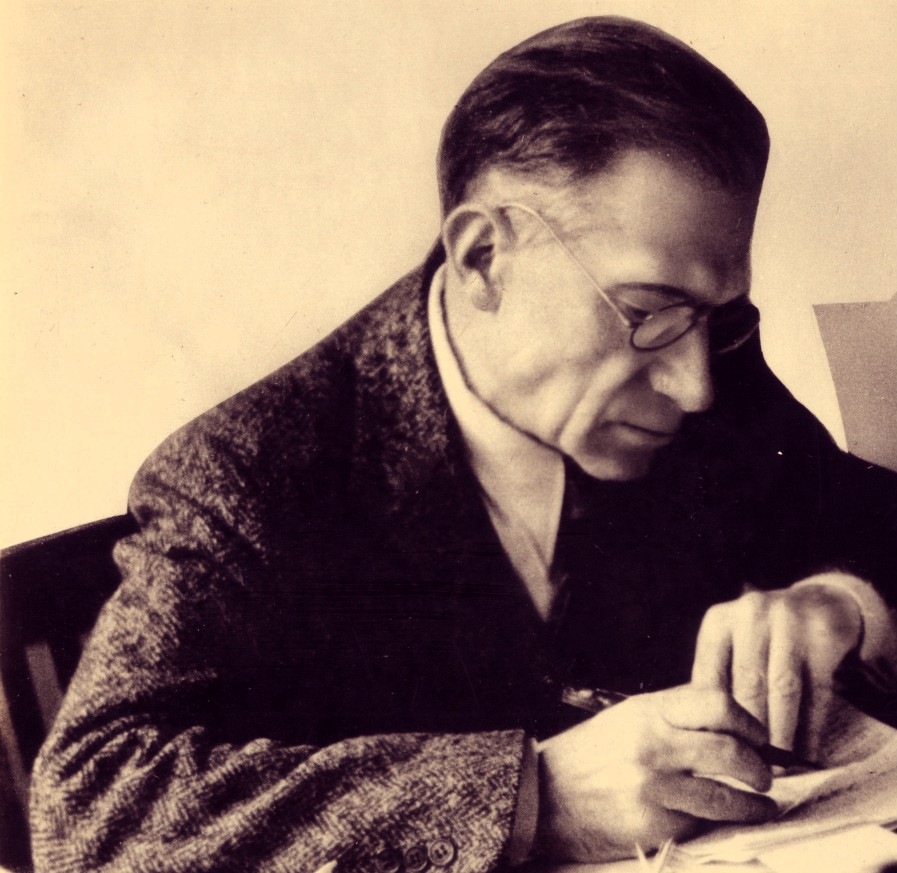
On his way to an extended visit to the Soviet Union, and the Fifth World Congress, Olgin visited Germany in the aftermath of the October Revolt, where crisis weighed upon crisis.
‘In the Land of Gloom’ by Moissaye J. Olgin from The Daily Worker Magazine. Vol. 2 No. 58. May 24, 1924.
WHEN a man has spent in a foreign country a little over four days, one cannot expect him to have a clear view on every phase of its life. The press correspondent who says “he knows it all,” is fooling himself or his readers. I would not claim to give here an adequate account of the German economic and political situation. I will only confine myself to a few indisputable facts which force themselves upon every observer as soon as he begins to orientate himself on German soil.
Low Wages, Unemployment, Starvation.
FACT number one is the miserable situation of the German working class. With the stabilization of the mark, prices in Germany, excepting rents, are on the same general level as are the prices in the United States.
The average wage of a German working man is somewhere in the vicinity of twenty marks a week. Peak wages for the highest skilled workers (such as the members of the printers’ union) do not exceed thirty-six marks; after deducting taxes, sick benefit dues and other obligatory payments, the highest paid worker brings home no more than thirty marks. The dollar buys now a little over four marks. Those of the German workers who are happy enough to have full-time continuous employment, earn as much as $5 to $7.50 a week. The number of such fortunates, however, is not very large.
There are four million of unemployed in Germany today. There are twelve million who work part of the time.
“How can you make both ends meet?” I asked a cabinet maker in a suburb of Berlin.
The man looked at me with a smile of despondency.
“One must,” was all he said.
I HAD soon a vivid illustration of how “one must.” The man had come home after eight hours of work. He was a sturdy fellow of about thirty, though of middle height. The meal his wife put before him on the table consisted of a soup-piste of mashed potatoes with gravy and a piece of bread. That was all. Later in the evening he would drink a pint of beer in his union hall, or maybe he would even abstain from this.
THE man lived in one small room with his wife and a three-year-old child. He could not allow himself the luxury of decent clothes. He could not allow himself the luxury of a theatre, or a concert. He could not allow himself the luxury of an “ausflug” (holiday trip) out of town on a Sunday. He could not allow himself anything. And he still belonged to the aristocracy of labor. His wife told me that, as a rule, the German worker eats meat only once a week. The life of the unskilled laborers is still worse. The life of the unemployed is hell. There movement afoot to change the eight-hour day for ten. In some cases it has been accomplished. That there must be dissatisfaction among the workers under conditions like these, is easy to imagine.
The Revolt of the Workers.
FACT number two is this bitter revolutionary dissatisfaction of the laboring masses. The wave of resentment is growing. The readiness to fight becomes more manifest every day. The masses have come to after the defeat of last October. In reality, the masses had never been subdued.
It is true that long years of hopelessness under the treaty of Versailles, long years of underfeeding and actual starvation have sapped the vitality of the German working class as a whole; and have thrown a portion of the workers into a state of nerveless stupor. But even among the most devitalized elements smoulders the fire of revolt. Under the ashes of despair there is so much hatred for the ruling classes and so much contempt for capitalist law and order that any shock is capable to provoke an explosion. “We have reached the end of the rope. “We have nothing to lose.” Where this sentiment is widespread, a revolution is abroad.
THE first manifestation of the strengthening will to struggle among the working masses is the wave of strikes. When I arrived in Hamburg, baggage had to be carried by the passengers themselves (to the great and bitter resentment of the paunch-carrying German “buergers”) because the porters had gone on strike. This was the first skirmish of an impending all-German railroad strike. The strike has been averted by the compromise of the union bureaucrats, but the workers are not content with the results. There has been a partial strike of the printers. There is a miners’ strike impending. There is a strike fermentation among millions. This in spite of the A.D.G.B. (Allgemeiner Deutscher Gewerkschafts-Bund—the German A. F. of L.) which tries to smother the movement.
A second manifestation of the German workers’ revolt is their switching over to the Left. The Communist movement is growing by leaps and bounds. A situation has been created where, when a worker says “fight,” he must say “Communism.”
Just when I was in Berlin, the most amazing and most encouraging victory was won by our comrades in Bavaria at the election. This country, famous by its fascism, by the Hitler counter-revolution, by the shame of the Hitler-Ludendorff trial, by assaults on the Communist workers, by imprisonment of Communist leaders and shutting down of Communist papers, had, at the April landtag election, cast over 200,000 votes for the Communist ticket, four times as much as on the previous election. It should be noted that an open election campaign could not be carried on by our Bavarian comrades, and that literature could not be distributed freely. It should also be remembered that Bavaria is a predominantly agricultural state and that the bulwarks of Communism are the central, northern and northwestern industrial regions.
THE Bavarian vote shows the trend of the revolutionary sentiment among the German workers. Other signs of the same revolutionary character are not lacking. The labor movement in Germany has reached a state where, either it is Communism, that is to say class-struggle and revolution, or it is nothing at all.
Social Democracy Is No More
FACT number three is the collapse of the center. By the same token by which the workers rally to the extreme Left, the bourgeois elements rally to the extreme Right, i.e. to fascism. The pacifyers, the compromisers, the preachers of social collaboration the prophets of all-healing bourgeois democracy are simply melting away. The decay of the Social-Democracy is, perhaps, even a quicker process than the disintegration of purely bourgeois liberalism. The Social-Democracy, by becoming an appendix to the capitalist state and by defending private property against the revolutionary workers, has become historically useless. Comrade Trotzky, recently provoked great merriment all over Russia by the following remark: “The English worker,” he said, “will ask himself: ‘why should I scratch behind my right ear with my left hand? Why should I support McDonald who takes orders from the liberal bourgeoisie, when I can meet the same bourgeoisie myself face to face?’” This is still more true about the German Social-Democracy. Those of the American comrades who still remember the Bebel-Kautsky-Ledebur Social-Democracy of pre-war times and who have not seen it in action (for reaction) afterwards, should keep in mind that there is practically no difference between the German Social-Democracy of the present and a liberal bourgeois party of the pre-war epoch, such as, for instance, the Russian Kadets. The German Social-Democracy is not even using a socialist phraseology any longer. (It has substituted “social conscience” for class consciousness and class-struggle.) The German “Vorwaerts” is no more liberal than used to be the “Berliner Tageblatt” in 1912. I have personally read the following classic remark in the “Vorwaerts” of April 8: “The Russian Communists denounce bourgeois class justice in the capitalist countries, while they themselves practice proletarian class justice in the Russian Soviet states.” Proletarian class justice is equally inacceptable to the German “Vorwaerts” as is capitalist justice. This illustration alone may suffice.
IN practice the German Social-Democracy offers nothing to the working class which could not be and is not being offered by the liberal portion of the bourgeoisie. Fighting against capitalism is criminal because it undermines the economic foundation of the fatherland. Demands presented to the bosses must be mild or else capitalism will not be able to get its due dividends. Reparation bills must be acknowledged and paid because the German army is not strong enough to fight the French. Communists must be downed and smashed because they voice the hatreds of the masses and lead in revolutionary fights, against the only order which is possible at present, namely the capitalist order. This is, roughly, the ideology of the once famous Social-Democratic party. This is the tone and the trend of everyday actions. When I was in Germany, the Dawes committee published its report. The Social-Democratic press was more docile and more crestfallen as regards the crazy bill than was the liberal press. In the strike wave, the Social-Democratic union bureaucrats try to compromise as quietly as is desirable for the bosses and on terms as mild as would only keep the workers from striking. When it comes, however, to persecuting the Communists in the “Gewerkschaften” (unions) or even outlawing entire red sections of the unions, the same Social-Democrats manifest unusual initiative and vigor.
The natural result is a catastrophal loss of Social-Democratic prestige among the mass of the workers, the collapse of Social-Democracy as a political factor, a rush of the workers of any degree of class-consciousness to the sphere of the revolutionary Communist influence and revolutionary action. “German Social-Democracy is no more;” this is a remark repeated in Germany with the same certainty as we, in America, speak of the disappearance of the S.P.
Fascisti.
FACT number four Is the growing militancy and the growing number of the extreme Right which in Germany is called the “Voelkischer” and which we may name with the old familiar Fascisti. The program of the Right is very simple: abolition of the constitution, establishment of a monarchy, dissolution of all Socialist parties, annihilation of the Communists, a ten or twelve hour labor day, organization of a strong national army under a great national dictator, fight to the finish against the French. The Fascisti are militant not only in words but also in action. They make riots. They appear in workers’ quarters and attack workers’ gatherings. They do scab work in strikes. They organize anti-Jewish pogroms. For a radical or a person with an intellectual or a Semitic appearance to come to a meeting of the Voelklsche is to risk a couple of ribs. I was told by an eyewitness that at one of their meetings the younger members formed a line near the door asking the comers for donations and thereby singing a song which had the refrain:
“Give, give, give,
That we may kill off
The Messopotamian flatfoots.”
It is quite obvious that a movement of this kind, appealing to the patriotism of the German philistine, appealing to the class interests of the German industrialist, appealing to the group interests of the military caste, appealing to the consciousness of power and supremacy which is inherent in the German bourgeoise, appearing to offer a quick and glorious solution of the present crisis, must attract a great number of disgruntled elements in the unhappy German empire. The weakness of the movement is in its inability to offer any real solution. It is childish to imagine that the Germans could wage a successful war against the French in the near future.
***
Among these forces the Communist party of Germany must steer its way and lead the masses towards a revolution. When I was in Berlin the Communist national congress was still in progress. It ended on the eve of my departure from Germany. The story of my meetings and conversations with the German comrades must be postponed to a later correspondence.
(Moscow, April 29, 1924)
The Daily Worker Saturday Supplement, later changed to a Sunday Supplement, of the Daily Worker was a place for longer articles with debate, international focus, literature, and documents presented. The Daily Worker began in 1924 and was published in New York City by the Communist Party US and its predecessor organizations. Among the most long-lasting and important left publications in US history, it had a circulation of 35,000 at its peak. The Daily Worker came from The Ohio Socialist, published by the Left Wing-dominated Socialist Party of Ohio in Cleveland from 1917 to November 1919, when it became became The Toiler, paper of the Communist Labor Party. In December 1921 the above-ground Workers Party of America merged the Toiler with the paper Workers Council to found The Worker, which became The Daily Worker beginning January 13, 1924.
PDF of full issue: https://www.marxists.org/history/usa/pubs/dailyworker/1924/v2n058-may-24-sat-sup-1924-TDW.pdf

