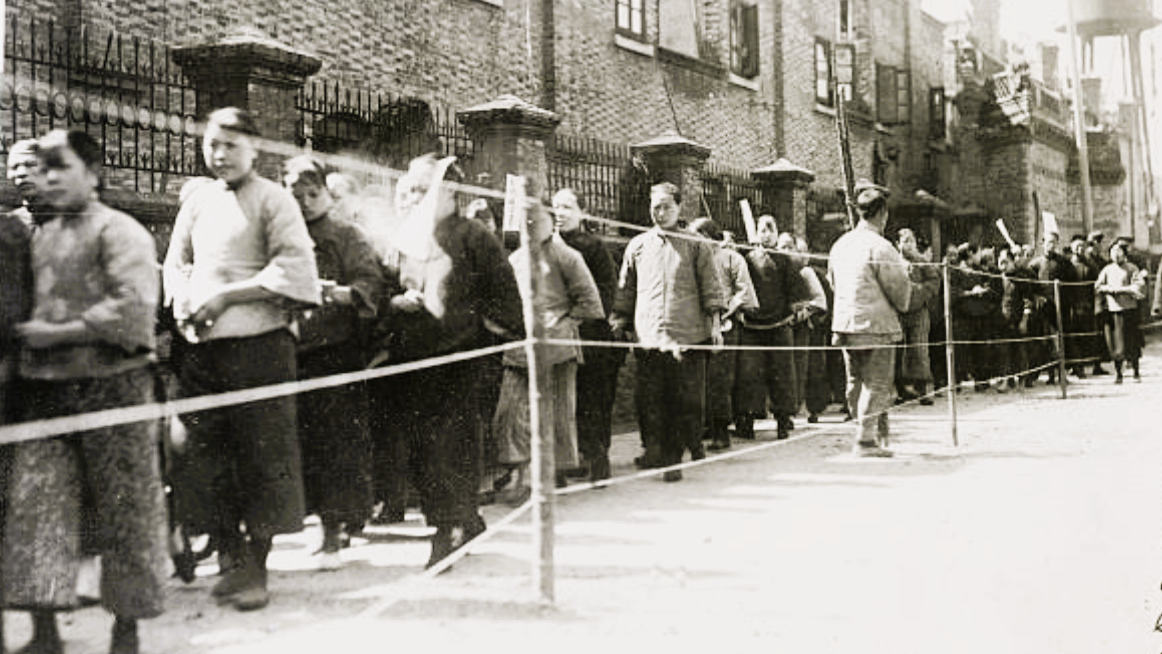
The increased exploitation, and continued strike action, of Chinese women workers in the years following the defeat of 1927’s Revolution.
‘The Position of the Chinese Working Woman’ by A. Rasumova from International Press Correspondence. Vol. 10 No. 10. February 25, 1930.
Chinese industry has developed mostly in the last decade. The foundation of Chinese industry is the production of textiles. In China there are in all 122 textile mills, 49 of which belong to foreign capitalists.
The millowners prefer to employ women and child labour, as this is cheaper than adult male labour. The number of women employed in the textile mills already amounts to 70 percent of the total number of textile workers. In the Shanghai mills, where almost the whole of the textile and silk industry is concentrated, over 600 000 workers are employed, of whom 420 000 are women.
In the Japanese mills 49 per cent of the female workers are over sixteen years of age, and 29 per cent, are under sixteen, i.e. are children. In the Chinese mills 53 percent are over sixteen years of age and 23 percent are children. In the English undertakings the respective figures are 58 percent and 16 percent.
The position of the Chinese working woman is incomparably worse than that of the woman proletarian of other countries. Wages amount to 10 to 15 Mexican dollars (one Mexican dollar is equal to about two shillings) a month with a twelve-hour working day and no Sunday or other rest day. There is no labour legislation, no protection of labour and no insurance. Girls under sixteen earn from 5 to 6 dollars a month, and likewise work 12 hours a day. That is the position in Shanghai, but in Canton and other towns wages are even lower.
Even with the extremely moderate demands of the Chinese worker in the way of the necessities of life, these miserable wages do not seven suffice to insure them against hunger.
Wages in the tobacco factories of the English and American Companies are somewhat higher. Here the working day is ten hours, and children under 14 years are not employed. The women, of course, receive lower wages even when performing the same work as the men. As in general, here also there is no weekly day of rest. In the whole year there are only three days holiday, i.e. at the New Year, but for which no pay is granted. An exceedingly strict regime prevails in the factories. Absence from work is punished with heavy fines, if not with dismissal. At the time of the Wuhan Government, it was proposed in the Hankow factories that every Sunday be declared free, and in addition that there be seven holidays in the year with pay. At the time of the New Year the factories were closed from 10 to 14 days, but of course the workers did not receive any pay during this time. Chaing Kai-shek however, restored the old state of affairs.
The miserable wages of the workers are further shortened by other means. They are paid in copper coins, the value of which is continually fluctuating. The foreman speculates with the money by paying wages, according to the official rate of the currency, which is always lower than the commercial rate.
The unbounded exploitation of the Chinese working woman has of course not failed to have an effect on her activity. At every time of the Chinese revolution and of mass movements, of revolts, demonstrations and strikes, the working women have taken part in all actions. In the years of reaction, after the overthrow of the Canton Commune, the Chinese working women did not give way, but took part in the daily fights for improving their working and living conditions and participated in the class struggle of the Chinese proletariat against militarism, imperialism and against the Kuomintang government.
The Chinese working women are for the greater part unorganised. They do not enter the yellow government trade unions, as they see that these do not represent their interests. Also in the red trade unions there are very few women, as they are illegal, a circumstance which prevents a big influx of working women. But the Chinese working women, who realise the necessity of organised leadership of the struggle, are creating their own organisations in the factories and supporting the red trade unions. The figures regarding the participation of women in the strike movement in China prove more than anything else that the Chinese working woman is conscious of her class position and has realised that the only path to the emancipation of the working class is that of struggle, In the year 1926, there were in Shanghai alone. 169 strikes in 165 factories in which 202,297 workers, including 12,716 women participated.
In the year 1927 the working women of 83 silk spinning mills, 1,000 women tobacco workers. 3,000 working women in the Japanese textile mills went on strike,
In the years 1920 to 1927 there took place in China over 700 strikes in which working women participated. In the year 1928, in Shanghai alone 120 strikes took place. In these strikes 213,966 workers, including 122,807 women, participated. These strikes had partly an economic, partly a political character, 25 strikes can be regarded as purely political.
In the year 1929 strikes were no less frequent. From May to August there took place in Shanghai 75 strikes involving 57,757 working men and women; in September/October there occurred 14 strikes and 75 disputes involving 113,167 workers. In addition there is the strike of the workers in the match factory Tsingtau, which has already lasted for several months. The repeated attempts of the employers to enter into separate negotiations with individual groups, have proved abortive. In spite of unemployment the working women remain firm and united.
The party of the “reorganisationists” (Left Kuomintang) has set up a programme for the “women’s movement” which contains, among others, the following demands:
Elaboration of laws securing equality for women; guarantee of freedom of marriage; elaboration of a law on women’s labour, stipulating equal pay for equal work and protection of mothers; improvement of the standard of living of working women, two months leave for working mothers after confinement; prohibition of trading in children etc.
The Kuomintang adopted a similar programme at its last Congress. The government trade unions likewise dealt with the question of women’s labour and the last government bill already states that women’s work in factories injurious to health is forbidden, making however the reservation that the conditions injurious to health obtaining in the factory must be ascertained by the factory inspector. Also women’s night work (from 10 o’clock in the evening to 6 o’clock in the morning) is forbidden; the trade unions are instructed to organise kindergartens etc.
Of course these laws do not bind anybody and their propagation among the working women has not called forth the same illusions as formerly. The working women are gradually realising that neither the Kuomintang nor its trade unions, neither the “Left” nor the Right are really doing any thing for the emancipation of the working class, and they are consequently going over to the side of the Communist Party. The campaigns carried out under the slogans of the Communist Party and of the Young Communist League during the last year have resulted in winning a considerable number of working women. On the 1st of May, on 30th of May (anniversary of the general strike of the Shanghai proletariat), and on the 1st of August, the working women participated in the demonstrations which were dispersed by the police. They distributed leaflets, and delivered speeches. Many of them were arrested or simply shot. But all this cannot keep back the Chinese working woman from determined struggle.
International Press Correspondence, widely known as”Inprecorr” was published by the Executive Committee of the Communist International (ECCI) regularly in German and English, occasionally in many other languages, beginning in 1921 and lasting in English until 1938. Inprecorr’s role was to supply translated articles to the English-speaking press of the International from the Comintern’s different sections, as well as news and statements from the ECCI. Many ‘Daily Worker’ and ‘Communist’ articles originated in Inprecorr, and it also published articles by American comrades for use in other countries. It was published at least weekly, and often thrice weekly.
PDF of full issue: https://www.marxists.org/history/international/comintern/inprecor/1930/v10n10-feb-25-1930-Inprecor-op.pdf

