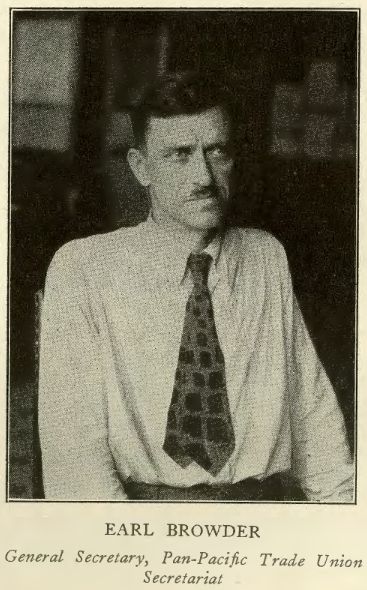
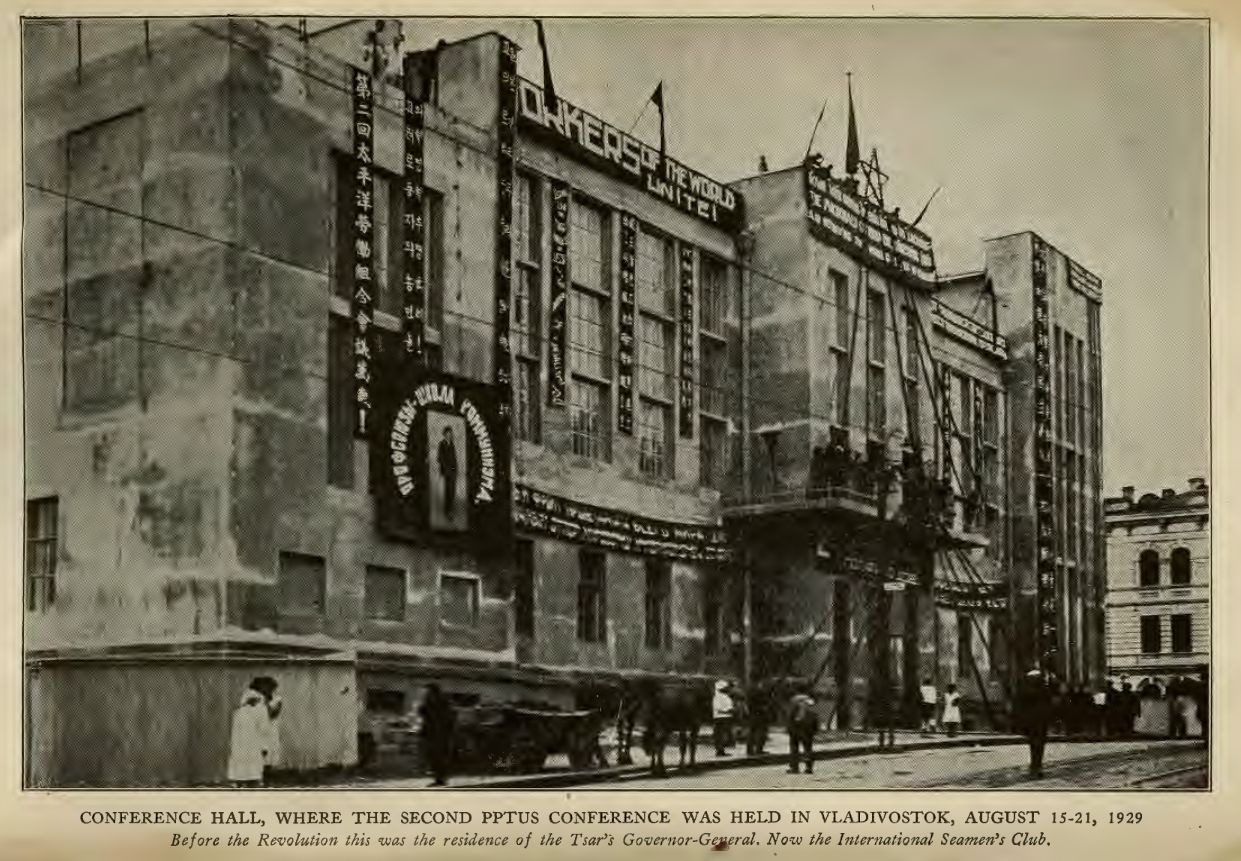
Browder, speaking as the Secretary of the Pan-Pacific Trade Union Secretariat, gives an informatively valuable, businesslike overview of the Profintern’s work in the larger Pacific region from its 1924 beginnings, through the creation of the Secretariat and its founding Conference in 1927, to the various gatherings and campaigns since. Given at the P.P.T.U.S.’s Second International Conference held in Vladivostok during August, 1929.
‘Report on the Work of the P.P.T.U.S. Since the First Conference’ by Earl Browder from Pan-Pacific Monthly. No. 32. November, 1929.
The Secretariat Report was presented at the fifth session by the General Secretary, Comrade Browder. He said:
COMRADES:
Since the enemies of the PPTUS have concentrated their attacks upon us, which extend from the British-Indian Government’s denunciation of us as a “communist conspiracy,” and the Japanese and Chinese reactionaries’ assassination of our Secretariat members, down to the barking of the smallest reformist trade union traitors, it will be of some value to the large masses of workers who will be watching our gathering, to give in some detail the history of the origin of the PPTUS, before proceeding to report on the work since the First Conference.
ORIGIN OF THE PAN-PACIFIC SECRETARIAT
The only predecessor of the PPTUS, was the holding, in 1924, of a Pacific Transport Workers’ Conference, in Canton, China, which was attended by representatives from China, Philippines, the Soviet Union, and Indonesia. This did not result in any permanent organization, although it was of great value, both for its own work and for the resulting contacts established, especially with the Philippines which had hitherto been entirely outside the world labor movement.
The project of a Pan-Pacific labor organization was first publicly put forth by the New South Wales Trades Council in Australia. In February, 1925, this organization sent invitation to all countries of the Pacific to send delegates to Sydney, Australia, on May 1st, 1926, in order to form a Pacific central labor organization. When this date arrived, however, so few delegates had come that the meeting resolved itself into a preliminary Conference only, decided to call the Conference for one year later in Canton, China, and to invite the All-China Labor Federation to establish with the Australians a joint preparatory committee. This decision was ratified in August, 1926, by the Third All-Australian Trade Union Congress. On September 10, 1926, the All-China Labor Federation ratified the decision; followed by the All-Union Council of TU’s on October 6; and by the Japanese TU Council (Hyogikai) in January, 1927. The All-India TU Congress decided to send delegates, at its Congress in October, 1926, but these delegates were refused passports by the British-Indian Government. From these facts, which are all matters of public record, the origin of the PPTUS is clearly and definitely that of response to a widely-expressed and deeply felt necessity of all the most important bodies of organized workers in the Pacific area.
The First Conference, called for Canton, China, on May 1st, 1927, found itself face-to-face there with the counter-revolutionary coup of General Li Chi-sen, and some of the delegates were arrested by the militarist. It was necessary to transfer the gathering to Hankow, which was still under the revolutionary government. A large portion of the Japanese delegation has been arrested by the Japanese police; the Australian and Indian delegations were refused passports by their governments; and the Philippine organizations were holding their own Congress at the same time, and had insufficiently close connections to follow the readjustment in plans. As a result, even our First Conference, after a year and a half of preparation, was still not fully representative of the full scope of our government. The delegates to the First Conference represented 8 countries: China, Japan, Soviet Union, Indonesia, England, France, Korea, and U.S.A.
THE WORK OF THE HANKOW CONFERENCE
It is unnecessary to review in detail the work of the First Conference. The program laid down, and the various decisions, have all been tested in the fire of two years struggle, which has proved their essential correctness. We may characterize the results of this Conference in four points: (1) The isolation of the different national labor movements of the Pacific was finally broken, and working relationships established between the different lands; (2) The general problems of the Pacific were clarified, and the class nature of these problems clearly stated for the first time for all the Pacific trade unions; (3) A beginning made toward the international solution of the various national problems of the different countries; and (4) The establishment of a definite, recognized, center of organization and leadership for the whole movement, in the Pan-Pacific T.U. Secretariat. These were all fundamental, historical achievements.
FROM THE FIRST TO THE SECOND PLENUM
From its moment of birth the PPTUS has functioned in the midst of the most bitter class struggle. The First Plenum of the Secretariat, held immediately after the Conference, launched the “Pan-Pacific Worker,” sent a delegate to Philippines and Australia to secure the approval of these organizations to the work of the Conference and affiliation to the PPTUS, and set up the Secretariat as a functioning body. But within two months the counter-revolution in China had so isolated our Secretariat, that regular connections even with the Chinese unions were broken, and the entire practical work of the period to the Second Plenum was necessarily devoted to the restoring of broken connections and adjusting the PPTUS to work under these conditions. Two definite steps forward were achieved during this period: the approval of the decisions of the First Conference by the Philippine Labor Congress, and their affiliation to the PPTUS, following the report given them by the representative of the PPTUS, Comrade Harrison George; and similar action by the Australesian Council of Trade Unions.
THE SECOND PLENUM OF THE PPTUS
The Second Plenum, meeting in Shanghai in February, 1928, opened a more advanced stage of our work. Participating for the first time were the delegates from Australia and the Philippines. A campaign of international solidarity and aid to the Chinese Trade Unions was launched, with an appeal against the white terror, which, when taken up soon after by the Fourth Congress of the Profintern, culminated in an International Two-week Campaign for Aid to the Chinese Trade Unions. As a specific example of the practical results of this campaign, I may cite the case of the U.S.A., where the campaign extended over several months, with the distribution of 100,000 brochures on the Chinese labor movement, scores of public meetings in halls and on the streets, street collections of money, and the final remittance to the All-Chinese Labor Federation of $1700 Mexican dollars (equal to $850 U.S.) The small beginnings in this campaign were sufficient to show the tremendous possibilities of such international demonstrations when properly prepared, and opened up new perspectives for such work. The Second Plenum was of distinct value in eliminating the right-wing deviation in the Chinese labor movement which tended to liquidate the red unions and surrender the field to the Kuomintang semi-fascist unions; and also the beginnings of the struggle against the ultra- left tendencies of “putchism” and abandoning mass work in favor of individual terror against traitors.
The Second Plenum constituted a turning point for the development of the Philippine trade unions, which, under the inspiration of their contact with the PPTUS, began a deep process of reorientation and reorganization, which we will describe at a later point, and which our Filipino delegate here will deal with more at length. At the same time, with the participation of the Australian delegate, Comrade Ryan, it launched the two slogans which proved to be the key to immediate developments in that country, “Struggle against industrial peace” and “Struggle against race prejudice.”
FROM THE SECOND TO THE THIRD PLENUM
The next period from February to October, 1928, marked a sharp intensification of the class struggle in the other countries of the Pacific, China, Indonesia and Korea already, living under white terror. The imperialist offensive against the working class and against the colonial liberation movement was intensified on a large scale in all-countries; and the reformists of the imperialist countries began great campaign also, (launched in the speech of Purcell opening the Paris Congress of the Amsterdam International) to extend their activities to the Far East. This reformist invasion of Asia, typified in this period by the tour of Purcell in India, come simultaneously with the adoption of the Colonial Program of the Second International, which with the utmost cynicism denied every principle of colonial liberation and openly established in theory the established practice of international reformism, support of imperialist oppression. During this period we have the rise of the gigantic strike wave of the proletariat of India, the beginning of sharp differentiation of Right and Left wings, and the final coming into the open of the General Secretary of the All-India TU Congress, Mr. Joshi, as advocate of affiliation to Amsterdam and opposition to the PPTUS: Our Secretariat made strenuous efforts during this time to establish direct contact with India, but our delegate was deported by the British-Indian Government. However, our letter to the All-India TU Congress was widely published in the Indian press, and reached the broad masses. Our sharp attacks against the treacherous policies of Mr. Joshi were widely discussed in India; we called attention, for example, to Mr. Joshi’s open justification of the government murder of railroad strikers, and his appeal for rewards for strikebreaking. Inasmuch as Mr. Joshi’s friends have denounced this charge of ours as slander, it is worth while to establish the facts here for the benefit of the workers of India, who still suffer the leadership of Mr. Joshi. I have here the July, 1929, issue of the “Indian Railway Magazine,” of which Mr. Joshi bears joint responsibility with his fellow-editors:
“The laborers who refused to listen to our warning have paid dearly for their foolhardiness with their lives…It was a foregone conclusion that the strike would fail…The police naturally opened fire with the loss of life as aforesaid…This labor trouble has served, however, to bring out two remarkable factors both of which constitute distinct assets of the South Indian Railway. The one is the great statesmanship exhibited by the Agent (British government administrator) which has won for him the warm approbation of one and all of the public and raised him considerably in the public estimation, and the second is the great, nay the intense, loyalty of the station staff who stood as their post of duty (that is, they scabbed, blacklegged, E.B.) amidst dangers and difficulties impossible to describe…The Agent has rightly paid a warm tribute to the loyalty of the men (that is, the blackleg! E.B.) and we do sincerely hope that the appreciation would take a more substantial form in the shape of one month’s pay as a special bonus and the redress of their long-standing grievances as to summary dismissals, excessive punishments, etc.”
To our knowledge this justification of murder of strikers, praise of the imperialist murderers, and plea for reward to strikebreakers, has never been repudiated by him, and his name still stands on the cover of the “Indian Railways Magazine” as one of its editors. We here repeat in this Conference, what we said a year ago to the Indian workers, that the General Secretary of the All-India T.U. Congress has proven himself in this, as in a hundred other instances, unfit as a member, not to speak of as a leader, of the Indian trade unions.
In Australia, during this period, the employers began an offensive against the wages and living standards of the whole working class. The PPTUS actively assisted in mobilizing the working masses of Australia against this offensive. Jointly with the Australesian T.U. Council, we began publication of an Australian edition of the Pan-Pacific Worker, under the editorship of Comrade J.S. Garden, secretary of the New South Wales Trades Council, and with the effective collaboration of Comrade Carpenter, which took the lead in this struggle which was conducted by the employers and government under the well-known hypocritical slogan of “Industrial peace.” The government, employers, capitalist press, and right-wing trade union leaders immediately launched a great offensive against the PPTUS. The government announced that the Pan-Pacific T.U. Congress, which the Australian unions wished to be held in their country, would under no circumstances be allowed. The press raised a great howl about the “White Australia” policy being endangered by Australian workers associating with “Asiatics” in the PPTUS. The right-wing in the trade unions gathered their forces and tried to separate the Australian trade unions from the PPTUS at the Emergency Congress called in Melbourne in July, 1928. The climax of these attacks upon the PPTUS is found in the speech at this Congress by a delegate, Mr. Gibson, who denounced our organization because, in his words: “There are three white men on the Red Executive, and a heterogeneous mob of Asiatics, with unpronounceable names, who have the impertinence to lay down a policy for the Australesian Council of Trade Unions.” But three-fourths of the delegates repelled the reactionary attack, and reaffirmed the adherence of the Australian unions to the PPTUS. At the same time, however, on their domestic struggles with the employers they were not so clear, and for a time became ensnared in the “industrial peace” negotiations, on the model of Mondism, which only this year did the class-conscious workers succeeded in breaking up.
In the Philippines during this period we witnessed a revival of the labor and peasant movements, the publication of two new papers, one of the trade unions and the other of the peasants, both of which reflected the policy of the PPTUS, and the stepping forward of the workers and peasants against the treacherous policy of the bourgeois-nationalist politicians who have sold themselves to American imperialism for the price of “economic development” (for American imperialist purposes) of the Philippines. The unions revived their activities, and also began to take the field with mass demonstrations, such as the march on the Filipino Legislature in protest against the high price of rice. At the same time, the right-wing elements began consciously to organize themselves under the leadership of the bourgeois political parties.
In Japan, this period is marked by intense white terror against the labor movement. Beginning in March, with mass arrests and the outlawing of the left trade unions and political parties, it resulted in the assassination of a member of the Japanese delegation to our Third Plenum, October 1928, Comrade Watanabe, whose memory we have honored at the opening of this Congress. During this period the PPTUS was able to serve the Japanese trade unions in their difficulties, in assisting them in working out policies and adjust themselves to new conditions of complete illegality, preserving their red union organizations and still keeping close contact with the masses. Our Japanese delegate will doubtless give us an intimate view of the situation in Japan, so this report will limit itself to the most general characteristic of the period under review.
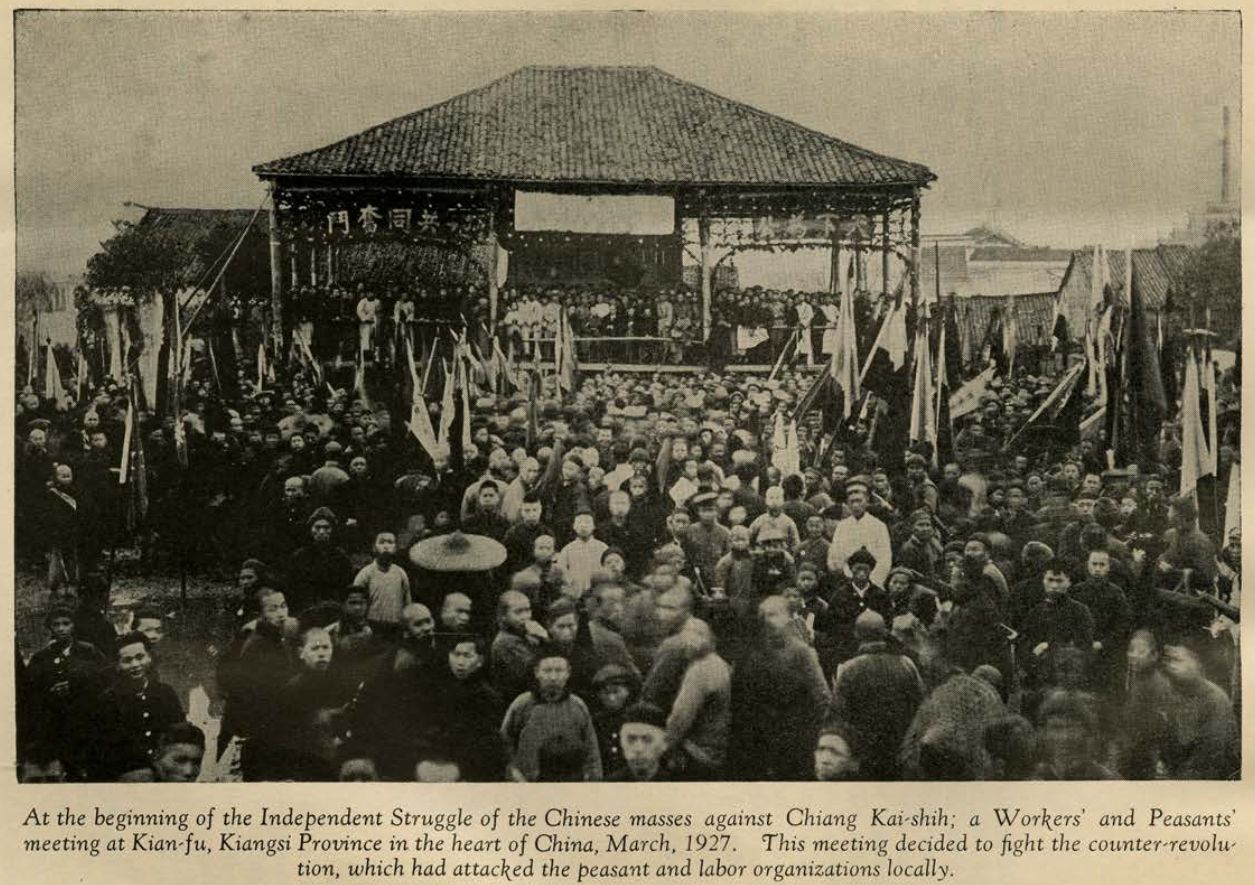
In China, the period is marked by the revival of working class activities in a large strike movement, the continued maintenance of the peasant movement in the interior, the most brutal white terror by the militarists, and the crystallization of the factions in the Kuomintang, under the influence of the various Imperialist Powers. Within the All- China Labor Federation, the period is one of close collaboration with the PPTUS, the weeding out of the deviations of policy (both liquidationist and adventurist, right and ultra-left), and the reestablishment of mass work of the red unions. The meeting of our Third Plenum occurred at the time of the establishment of the so-called October Government of the Kuomintang, the return of Chiang-Kai-shek to power, and the consolidation of American influence in a dominating position in Nanking.
THE THIRD PLENUM OF THE SECRETARIAT
The Third Plenum met in Shanghai, on October 27 and 28, 1928. Besides registering the further growth of the PPTUS, in the affiliation of the seamen’s and miners’ unions of New Zealand, and the holding of a conference of Pacific countries of Latin-America, with representatives of Peru, Ecuador, Columbia, and Mexico, who pledged to work for effective affiliation of their organizations to the P.P.T.U.S., the Third Plenum also had to take up seriously the struggle against international reformism and its invasion of the East, which came up particularly sharply at this time in the visit of Mr. Albert Thomas, of the International Labor Office, to China, Japan, Indonesia, and India; and also in the announcement of the project of an Asiatic Labor Conference by the reformist imperialist tools, Mr. Bunji Suzuki of Japan and Mr. N.M. Joshi of India. The Plenum denounced this effort of the international splitters and Eastern reformists, and issued a call to the Indian workers to disavow Mr. Joshi’s works. This Plenum also had to organize the Second Conference, our present gathering, decide upon its place and issue the call. It is characteristic of the whole present period of development in the East, that the P.P.T.U.S. had found its Congress prohibited in Australia, Philippines, and all other countries, with the exception of the Soviet Union. While the delegates to this Conference are all delighted to be in Vladivostok, especially for the opportunity it gives us to study the socialist construction of the Soviet Union and to meet personally our comrades who are doing such mighty work, we do not hide from our comrades of Vladivostok that we would have preferred to hold the Congress in Tokio, or Shanghai, or Manila, or Sydney, because that would have brought us closer to those million masses of still unorganized workers of the Pacific whom it is our special mission to mobilize. Nor do we hide our hope that the next Pan-Pacific Congress will find the workers in power in some other great capital of the East, such as Tokio or Shanghai, so that we may call in such a place a greater Pacific Trade Union Congress than we have yet held.
OUR WORK FROM THE THIRD PLENUM TO THE PRESENT
Since the Third Plenum our work has been carried on under conditions of further sharpening of the class struggle, intensification of the capitalist offensive, development of imperialist rivalries, war preparations against the Soviet Union, the maturing of the differentiation in the national liberation movements, and the further rising of the working masses, especially in India. During this last period, India has come to play a more and more prominent role in the developing revolutionary wave. We must say that India is on the eve of a great revolutionary upheaval, which will have the most enormous influence upon the whole world and especially upon the East.
Our Third Plenum had commissioned Comrade Ryan, of Australia, to attend the Eighth All-India Trade Union Congress on our behalf, in December 1928. Comrade Ryan succeeded in evading the British police blockade and carrying through his mission, with the result of a crystallization of all those forces in the All-India Congress standing on the basis of the class struggle, in a fight for affiliation to the P.P.T.U.S. But while during 1928 the left-wing proletarian leadership had won over a great majority of the organized Indian workers, the petty-bourgeois nationalists and reformists still controlled the machinery of the Congress and by manipulation succeeded in blocking affiliation by a few votes, which were almost evenly divided. Even with their organizational control, however, the right wing leaders did not dare openly propose rejection of the P.P.T.U.S., but camouflaged their opposition under a plea for delay in order to study the situation, postponing the affiliation question until next year. A further indication of growing class-consciousness of the Indian trade unions is the fact that the right wing, in order to defeat the worker-candidate for President of the Congress, were forced to put forth the still-popular young “left” nationalist, Jawaharlal Nehru (Nehru, Junior), who was elected over the worker by only a few votes.
Since that Eighth Congress of the Indian T.U.S., great strike struggles have been carried on of an extent hitherto unknown in India, and out of them have grown up new, and mighty left-wing trade unions based squarely upon a program of class struggle and under left-wing leadership. Thus, the Girni Kamgar textile workers union of Bombay, has enrolled 65,000 workers this year, and led them in long and stubborn struggles. The railway men on many roads are organizing into revolutionary trade unions. The petty bourgeois nationalist leaders who have been such a stumbling block to the development of the Indian movement are now definitely in decline in their influence over the masses. We can state quite definitely that the majority of the Indian workers stand on the program of the P.P.T.U.S.
In Australia, a further development of the leftward movement of the masses is evidenced in the break-up of the “industrial peace” conferences, through the efforts of our militant comrades of the New South Wales Trades Council. With a constantly sharpening offensive of the capitalists, the fighting mood of the Australian workers is necessarily increasing. It is to be hoped, and we must do everything possible to help bring it about, that this fighting mood of the masses will also be accomplished by more clarification of program, especially for the struggle against compulsory arbitration and the uprooting of racial prejudices. It is unfortunate indeed that we again miss the opportunity of discussing these questions directly with an Australian delegation, because of the actions of the Japanese police in turning them away after they had arrived at our very doors.
In Japan, the further development of the semi-fascist reaction is witnessed in the murder of Comrade Yamamoto, representative of the revolutionary Japanese workers in the Diet. Further mass arrests of left trade union leaders have taken place. In spite of all persecutions, our comrades have maintained their organization and their mass contacts, which facts are demonstrated by the mass demonstrations on May 1st under revolutionary slogans, etc. We must emphasize, that our Japanese comrades are living through one of the most difficult periods in their history at the present time, and the P.P.T.U.S. must have as one of its first casks the giving of all possible assistance to the Japanese left trade unions. They are fighting on one of the most difficult and important sectors of our Pan-Pacific front, in the very heart of Japanese Imperialism.
In the Philippines, we must note the progress made in unifying the Filipino and Chinese labor organizations, and the conducting of successful joint strikes for improved conditions–something seen for the first time in the Islands. Further we must note a successful congress of the Peasants Confederation, and the further growth and development of the peasant movement, the raising of the slogans of struggle for practical improvements in the peasants’ lot. The struggle against the traitorous bourgeois nationalist parties, and the emergence of the workers and peasants as the spokesmen and fighters for independence, has led to a section of the corrupted elements in the C.O.F. (Philippine Labor Congress) splitting the Congress when they were unsuccessful in capturing it for the bourgeois parties. We must congratulate our Filipino comrades upon their success in preserving the main body of the trade unions against the reactionary splitting elements, a must give them all possible assistance in consolidating the Labor Congress (Proletarian) upon its new course.
In China, the last period is characterized by the new militarist wars, the further consolidation of American Imperialist influence, and the resulting new series of war provocations against the Soviet Union. This we have dealt with fully in the reports and discussion of the War Danger. The growing fighting spirit of the Chinese workers is demonstrated by the growth of the strike movements and by the militant demonstrations in Shanghai on May 30th, when the Shanghai proletariat destroyed the offices of a reactionary Kuomintang newspaper. The main problem of the revolutionary unions in China today, is that of perfecting their methods of mass work, the consolidation of the red unions and the simultaneous penetration of the “yellow” unions wherever these have masses; and the establishment of organs for leading and mobilizing the unorganized masses, in the shape of shop committees, committees of action, etc.
OUR SHORTCOMINGS AND WEAKNESSES IN INTERNATIONAL CONNECTIONS
Undoubtedly our most serious weakness has been our lack of regular and systematic contacts with several countries, such as Korea, Indonesia, Formosa, Indo-China, etc.
In these countries, white terror prevails, with the most brutal forms of imperialist exploitation, forced labor and slavery. We must at all costs find the ways of penetrating the Imperialist walls of isolation with which they endeavor to prevent the growth of trade unions and revolutionary influences in these countries. This is one of our first tasks. This weakness stands out as one of the first lessons of this brief report of our practical activities also in connection with all our work, even in those countries where we have accomplished the most. This is primarily due to lack of a sufficient number of adequately prepared comrades for the work. The systematic preparation and training of workers for the general Pan-Pacific work is one of our most pressing needs.
OUR WORK IN PUBLICATIONS AND DISTRIBUTION OF DOCUMENTS
Special attention must be directed toward our work in publishing and distributing information and documents of the Pan-Pacific movement. The central organ of the P.P.T. U.S. has had a stormy career. It has been forced to change its location and address three times. The original “Pan-Pacific Worker” was published in Hankow, in 14 issues, up to March 1928. At that time General Hu Tsungtu, the Wuhan militarist, executed the entire staff of a print shop caught printing a communist leaflet, which so terrorized all printers that we could not persuade them to continue issuing our magazine. We finally resumed publication, from Shanghai, changing the name to “Far Eastern Monthly” to quiet the fears of the printers. The difficulties of issuing in Shanghai became so great, that we finally transferred the publication to San Francisco, where it is now published under the name “Pan-Pacific Monthly.” In all 28 issues have gone forth, containing the most valuable and comprehensive materials on the Pacific labor and national liberation movements which have ever been made available. While exhibiting the shortcomings that might be expected from the conditions of its production, the Pan-Pacific Monthly has been a mighty weapon in the development of our whole movement.
In addition to the central organ, in English, we have issued the Australian edition of the “Pan-Pacific Worker” jointly with the Australian trade unions. In many respects this has been our most successful publication, its special merit being that it was an Australian publication with mass circulation. Issued twice a month for its first year of publication to April this year, and since as a monthly combined with the “Labor Monthly” formerly issued by the New South Wales Trades Council, it has been the fighting spokesman for the P.P.T.U.S. and for the Australian workers against the capitalist offensive. Without the Australian edition of the “P.P.W.” it is doubtful if we could have registered a fraction of the successes which our work there has shown.
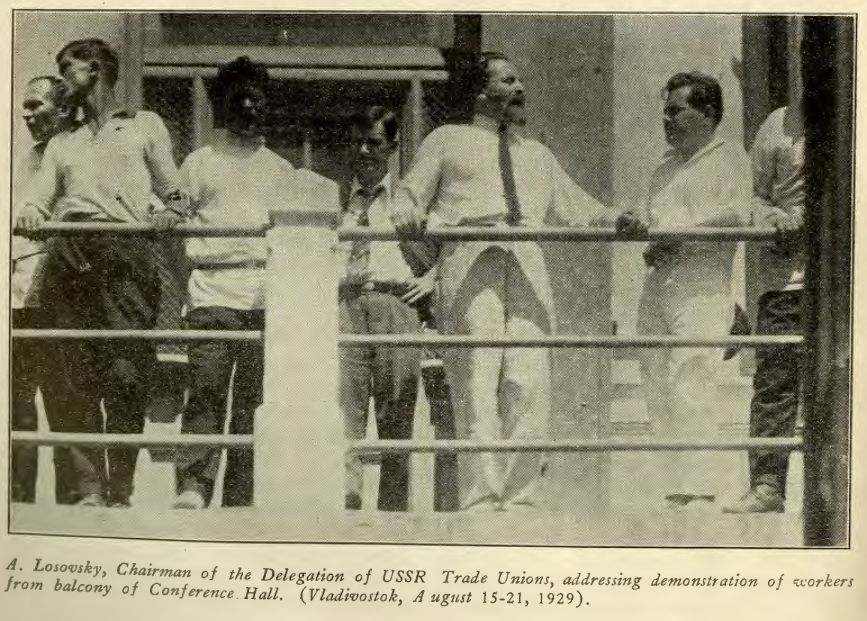
A press service to all the different countries, giving news and analytical articles, was maintained from Shanghai until the PAN-PACIFIC MONTHLY was moved to America, since then the press service has been superseded by a mimeographed “Far Eastern Bulletin” performing the same functions in a more organized manner. Pamphlets have been issued in Australia, explaining the P.P.T.U.S. and its work, which reached mass circulation, and on the struggle against race prejudice. Comrade Losovsky’s pamphlet on the P.P.T.U.S. in Russian and English reached a wide circulation.
In reaching the other languages of the Pacific countries, we have had success in mass distributions in Chinese, Japanese, and Tagalog, using the local and national publications and issuing special brochures, securing translations of at least the most important materials.
It is my opinion that in the publishing department of our work, we are only in the barest beginnings, and the results achieved by these small efforts would justify an intensified program of work along this line.
STRUGGLE AGAINST WAR AND FOR DEFENSE OF SOVIET UNION
In addition to the wide distribution of the various resolutions and manifestoes of the P.P.T.U.S. against the War Danger and for defense of the Soviet Union, the P.P.T.U.S. has been able to add concrete tasks in this field. The Far Eastern Conference Against War and Defense of the U.S.S.R., which was held in Shanghai in June, 1929, participated in by Chinese, Japanese, and Filipino delegates, was of great assistance in mobilizing the situation of the workers of the world to the menacing developments in Manchuria which culminated in the seizure of the Chinese Eastern Railway, In addition the P.P.T.U.S. has been instrumental in helping organize several workers delegations to the U.S.S.R., and had published and distributed reports and materials on the successful construction of socialism in the U.S.S.R., on the Soviet T.U. Movement, and on conditions of life and labor under the Soviet Power, all of which have broadened and deepened the mass movement of the workers against the Imperialist War menace which is directed against the Soviet Union.
It has, however, not neglected to keep the workers of the colonial and semi-colonial lands informed of the developments of revolutionary trade unionism in the capitalist countries, of the great class battles in Europe and America, of the role of European and American reformism in the support of imperialist oppression and in misleading and corrupting the young colonial labor movements. At the same time we have given special attention to awaken the working masses of the imperialist lands to a knowledge of an interest in the rising labor movement of the East and of Latin-America, and to bring to them a full understanding of the decisive importance which the new divisions of the international labor movement have to play in the overthrow of imperialist oppression. Both these phases of our work must be developed and extended.
OUR RELATION TOWARDS OTHER INTERNATIONAL ORGANIZATIONS
The P.P.T.U.S. is an autonomous organization, separate from all other international organizations. It is not an “International” itself, but a regional federation of trade unions for special purposes stated in our statutes. But from the beginning we have taken an attitude of cooperation with all international organizations sympathizing with our aims, and have stood for the program of international trade union unity. In the developments of the past two years, we must record that all international organizations have taken up an attitude towards us, some friendly other hostile, in accordance with their own attitude towards imperialist oppression and colonial liberation.
Among those which have demonstrated their enmity we must note the Amsterdam International (I.F.T.U.); the Second International (Socialist and Labor International); the Pan-American Federation of Labor; the International Labor Office, etc.
LABOR MOVEMENT IN THE IMPERIALIST COUNTRIES
The P.P.T.U.S. has considered that its primary task lay in the colonial and semi-colonial countries, with considerable attention also to Japan and Australia which are so closely woven into the problems of the East.
These are all the agencies of international reformism, which more and more openly are coming out as the instruments of imperialism and capitalist oppression within the working class. We have nothing to be surprised about in their hostility to us.
On the other hand we have established relations of friendly co-operation with other international bodies, which truly stand against imperialism. These are, first of all, the Red International of Labor Unions, to which many of our affiliated organizations belong, and which is in full support of our work in the Pacific. Secondly, is the Latin-American Trade Union Federation, formed at Montevideo last May, which embodies the large majority of the organized workers of the Southern Americas, and with which we have a compact of fraternal collaboration, and which follows lines in Latin America similar to ours in the Pacific. And thirdly, is the Anti-Imperialist League which is a world federation of all anti-imperialist organizations and individuals, and with which our Third Plenum associated the P.P.T.U.S., and to which many of our affiliated organizations are connected. We are sure that this Conference will confirm these relationships which we have established, and will instruct the P.P.T.U.S. in future not only to consolidate more firmly the fraternal union of all organizations of struggle against imperialism, but also to intensify the struggle against all those which serve imperialism.
CONCLUSION
In concluding this report on the tasks and work of the P.P.T.U.S., let me say, that I am sure this Conference will agree that in spite of the magnitude of our tasks, in spite of the shortcomings of our work, and the difficulties which must be overcome, yet our first period of work has been fruitful and has fully justified the efforts put into it. Where a few years ago was isolation almost complete for each country, with young movements blindly struggling towards liberation with only the light of their own limited experience to guide them, there now exists an integrated international movement and consciousness, making available for all and consciously using for all the joint, collective experiences of the entire labor movement. We have laid a solid foundation for the future great structure of International Trade Unionism which will be built in the Pacific, as a part of the greater World International. We have made a living reality for millions of workers, those aims which we set ourselves two years ago at Hankow, when we declared:
“In order:
1. To carry on a joint struggle against the dangers of war between the Powers of the Pacific;
2. To counteract the imperialist dangers that menace the Chinese Revolution;
3. To help the oppressed peoples of the Pacific to liberate themselves from the yoke of imperialism;
4. To fight against and remove all racial and national barriers and prejudices which still divide the exploited classes and oppressed peoples to the advantage of the exploiters and oppressors;
5. To cement and to maintain a real fraternal united front of the exploited classes in the countries of the Pacific;
6. To organize and to carry out joint actions of the exploited and oppressed peoples against the oppressing Powers;
7. To fight for World Trade Union Unity and for the creation of a single United Trade Union International; the representatives of the revolutionary trade unions of the Pacific having gathered at the Pan-Pacific Trade Union Conference, herewith decide unanimously to create immediately an organ of connections, propaganda, and action this organ to be called: The Pan-Pacific Trade Union Secretariat.”
Comrades: I think we are all of one mind that this decision of our First Conference two years ago, and the fruits of that decision in the two years of work which we have experienced since then, have proved to the full the correctness of that decision and the program there laid down. It is our task to take this foundation which has been laid, and build further and better, in the full knowledge that we are making a permanent contribution to the history of the march of the working class of the world toward the defeat of its enemy, World Imperialism, and the inauguration of the World Republic of Labor.
Down with Imperialism and Imperialist Wars!
The Pan-Pacific Monthly was the official organ of the Pan-Pacific Trade Union Secretariat (PPTUS), a subdivision of the Red International of Labor Unions, or Profitern. Established first in China in May 1927, the PPTUS had to move its offices, and the production of the Monthly to San Francisco after the fall of the Shanghai Commune in 1927. Earl Browder was an early Secretary of tge PPTUS, having been in China during its establishment. Harrison George was the editor of the Monthly. Constituents of the PPTUC included the Australian Council of Trade Unions, the All-China Federation of Trade Unions, the Indonesian Labor Federation, the Japanese Trade Union Council, the National Minority Movement (UK Colonies), the Confédération Générale du Travail Unitaire (French Colonies), the Korean Workers and Peasants Federation, the Philippine Labor Congress, the National Confederation of Farm Laborers and Tenants of the Philippines, the All-Union Central Council of Trade Unions of the Soviet Union, and the Trade Union Educational League of the U.S. With only two international conferences, the second in 1929, the PPTUS never took off as a force capable of coordinating trade union activity in the Pacific Basis, as was its charge. However, despite its short run, the Monthly is an invaluable English-language resource on a crucial period in the Communist movement in the Pacific, the beginnings of the ‘Third Period.’
PDF of full issue: https://www.marxists.org/history/international/profintern/pan-pacific-monthly/n32-nov-1929-PPM.pdf

