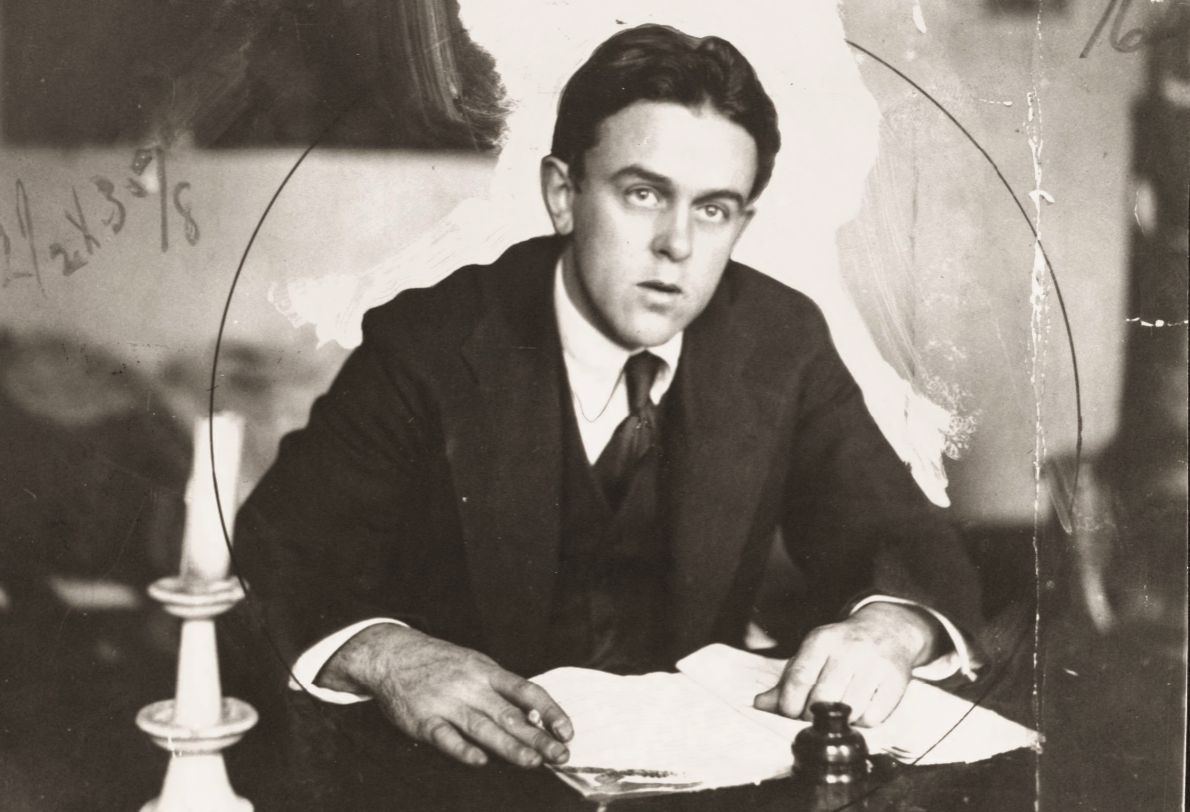
A must-read essay on what made Reed such an exemplary writer, one whose best journalism remains a Gold Standard of radical reportage. Sergei Dinamov, from a working-class family and former textile worker, joined the Bolsheviks at 19 and fought in the Civil War as a young man, serving in the Red Army until 1926. While in the army, he studied literature and on his discharge he would teach at Moscow State University, so leading its Lit Department. There he specialized in U.S. writers–authoring works on Edgar Allan Poe, Jack London, Mark Twain, and Ernest Hemingway while editing several prestigious literary magazines, and also serving as head of Bolshevik’s Central Committee ‘art center.’ Becoming editor of International Literature, magazine of the International Union of Revolutionary Writers, where this essay was published, Dinamov was the Soviet Union’s lead Shakespearean authority, as well the expert on John Reed. The article below, being an important contribution to understanding and appreciating one of the finest journalist-artist the U.S. ever produced and a comrade no less, John Reed. Like so many revolutionaries of his generation, Dinamov did not survive the Purge years. Arrested in September 1938, convicted on April 15, 1939 on the spurious charge of participating in a ‘counterrevolutionary terrorist organization’, Sergei Dinamov was murdered the following day, April 16, 1939. To be ‘rehabilitated’ on May 19, 1956.
‘The Literary Method of John Reed’ by Sergei Dinamov from Literature of International Revolution. No. 4. 1931.
John Reed’s course of development was long and instructive, being that of a journalist, of an artist, of a revolutionary, of a communist, who began his career on the Pacific Coast and finished up at the walls of the Kremlin. Reed is the only writer who has a book to which Lenin wrote an introduction. But in order to live through the ten days of the October Revolution and to deserve Lenin’s “I recommend this work with all my heart to the workers of every country.” Reed had to pass through a whole series of stages, and had to overcome many of the contradictions inherent in the process of his mental development. While remaining at the summit of professional journalism he had yet to become a revolutionary, a Bolshevik. Very much indeed may be learnt from John Reed’s achievement, and as much can be learnt from his failures. His work as a whole is one of the most valuable contributions to that international proletarian literary experience which his not yet been assimilated by the proletarian literary work of the international.
“Reedism” is represented by that type of sketch which takes the form of a concentrated conspectus of a large design: in Reed’s biggest things there is always a promise of still greater things, and when he expands his them: there is always room for a yet wider expansion. That is not because Reed does not take miny sides of reality in his grasp—on the contrary it is rather explained by the fact that much is grasped in a small com pass, and life is “wrung out”, compressed within certain bounds, and cast into a concise form under the tremendous pressure of thought. The conciseness then becomes an expression of the multiplicity of this pressure, and of its irresistible force. “Reedism” in fact involves “worrying matter into shape” as it were. There is no kind of gentleness in Reed’s attitude to things, for any kind of “fondling with nature and history is as Lenin has said “an attempt to purge them of their contradictions and antagonisms.” Reed is rough and determined, he stands up against reality in order to seize in thought what is of real significance, what is fundamental, what is essential. He is not dismayed by the impact of reality and will not allow himself to drift down the current of details and the infinity of facts, but on the contrary subordinates details and facts to reality, to objectivity. He rejects the insidious tendency towards empiricism, whether it be factual empiricism where facts gather themselves around the swaying thought, or political empiricism where literature becomes a mere rephrasing of newspaper editorials, or again psychological empiricism where the artist dives “unconsciously” into the depths of the subconscious, the super-conscious, the “non-conscious” and the “beyond-consciousness,” overlooking the objective basis of this psychological substratum,–going no further thin the more quality and moving about from one of its phases to another (a quantitative relation to reality). Empiricism is foreign and repugnant to Reed—his thoughts are merged with facts though they are not dissolved in facts nor subjugated to them. But “Reedism” in all its completeness is a whole series of incompleteness’s. Reedism did not come to full strength all at once but through sudden leaps and transitions. We must understand the weaknesses of John Reed before we can see the strength of his method.
“Flexibility applied objectively so as to reflect the many-sidedness of the material process and its unity—that is the dialectic, that is the true reflection of the continual development of the world.” (Lenin). Reed was not always able to see the world dialectically like this—the subjective sometimes got the better of him. It can sometimes be noticed in his The War in Eastern Europe that events are represented as spontaneously following upon one another, not in related to their objective development, but rather subjectively; the movement of the ego carried with it a series of representations; personality becomes the basis of the System of images. Events seem to impinge upon consciousness independently of their own nature. The first cause and final outcome of phenomena, manifest themselves not within but rather outside of phenomena, in the artist who is portraying them. Now the sketch is created as follows: the phenomena are brought into the arena of representations, move and then suddenly collapse before completing their path of development. Thus Turkey, Greece and even to a certain extent Russia during the War period were presented by means of a series of fragmentary representations. Whatever happened to come into the field of view was reflected, even though it was of the most trivial and random nature (especially the chapters about imprisonment in Russia). Here his pre-occupation with detail carried Reed away and his art lost its coherence. He makes up for this fault with his chapters on the general condition of the country, but the necessity of the universal to supplement the merely contingent speaks for itself (the chapters “The Face of Russia,” “A patriotic Revolution,” “Petrograd and Moscow.”) Of course here external causes played a very important part (John Reed was not allowed to remain in Russia and he was shortly afterwards deported). But the essence of the matter lay in something else; it lay in the point of view in the literal and metaphorical use of this term;—the point of view on the one hand as one of the points of objective reality (the question of subject) and the point of view on the other hand as the attitude of the artist (the question of the ideological standpoint). Great works of art are brought forth as a result of the unity of these two aspects. Great art demands bringing to the forefront that which is most characteristic and charged with social purport among the great variety of phenomena which reality offers; it reproduces life in all its objectivity and the world through its most significant relationships. This is also what makes art so readily attainable by the rising class of our times, namely the proletariat. In seizing his object the artist is himself carried along by it and through his contact with it his experience is enriched. Thus it is not merely by chance that it was just the October revolution and nothing else that Reed described with such force. It is no less significant that in the course of one and the same period Reed showed sudden spurts of genius and equally sudden weak moments. Thus his sketches of Europe were unimaginative and commonplace, but his trip to Mexico resulted in a sudden rebirth as it were, and he wrote a number of brilliant pictures of revolutionary Mexico. The War in Eastern Europe and Ten Days That Shook the World: are separated by a very short space of time, but what a tremendous difference there is between them! It is essential that efforts should be made by revolutionary writers in acquiring subject matter, but it must nevertheless be remembered that the quality of the subject matter depends on the style. Workers as represented by Dickens, Zola, Bibik, Niechaiev and Chumandrin are quite different types of people.
In this seme book The War in Eastern Europe Reed sometimes becomes held up by exoticism and attention to trivialities. His flow of thought loses its accustomed swiftness and becomes becalmed in contemplation. The ideas become wedged in, as it were, by the immobile mass of heavy descriptive matter. He turns to history, but history takes the form of a directory.
“Grouped around the site of the Hippodrome to the east are pure Greeks, with Hellenic and Byzantine traditions unbroken for fifteen hundred years, and westward dwell the Albanians, that mysterious people who are supposed to have fled west from Asia at the break-up of the Hittite kingdoms.”
The sketch should include history, in it the whole past and present of its object should be knit together in such a way that no introductions or prefaces are needed. But here the history enters in as an afterthought and not as an organic and inseparable part of the whole. In Insurgent Mexico Reed deals much more skillfully with the historical material. Thus in the chapter Los Pastores he very aptly brings in fragments from the previous rule of the Spaniards in Mexico. As a result the present is given a much deeper significance and with much greater clearness. The struggle of the Mexican peasants and workers against Spain becomes an expression of a necessary law of history, and individual facts, such as Villa’s demand for immediate evacuation by the Spaniards, gain in universality and become less isolated and particular. But on the whole Reed lacks this historical approach, his ideological horizon is too narrow. There are many points on which he does not touch at all (for example he does not understand the role of American imperialism in Mexico). A writer of sketches must go deep, otherwise his art will become superficial. It is impossible to think of a Soviet writer of sketches who had not a clear idea of the whole policy of the Party, for it is not enough merely to have a sharp eye, one must be able to see in everything the universal and the particular. In these two books Reed does not show himself at his best. Thus instead of giving an ideological portrait of Villa he presents him almost photographically for ten pages, thus failing to disclose the true character of this “leader.”
The objective sketch is typical of bourgeois literature. Here the writer takes the part of some intelligence standing over and above all classes, or rather of an impartial photographer who is quite indifferent to his subject whether it be a house on fire or a street battle. On the other hand in the bourgeois sketch the expression of class subjectivity is patent. Instead of an objective presentation of phenomena, an attitude for against what is being described makes itself evident. The sketch then begins to pass judgment on the phenomena, and becomes subjective.
The objectivism and subjectivism of bourgeois literature are equally foreign to the materialist artist. He is objective but only in the sense that he properly appreciates a given social economic formation and the antagonistic relationships to which it gives rise—discloses the class contradictions and in doing so defines his point of view. Thus on the one hand the materialist is a more thoroughgoing objectivist, because his objectivism is carried further and has greater depth. On the other hand he is class-subjective, but only in the sense that his art is a Party art and he is consequently obliged in a quite open and straightforward manner to take the point of view of a definite social group in his evaluation of all events. John Reed sometimes pays tribute to his own petty bourgeois class. He occasionally fell into objectivism and his “impartial” attitude towards reality served to defend the bourgeois regime. Thus in his sketches about militarist Servia he never ceases to insist that there is no class war in Servia, no division of the people into rich and poor, an idea with which he is continually stuffed by Servian officials like colonel Subotitch who says “We are all peasants in Servia–that is our pride.” This kind of objectivism makes its appearance with Reed in one or two parts of his book on Mexico. But all the same this objectivism enters merely by chance. Impartiality, indifference, contemplation and cold passivity are as a rule foreign to him. Passionate love and bitter jealousy are what characterised him as an artist and even before the great October pointed out for him the path to Bolshevism. To pierce the surface of things and see their essence, to see beneath the outer covering the inner contradictions—that is what is demanded of the artist. What the proletarian writer requires is not pure representation, not the Kantian unpurposiveness of art as its highest merit, what he wants is to pass judgment upon life and to give a ‘Class and Party’ evaluation of it. But this judgment means leaving objectivity and taking up a definite class position, it involves thoroughly merging oneself into a definite class group and making a thorough break with everything that is hostile to it. John Reed like Maiakovsky, Barbusse and Gorky showed by his life’s work that the path of the true artist in bourgeois society is the path leading to the proletariat. John Reed never wrote a single line in defense of bourgeois society, he was always wholeheartedly on the side of all that protested and rebelled against this society. It was not merely a lukewarm sympathy that he felt for the working class, he threw in his lot with them and sank himself in the revolutionary movement. It is true that he did not fight rifle in hand, but there can be no doubt that only an early death prevented this delegate to the Communist International from taking up arms.
“There were a hundred and fifty of us stationed at La Cadena, the advance guard of all the Maderista army to the West. Our business was to guard a pass, the Puerta de la Cadena…
“The first day we reached La Cadena, twelve of them rode up to reconnoiter.”
Such “we’s” as these are met with all through the book, Insurgent Mexico. The artist joins in with the peasants in revolt, he is a true companiero—comrade—entering the fight against feudalism and the bourgeoisie of the peones. He is not one of them but he is with them.
Reed tears off the outside form of things. Where the bourgeois sees in revolution nothing but dirt and barbarism, Reed sees only the transitory and temporary being destroyed, and he sees that this destruction is necessary. He puts up with the hardships of revolution because he knows what revolution is.
“Pretty soon somebody shut the door. The room became full of smoke and fetid with human breath. What little silence was left from the chorus of snoring was entirely obliterated by the singing which kept up, I guess, until dawn. The campaneras had fleas…
“But I rolled up in my blankets and lay down upon the concrete floor very happily. And I slept better than I had before in Mexico. At dawn we were in the saddle…At noon we roped a steer and cut his throat and because there was no time to build a fire, we ripped the meat from the carcass and ate it raw.”
What is that but a trifle, a chance incident, a detail? Perhaps it is a trifle, perhaps a detail, but it is a detail full of deep significance, inspired by the revolutionary daring of the artist, and serving as a most instructive example for any writer of the fact that true art is always courageous and is not put off by the first hindrance. John Reed was not put off by the hardships involved in finding material for his work. He wanted to see things as closely as possible although in doing so he risked his life. You cannot invent reality unless you have experienced it. But in order to experience it you have to live side by side with it and not look at it through binoculars. “Jack” Reed had no patience with these literary binoculars.
“I sent a polite request to general Mercado. The note was intercepted but General Orozco who sent back the following reply: ‘Esteemed and Honored Sir, If you set foot inside of Ojinaga, I will stand you sideways against a wall, and with my own hand take great pleasure in shooting furrows in your back.’
“But after all I waded the river and went up into the town.
“I ran and ran until I could run no more. Awful cramps gripped my legs…I wasn’t very frightened. Everything still was so unreal…I kept thinking to myself:—’Well this certainly is an experience. I’m going to have something to write about.’”
“Then came yells and hoofs drumming in the rear. About a hundred yards behind ran little Gil Tomas…I saw the foremost horses hoofs strike him…The colurados jerked their mounts to their haunches over him, shooting down again and again…Before I could stir the colorados came plunging down the hill side. ‘There he goes!’ they yelled and, jumping their horses over the arroyo not ten feet from where I lay, galloped off into the desert. I suddenly fell asleep.”
For the sake of illustration we may add that the American writer Beirce was shot in Mexico while Reed was there. No less exciting things happened to Reed during the October days when he was several times arrested and once put up against the wall. But he was able to overcome all these hindrances. Taking no notice of the hardships he went on stubbornly collecting his material and filling his art to the brim with the rich content of life. So it was that in Ten Days there was nothing that one could reject, nothing that one could abbreviate, and it would be as difficult within the form that his story took to add anything to it. Lenin only said a few words about his book although he was writing for Americans, for Western people—for everything necessary was to be found in this powerful book itself, Reed had made such a thorough selection of his material. This literary experience of Reed’s shows that reality is mastered not in study armchairs but on fields of battle—whether on fields of armed combat or those of a collective farm. When S. Tretiakov or Stavsky not only study collective farms and the countryside but actually live and work with the advanced peasantry, it is no less heroic than the example of John Reed, and its literary results are no less prolific.
Let us return to the question of the judgment passed on life through art. From the point of view of Pereverzey the possibility of such a judgment would seem absurd. How can the artist appraise reality if he is all the time representing only his own class and he has no knowledge of any other class. How can judgment be passed on a reality that has been rejected, if it cannot be perceived beyond the limits of a given class. But if a thing cannot be perceived outside these limits, then it is clear that these limits themselves cannot be perceived, for one can only be aware of even one’s own class in its connections and relationships with other classes. But this inactive devastating little theory of our professor has nothing in common with Marxism. The passivity of the art of the declining classes is quite foreign to proletarian art and so also is the non-party “objectivity” which indirectly defends the order that is passing away and all that is already socially dead. True proletarian art is always Party art, and it was not for nothing that Maiakovski called his works “Party booklets.” But the content of this judgment is not the same with every artist, its nature and extent is achieved in style. For artists who have not, so to speak, reached the vanguard of style a mere journalist’s appraisal of what is disapproved of is most often found and it is generally denounced in bald and formless phrases. So it is for example with the English miner Joe Corry in all of whose books capitalism appears but always as some ill-defined idea. With him cries of protest and slogans take the place of imagery. Does not this prove that Pereverzev is right? Not in the least. The art of any class cannot be understood in its particularity and its individuality, but only in its universality. If we take the style of proletarian literature as. a whole we see that the writers of the vanguard, the artists belonging to the most mature groups, have already passed on to the figurative representation of the hostile classes, thus overcoming the limitations of the initial stages in the development of a proletarian style; (for example the novel entitled “Anna the Proletarian” by the Czeck writer I. Obracht where a number of well developed pictures of the bourgeoisie are given).
John Reed was a master of the art of thinking pictorially, he did not ever replace it with the methods of crude journalism. Reed’s method is extraordinarily fertile from this point of view. Separate facts, events and people stand side by side in his works. They pile up one on top of the other until the point is reached where only a few more additions would break through the bounds separating Reedism from the most planless empiricism. Sometimes this point is actually reached, but more often at the right moment and in the right place Reed links up the individual with the universal and cuts short the stream of particularities. In The War in Eastern Europe for instance Reed gives us a tremendous amount of empirical factual material, and at times himself becomes entangled in it, but then he later straightens it out and finds a philosophic axis around which to organize this load of facts so as finally to pronounce his judgment on them. “With such a stock, with such a history, with the imperialistic impulse growing daily, hourly, in the hearts of her peasant soldiers, into what tremendous conflicts will Serbia’s ambition lead her!” In his usual effective way Reed makes his conclusion concrete by adding a picture of a particular instance:
“There was a soldier standing on guard at the platform, a tall wiry, bearded man dressed in the fragments of a uniform and shoes with sandals of cow hide and high socks embroidered with flowers. He was leaning on an Austrian rifle, staring out over the heads of the sweating workmen to those dim mountains lost in the dark beyond. And as he looked he sang, swaying slightly to the rhythm, that most ancient Serbian ballad of all, which begins: ‘How is it with thee, O Serbia, my dear mother…’”
The point where the artist passes his judgment presupposes, as a sine-qua non a resort to what Tolstoi called, “generalization.” Reed knew how to select a single circumstance, rich in content, which even in its particularity is at the same time a generalization. Thus in “Insurgent Mexico” he discloses the ideology of the peasants in revolt by means of one single instance summing up as it were all that has gone before and throwing light on all that follows.
“’We are fighting”, said Isidro Amayo “for libertad.”
‘What do you mean by libertad?’
‘Libertad is when I can do what I want.’
‘But suppose it hurts somebody else.’
He shot back at me Benito Juarer’s famous sentence–‘Peace is the respect for the rights of others!’
I wasn’t prepared for that. It startled me, this barefooted meztiso’s conception of Liberty.”
An even more effective and trenchant use of the pictorial method is made by Reed in his book of stories The Daughter of the Revolution. In “The Englishman” he portrays the arrogant aristocratic Briton who looks with contempt on everyone and everything. Reed gives a few of his remarks, sketches in the background and through the behaviour of his hero discloses his inane vanity, though his own attitude towards him is hardly expressed in his few vigorous phrases (for instance: “There are very few things an Englishman can talk to a stranger about without losing his dignity—probably only the weather.”) But Reed would remain a shallow empiricist if he merely confined himself to this objective description. He goes further however. He illustrates this English diehard with an angry flash of contrast, placing him beside another highborn Briton, this time a drunkard and a rogue who has nevertheless preserved the main traits of the first hero. Thus making use of contrasting social images and throwing over the usual conventions, Reed shows most effectively by figurative means his attitude to the bad elements in the environment which he is depicting.
Reed does not like using indifferent epithets, he fills his style with social meaning, and organically combines this social content with the very structure of his language. His sentences are sharpened like weapons. But the sharpness is not externally in evidence, it is not angular, but neither is it polished until it no longer hurts.
“They came tramping along with the heavy, rolling pace of booted peasants, heads up, arms swinging—bearded giants of men…Row after row of strong black, incurious faces set westward toward unknown battles for reasons incomprehensible to them.”
“Leaving Bucharest on a dirty little train you crawl south over the hot plain, passing wretched little villages made of mud and straw like the habitations of an inferior tribe in Central Africa.”
This method of passing class judgment attains to maturity in Ten Days, Reed’s ideas are here combined with great colorfulness of imagery, and their structure is well defined and powerful. Thus in the chapter “Background” he sketches out the way things stood, tells us of the people he met and his impressions, reproduces conversations he has heard, and then passes on to more general matters. He describes the activities of speculators and in passing mentions the correctness of the line taken by the Bolsheviks, and then with a swift stroke of the pen he writes:—”Having at one bound leaped from the Middle Ages into the twentieth century, Russia showed the startled world two systems of Revolution–the political and the social—in mortal combat;” and then;—“A grand swell of revolt heeved and cracked the crust which had been slowly hardening on the surface of the revolutionary fires, dormant all those months. Only a spontaneous mass-movement could bring about the, All-Russian Congress of Soviets;” and again—”Such a deluge of high and hot thoughts that surely Russia would never again be dumb:”
He very often ends up his observations by emphasising some thought which even he himself has not expected. “And I suddenly realized that the devout Russian people needed priests to pray them to heaven. On earth they were building a kingdom more bright than any heaven had to offer and for which it was a glory to die.” Reed never allows himself to fall under the influence of caprice. Facts do not carry him away but rather he himself organizes them and selects them to suit the objective flow of events. Thus friends and enemies, particular and general, inherent and contingent—all find their expression in his work, in no way hindering one another nor crowding out the essential, but rather adding emphasis to what is real or significant. Ten Days is not a book of memoirs (no great revolutionary ever wrote memoirs; neither Marx nor Engels nor Lenin but only Trotsky wrote memoirs.) No, Ten Days is not a book of memoirs, it is a book that portrays reality objectively. The writer shows his individuality only in virtue of the fact that he sinks it in his class.
Reed frequently steps aside and pronounces judgment on the passing events, not through his own mouth but in the words of the Party and the working class. Documents are for him not something external, they are intimately bound up with the whole structure of his story telling, their limits are merely the limits of a different kind of type in the printing, and fundamentally they are inseparable from the whole remaining material of the book which itself, taken as a whole, is really a document. Reed is not an onlooker, and that is just why he sees so much. He is not a mere collector of copy, he actually takes part in the events and takes sides. The side he takes is that of the Bolsheviks. Hence the oratorical character of the book in parts, the frequent use of purely oratorical phrases and exhortations and slogans with which Reed cuts short the utterances of his friends and enemies. At the same time he cuts himself short when he wants to make a commentary on the events which have already been commented on by the Party. Thus after describing a certain speech he adds:
“No one was satisfied. The reactionaries wanted a “strong” imperialist policy but the democratic parties wanted an assurance that the government would press for peace. I reproduce an editorial in Rabotchi Soldat (Worker and Soldier) organ of the Bolshevik Petrograd Soviet.”
Reed does not act according to Pereverzev’s prescription—he does not turn merely to his own class, but he gives this class in its relations and antagonisms to the social groups which oppose it. He sees and portrays the dialectics of social development. He shows how in society various class tendencies are pitted against one another and how various social groups fight around the levers of historic development and how a new Russia is forming which will neither be Russia nor a Russian Republic.
Reed here always remains faithful to his usual method of representing people outside the contingent circumstances and what is narrowly subjective in them. The method of subjective psychologism is quite foreign to Reed, and the emptiness of purely external objectivism is equally foreign to him. A proletarian writer cannot be a solipsist and a subjective idealist to whom “bodies are mere complexes of sensations.” (Mach) A proletarian artist cannot be a Freudian either, tracing the social to the sexual and subconscious. To hem in reality within the boundaries of the ego and to put everything on a psychological basis is to show a lack of the creative power necessary to grasp the social essence of the subjective. Reedism gives proletarian literature an entirely different method. Reed never probed into the “unfathomed” (though in actual fact extraordinarily shallow) depths of “psychologism.” He selected before everything else the active element in a human being, and he did not treat the psychological as something in the subject isolated from reality. Reed teaches us to take the subject in its active manifestations. He takes the subject in its relation to reality, in its nature as manifested and not as implied. Hegel says that “for empiricism in general the external is the true.” But the “external” for Reed is not the external (this kind of empiricism is characteristic of the so-called objective psychological school, particularly of Pavlov and his followers)—for Reed the external is also the internal, the subjective traced back to the objective which is understood as the activity of the subject in its social significance. For a writer whose method is the subjective-psychological, what is particularly characteristic is the empirical relation to reality, although he is chiefly concerned with “internal experiences.” This “internal” element in so far as it is only taken in its external aspect thus leads him in the end to empiricism, however much he may have intended to be subjective.
Reed sees the world differently. His characters are not psychological complexes of self-contained experiences. They represent a definite system of relationships to reality, objectivized in action. The creative skill of the artist is measured by the kind of actions of the subject which he portrays. Sometimes the function of art is to disclose the subject’s insignificance. Chernishevski has derided such “activists” as these:
“Spin out, repeat, assert the same thing twenty times, each time with new (and impressive) variations, new washes of colour, new modulations of thought, new shades of feeling. With us for instance, if the hero puts on his slippers, the procedure will take at least a page and a half, but he puts on his slippers about twenty times, and our art requires of us to write one and a half pages about it each time. Now that is real art—and the kind I have a talent for. But you try and carry out such a roulade. You won’t have the voice to do it, but I will carry it out. Excellent, only your art reminds one of the process carried out at dinner by toothless old men. Anyone who has good teeth immediately bites his mouthful, but the poor thing who has no teeth chews and chews, munches and munches in a way that makes you wonder at the patience some men have. But wouldn’t it be better not to take a mouthful that you can’t bite straight away?
“Now is this mashing up with water art? What art is there in this? Art consists not only in having every word in its place, but in having no words that are not absolutely necessary and unavoidable, and in having as few words as possible. There is no art without conciseness.”
In another of his essays (“Have not things begun to change”) Chernyshevski gives the correct formulation of the method of representation. “Be able” he writes, “to subsume the personal aspects of one and the same feeling under the universal to which in essence they belong.”
The method of psychological representation can be found in John Reed’s early story “Seeing is Believing.” In the centre of the story is a girl. Her subconscious is not touched upon. If she was put for a moment on the highroad of subjective psychologism she would immediately evaporate. But with Reed she does not evaporate, she grows into a figure having great psychological significance. The character of the girl is unfolded in her relation to New York and in the story of her adventures—her arrival from an out of the way provincial town in Ohio and her life in New York without friends or relations. Alongside of her a bourgeois is depicted who under the influence of this naive but determined girl does a number of things which are quite incomprehensible from his point of view, helps her, although he does not trust her, repeatedly comes to her aid although she seems to be deceiving him, returning again to New York after he has given her money for her ticket. Thus without any depth of psychology we have portrayed two people coming from different social groups, brought together by chance, coming near to one another for a moment, disclosing their psychology in their mutual relations and then going their respective ways. In Reed’s “Broadway” the face of New York by night flashes out for a moment with its electric illumination, the glitter of jewels the bright light of its advertisements, its noisy patchwork of cafés and theaters, and into this dazzling sluice-gate the figure of a lonely old man is thrown, selling for a couple of cents Happiness for Life–a matrimonial newspaper an old man whom capitalism has robbed of wife and child and his very life-blood. Reed sketches in the figure of this unhappy seller of happiness, using his characteristic method of a synthesis of the subjective and objective. In all his sketches Reed works equally confidently with this method, creating the subject as the totality of social relationships. We find represented in his works an endless number of people of different classes and orders, and their characters are all unfolded in just this way. Let us give one example. In War in Eastern Europe he depicts an Armenian merchant. In all he devotes only sixteen lines to him, of which nearly half consist of a conversation with him. This is what Reed selected out of this conversation:
“Yes I am a Turkish subject and my family for generations. They are fine people the Turks, hospitable, kindly, and honest. I have nothing with which to reproach them, but, of course, I am for the Allies. When England holds the Dardanelles—ah then there will be good business! Then there will be much money to be made!”
Within the limits at his disposal it would have been impossible to give a clearer class portrait of the bourgeois than Reed has here done. But that is only a single example, and there are hundreds of such passages in Reed. This does not mean that this is the only way to portray the subjective, but we insist that one must make this method one’s starting point, must put it at the basis of the proletarian literary style.
It might seem that there was nothing easier than to put down a number of conversations and gather together a heap of facts in order through them to give an idea of a certain event. In fact Reed’s method was so simple that it came down to this:—he left his house, met some soldiers, asked one of them a question, wrote down the answer, and this answer was so fraught with significance that the single line grew into a volume.
“What side do you belong to?” I asked, “the Government?”
“No more government,” one answered with a grin, “Slava Bogu” (glory to God).
“That was all I could get out of him…”
Not much is it? but a lot all the same, a very great lot. Reed was able with extraordinary facility to feel what was fundamental in this dialogue, and to express that in the very shortest way possible, giving to his words, through their very conciseness, a weight of meaning.
And so it is throughout all his work. In this lies the facility of Reedism. It is one of the surest signs of John Reed’s unusual capacity for seeing the world with a view to altering it. He does not make use of a single detail if it is merely accidental. He never buries what is essential under a mass of unnecessary words, and he will not write a phrase which might upset the balance of his work or fall discordantly. This “facility” is the result of great labor and is a sign of the difficulty of the Reedism method. In Reed’s art there is nothing forced, there is no overloading or heaviness of style. There is nothing voluminous about his work. Its meaning is transparent, its form is regular to the last degree of precision, its inner significance and its presentation are united to form one single whole. Objectivity has found in his person a magnificent subjective form.
Perhaps nowhere is the originality of this method of Reed’s so strikingly evident as in his description of one of the most important of those who lived through the events which he describes. This man says of himself:–
“The soldiers whispered together for a moment and then led me to the wall and left me there. Suddenly I understood everything. They were going to shoot me.”
According to the method of subjective psychologism it would have been necessary here to develop the richness, the delicacy, and the depth of feeling experienced by the psyche, to reproduce all the seasations of a man at whom the rifles have been levelled, and so on. In fact even proletarian writers sometimes devote pages or so to describing the refinements of sexual experience, so why not here where we are faced with something very much more fundamental. But no, Reed does not indulge in such descriptions. He has expanded the whole theme in a few lines and has gone on to an interpretation of facts. We know that this hero had a wife, Louisa Bryant, that there were all sorts of troubles and difficulties, but all the same Reed did not allow himself to be deflected by them from his description of the revolutionary movement. It is hardly necessary to add that this unpsychological hero was John Reed himself.
To present the personal flow of events as a social flow of events, to portray social development alongside of personal development, to present facts not as self-sufficing but in their relation to the universal, to express this universal through the individual and particular, keeping clear of empiricism in one’s political psychological and factual treatment of the subject matter–that is what John Reed’s work teaches us. The imperishable significance of “Ten Days” is due to the fact that it is the secult of a combination of revolutionary daring with the right literary method used by a man highly developed mentally, with a wide political horizon and an unimpaired proletarian philosophy.
We are for Reedism and against those who make a fetish of facts. We are for Reedism and against the method of subjective psychologism. We are for Reedism and against non-party art.
Literature of the World Revolution/International Literature was the journal of the International Union of Revolutionary Writers, founded in 1927, that began publishing in the aftermath of 1931’s international conference of revolutionary writers held in Kharkov, Ukraine. Produced in Moscow in Russian, German, English, and French, the name changed to International Literature in 1932. In 1935 and the Popular Front, the Writers for the Defense of Culture became the sponsoring organization. It published until 1945 and hosted the most important Communist writers and critics of the time.
PDF of full issue: https://www.marxists.org/subject/art/literature/international-literature/1931-n04-LWR.pdf

