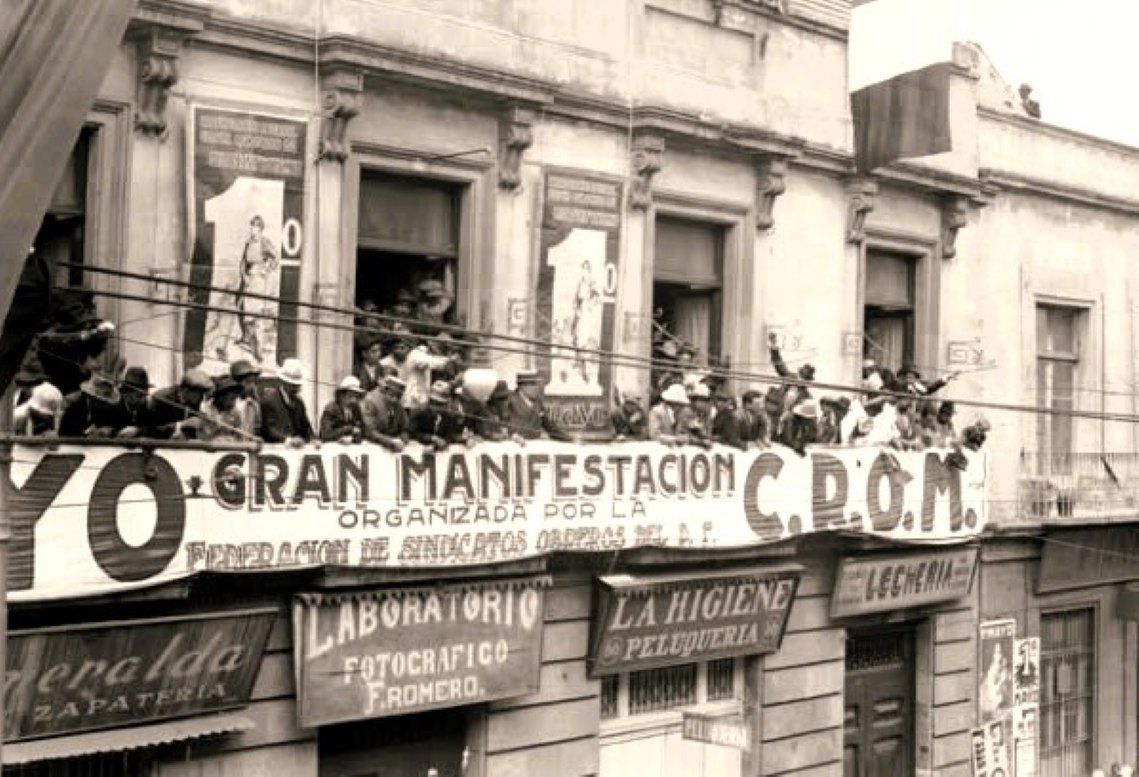
Russian-born Ella Goldberg with her husband Bertram Wolfe were central figures in the formative period of Mexican Communism, living there as Comintern representatives until 1925. That year the new Calles government outlawed the C.P. and ordered their expulsion from Mexico; however both remained closely involved in Mexican politics afterwards, including through Comintern work. Writing as Janet Cork, Wolfe details the balance of forces following the assassination of President-elect Obregon, focusing on the powerful CROM unions and their leader Luis Morones, as ex-President Calles sought to continue to wield his power from ‘behind the scenes.’ This was the scenario that led to the establishment of the PRI, the Institutional Revolutionary Party, which would remain in power without interruption for the next seventy years.
‘Class Forces in Mexico’ by Janet Cork (Ella G. Wolfe) from International Press Correspondence. Vol. 6 No. 60. September 6, 1928.
In the last ten years there has arisen in Mexico a loosely organised working class, but this working class is divided. On the one hand the Mexican Federation of Labour (CROM) led by Morones and his satellites, on the other a number of independent unions.
The CROM is a class collaboration organisation par excellence. Not only does it make alliances with its own bourgeoisie but also with American finance capital. Morones has repeatedly refused to organise the workers employed by American interests. Therefore most of the oil workers, a majority of the textile workers, all the miners, and the railway confederation belong to independent unions. In the recent struggle of the Jalisco miners the CROM made an alliance with the Catholic unions to break the strike of the independent miners. “El Machete”, the organ of the Mexican Communist Party, published a series of sensational documents exposing the relations between the CROM and the Catholic rebels in Jalisco and proving that the CROM had furnished arms to the Catholics against the miners.
Opposed to the ideology of the CROM leadership are the independent unions of Railway Workers, Oil Workers, Textile Workers and Miners. These base themselves on the class struggle. They have had a difficult uphill fight against foreign interests in Mexico. Every time they declared a strike President Calles would use Morones to break it.
On the Agrarian field. The last eighteen years of revolution and suffering have produced a partially armed peasantry. For a long time they were militant in a sort of hit-and-miss way. During the last five years, however, over a million have been organised into the National Peasants League, under the direction of Communists and affiliated with the Peasants International. This makes them a powerful force in Mexican politics and considerably lessens the importance of the army and reduces its capacity for irresponsible mischief.
The Agrarian field, however, is also divided. There is a National Agrarista Party, a political organisation, under the direction of Soto y Gama, which although it really represents the well-to-do farmers nonetheless in its programme and official statements uses revolutionary phraseology to confuse the peasants and divide them, and by this means it has acquired a peasant following controlled by the well-to-do farmers. This party stands against the programme of land distribution to the peasants.
In close relation to the above economic groups stand the foreign interests. They often provoke the militant workers and peasants to strike or fight. This is where the yellow labour, and peasant leaders come in. A Mexican president, if he is to remain president, must know how to jockey between the demands of the militant workers and peasants on one hand and the ruthless pressure of foreign capital on the other. The president alone is incapable of such a fete. So he constructs a cabinet to assist him. In his cabinet he must have someone identified with labour who can keep labour docile someone who can put the breaks on the militants. That is why Calles chose Luis Morones as his minister of Commerce and Labour. Morones has acquitted himself with honours as strikebreaker and traitor to his own class.
As for the peasantry, the presence of Adelberto Tejeda in the Calles cabinet was a sort of sop to the poor peasants. In case of militancy Calles could count on him “to attempt to keep them in check”.
After the assassination of Obregon, Calles had to reconstruct his Cabinet. Why has he protected the labour leaders? The foregoing facts answer the question. He still needs Morones, he still finds him essential to the development and consolidation of the national bourgeoisie and to help keep the peace with foreign interests. And although Calles accepted Morones’ resignation, it is an open secret that the Labour. Department of the Government, Munitions and Printing are still run by labour men under the guidance of Morones and his friends.
There are some who contend that American imperialism is trying to build a coalition between the petty bourgeoisie, the Catholic Church and the remnants of feudalism in Mexico. There are others who maintain that the remnants of feudalism are so small and politically so unimportant that they are not worth wooing, that representatives of the Church would be the upsetting element in the government, for the workers and peasants could less easily be fooled then; that such a coalition would be extremely unstable and incapable of insuring peace. And since “peace” permits of more intensive exploitation and greater profits, it seems logical for foreign interests to maintain the present combination a petty-bourgeois “labour”, “agrarian” coalition.
Statements that Morrow has supported Calles in his defense of Morones against the extreme right of the Obregon group bear out this contention. The present reconstruction of the Calles cabinet along these same lines, further strengthens this view.
International Press Correspondence, widely known as”Inprecorr” was published by the Executive Committee of the Communist International (ECCI) regularly in German and English, occasionally in many other languages, beginning in 1921 and lasting in English until 1938. Inprecorr’s role was to supply translated articles to the English-speaking press of the International from the Comintern’s different sections, as well as news and statements from the ECCI. Many ‘Daily Worker’ and ‘Communist’ articles originated in Inprecorr, and it also published articles by American comrades for use in other countries. It was published at least weekly, and often thrice weekly. Inprecorr is an invaluable English-language source on the history of the Communist International and its sections.
PDF of full issue: https://www.marxists.org/history/international/comintern/inprecor/1928/v08n60-sep-06-1928-Inprecor-op.pdf

