In 1930, after two years of factional expulsions and convulsions, the Communist Party’s dues-paying membership had dropped by a third and counted just 6,800, the lowest number in its first thirty years. On top of that, the turnover rate was extremely high with an extraordinarily small number of comrades having more than a few years seniority. In response to those dog days, the Party engaged in a number of recruitment drives and attempts to create retaining mechanisms for new members. Here is an analysis of 1930’s efforts. A sharp rise in the class struggle would see the Party grow to over 20,000 members by 1934.
‘Experiences In Keeping New Members’ from party Organizer (Internal Bulletin C.P.U.S.A.). Vol. 3 No. 4. June-July, 1930.
GENERAL.
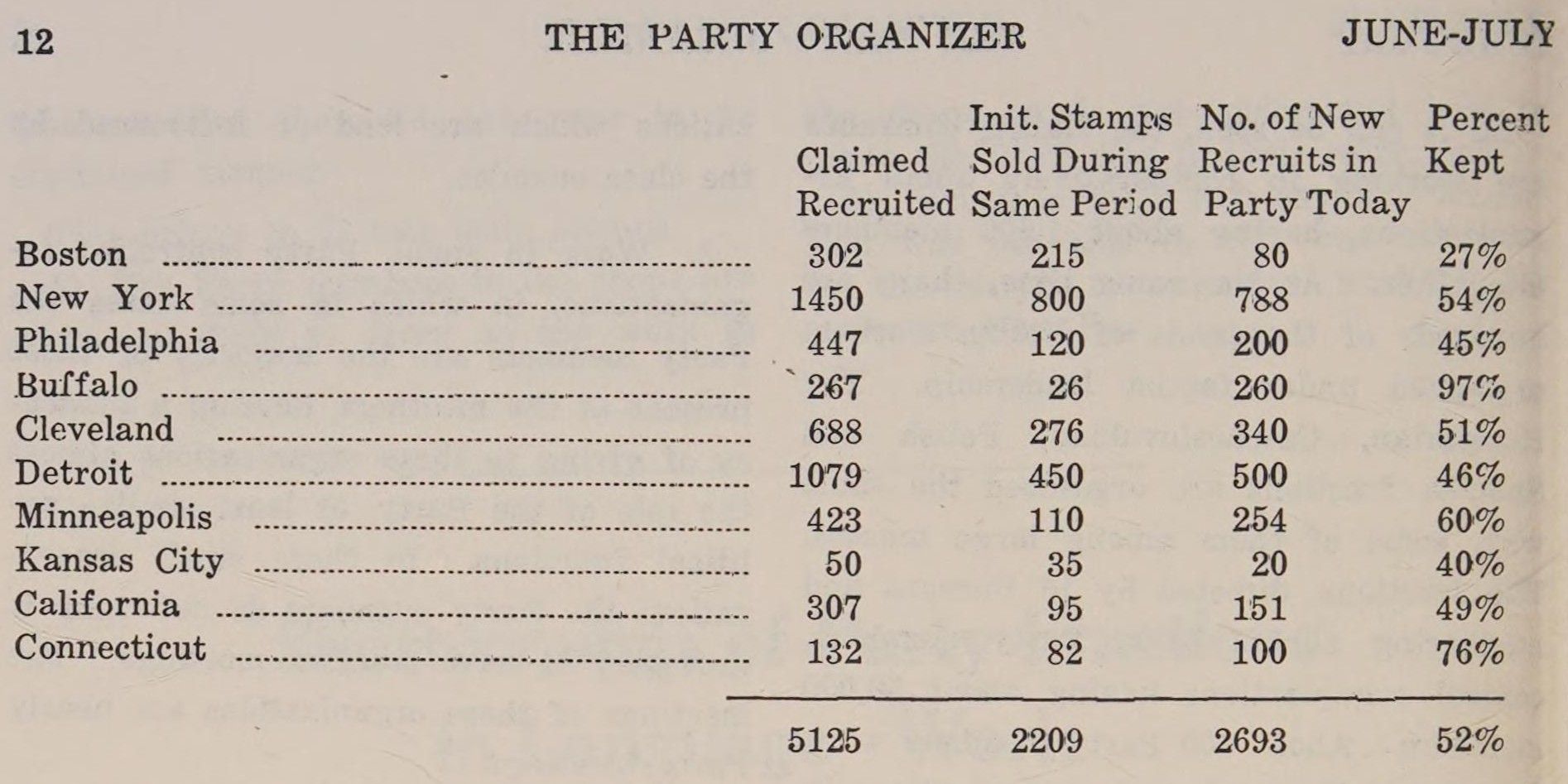
The most glaring deficiencies in the organizational and agitprop work of the Party is brought out in an analysis of the capacity of our Party to retain the new members taken in during the recent Recruiting Drive. An examination of 10 of the 15 districts who participated in the Drive shows: [See chart above]
If we contrast this table with the figures given at the conclusion of the Recruiting Drive, based or the official reports of the DO’s [District Organizers], we see that there was much boasting which only harms the Party in the long run and particularly do we evidence absolute failure of the nuclei to absorb these new members into their life and activity. The inadequacies of the Agit-Prop work showed itself in the few classes established and where functioning, the small number of new members involved.
All of this brings out more sharply than ever the weaknesses already pointed out (lack of recruiting in shops; primarily recruitment at demonstrations and meetings; large number among unemployed; few shop nuclei organized; absence of self-criticism in connection with the Drive on the part of the Districts, etc.) in the CC Resolution on Results of the Drive.
Today there still faces the Party as Task Number One, that which was pointed out on March 12th in the CC Resolution which says:
“1. Work Amongst the New members. This can only be done by firstly, a sharp change and improvement of the organizational and political life of out shop and street nuclei. This means that every unit must discuss in full the political campaigns and issues before the Party and how to carry these through in every day activity of the nucleus. Every nucleus must outline for itself, under the leadership of the District and Section Committees, concrete activity to carry through in the factories the political and organizational tasks of the Party. Linked up with this is the improvement of the functioning of the nucleus, which must meet regularly, on time, and with the nucleus executive giving leadership at all times. In activizing the nucleus, every member and particularly the new members must be involved in activity. The Districts and Section Committees must eliminate “circular” leadership as far as possible and give detailed personal attention to every lower organization, and
Secondly, the immediate establishment of classes, discussion meetings, study groups of all types (see March Party Organizer), development of Workers’ Correspondence, etc., in which all new members must participate.
In these study groups and courses, Party problems and major political issues, particularly in connection with Party program amongst the Negroes, must be studied, discussed and explained.”
The loss of new members up to now must sound the alarm for the entire Party as to the weak organizational status and capacity of the Party, and the above tasks of the Party must be applied immediately and energetically with full supervision of the District and Section Committees.
In an effort to popularize this problem, we will print in each issue of the Party Organizer, experiences of specific districts. In this issue we give experiences of Chicago and New York.
CHICAGO.
Ata recent meeting in the Calumet Section Committee held in order to discuss the Convention Thesis, a number of old leading members were still disputing whether there is radicalization amongst the workers and they were particularly doubtful as to whether unemployment is developing on a large mass scale. At this very same meeting, there were present six workers, both employed and unemployed, and one Negro worker who had recently joined the Party in Indianapolis. These workers, both in relating their experiences and in their spirit, refuted all the arguments of the old members who still doubted whether there is unemployment and radicalization.
All of the Indianapolis new members spoke at the Section committee meeting and without exception, expressed one desire and hope, namely, that they expect to remain in the Party in order to be able to FIGHT and gain KNOWLEDGE. These were the exact slogans put forward by these new members themselves.
If we want to summarize what the new members expect from the Party when they join it is precisely given by the Indianapolis new members. And the main reason in failing to keep the new members lies precisely in the fact that our units and the old members, to a large degree, are removed from direct participation in the class struggles, as concretely expressed in the failure to carry on shop activities and TUUL activities, and furthermore linked up with this, the failure of political discussion and lack of political life in the new units to give knowledge to the new members who expect to get it when they join the Party.
Various discussions in the units in Chicago District have shown, that the new members, joining the Party as a result of the Party’s campaigns and their desire to fight against the effects of the present crisis, are participating proportionally more frequently in discussions than some of the old members who have no class struggle experiences to relate and to link up their experiences with the general political line of the Party.
Organizational looseness and lack of responsibility are one of the main factors responsible for the failure to keep new members and lead them to more activities. Numerous examples can be given from our recent experiences, but we will only relate one which brings out that fact forcefully. A new member, who is a machinist and who came to our Party as a result of the TUUL activities, was placed in charge of the Metal Trades fraction. He called a meeting of our Metal Trades fraction, sent out 90 letters and only five showed up. This discouraged him a great deal and he actually told the comrades in charge of the TUUL that there is a great gap between what he heard of our Party before he joined, and what he finds now when there is so little discipline, responsibility, and desire for actual participation in the class struggle. Other cases, for instance, when new members filled out application cards to the Party three times and they were not attached to any unit. This surely is an indication of the organizational looseness which is responsible for the failure to keep many of the new members.
While we must not start a campaign of eliminating old members, it should be remembered that in many instances the old members who cannot digest the new line—and especially to carry it out in practice, are a drag on the new members. For instance in Whiting, Indiana, it was absolutely necessary to eliminate the old members in order to be able to retain the new members. We have now instances in the city of Chicago where old members sent in their resignation, some without excuses, others frankly stating that the greater demands of the Party, because of the sharpened struggles, makes it impossible for them to remain in the Party.
We had recently a discussion in all of the Party nuclei on the TUUL. At one of the nucleus meetings one of two petty bourgeois elements have resigned from the Party and some of the new members have joined the TUUL.
While the main weapon in keeping the new members is drawing them into activities and raising the political level of the units, at the same time we must give special personal organizational attention to them and particularly arrange special educational activities. In every section of the city we have classes for new members. Our recent experience shows that, generally speaking, the new members are ready to attend these classes and to participate in them. The failure of some, and the great shortcomings in others, are mainly due to organizational looseness in the arrangement of the classes. In connection with this it is interesting to note that in many cases the Negro workers are more prompt and more interested in the class than the new white members. Generally we try to follow the following outline for the new members’ classes.
1) Discussion on what brought them into the Party; 2) the present crisis in the light of the fundamental laws of Marxism; 3) the main campaigns of the Party as the TUUL, Election campaign, Daily Worker, etc.; 4) Organizational structure and activities of the Party.
Of course, these classes do not exhaust our educational activities for new members or for the Party as a whole. They are only a step in initiating the new members into the Party’s political life and to enable them to feel their way through the Party. We are also making special attempts to stimulate reading amongst the new members.
NEW YORK
The membership drive was still in full swing when the Comintern letter warned our Party that our most important task during and after the drive is to keep the new members. The last plenum of our Party has as a special point on the agenda—how to keep the new members. This point in the resolution placed clearly before the Party what needs to be done in order that the workers who join our ranks shall be retained in our ranks and how to do it. In spite of the warning of the Comintern, in spite of the very thorough, concrete resolution of the Party plenum, almost no effort was made to correct the well known shortcomings and mistakes in this respect.
We will not enumerate the very serious mistakes and shortcomings which kept out of the Party, 500 workers who showed their willingness to join the Communist Party during the membership drive. Our task in this article is to deal with the experience of New York District in the effort to keep the new members, who after long waiting were assigned to units.
1. After a long wait the worker becomes a Party member. He or she has a membership book, attends the first meeting, and receives the first delusion. What did the worker expect when attending the meeting. Discussion on the struggle against capitalism, on the methods by which the toiling masses can be organized, political education to clarify the significance of the day to day struggle, and the duties of a member of the Communist Party. Instead of this the new member comes to a meeting where everything is discussed but the problems that he expected. In one of the units a new Party member made a statement that after being in the unit eight weeks he did not see any difference between his unit meeting and the meeting of his Society. He never heard anything about the activities the Party is engaged in at the unit meeting. It is a miracle that this comrade is still a member of the Party. Do not permit the unit meeting to degenerate into a continuous business meeting.
2. Reading of long communications at unit meetings is another obstacle which disrupts the work of the unit. The unit bureau should prepare the agenda and report to the members. The Districts and Sections should not send long communications to the units but should send representatives to take part in the life of the units.
8. It is difficult for a new member to understand the Party language in the unit. Even an old member finds it difficult to understand the meaning of some of the symbols. Our Party members are in the habit of using abbreviations for names of organizations and even for certain actions of the Party. In one unit where four new members listened with interest to a speech about the new turn of the Party they heard the following: “The Party made very good progress on the I.R.D.” The eyes of the new members sparkled. One of them said: “We made progress there too, we will lead the next big strike. Did you hear it? The subway workers are with us.” The speaker became very angry and said, “How can any one be so dumb. I said, I.R.D., not I.R.T., and what I said means International Red Day and not Interborough Rapid Transit.” The new members were very much astonished and at the next meeting two of them did not show up due to the retort of the clever speaker. These members were lost to the Party. The comrades must be patient and must not expect the new members to understand everything. The full names should always be used instead of abbreviations. It is just as easy to say International Red Day instead of I. R. D., also District Literature Department instead of D.L.D. Even some of the old Party members would not understand the meaning of these letters.
4. Draw the new members into activity. Don’t let them sit in at the meeting without giving them responsible work. They will think that the unit does not trust them. The new members joined the Party because they saw in the Party a fighting army and by joining expressed a desire to enter into the fight. They want work, revolutionary work, otherwise they will be disillusioned and drop out.
5. It is very important that the comrades give personal attention to the new members. Don’t run away after the meeting. Speak to the new members, discuss (Party problems with them, make them feel that the Party is interested in developing them. Don’t treat them with a superior air. Help them in a comradely way to understand Party problems.
6. One of the most important factors for keeping new members is to have a meeting place that is not a bedlam. In five of the section headquarters four or five units met in the same evening. Many of the new members were lost because of this arrangement.
7. The classes for the new members are basically important. Every section in the New York district, with a few exceptions, had a new members’ class. Here too, we face the same shortcoming as in the meeting place of the units, The classes were held in the section headquarters at the same time as many other meetings. The old Party members after their meetings were over, would form a fringe around the classes, pass remarks and smile benevolently at the answers of the new members. This also served as a factor in losing new members for the Party. The Party cannot afford to permit a continuation of the shortcomings here enumerated. Drastic steps must be taken to correct these and to carry out the directives of the Central Committee resolution on keeping new members. Every Section and District leading committee must regard this as a task of major importance which must be persistently carried out.
The Party Organizer was the internal bulletin of the Communist Party published by its Central Committee beginning in 1927. First published irregularly, than bi-monthly, and then monthly, the Organizer was primarily meant for the Party’s unit, district, and shop organizers. The Organizer offers a much different view of the CP than the Daily Worker, including a much higher proportion of women writers than almost any other CP publication. Its pages are often full of the mundane problems of Party organizing, complaints about resources, debates over policy and personalities, as well as official numbers and information on Party campaigns, locals, organizations, and periodicals making the Party Organizer an important resource for the study and understanding of the Party in its most important years.
PDF of full issue: https://www.marxists.org/history/usa/pubs/party-organizer/v03n04-jun-jul-1930-Party%20Organizer.pdf

