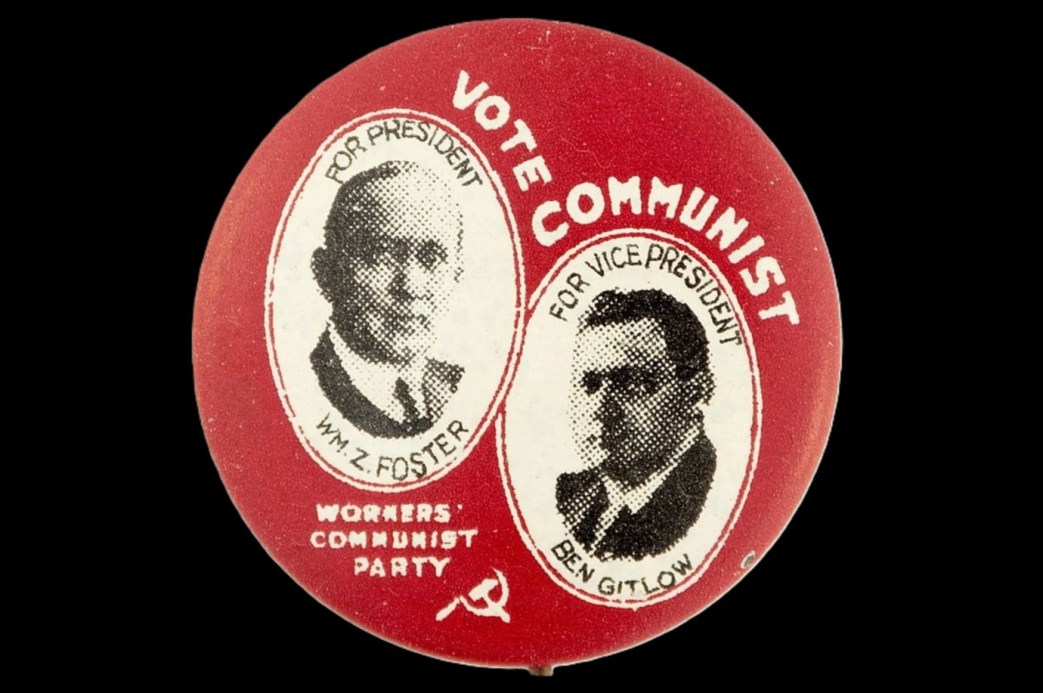
1924’s Farmer-Labor/LaFollette attempt to create a working class party for that year’s election fractured and collapse in a real debacle. A late decision, pushed by the Communist Party’s ruling majority Foster-Cannon-Bittelman faction, was made to run an open C.P. ticket with Foster for President and minority supporter Ben Gitlow as V.P. in an election just weeks away. It was not without considerable internal dissent. Here, Bittelman reaffirms the Communist attitude towards parliamentarism as he understood it in defense of the decision. Only able to get ballot access in less than fifteen states, that year the C.P.’s ticket received just 38,669 (0.13%).
‘A Communist View of Political Action’ by Alexander Bittelman from The Daily Worker Magazine. Vol. 2 no. 140. August 30, 1924.
WHAT I am going to say in this article will sound perhaps a little too elementary. It may even appear as a re-statement of some of the ABC of Communism. But then, why not? The elements of Communism are its fundamentals, its basic principles and final aims. And if there is ever a time when Communists must have their eyes fixed steadily on their final aims, it is the time when they are engaged in immediate, so-called practical activities.
One might lay down (Lenin did that a number of times) the following tactical directive: The more immediate and practical our tasks the more urgent is the need for keeping before our eyes the final aim of Communism. Why? Because our immediate activities, our struggles for partial demands of the workers, assume a revolutionary character only inasmuch as they are conducted with a view to our final aims. In other words, a policy is correct only if it prepares the workers and our own party for the last struggle for power. And it is from this angle that I am going to discuss political action and the present presidential campaign.
Do We Accept Capitalist Democracy?
By participating in an election campaign, do we or do we not recognize and accept capitalist democracy?
Such questions are still being asked and they have got to be answered. The people that ask such questions are, as a rule, workingmen, former members of political parties, who have become disillusioned and even disgusted with political parties and politics as a whole.
They say: Politics is the game of the bourgeoisie. The latter, through its press, pulpit, schools, theaters, movies, etc., is assiduously cultivating in the minds of the masses the belief in politics as the only legitimate means for the adjustment of “social grievances.” But the rules of the political game have been made by the bourgeoisie and no matter how well the workers may play this game, they are always bound to lose.
Thus runs the argument against politics and political action. It can all be reduced to the single idea that by participating in politics one accepts the existing political order of the bourgeoisie.
Is it really so?
Well, there are all kinds of politics; that is, there are many ways in which the American workers of today participate in politics. There are working-men and women who take part in politics thru the Republican and Democratic parties. This is one kind of politics about which there cannot be the least doubt that it is a game played in the interests of the capitalists and against the workers. This sort of politics is no good and the sooner the workers break with it the better.
Then there are workers that participate in politics as union men, as members of labor organizations. This is already a better sort of politics, better, that is, than participating in politics through the political parties of the capitalists. However, it all depends upon how the thing is being done.
Here, for instance, is Gompers. He stands for the idea that organized labor must participate in politics for the purpose of punishing its friends and rewarding its enemies. Which sounds pretty nice. It looks almost as if Gompers favors the participation of labor in politics for the purpose of promoting the interests of labor.
But it isn’t so. Gompers has no concern with labor as a class. Gompers rejects the class-struggle. He opposes the formation of a political party of labor or any other action that would lead to a struggle between capital and labor along class lines. Gompers’ politics are just as bad (if not worse) as those of the democratic and republican politicians. He who follows the lead of Gompers is following the lead of the capitalists. Then there is the C.P.P.A., whose politics is practically the same as Gompers’ except that the former was the first to unite with the middle classes thru LaFollette in the coming presidential elections. Large numbers of workers will be taking part in politics through the C.P.P.A. and the LaFollette movement. Which, of course, does not alter the fact that the politics of the C.P.P.A. is petty-bourgeoisie politics, substantially of a capitalist nature, which means bad politics for the working class.
Now, to return to the argument against politics in general, one might safely say this: If there were no other kinds of politics possible for the workers to engage in but the ones outlined above, one would be compelled to conclude that there is no way in which the workers can with profit to themselves engage in political action. Which would mean nothing more nor less than accepting the idea that the class struggle is impossible.
The Class Struggle Is a Political Struggle.
This is ABC, therefore, it must be taken as our starting point. He who accepts the class struggle for the abolition of capitalism, must also accept the idea of political action.
Why? Because you cannot start abolishing capitalism before you have destroyed the ruling power of the bourgeoisie and established in its place the ruling power of the working class. Therefore, the aims of the class struggle becomes the seizure of political power by the working class and the establishment of the proletarian dictatorship. In other words, the class struggle is a struggle for political power by the oppressed class against the ruling class.
Now, if this is true, then it follows that to deny the political struggle is the same thing as denying the class struggle. For there can be no class struggle, no real struggle against capitalism, other than a struggle against the capitalist state, against the rule of the bourgeoisie and for the rule of the working class.
Political Struggle and Election Campaigns.
This much will undoubtedly be accepted as true by every member of the working class who hates capitalism and believes in the Social Revolution. The argument that may be made will be directed not against the political struggle but against the participation in election campaigns, the main argument being this:
You cannot abolish capitalism by means of the ballot box.
Perfectly correct. Capitalism will be abolished only after the machinery of the capitalist state has been totally destroyed and a proletarian state erected in its place. But what of it? Merely this that the workers must be educated, organized and trained for the great battles that will result in the seizure of power by the workers. How? By utilizing every possible opportunity for unmasking the sham of capitalist democracy, for winning the masses over to the cause of Communism, and for organizing the advanced sections of the working class into the ranks of the Communist Party.
The only question to be considered is: Do election campaigns offer opportunities for this kind of work? We say, yes. In time of election campaigns the masses are more interested in politics than at any other time, which means that they will listen to us more readily and intently than they might otherwise. And further. Election campaigns are political campaigns. This is true in the sense that various groups and classes enter the open field of struggle to secure political power for the promotion of their respective interests. Because of this fact, election campaigns offer, as a rule, a very effective means for showing the workers the class-nature of capitalism and the workings of its ruling machinery. In short, we participate in election campaigns for the purpose of developing the class-consciousness of the workers, organizing them into a political party of their own, and training them for direct political struggles against the capitalist state.
For us the political struggle is a much bigger thing than election campaigns. The latter we consider merely one of the phases and forms of the political struggle of the workers. We know that the day will come when the center of gravity of the political struggle will lie not inside but outside of the organs of the capitalist state. And for this day we have got to prepare.
But we also say this: that when we participate as Communists in election campaigns we are thereby building the army and preparing the weapons for the last mighty struggle for power that will overthrow capitalism and establish the rule of the working class.
The Daily Worker began in 1924 and was published in New York City by the Communist Party US and its predecessor organizations. Among the most long-lasting and important left publications in US history, it had a circulation of 35,000 at its peak. The Daily Worker came from The Ohio Socialist, published by the Left Wing-dominated Socialist Party of Ohio in Cleveland from 1917 to November 1919, when it became became The Toiler, paper of the Communist Labor Party. In December 1921 the above-ground Workers Party of America merged the Toiler with the paper Workers Council to found The Worker, which became The Daily Worker beginning January 13, 1924.
PDF of full issue: https://www.marxists.org/history/usa/pubs/dailyworker/1924/v02a-n140-supplement-aug-30-1924-DW-LOC.pdf

