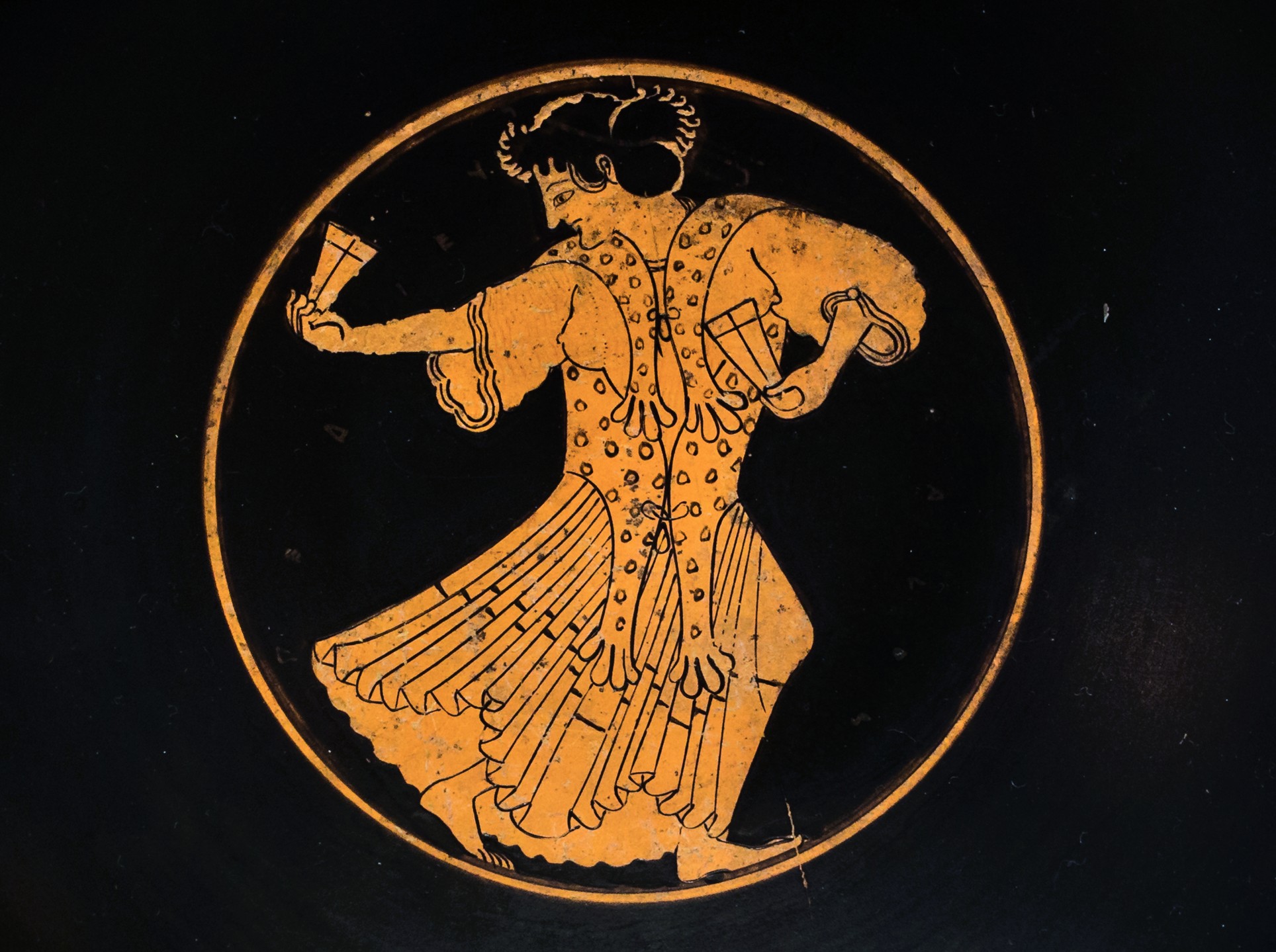
A fascinating piece from Harry Elion looking to the popular, topical, and purposeful public dance of Ancient Greece for inspiration in the creation of a new, modern, revolutionary dance. Elion was secretary of the League of Workers Theatres, an editor of New Theatre, and a leading figure in the vibrant radical arts movement throughout the 1930s. Betrayed his former co-worker Eli Kazan and named to the HUAC in 1952, to be blacklisted in the McCarthy years.
‘Perspectives of the Dance’ by Harry Elion from New Theatre. Vol. 1 No. 8. September, 1934.
DURING the past few years I have watched with keen interest the development of the Workers’ Dance movement. One cannot deny that much has been done toward the development of this field of proletarian culture. However, while was watching the dances presented at the Dance Festival it became clear to me that a thorough examination of the aims and methods of the workers’ dancers is necessary if the dance movement is to make immediate progress. The weaknesses so glaring in almost all the dances result mainly from a lack of understanding of the relations between content, form and style. Although one could notice a general improvement in the mastery of the technique of dance form, the content, though selected from class struggle events, did not get across the footlights clearly. It was as though content and form were not integrated but parallelled. At times content overshadowed form and at other times form completely obscured the content. This seeming contradiction between improved technique and lack of clarity in expression is the very basic difficulty of dancers. It arises from the rigid adherence to formal technique when the question of a new content is involved.
It is a generally accepted principle that revolutionary art form is dependent upon its content. This principle was reiterated at the last Dance Convention and was accepted as a basis for work. When we examine the content of the various dances presented at the Festival we find that most of it was abstract. In Bruno Tesch Memorial dancer after dancer walks to death of his own free will. Intuitively they are drawn to the butcher’s axe. These dancers may have reason for doing it, but the audience was never let in on the secret.
In the same manner were the dancers in Dirge attracted by the light. In Uprising they were drawn, just as intuitively, upward, forward, as a moth is drawn to the light. Certainly terror, upsurge and uprising are manifestations of a very bitter class struggle. In this struggle every gain, every defeat is a result of terrific class conflicts. If the subject matter of workers’ dances is to be class struggle, these conflicts must become more apparent in the content of the dances.
If the workers’ dancers honestly and truly make it their task to use the manifestations of class conflicts in life as content for their dances, the form of the dance will of necessity have to undergo some development in the direction of becoming more dramatic. I stated in my introductory paragraph that most of the dances failed to develop their subject matter. This failure was due to the fact that the dance embodied no conflict. Development without conflict is impossible because such conception is undialectical. Every dynamic art form must base its conception upon conflict. Eisenstein formulated this principle in the following manner:
“In the realm of art, as the fundamental basic principle (this dialectic principle of dynamics incarnates itself in conflict) of the substance of every art-work and every art form. For art is always conflict.”
The static influence in the dance conception comes from the bourgeois dance. There is only one way to overcome this influence and that is to make dramatic development, or conflict, part of the dance form.
THE problem of style and its relation to the content of the dance requires a thorough analysis; for it is in the field of style that the workers’ dances show most the influence of the bourgeois dance. The dance images with few exceptions are not derived from the content of the dances but from some preconceived styles. As a result, it would probably be necessary to equip every member of the audience with a dictionary, defining the meaning of every movement in order to make the dance understood. If the content of the dance is a specific incident in the class struggle the basic image, in order to be communicable to the audience, must be derived from that incident and not from any abstract movements. The content of a dance, if it is specific and not abstract, will provide a basis for a communicable image. From the particular the general is derived. Lenin formulated this truth in the following passage quoted by V. Adoratsky in Dialectical Materialism:
“The approach of the mind (of man) to a particular thing, the taking of a cast of it (in other words, an impression) is not a simple direct act; a lifeless mirror reflection, but a complex, twofold and zig-zag act, which harbors the possibility that the phantasy may entirely fly away from reality; what is more, it harbors the possibility that the abstract conception, the idea, may be transformed (imperceptibly and unwittingly on the part of man) into phantasy (and in the long run into God). For even the simplest generalization and the most elementary general idea is a fragment of phantasy.”
How much more are we subject to flying away into the realm of phantasy when we begin with the most abstract ideas, such as Uprising and Upsurge?
The researches into the art creations of the aborigines can teach us much in this regard. Harrison writes in Themis, p. 44, that
“…when the men return from the war, the hunt, the journey, and re-enact their doings, they are at first undoubtedly representing a particular action that actually has taken place. Their drama is history, or at least narrative; they say, in effect, that such and such a thing did happen in the past. Everything with the savage begins in this particular way. But it is easy to see that if the dramatic commemoration be often repeated, the action tends to cut itself loose from the particular in which it arose and becomes generalized, abstracted, as it were. The particular hunt, journey, battle is in the lapse of time forgotten or supplanted by a succession of similar hunts, journeys, battles, and the dance comes to commemorate and embody hunting, journeying, fighting.”
This is not only confined to the savage but is the life history of every idea or concept. The dancers can learn from this that if they proceed in the same manner to dance out the specific incidents of the class struggle they will in due time acquire a dance language which will enable them to represent struggle in general. This does not mean that they will remove the “possibility” of getting into the field of phantasy.
The contradiction between the facts that the dancers have reached a higher level of technical development while the content of the dances remains obscure, results from the fact that while the dancers generally accept the proposition that form is derived from the content, their preoccupation with the existing technique in the dance makes it impossible for them to carry this truth into practice. The dancers cannot find the solution to their difficulties in the study of the contemporary dance alone; they must acquire a historical perspective of the dance in its relation to other cultural forms and to society as a whole. When they do this they will of necessity come to the conclusion that while dance throughout its history had its internal development, it had to undergo changes in accordance with the demands placed upon it by every change in society as a whole.
Historical Perspective
IN the primitive communities, the dance plays a very important role. Every function, birth, education of the young, religion, sickness and death, and above all the struggle for existence finds its expression in the dance.
The content of these dances varies with the specific conditions of obtaining a livelihood. Among the hunting and fishing tribes it deals mainly with the invocation of the spirits and the forcing of the evil spirit to supply herds of animals for the hunt. When there is a scarcity of animals, the tribe will get together and perform a ceremony which represents a hunt. This will be continued until a herd appears. The witch doctor usually does not hold these ceremonies until he gets tidings that a herd is not far away. He fears for his prestige.
In more developed communities where agriculture is the dominant means of support, worship of the elements, the sun, the moon, the wind, the rain, is more closely tied up with the contents of the dances.
The Greek dances were no exception. The content and form of the dances were closely associated with the life of the time. The dances fall into two distinct classes: dances designed for war training, and work dances. During the decadent period of Greek life another class of dances appears, the entertainment or sex dance. Xenophon describes one of these dances in the “Banquet” and concludes that:
“When the guests saw that they (the dancers) were embracing one another and seemed to be going to repose, such of them as were unmarried vowed that they would marry and such of them as were married mounted their horses and rode off to join their wives; while Socrates, and the others who stayed behind, proceeded, with Callias, to accompany Lycon and his son in their walk.”
Such were the effects of the dance. However, another dance was performed at the same banquet and is described in the following manner:
“A hoop was brought in, stuck round with swords standing upright. Into the midst of these swords the dancing-girl leaped head foremost, and sprang out head foremost over them so that the spectators were struck with terror lest she should be hurt.”
A guest remarked that this dance should be exhibited to the youth as a feat of courage to train the youth to run upon swords without fear.
There are more direct opinions of the ancients as to the value of the dance. Atheneus states in “Deipnosophists”:
“…the kind of dancing which was at that time used in the choruses, was decorous and magnificent, and to a certain extent imitated the motions of men under arms…For the dance is very nearly an armed exercise, and is a display not only of good discipline in other respects, but also of the care which the dancers bestow on their person.” It must be remembered in this connection that dancing was prescribed as part of the training of the youth for war. The contents of two dances described by Atheneus show clearly how the content of the dance was used to inspire the Greeks to fight and struggle.
“After the libations were made, and the guests had sung a paen, there rose up first the Thracians, and danced in arms to the music of a flute, and jumped very high, with light jumps, and used their swords. And at last one of them strikes another, so that it seemed to every one that the man was wounded. And he fell down in a very clever manner, and all the bystanders raised an outcry. And he who struck him, having stripped him of his arms, went out singing sitalces. And others of the Thracians carried out his antagonist as if he were dead; but in reality, he was not hurt. After this some Aenianians and Magnesions rose up, who danced the dance called Carpaea, they too being in armor. And the fashion of the dance was like this: One man, having laid aside his arms, is sowing, and driving a yoke of oxen, constantly looking around as if he were afraid. Then there comes up a robber; but the sower, as soon as he sees him, snatches up his arms and fights in defense of his team in regular time to the music of the flute. And at last the robber, having bound the man, carries off the team; but sometimes the sower conquers the robber, and then, binding him alongside his oxen, he ties his hands behind him and drives him forward.”
A great many of the dances dealt with work subjects, (i.e., the sower’s dance). The songs used as accompaniment to these dances show that almost every phase of work had its song and dance. The movements were derived from the particular work the dance represented as was indicated in the above quotation. The audience recognized these movements very easily and were very definitely involved in themes of the dancers.
The Romans used the dance for entertainment’s sake even more than the Greeks. However, the Romans developed pantomime to a very high form; pantomime became one of the most popular forms of entertainment. G. Vuillier in his History of the Dance quotes an incident which shows how popular this form of entertainment was, and at the same time sheds light on its role in the class struggle. The supporters of two mimes, Pylades and Bathythis, would have battles in the streets of Rome as to which of the two was a better performer. Every person was either a Bathylian or Pyladian. Augustus reproved Pylades on one occasion for his perpetual quarrel with Bathythis. “Caesar,” replied the dancer, “it is well for you that the people are engrossed by our dispute; their attention is thus diverted from your actions!” It would be a mistake to think though that the dance did not have any class struggle content.
THE exponents of “art for art’s sake” who get their inspiration from the ancients, base their knowledge of the dance not on the content of these dances but on the movements divorced from the content and preserved on frescoes and vases. As a result these movements, though they had meaning at the time, have no meaning to us. Thus Maurice Emannuel in The Antique Greek Dance has taken up the positions of the legs and their movements, the positions and movements of the arms; and those of the head and torso, as used in the modern classic dance and depicted upon ancient vases, high and low reliefs, and upon frescoes of Pompeii. Similarly Duncan states in The Art of the Dance that the most beautiful dream is that of finding again the Greek theatre that is ideal for both spectators and actors. To bring to life again the ancient ideal. I do not mean to say, copy it, imitate it; but, to breathe its life to recreate it in one’s self, with personal inspiration; to start from its beauty and then go toward the future. The subject of the dramas can be modern. But to find again the ancient idea, and by a miracle of love and devotion, to unite anew the arts and the artist.”
Another time Miss Duncan denies that she was inspired by the ancients and states that she is “American” foremost. Duncan’s creative ability and her eclectic philosophy fortunately permitted her to create in spite of the Greek influence. However, she might have been much more effective had she completely divorced herself from this influence.
I shall not attempt to give an exhaustive historical analysis of the development of the dance, for neither space nor time will permit me to do this. The object here is to give a perspective that will aid those who are preoccupied with the dance in further researches. The medieval period was less fruitful as far as dance creation is concerned. This was largely due to the fact that the church interfered and permitted only church dances. The rise of the merchant bourgeoisie brought a fresh wave of cultural development and with it the revival of the dance. The dances however were mainly confined to the ruling classes and reflected their preoccupation with court manner and chivalry. G. Vuiller states that:
“…the dances of the eighteenth century had a charm all their own; with their supple and rhythmic grace they combined a dignity which surrounded man, and in a still greater degree, woman, with an atmosphere of beauty…But there was a fearful morrow to those days of supreme elegance and careless gaiety…The roar of Revolution broke in upon the dream; kings, women and poets were dragged on tumbrils to scaffold…And yet dancing went on…men and women danced round the scaffold, their feet stained with blood. Twenty-three theatres and eight hundred public halls were open every evening immediately after the terror…A veritable revolution took place in dancing at this period. The middle classes developed a passion for balls, which had hitherto been confined almost exclusively to the aristocracy, save for the rustic festivals of country districts. Unable, however, to enjoy the amusements in their own small rooms, dancers soon flocked to public saloons…”
Dances such as polkas and waltzes became very popular. However, the bourgeoisie soon got rich and could afford large enough rooms. The modern dance was revived as private entertainment. It was again divorced from its social function, and assumed the character of entertainment. Its content was sex and exaltation with pure being. The bourgeoisie was growing, prospering. A healthy body, an apple, grapes, and other objects became subject matter of art. The technique that developed under these conditions was suited to the needs of the audience.
While it is true that the workers’ dance could not cast aside bourgeois form and style at its inception, it is equally true that such a slavish adherence to such form and style will not permit proletarian content to get across to the audience. During the process of creative work it is necessary to develop new forms, to experiment with style and above all to make every attempt to derive both from the content.
The workers’ dance took over a great deal of the bourgeois technique. In fact most of the leaders in the dance were trained to be bourgeois performers. The workers’ dance must free itself from this influence and create a dance form that is expressive of the workers’ needs. This form will come as a result of the revolutionary content, providing the dancers free themselves from the idea that all that has to be done is to give the bourgeois dance working class content.
The New Theater continued Workers Theater. Workers Theater began in New York City in 1931 as the publication of The Workers Laboratory Theater collective, an agitprop group associated with Workers International Relief, becoming the League of Workers Theaters, section of the International Union of Revolutionary Theater of the Comintern. The rough production values of the first years were replaced by a color magazine as it became primarily associated with the New Theater. It contains a wealth of left cultural history and ideas. Published roughly monthly were Workers Theater from April 1931-July/Aug 1933, New Theater from Sept/Oct 1933-November 1937, New Theater and Film from April and March of 1937, (only two issues).
PDF of full issue: https://www.marxists.org/history/usa/pubs/workers-theatre/v1n08-sep-1934-New-Theatre.pdf

