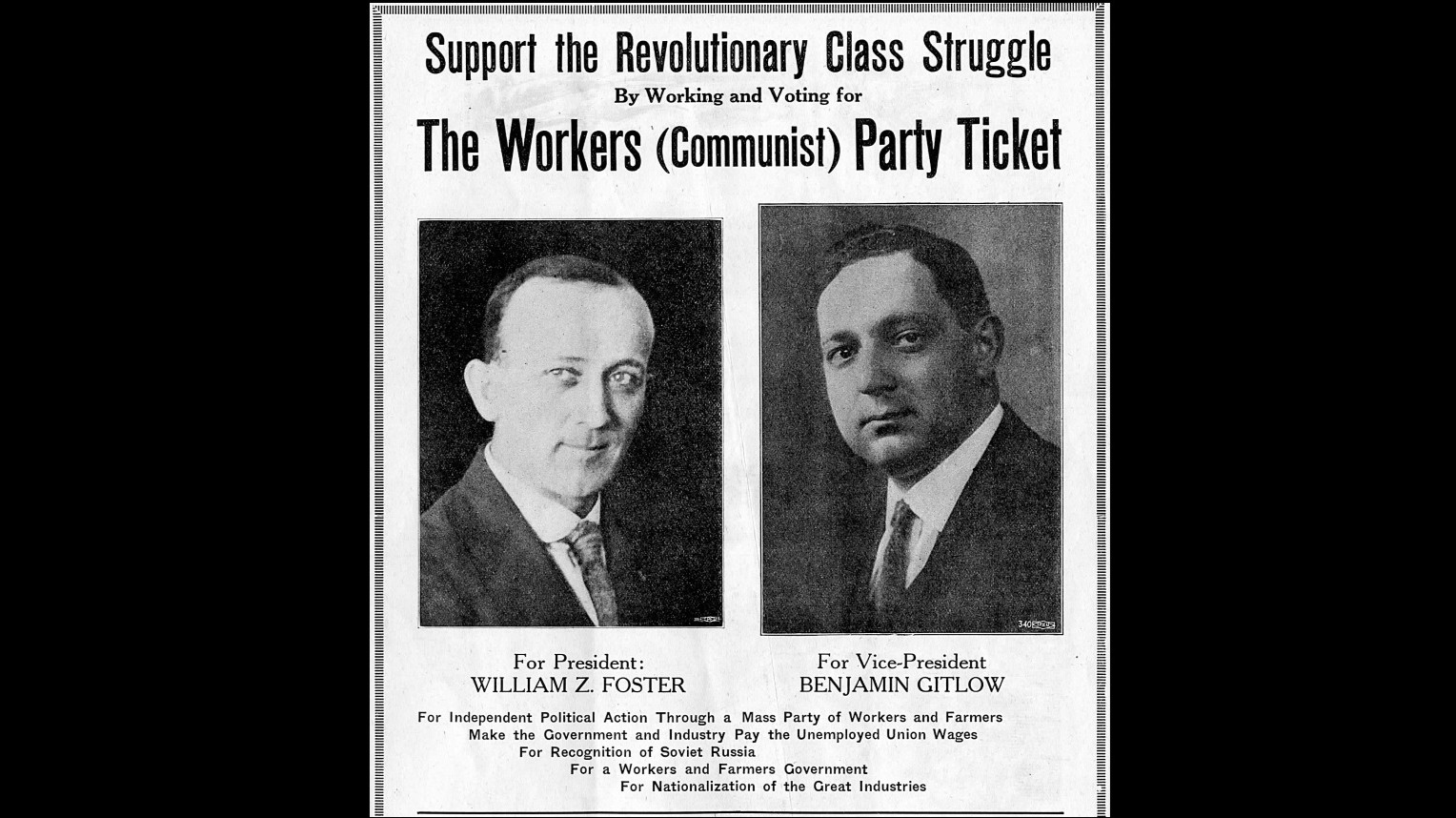
Despite some early promise, the failures in creating a new Labor/Farmer-Labor Party to contest 1924’s election, led the Workers (Communist) Party to decide to run independently in its first ever national electoral campaign. Most energetically supported by the Foster-Cannon majority of the Party’s leading Executive, it faced reticence and resistance from the Pepper-Lovestone-Ruthenberg minority. Below Ruthenberg challenges Foster’s November, 1924 article ‘The Workers Party to the Fore’, advocating the campaign. With the collapse of Labor Party attempts, La Follette’s strong ‘progressive’ agrarian run, and the failures of the C.P.’s vote, only able to get ballot access in less than fifteen states the Party received just 38,669 (0.13%), Ruthenberg asks what’s next for the possibility of a Labor Party.
‘Is the Movement Towards Class Political Action Dead?’ by Charles E. Ruthenberg from Workers Monthly. Vol. 4 No. 2. December, 1924.
The Workers Party faces the problem of shaping the policy which it will pursue in order to develop class political action by the workers of this country. A group in our party, under the leadership of Comrade Foster, who presented his view in the November Workers Monthly, is of the opinion that the movement towards class political action by labor is dead and that therefore, the Workers Party must abandon the slogan “For a Class Labor Party.”
In order to grasp the significance of the present situation, it is necessary to examine fundamentally the basis of the farmer-labor united front policy which has for two years been the major political policy of our party. Such an examination will give a clear answer to the question, “Is the movement towards class political action by labor dead?” and serve as a guide to our party in formulating its position.
The Basis of Our Farmer-Labor United Front.
What were the facts which in June, 1922, influenced the Central Executive Committee of the Workers Party to adopt the slogan “For a Labor Party” which was later widened to “For a Class Farmer-Labor Party?”
The Central Executive Committee of our party at that time was considering the application of the united front policy which had just been formulated by the Communist International, to the conditions which existed in the United States. The policy of the United Front was and is that Communist Parties shall take up the immediate issues growing out of the class struggle, take the leadership of the struggle, and demand that other existing organizations claiming to represent labor shall unite in support of the immediate struggles of the workers. Thus, the united front policy is both a weapon for the mobilization of the workers for the immediate fight against capitalism, and a means of exposing the misleaders of the workers through their refusal to join a united front fight on issues growing out of the immediate demands of the workers.
The Central Executive Committee of our party, in casting about to find the means of applying this policy on the political field in the United States, faced the situation that in this country no mass political organization of labor existed and that the workers were still supporting the parties of their class enemies, the Republican and Democratic parties. The problem of a united front politically, therefore, was not the question of manouvers against existing political parties of labor which were misleading the workers, but a question of slogans which would develop independent political action by the workers.
The forces which develop class political action by labor are the experiences of labor in its fight for more of what it produces and for better working conditions. It is a funda, mental of Marxism that the development of capitalism brings about the intensification of the class struggle, that this intensified class struggle involves the open use of the state power against the workers and forces the workers into the political struggle as a class in their own defense. If this fundamental Marxian principle is not true, then our Communist hope of a proletarian revolution is an illusion.
In 1922, when the united front labor party policy was adopted by our party, it was apparent that we had reached the stage of development in the United States which would produce a class political struggle by the workers on a mass scale. The development of capitalism in the United States, as a result of the war, has brought about an intensification of the class struggle here. The great industrial revolts of 1919 and 1922 were the expression of this situation. The more open use of the state power against the workers developed the idea of labor political action to take this weapon out of the hands of the capitalist exploiters. The demand for such labor political action took the form of a movement for a farmer-labor party.
It was thus no artificial slogan created by our party which was the basis of our united front farmer-labor policy, but the actual developments of capitalism and the workers’ struggle in the United States. Our party adopted the slogan “For a Labor Party” as a means of crystallizing the sentiment for independent political action by labor which had grown up thru the life experiences of the workers. Therefore, the slogan “For a Labor Party” was not based upon mere ephemeral conditions, but upon the rock foundation that the developments of capitalism intensifying the class struggle, bringing with it the use of the state power against the worker, inevitably forced them into a class political struggle against the capitalist state power.
Divergent Views Within the Party.
Before taking up the present validity of the slogan “For a Class Labor Party” as a means of agitation and mobilization of the workers for the political struggle against the capitalist state power, it is necessary to examine the divergent views which developed within the party during the farmer-labor united front campaign. This examination will throw some light upon the basis of the present opposition of the Foster group to the continuation of the slogan “For a Class Farmer-Labor Party” as enunciated by the Communist International.
The differences of viewpoints in regard to the application of the farmer-labor united front policy developed in the Central Executive Committee of the party immediately after the formation of the Federated Farmer-Labor Party. There had been representatives of some 600,000 workers and farmers in the Federated Farmer-Labor Party convention. It was the view of the then majority of the then Central Executive Committee, expressed in a thesis and resolution by Comrades Pepper and Ruthenberg, that by an aggressive organizational campaign it would be possible to organize in the Federated Farmer-Labor Party from 200,000 to a quarter of a million workers, thus creating a left wing radical farmer-labor organization.
The group which supported this viewpoint contended that it was to the best interests of the Workers Party to organize such a left wing radical farmer-labor bloc around itself and under its leadership. This bloc, it contended, would strengthen the Workers Party. Through a careful and systematic campaign of Communist education it could be developed closer to the Workers Party, with the ultimate object, after a period of such preparation, of absorbing the best elements in this bloc into the Workers Party and thus developing the Workers Party as a mass Communist Party.
The Pepper-Ruthenberg group also contended that the formation of this left bloc farmer-labor party, under the leadership of the Workers Party, would give the Workers Party a powerful weapon with which to manoeuver in relation to a broader farmer-labor united front.
This viewpoint and policy was bitterly opposed by the Foster-Cannon group. They contended that the formation of such a left bloc farmer-labor party under the leadership of the Workers Party was a misapplication of the united front policy. In a thesis submitted at the November meeting of the C.E.C. in 1923, it was argued that the policy of the Workers Party must be directed toward the creation of a broad all-embracing farmer-labor party. It was the view of the Foster-Cannon group that thru some magic the whole or a great part of the organized American labor movement would be organized in a broad mass farmer-labor party in which the Workers Party would assume the role of a relatively weak left wing and not the position of leadership and control.
The Pepper-Ruthenberg group declared that this wide all-embracing labor party was an illusion, and that the development of the working class of this country would not and could not be to enter the field of political struggle as a class thru one great stride forward which would carry with it the great bulk of the workers. It declared further that the policy of our party in carrying on the campaign for a labor party was not primarily to build up such a broad mass labor party but to strengthen and build the Workers Party as a mass Communist Party and if it was necessary to sacrifice the broad mass labor party for a mass Communist party, that it was our Communist duty to build the mass Communist Party.
Misconceptions of the United Front Policy
The policy of the Foster-Cannon group in directing the work of our party toward the creation of a broad all-inclusive farmer-labor party in which we would be a weak left wing and sacrificing the organization of a left bloc radical farmer-labor party around the Workers Party which would be under its leadership and control, shows a fundamental misconception of the united front policy.
The purpose of the united front tactic is to build up and strengthen the Communist Party. It must take every advantage of the situation during the united front manoeuver in order to increase its prestige, its leadership and its membership. The united front tactic is the method of building a mass Communist Party.
In place of holding this view, the Foster-Cannon group seems to consider the creation of a broad mass labor party as a goal in itself irrespective of the relationship of the Workers Party and the effect upon the Workers Party. It was ready and did sacrifice the creation of the left bloc radical farmer-labor party under the leadership of the Workers Party for the illusion of an all-inclusive broad labor party. Its opposition and continued struggle against the organizing of the Federated Farmer-Labor Party around the Workers Party prevented the creation of such a left bloc radical farmer-labor party under the leadership of the Workers Party which, if created immediately after the Federated Farmer-Labor Party convention would have materially changed the position of the party in relation to the whole farmer-labor movement and later in relation to the LaFollette movement.
The same misconception which was manifest in its policy in relation to the Federated Farmer-Labor Party obtrudes itself in the slogan which it offers at the present time as a substitute for the slogan “For a Class Labor Party.” The slogan which is to succeed the slogan “For a Class Labor Party” is “Build the Workers Party.”
If the Foster-Cannon group considers this slogan “Build the Workers Party” as a new slogan to succeed “For a Class Labor Party,” then it must have held the opinion that in carrying on the united front farmer-labor manoeuver we had some other purpose than to build the Workers Party. Its policy of sacrificing everything for the creation of a broad all-inclusive farmer-labor party was this other purpose. In opposition to this the Pepper-Ruthenberg policy was to build a left bloc farmer-labor party under the leadership of the Workers Party and thus ultimately to form a mass Communist Party. The Pepper-Ruthenberg policy in carrying on the farmer-labor united front, was always to build the Workers Party.
The Foster-Cannon group now proposes to abandon the slogan “For a Class Farmer-Labor Party” and substitute “Build the Workers Party” because of its erroneous ideas of the purpose of the farmer-labor united front manoeuver. Those members of our party who have always seen clearly the farmer-labor united front policy was a manoeuver to build and strengthen the Workers Party need not adorn themselves in sackcloth and ashes and repent for their past sins.
Will Labor Stand Still?
The argument of the Foster group against the continuance of the slogan “For a Class Labor Party” is that in the LaFollette movement “there has been submerged what promised to be the beginning of a mass party of workers and farmers upon a class basis with a class program, the rising farmer-labor party movement.” I am suspicious that behind this viewpoint that the LaFollette movement has ended the usefulness of the slogan “For a Class Labor Party,” there are some vestiges of a belief that in the LaFollette progressive party we have that broad mass all-inclusive labor party which the Foster-Cannon group advocated as the goal of the Workers Party policy.
Undoubtedly it is true that the formation of a broad all-inclusive farmer-labor party, with a program expressing the class interests of the two classes, is not likely for the immediate future. The illusion which the Foster-Cannon group had that such a party could be formed is still an illusion. The struggle which the Foster-Cannon group made in the past to direct the party policy toward the impossible goal of the realization of this illusion is very probably at the bottom of its present opposition to the continuation of the slogan “For a Class Labor Party.”
The potency of the slogan, so far as this goal was concerned, is ended at the present time. The potency of the slogan still remains so far as the goal of those who used it as a means of bringing under the leadership of the Workers Party, the most conscious and radical workers in the labor movement and of thus building the Workers Party.
The reason why the slogan remains a potent slogan for our party to use as the basis of its united front manoeuvers on the political field is because capitalism and the intensification of the class struggle remain. The original policy was based upon the assumption that the intensification of the class struggle must develop class political action by labor. The Foster group, in their election statement, agree that the immediate future in the United States holds an intensification of the class struggle—that the Coolidge-Dawes administration means new attacks upon labor. The Foster group is compelled to agree that the LaFollette movement does not represent class action by labor. If the immediate future holds intensified class struggles between the workers and the capitalists, if we agree that the LaFollette movement cannot express the class political struggles of labor, and if we agree with the Marxian principle that the intensified struggle between the workers and capitalists forces the workers into political class action, then there is no other conclusion than that the immediate future holds an even greater movement toward class political action by labor than we have had in recent years and that the slogan “For a Class Labor Party” remains the best slogan thru which to carry on the work of agitation for such class political action and the ultimate mobilization of the workers for class political action.
Our Policy.
Our party made its greatest gains thru its united front farmer-labor policy. It was the application of this policy that brought it in contact with the workers and established its prestige as a political party. Thru the application of the united front policy on the political field, it developed from a sectarian propaganda group into an actual factor in the struggles of the workers of this country. It strengthened itself and its leadership thruogh the united front manouever. The party must continue to apply the united front tactic on the political field. The slogan “For a Class Labor Party” remains a potent slogan thru which to bring the workers who are developing towards class political action under the influence and leadership of the Workers Party. It must continue that slogan for the purpose of agitation against both the old parties and against the LaFollette movement.
Its aim in conducting the agitation under the slogan “For a Class Labor Party” must be the ultimate mobilization of the left wing radical bloc in the labor movement under the leadership of the Workers Party. It must be to penetrate this group which thru the slogan “For a Class Labor Party” it brings into action with itself and under its influence, with Communist understanding for the purpose of ultimately absorbing its best elements into the Workers Party.
The Foster group proposes as a substitute for this policy the direct attempt to draw into the Workers Party the workers whom capitalism teaches the necessity of labor fighting as a class on the political field. We shall abandon the slogan which in the past has enabled us to establish close contact with at least the left bloc of the labor movement and return to our former status of sectarian propaganda. That is the effect of the policy of the Foster group. It means the repudiation of the united front as a weapon of our party on the political field. The same reason exists today for the slogan “For a Class Labor Party” which existed when we adopted it. We cannot establish contact with the undeveloped workers who are still in the old parties or who have moved into the LaFollette movement by mere propaganda for Communist principles. We can, however, using the lessons of their experiences in the use of the state power against them in their immediate struggles, establish contact and our leadership by offering to unite with them under the slogan “For a Class Labor Party” and a class fight by labor.
The slogan “For a Class Labor Party” still is the best road open for the building of the Workers Party and making it a mass Communist Party.
The Workers Monthly began publishing in 1924 as a merger of the ‘Liberator’, the Trade Union Educational League magazine ‘Labor Herald’, and Friends of Soviet Russia’s monthly ‘Soviet Russia Pictorial’ as an explicitly Party publication. In 1927 Workers Monthly ceased and the Communist Party began publishing The Communist as its theoretical magazine. Editors included Earl Browder and Max Bedacht as the magazine continued the Liberator’s use of graphics and art.
PDF of full issue: https://www.marxists.org/history/usa/culture/pubs/wm/1924/v4n02-dec-1924.pdf

