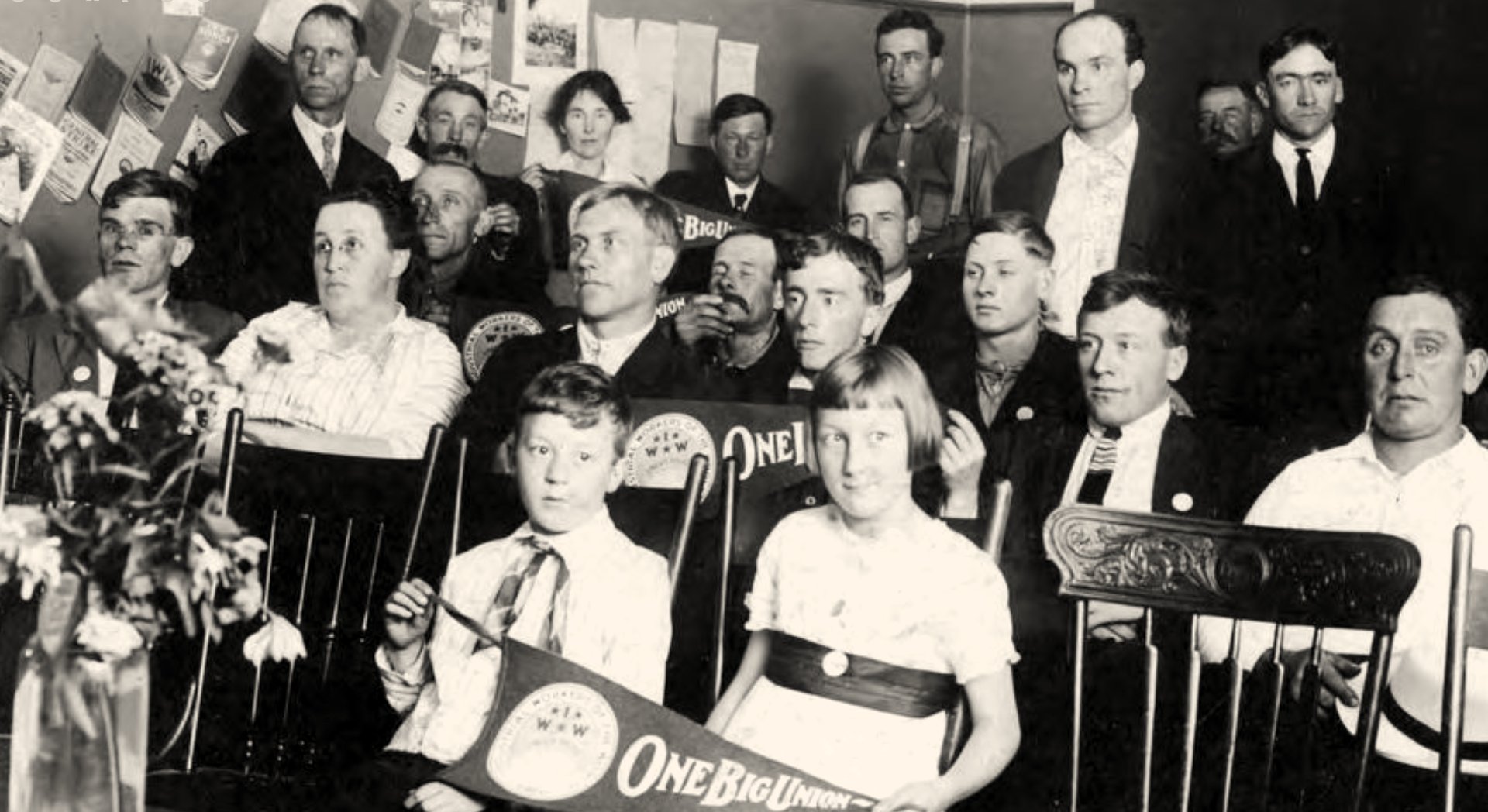
In June, 1917, a strike by I.W.W. Local 500, Lumber Worker Industrial Union, won an eight-hour, 5-dollar day on the St. Maries River in Montana, helping to ignite a general strike of workers in the essential, war-time lumber industry. First centered in Idaho, Montana, and eastern Washington, it quickly grew to encompass much of the Pacific Northwest. Involving tens of thousands of workers and their families across widely dispersed, often isolated, camps scattered over a massive area, the strike had a real impact. Shutting down a number of shipbuilding operations on the coast, by the end of the year most loggers in the region had won the 8-hour, 5-dollar day. A real accomplishment. An early report as the great struggle began.
‘General Strike of Lumber Workers in Full Swing’ from Solidarity (Chicago). Vol. 8 No. 390. June 30, 1917.
LUMBER JACKS AND MILL MEN UNITED TO WIN FULL DEMANDS–ALL LOGGING OPERATIONS SOON TO BE TIED UP
The general strike of all the workers in the woods and hills that was decided upon by the general convention of lumber workers last March is on. From all reports this strike will be the most far-reaching and successful effort the slaves of the lumber trust have ever made to better their conditions.
The purpose of the strike is to secure the eight-hour day, and other demands decided upon as being essential to the upkeep of strength and health in the present period of high prices. One thing is certain, that the lumber workers are seizing the greatest opportunity in history to make their strike a winner. All too long have these men permitted themselves to be over-worked, underpaid and the victims of the rottenest conditions imaginable. Now they are determined to use their organized power to better their lot, and get more of the good things of life.
According to a wire from James Rowan, secretary of L.W.I.U. No. 500, all men at Sand Point, Bonners Ferry, Spirit Lake, Lac Lede, Elk, Ruby and the Ste. Maries country are coming out solid, and the strike promises to tie up all logging operations in western Montana, Idaho and eastern Washington.
A report from J.I. Turner, of the organization committee of I.U. 500, addressed to Solidarity from Ste. Maries, Idaho, says strike is spreading rapidly, and many mill workers are already out with the lumberjacks. Turner also says that other camps are making preparations to join the strikers, and the lumber workers are joining the I.WW. every day, while the spirit of determination and the solidarity of the strikers is simply great.
It is evident that the companies are finding it increasingly difficult to procure scabs and have, in fact, almost given up the attempt. From all appearances the strike will be just what it proposes a short, powerful, united effort of the lumber workers, strongly organized and determined to win a sweeping victory.
Louis Miller writes from the picket line at Eureka, Montana, that the loggers’ strike on the Fortine looks good, and that scabs are quitting every day, as well as the school kids who were trying to save the day for the lumber barons. Every time a new bunch of men leave the jobs the “cockroaches” get busy trying to get the scabs up the river to start working again. Miller states that the wobblies have the Eureka Lumber Co. going, and that a little more united effort will bring them to their knees.”
From Sand Point, Idaho, comes the following communication from the press committee of the union:
“After a month of almost inhuman treatment by the Humbird Lumber Co., the workers at camp six decided to call a strike for better food. So on June 15, at noon, the men appointed a committee to see the boss, and present our demands. The boss politely told the committee that the food was as good as we could expect, and that he could not consider any of our demands.
“The committee then went to the bunkhouse and called for a meeting to talk things over. There were about seventy-five I.W.W.’s in the bunch, and they all decided to present the boss, not only the demand for better food and conditions, but the full demands drawn up by the last convention of the Lamber Workers Industrial Union No. 509, of the I.W.W. Then came the news of the general strike of the lumber workers in the northwest. We consulted the organization committee, and are now on strike with the big bunch.
“The lumber workers went to town very quietly and brought back food for the picket line, and then settled down to enjoy a long-deserved vacation. There are still a few so-called human beings here who cannot see any further than their noses, and who persist in keeping the boss from getting lonesome. They are known as “scabs,” and most of them have a hard time of it.
“One of them (Ole, the hobo), a tiemaker, was very inexperienced in loading logs, and was badly hurt as a consequence. He is now in the hospital. Another scab, a cook, spoke so disgustingly of the American flag that the scab Bunkies couldn’t stand it, and had to quit. The cook is now in jail where he can harm ng one, A few scabs are still at work here among whom are; John and Oscar Odeson, Alex Fetterly, Jack Finn, Gus Rush, Fred Corkren, Mike Kenney, Melville Hull, Fred Stevenson, John Busch, Ed. Doyle, Geo. Spooner, Ed Encleous and “Prince” Martin Dovers.
“J.P. Thompson spoke here on the nineteenth to a full house, and what he told the scissorbills made them sit up and take notice. We took up collection for the strikers, which amounted to $57.15. Victory is in sight, and this is the beginning of the end!
“From Bonners Ferry, Idaho, Albert Kinnur and John Crowby, of the organization committee there, report that all workers have walked out of the logging camps to secure their demands. The boss said, “It’s hell!” when he saw us leave, but he doesn’t know how many different kinds of hell it will be if he doesn’t come across. We have everything under control. Have pickets out at Eddy, Meadow Creek, Naples and Bonners Ferry. The solidarity around here is fine. The defense stamps are selling fast…We are out to win!”
From Index, Wash., comes the following Interesting communication from the branch secretary:
“For quite a number of years the workers of this district have been working under open-shop conditions, and for smallest of pay, and under the rottenest of conditions. It remained for the I.W.W. to organize the slaves, and to rectify the unsanitary conditions, and raise the wages.
“A few weeks ago the loggers went on strike for better grub, sanitary camps and the right to organize. The millmen, who were members of the I.W.W., came out in sympathy, and the strike was won in two days. Not only were all of the demands granted, but the wages of all employees were immediately raised, and the company, they and there, agreed to refrain from discriminating against union men; in fact, only organized men will be employed in the future. The company will hire all men from the I.W.W. hall. Friday was pay day, and all who had not already lined up, did so that day. We now have a membership greatly in excess of two hundred and fifty at the Index Galenz Log Co., besides a large membership at Heybrook, Skykomish and Alpines. The members are wearing their buttons on the job, and it certainly looks good to see them as they walk around town with their Wobbly buttons on their coats or hats. The slaves of other companies are beginning to do the same, and it will not be long before this district will be solidly lined up in the O.B.U.
“Our first business, meeting was held yesterday at the largest hall in town, with some two hundred members present. It was one of the largest and most enthusiastic meetings that I ever attended. Job stewards were elected for both the mill and the camp–five for the mill and six for the camp.
“It will be their duty to see that all members are paid up, and that no one unless he is carrying a card or is willing to do so. They will also a grievance committee, and will handle all grievances for the men the company. The men endorsed E.J. Shapeero as Br. secretary, and instructcted him to apply for a branch charter for Index, and to negotiate for a suitable hall. Business meetings will be held every Tuesday night at 8 p.m. Other business of importance was favorably acted upon. I believe that whole district will be affected by the solidarity shown at Index. Delegates Curtis and Tucker have certainly done some excellent work here. We could some more like them for the other camps.
What has been done at Index can be done elsewhere. Let’s get busy and the whole lumber industry on the I.W.W. map!
E.J. SHAPEERO, Br. Secretary, Index, Wash.
***
Summary of Strike Situation by Secretary of 500
The strikes on the Fortine, Stillwater, Flathead, Marble and Kaligell Creek are still going on.
On the Fortine, scabs are quitting the time. Very few logs are going down the river. The best of the water is gone and from now on, it will be getting lower. At last report, the drive on Graves Creek had not started as the company could not get any men. Fellow Worker Smith at Fortine and about twenty more of the strikers have been arrested by the military authorities. More men have gone into the strike zone to take their places on the picket line and there are plenty more too, if needed. Fellow Worker Fred Hegge and Joe Ratti are still held at Whitefish and have not yet been charged with any crime. Steps are being taken to secure their release or find get on what charge, if any, they are held. The same proceeding will be taken in the case of the other men arrested on the Fortine. One significant and encouraging fact is that no increase was noticeable in the number of logs coming down the Fortine after these arrests were made. The strikers are still standing pat, the picket line is still intact, we are out to win in spite of hell and high water.

Things on the Stillwater are about the same as last reports. Strikers standing firm, very few scabs working, practically no logs coming down the river. The outlook for a clean cut victory looks brighter than ever.
Word has just been received from Fellow Worker Frank Smith that all the scabs have quit on the Flathead. The Somers Lumber Co. will have to do business pretty quick if they want ay logs this summer. It looks like they will soon be ready to hold a conference in the I.W.W. Hall. The pickets have been called off on the Kootenal. High water brought down some of the logs without drivers and the rest are being left in the river as Sandbar Stewart and his insignificant bunch of scabs are unable to move them, not one of them knows how to handle a boat. If these logs ever come down, Wobblies will bring them down for $5.00 for an eight-hour day. If they stay in the river until next spring, the scale is liable to be $6.00 for seven hours.
Everything is Jake on Kalispell Creek. The I.W.W, pickets are on the job at Newport and Priest River. The highwater only lasts a short time on this creek, now we expect the strike will be won in a few days.
On Homestead Creek, the strikers won a clean-cut victory, gaining the fall demands of $5.00 and board for an eight-hour day.
The lumberjacks are on strike at Cle Elum, Wash. The following camps are tied up: Guthrie McDougal at Casway, Tylers Camps near Casway, Cascade Lbr. Co. near Cle Elum. This strike is spreading and now affects practically all the camps in the vicinity of Cle Elum and Ellensburg. The Lumber Barons are evidently hard hit to judge by their squeal in the local capitalist papers. Everything in this strike is going fine and dandy. The Wobblies have got the camps well picketed and they do, not stop at that for the I.W.W. picket line extends from Minneapolis to the Puget Sound and we can extend it to Bangor, Maine, if necessary. The bosses have a hard time getting men to ship onto these jobs and if they do succeed in getting a few men shipped and they always refuse to go to work when they find out there is a strike The jacks are taking it easy and the bosses are running off their legs trying to get scabs. It is better than a circus to watch the antics of these animals in their frantic efforts to men to scab, but they are up against the working-class solidarity and all their efforts are of no avail.
There has been a walkout at Bronson’s logging camp near Fernwood on account of the chuck. Bronson better settle pretty quick or the strike is liable to spread to his other industries in St. Maries.
A bunch of Italian Follow Workers working in the green shed at Elk River saw mill went on strike for $3.50 per day. They had been working for $3.00 per day. They were told by the boss to go back to work for a few days and he would see what he could do for them, but they told him he would have to see right now, for they would not work another minute. So he granted their demands, the strike lasting only a few minutes. Miles Anthony reports the deputies have been taken out of the camps at Elk River. No doubt the company found they were not much use either for getting out logs or for breaking up the One Big Union.
Word has just been received from Dave Rommel that the jacks have gone on strike in the Humbird camps at Sand Point. The strike started over the grub, but the latest reports are that they are out for the full demands of the I.W.W.
The One Big Union is spreading over the country like a prairie fire and the workers in the lumber industry are by no means backward in keeping their end up. Roy Brown, Org. Comm. member, has gone to Eureka, Cal., to push the union ahead in that section. According to reports, the timber beasts of California are dead ripe for organization. Up to-date and scientific methods will no doubt succeed in building up a powerful organization on the job in California as they are doing in the Spokane district and on the Sound.
Pete Green, Org. Comm. member, has gone to Klamath Falls, Ore., and has already started a branch of No. 500 in that town. Pete Green will have charge of the work of organization in the state of Oregon, and we expect, in the near future, to see the Oregon jacks lined up solid for we know that Fellow Worker Green can deliver the goods.
Fellow Workers Frank Watson and Richard Mattson are starting to stir things up in Minnesota. Duluth has been chosen for district headquarters for the middle-west lumber region.

We are also receiving encouraging reports from the Southern District. Fellow Worker Clarence Edwards is upholding the banner of unionism in Louisiana. He is meeting with lots of opposition but he in standing his ground with the courage and persistency which is sure to win. Fellow Worker Wesley Wilson, formerly in St. Maries, is now in charge of the branch in La Grande, Oregon. He has taken a trip around the camps in the vicinity and reports the sentiment for Organization good. Word has been received that Fellow Worker Lavine, who has been in the hospital at Medford, Oregon, since last January, suffering with a broken thigh which he sustained by falling from the roof of the jail at Jacksonville, Ore., will be turned loose the 26th of this month. Fellow Worker Lavine was charged with shooting at a brakeman.
All delegates No. 400 are requested to send in their old credentials and get supplied with the new ones which are out. Stationary Delegates should be careful and send in the names and card numbers of all men to whom they issue credentials as well as the credential number.
The construction workers are still on strike on the Great Northern bridge at Odessa, Wash., against the Butler construction company. contractor has offered to grant all demands bet refuses to take back the strikers. The job is still tied up tight and will continue so. By the looks of things, if Butler does not take the strikers back, he will have to build the bridge himself.
The strike against Porter Brothers at North Yakima is still on. A few days ago, they made a feeble attempt to operate the steam shovel with few scabs but with very poor success. Porter Brothers have another Job at Kahlotus, Wash., all I.W.W. cats take notice.
FUNDS BADLY NEEDED TO CARRY ON THESE STRIKES.
Send funds to James Rowan, 424 Lindolle Block, Spokane, Wash. Yours for the O.B.U. James Rowan,
Sec’y Spokane District I.W.W.
The most widely read of I.W.W. newspapers, Solidarity was published by the Industrial Workers of the World from 1909 until 1917. First produced in New Castle, Pennsylvania, and born during the McKees Rocks strike, Solidarity later moved to Cleveland, Ohio until 1917 then spent its last months in Chicago. With a circulation of around 12,000 and a readership many times that, Solidarity was instrumental in defining the Wobbly world-view at the height of their influence in the working class. It was edited over its life by A.M. Stirton, H.A. Goff, Ben H. Williams, Ralph Chaplin who also provided much of the paper’s color, and others. Like nearly all the left press it fell victim to federal repression in 1917.
PDF of full issue: https://www.marxists.org/history/usa/pubs/solidarity-iww/1917/v8-w390-jun-30-1917-solidarity.pdf

