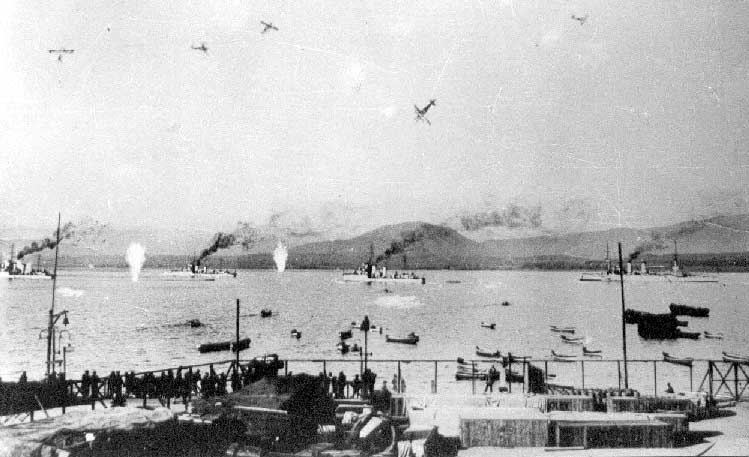
In the instability that followed the overthrow of Chile’s comprador dictator Carlos Ibáñez on July 26, 1931, a wide-spread mutiny by rank-and-file, left-leaning sailors succeeded in capturing much of the country’s fleet before succumbing a week later. Albert Moreau on the incident and what it was indicative of.
‘What Happened in Chile’ by Albert Moreau from The Daily Worker Vol. 8 No. 221. September 14, 1931.
THE mutiny of the Chilean sailors on September 2nd which spread like wildfire throughout the entire fleet, falling under the complete control of the red rank and file revolutionary workers of the Navy, is of tremendous significance, not only for the Latin American workers and peasants but also for the workers and poor farmers in the United States. In Chile, the revolutionary upsurge of the masses, which overthrew Ibanez on July 26th, has broken through the counter-revolutionary confines of the bourgeoisie, and bravely fought for a revolutionary way out of the crisis along the lines of the Communist program–levy on the rich to provide unemployment relief, confiscation of the large landed estates, confiscation of imperialist enterprises and the driving of the imperialists out of Chile, etc.–the masses of Valparaiso, Santiago and Coquimbo were demonstrating in the streets under the leadership of the Communist Party, for the establishment of a Chilean Soviet Republic and in support of the uprising of the sailors in the Navy and the rank and file in various Army units.
Simultaneously with the raising of the red flag on the fleet, the revolutionary proletariat of the cities, groups of revolutionary toiling peasants, and revolutionary students enthusiastically came out in support of the uprising. and under the leadership of the Communist Party they extended their strike actions in the most important industrial centers of the country. Various units of the army and air force refused to turn the guns against their brothers of the Navy.
The panic-stricken bourgeoisie and landlords, with the help of the imperialism, especially American imperialism, quickly mobilized their fascist tools in the air forces. The mutiny was crushed in the horrors of a blood bath. Hundreds of the mutineers were forced into submission. The fascist government of Chile is now proceeding with a wholesale massacre of the revolutionary workers who took part in the proletarian rebellion.
The causes for the uprising in Chile finds their explanation in specific conditions–both objective and subjective–the general characteristics of which are common to all the Latin American countries. In Latin America the revolutionary upsurge is growing with increasing tempo. The frequent coup d’etats of the opposing factions of the exploiting classes (which result from the deepening crisis, the desire to forestall the rise of the toiling masses under Communist leadership and from the sharpening struggles of the rival imperialisms) are beginning to be accompanied with militant mass movements and uprisings of the workers, the toiling peasantry and the poor population of the cities influenced and directed in various degrees, by the Communist Parties.
The deep economic and agrarian crisis, which hits with particular force the Latin American countries, is now accompanied with the beginning of a financial crisis. Chile is already showing the devastating effects of the financial crisis. It is, relatively speaking, the foremost country of Latin America that feels most the crushing burden of the huge loans invested by American and British bankers, the enormous interests of which the Chilean bourgeoisie is unable to account for.
Under the bloody Dictator Ibanez, Chile’s raw materials swiftly passed under the control of the United States bankers headed by Guggenheim. United States investments in Chile amount to $600,000,000.
The reorganization of the nitrate and copper mines through the system of rationalization introduced by Guggenheim deprived 30,000 workers of their jobs. The national revenue of the government suffered a deep slash with the organization of the nitrate trust known under the name of Cosach.
In vain had President Ibanez sought to obtain new loans from Wall Street in order to avert the financial debacle. Four of his financial Ministers succeeded one another until finally, he himself was swept out of the office under the rising pressure of the masses. Wall Street, that had no binding contract with Ibanez, saw the dangerous manoeuvres of British imperialism which was and is trying to take advantage of the chaos in order to regain its political hegemony over the national bourgeoisie, withdrew its support thanks to which Ibanez I was able to install since 1927 one of the most ruthless fascist dictatorships in Latin America.
The Chilean bourgeoisie which is attached to the chariot of imperialism, especially yankee imperialism has been the spokesman for Latin America in the Anti-Soviet front. Minister Barrett has been particularly active in the campaigns of slanders against the Soviet Union.
The bourgeoisie, the landlords and the imperialists have ushered in an intensified attack upon the working class and the toiling peasantry in their efforts to put upon them the entire burden of the crisis.
As a result of that, there has been a deep going radicalization of the masses in Chile. The Communist Party and the Chilean Federation of Labor which, previous to Ibanez’s dictatorship were the militant leaders of wide masses of the oppressed people, were able recently to recover from the savage blows pounded upon them during the five dreadful years of fascism. The working class of Chile which has a long history of militancy of class struggle is now gathering its strength and under the leadership of the Communist Party, it made the first attempt to give a revolutionary solution to the present crisis.
The present revolutionary upsurge of the masses counts with new elements that increase and brighten the revolutionary perspectives of the growing prerequisites of a revolutionary situation in Chile. This is the increasing participation of the Indian workers and peasants in the revolutionary struggle for their social and national demands aiming to overthrow the special conditions of national and social oppression under which they live.
But the Communist Party of Chile, in order to reach the present undisputable leadership over the broad masses of the people, was compelled to rid itself of the opportunist elements that for years have eaten the very vitalities of the Party and deprived it of a militant leadership. This the Communist Party was able to do by purging its ranks of alien elements and by exposing the renegade Hidalgo who now definitely aligned himself with groups of landlords, and petty bourgeois chieftains playing the games of British imperialism in Chile.
Hidalgo, who was sent to the Senate by the popular vote of the proletariat of Antofagasta, has betrayed the workers. He voted for a bill introduced in the Senate which provides for special repressive laws against the workers “for the security of the state.” He flatly refused the instructions of the Party to speak against the fascist bill. His insidious petty bourgeois activities within the Party were expressed in the “re-establishment of bourgeois democracy” in Chile, as “the first step for the struggle for a communist revolution”. His present counter-revolutionary activities through his participation in the bourgeois opposition fully confirmed the healthy attitude taken by the Party that with the help of the South American bureau of the Communist Party, expelled this pernicious, anti-working class element from the Party.
The Communist Party of Chile guided by the correct line of the independent revolutionary action of the working class was able to give leadership to the present uprising.
The ruthless crushing of the uprising is undoubtedly rich with lessons and experiences for the Communist Party and the revolutionary proletariat. We are not, at present, in a position to analyze the shortcomings of the Party which led to the temporary defeat, lessons that can also be of great value to the American Party. But there is an urgent and immediate task that faces the Communist Party of the United States and the revolutionary workers of this country. Our revolutionary duty is to fight for the immediate freedom of the workers who took part in the uprising and who face an imminent death in the hands of the hangmen of American imperialism.
The Chilean workers are now engaged in big strikes for the betterment of their conditions, against the fascist terror, for immediate relief to the unemployment, against wage-cuts and speed-up, etc.
The Chilean bourgeoisie is unable to find a solution to the deepening crisis. New class battles are pending. Our brothers in Chile are engaged in struggles for national liberation and from capitalist and landlord exploitation.
Demand the immediate freedom of the red sailors, soldiers and workers. Down with the butchers of the Chilean people!
Down with American imperialism!
Long live the struggles of the workers and peasants of Chile!
The Daily Worker began in 1924 and was published in New York City by the Communist Party US and its predecessor organizations. Among the most long-lasting and important left publications in US history, it had a circulation of 35,000 at its peak. The Daily Worker came from The Ohio Socialist, published by the Left Wing-dominated Socialist Party of Ohio in Cleveland from 1917 to November 1919, when it became became The Toiler, paper of the Communist Labor Party. In December 1921 the above-ground Workers Party of America merged the Toiler with the paper Workers Council to found The Worker, which became The Daily Worker beginning January 13, 1924.
PDF of full issue: https://www.marxists.org/history/usa/pubs/dailyworker/1931/v08-n221-NY-sep-14-1931-DW-LOC.pdf

