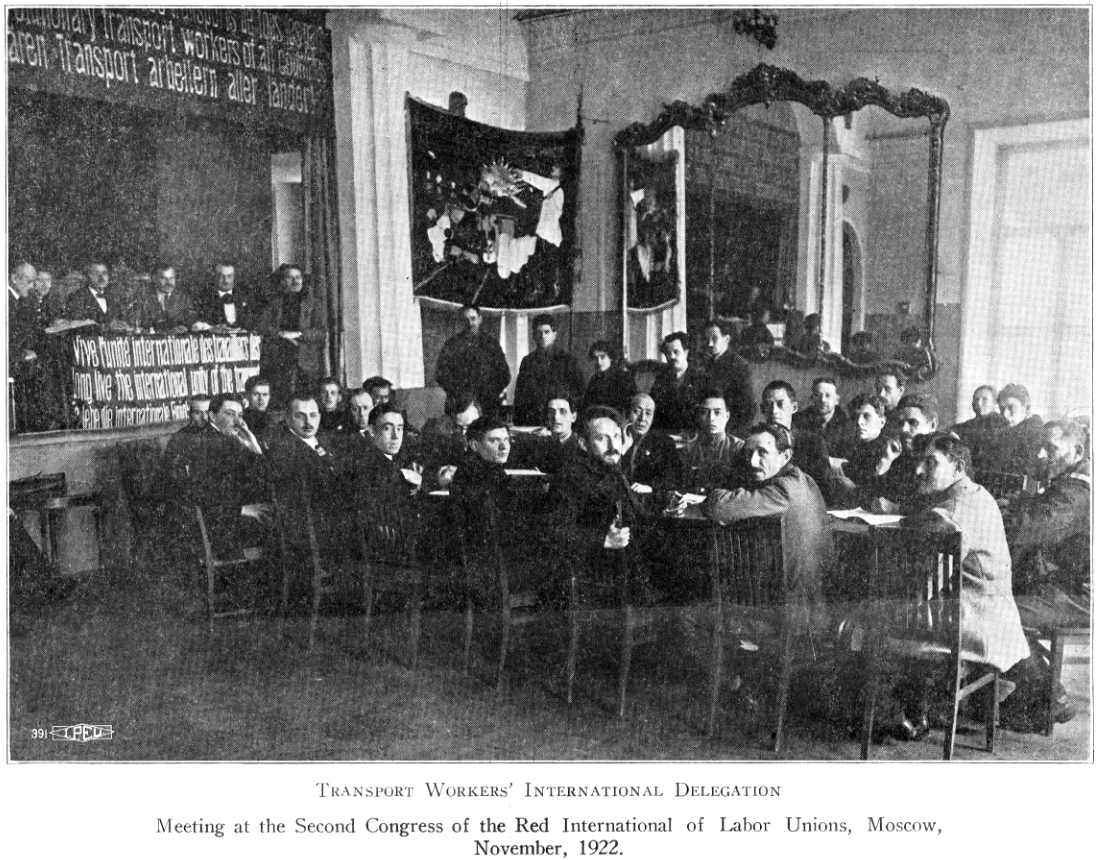
Debates between Communists and Syndicalists continued to dominate the Profintern’s Second World Congress. Lozovsky reports.
‘After the Second Congress’ by A. Losovsky from Labor Herald. Vol. 1 No. 12. February, 1923.
General Secretary of the Red International of Labor Unions.
THE Second Congress of the Red International closed an epoch of the International movement, showing today the difficulties which in the future the world’s labor movement must surmount. This movement is formed of diverse elements with contrasting traditions and opinions which will only disappear during the struggle. The task of the Red International was to unify these elements in the International movement in order that this might become the weapon and the guide of all revolutionary workers. A task arduous, detailed, and large, and one to demand energy and wisdom.
The Second Congress enlarged the limits of our activity, calling the attention of the International proletariat to various practical problems, of which four especially absorbed its studies, the united front, trade union unity, the organizations, and the relations with the Syndicalists.
The united front had no opposition. But it had some months before; however, life and experience are severe masters and they have demonstrated that the tactic of the united front was not an invention of the Moscow Bolsheviki, but one absolutely necessary to the workers of America and Europe. If the Communist International and the Red International have worked it out it is only an additional merit for them. The Second Congress discussed only the practical application of the united front.
During the discussion it became evident to the Congress that the continuation of the scissions occurring in several countries would be a cause of serious weakness to the workers. The Red International has done all possible to avoid these splits, and several times has proposed to the Amsterdamers to put an end to the dividing of the labor movement. But the obstinate perseverance of the latter in their disruptive course defeated these efforts.
Congress Condemns Splitting
How can we regain unity? In all its activities the Red International has shown itself to be ready to make every concession to this end. But it is evident that unity cannot be realized if the revolutionary workers have not at least a minimum of protection. The reformists demand unity, but when the Unity General Confederation of Labor of France proposed to them to organize a unity convention on the basis of proportional representation they replied with arrogance that they were the majority and that the revolutionaries had only to join their organizations. The same happened in Czecho-Slovakia.
We are ready to realise trade union unity on condition that the liberty of propaganda be guaranteed to the minority, reformist or revolutionary, on the basis of strict discipline during the actions against the capitalists.
In this respect the deliberations of the Second Congress could not be clearer. We worked persistently for the fusion of related organizations and the creation of a united front against the reaction.
The question of trade union unity involved the general question of the organizations, of which the Congress had to find a solution. The strengthening of the unions was considered by the Congress as the first duty of the workers. While realizing that this building up process might momentarily aid the reformists, the Congress declared that the strengthening of the unions is nevertheless the strengthening of the working class and of the social revolution. From this point of view it studied the situation in every country, indicating to all revolutionary workers their immediate tasks: united front, strengthening of the unions, struggle for communism on the basis of the daily demands of the working class.
International Industrial Federations
The Second Congress had to solve the question of the International Industrial Federations which, as is known, are in the hands of the Amsterdam reformers, and systematically exclude the revolutionary organizations on the pretext that they are affiliated to the Red International. The secretaries of these International Federations have not hesitated to ostracise a large number of European unions and to close the door to many from other parts of the world. Since its organization the Red International has condemned the immediate formation of new International Federations. But not being able to permit the breaking up of the Red organizations, it decided at its First Congress to constitute international propaganda committees, around which the revolutionary unionists should organize. The task of these committees was to bring about the unity of the International Federations. Although numerous delegates were favorable to the creation of revolutionary international federations, the Second Congress made manifest again its desire for unity in this field and instructed the revolutionists to work for the realization of that unity. The red organizations shall continue in affiliation to the propaganda committees and persevere in their work along the old lines. From now on the unity of the International Industrial Federations depends upon the Amsterdam secretaries. The Red International has done all possible and is determined to realize unity in spite of the reformist splitters.
Communist-Syndicalist Relations
The Second Congress solved the question of the relations between the Third International and the Red International, or rather between the Communists and the Syndicalists.
Since the First Congress the Syndicalists had carried on a bitter and violent criticism regarding the organic connections with the Communist International. The French Syndicalists, among which several tendencies developed at the First Congress, put themselves at the head of the movement. The “pure” Syndicalists saw in the organic union between the Communist International and the Red International sufficient reason to create a new trade union international completely independent of the Communist International and completely autonomous. Several groups joined this tendency: German localists, and Italian, Swedish and Dutch Syndicalists. Autonomy, independence: these have been the constant slogans of the Syndicalists against the Red International. But there was also among the Syndicalists a very strong group which, placing itself completely upon the platform of the Communists and accepting the dictatorship of the proletariat, wished to co-operate with the latter, but believed that the work between the Communist International and the Red International should not have an organic character. Among these Syndicalists–whose point of view is that they and not the Communists are the advance-guard of the labor movement–the need of a united front with the Communists was felt. This aspiration was given expression in the resolutions of the St. Etienne Congress and in the propositions made by the French delegation to the Second Congress. For the Communists the question was clear. Our Syndicalist comrades were merely giving expression to old prejudices. But as they were revolutionary workers, animated by a real desire for action, coming from a large number of organizations and not merely a few personalities, the Communists conscientiously yielded, for the purpose of realizing the united front against reformism and capitalism and in the hope that the experience of the future would demonstrate the correctness of the Communist point of view. Approving this solution, the Congress settled the conflict between the Red International and the Syndicalist organizations.
To clear up the situation, the Congress directed a manifesto to the Syndicalist organizations of all countries and to the Conference of Berlin, inviting them to affiliate to the Red International, instead of splitting the international trade union movement, and to work with the Red International and the revolutionary workers of the world for the liberation of the working class.
The Future Looms Bright
The Second Congress also considered the trade union movement in the colonial and semi-colonial countries, from which consideration it was made clear that the Red International is really an international organization, while the Amsterdam International is only a European body. In Java, in China, and in India, the labor movement is growing impetuously. The Russian revolution has developed new forces. In those countries the workers’ movement is still inflicted with nationalism, especially there where the struggle is against a foreign conqueror. Nevertheless, the spirit of class grows more and more clear in this formidable revolutionary torrent. The duty of the Red International and the Communist International is to give to this class movement a form always more precise and profoundly revolutionary, to permeate the mass with a communist spirit for the purpose of winning, in the struggle against foreign and national capital, the maximum of results.
The Second Congress was, above all, a practical gathering, being taken up principally by questions of organization and practical activity. It did not deceive itself, however, regarding the great difficulties confronting the revolutionary trade union movement. Tens of millions of workers still follow the reformists. Millions and millions of workers also follow the Catholics, the bourgeois democrats, the Protestants; while tens and tens of millions are still outside of every kind of organization. Confronted by a working class of which one organized fraction sustains capitalism, we must work out adequate tactics and programs. The International Federation of Trade Unions of Amsterdam, incarnation of the conservative elements in the working class, boasts of its millions of adherents. We recognize the numerical superiority of its membership. But it is only a European organization, while we are a world organization. It includes a general mixture of confused elements, reformistic and otherwise, while the Red International is composed only of workers animated by a real unity of program and tactics. The Amsterdam International has no sympathizers in our ranks, although we have great numbers in its organizations.
The Second Congress of the Red International has shown how great is the influence of revolutionary ideas in the world’s trade union movement. The workers of Europe, America, Asia, Africa, and Australia, march towards the red flag of the Red International of Labor Unions, because they read thereon: “war to the finish against capitalism, in the name of all power to the working class.”
When will they conquer? The Second Congress could not determine this. It is certain that the world’s proletariat will yet suffer partial defeats, but, in the course of its struggles and defeats it is forging the great world associations–the Communist International and the Red International–which will guide it to final victory.
The Labor Herald was the monthly publication of the Trade Union Educational League (TUEL), in immensely important link between the IWW of the 1910s and the CIO of the 1930s. It was begun by veteran labor organizer and Communist leader William Z. Foster in 1920 as an attempt to unite militants within various unions while continuing the industrial unionism tradition of the IWW, though it was opposed to “dual unionism” and favored the formation of a Labor Party. Although it would become financially supported by the Communist International and Communist Party of America, it remained autonomous, was a network and not a membership organization, and included many radicals outside the Communist Party. In 1924 Labor Herald was folded into Workers Monthly, an explicitly Party organ and in 1927 ‘Labor Unity’ became the organ of a now CP dominated TUEL. In 1929 and the turn towards Red Unions in the Third Period, TUEL was wound up and replaced by the Trade Union Unity League, a section of the Red International of Labor Unions (Profitern) and continued to publish Labor Unity until 1935. Labor Herald remains an important labor-orientated journal by revolutionaries in US left history and would be referenced by activists, along with TUEL, along after it’s heyday.
PDF of full issue: https://www.marxists.org/history/usa/pubs/laborherald/v1n12-feb-1923.pdf

