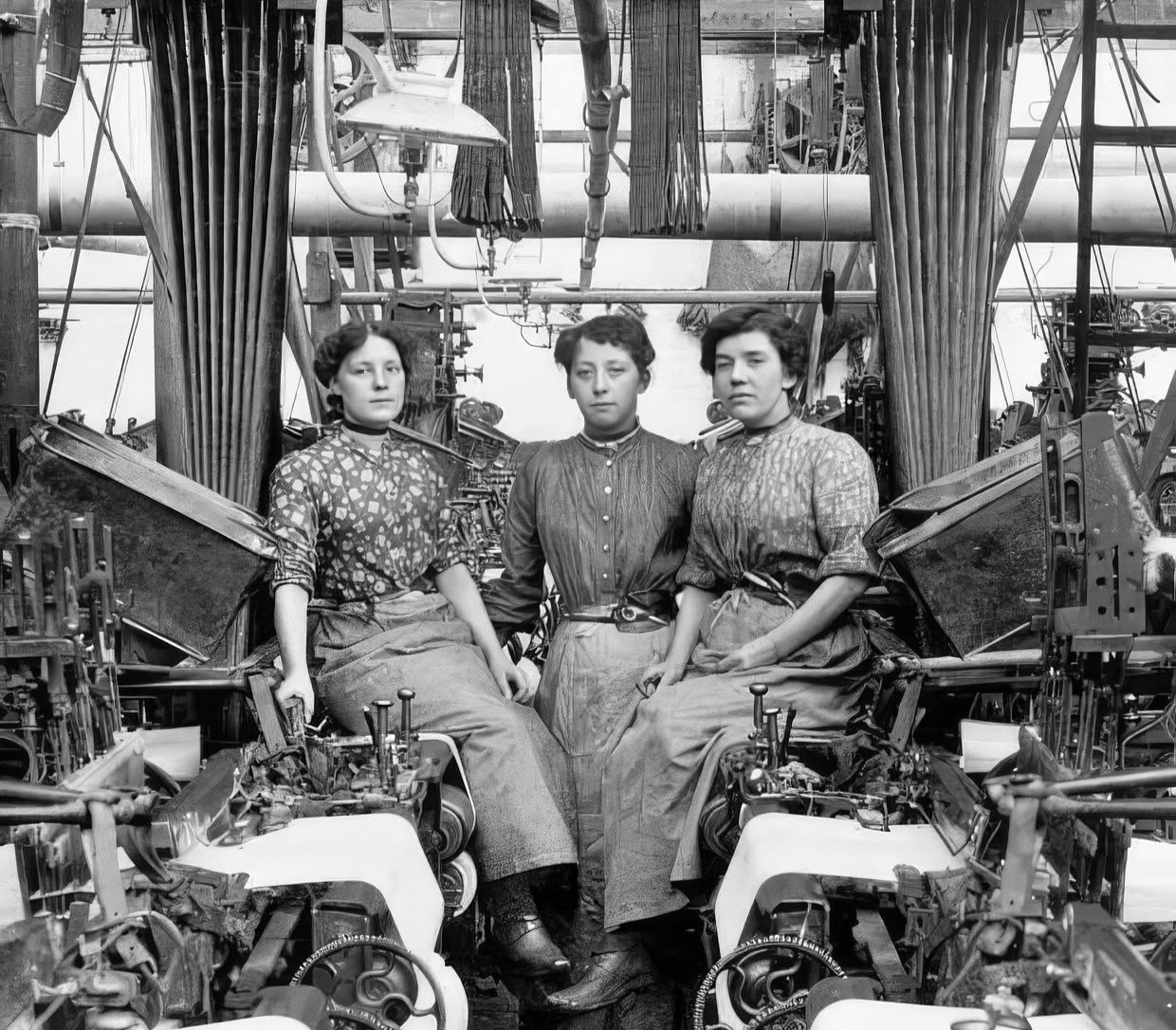
Lilly Webb on the conditions and struggle, under the Labour government, of women mill workers.
‘British Women Textile Workers in the Struggle’ by Lilly Webb from International Press Correspondence. Vol. 10 No. 10. February 25, 1930.
The increasing radicalisation of the working women in Britain is demonstrated most clearly in the struggle now taking place in the textile industry where the employers have launched their long planned offensive. This industry is one of the basic industries of Britain in the throes of an economic crisis. The vast majority of the workers are women (750,000 out of a total of 1,285,000).
Even before the recent attack the workers in the Cotton Section of the industry had suffered the following reductions in wages:
June 1921 60 percent
December 1921 40
April 1922 10
November 1922 40
The cotton employers not accidentally decided to begin their attack immediately following the election of the Labour Government. Following the employers demands for 12% per cent reduction in wages the Trade Union leaders balloted the workers. The result was that 90 per cent of the workers voted against any wage reductions. The employers then posted lockout notices and the struggle involving 500,000 workers began on July 29th.
The Trade Union leaders who were openly in favour of wage reductions decided to open negotiations with the employers on the basis of wage reductions. This decision was categorically rejected by the workers and the leaders had to revise their previous decision.
When it was obvious that the Trade Union leaders and the employers could not handle the situation alone, the Labour Government decided to openly intervene. Test cases were sent to the Ministry of Labour, appealing for unemployment benefits for the locked out workers. The Labour Government turned down this appeal. At the same time the Minister of Health sent a letter to the Boards of Guardians, pointing out that the granting of Guardian’s Relief to the locked-out workers was an illegal act
The anti-working class policy of the Labour Government was driving the working women over to the leadership of the Communist Party. In Burnley working women became members of a Committee of action under Communist leadership. In Oldham, women took an active part in the demonstrations organised by the Communist Party to demand relief from the Board of Guardians. It was at this period that the Labour Government decided to set up a Court of Arbitration. The workers were to return to work at pre-lockout wages, pending the decision of this Court. The vast majority of workers firmly believed that the Labour Government would protect their wages. The Court of Arbitration declared, however, for a 64 percent reduction in wages. The Labour Government thus succeeded in getting the workers back into the mills and then proceeded to cut their wages.
When the award was announced, the workers were seething with revolt. Protests and demands for action poured into the offices of the trade unions. Within a few weeks after the award, 10 spontaneous, unofficial strikes broke out in various parts of Lancashire. The revolt of the weavers, a big majority of whom are women, was so complete that the Trade Union leaders had to put forward demands for a 12% percent increase in wages and for a minimum wage of 7/6 d for each loom.
A ballot on the question of strike action to enforce these demands was taken in January and has resulted, in spite of the efforts of the trade union leaders, in a huge majority for a struggle (92,142 for strike action and 43,531 against). Despite this definite decision, the trade union leaders have refused to go forward with a strike.
Inspired by the success of the Cotton employers, the Woollen employers put forward demands late in 1929 for an all round reduction in wages of 10 percent. The Trade Union leaders offered 7 percent reduction and the employers modified their demand to one of 8.3 percent. A ballot of the workers resulted in a 80 per cent vote against any wage reductions and for a struggle. The Trade Unions leaders were forced to make a pretence of fighting.
There followed a series of isolated struggles, one of the largest of which was in Saddleworth where 1,300 workers, mainly women and girls, were involved.
In the Woollen textile industry women constitute 150,000 of the 250,000 workers employed. Women and girls have played the most prominent part in these local struggles, picketing and showing great bravery in face of police persecution.
In the woollen textile dispute the Labour Government again played an open and decisive role as strikebreaker. Special contingents of police were sent into those strike areas where the strikers were militant and prepared to accept the leadership of the Communist Party. Following effective picketing at the Kinder Mill Greenfield, the employers sent a telegram asking the Labour Government to put into operation the Trade Disputes Act introduced by the Baldwin Government following the General Strike and which the Labour Party pledged itself to repeal. The Labour Government responded to this appeal. The Trades Dispute Act was also used to arrest the Communists active in the strike area; one, a woman, was sent to prison for one month for expressing her opinion to a blackleg.
At Lunds, a notorious “sweat” shop, employing mainly women and girls, the strike has lasted for 10 weeks. The girls and women have picketed every day although faced by special detachments of police. These strikers have repudiated their old leaders and have set up a strike committee under the leadership of the Communist Party. In all mills, excepting Lunds the triple alliance of Employees, Trade Union Leaders and the Labour Government has succeeded in driving the workers back to work on varying reductions in wages (Kinder mill 5% per cent; Saddleworth mills 7% per cent etc.).
In the Cotton and Woollen Textile struggles the Party mobilised all its forces and worked energetically throughout the struggles, conducting a wide-spread agitation and propaganda, distributing strike sheets and leaflets.
The mood of the workers was militant. This was the moment for the Party to come forward, to sharply expose the Social Fascist Labour Bureaucracy and to present itself as a revolutionary alternative and to make a determined and consistent fight for the leadership of the struggle. This, however, the Party failed to do.
The wage reductions secured by the employers have not succeeded in stabilising the textile industry. Instead the continued decline in the industry is leading to new attacks. The mood of the workers does not presage a period of peace. The weavers demands have shown that offensive struggles will arise in the period in front.
International Press Correspondence, widely known as”Inprecorr” was published by the Executive Committee of the Communist International (ECCI) regularly in German and English, occasionally in many other languages, beginning in 1921 and lasting in English until 1938. Inprecorr’s role was to supply translated articles to the English-speaking press of the International from the Comintern’s different sections, as well as news and statements from the ECCI. Many ‘Daily Worker’ and ‘Communist’ articles originated in Inprecorr, and it also published articles by American comrades for use in other countries. It was published at least weekly, and often thrice weekly.
PDF of full issue: https://www.marxists.org/history/international/comintern/inprecor/1930/v10n10-feb-25-1930-Inprecor-op.pdf

