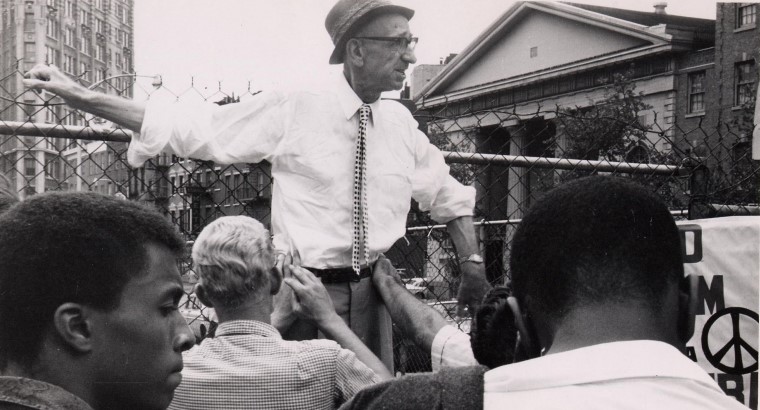
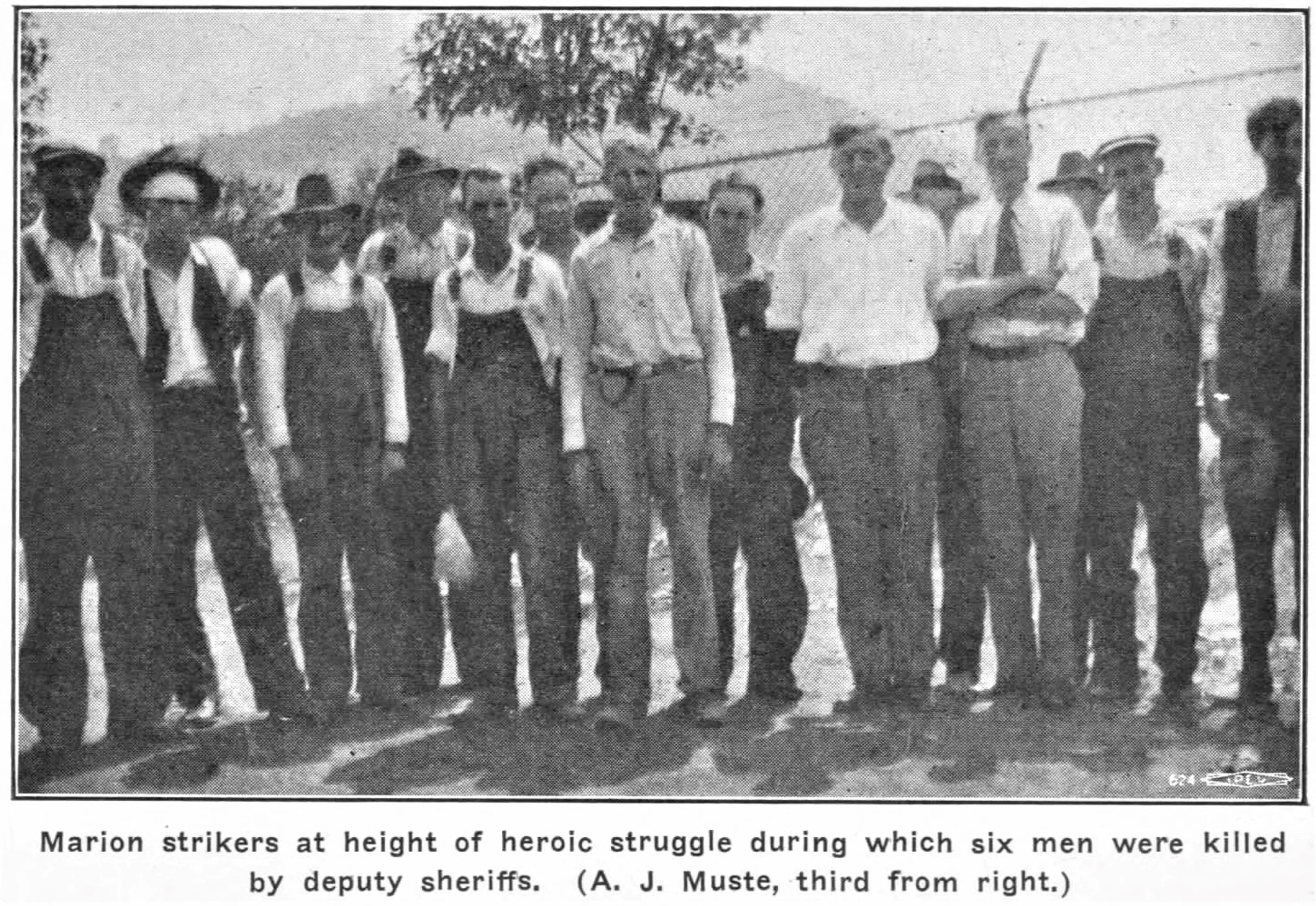
Asking what kind of party workers need, Muste looks at the Democratic and Republican Parties, then the Socialist and Communist, as the Conference for Progressive Labor Action launches a discussion of creating a new political force.
‘Do We Need a New Political Party in the United States in the United States?’ by A.J. Muste from Labor Age. Vol. 20 No. 4. April, 1931.
This article is written for the purpose of encouraging discussion, and not for the purpose of launching a new party.
The question divides itself naturally into two parts: first, can the American people, especially the workers, gain their end through either of the two old parties, Republican or Democratic, or through some non-partisian combination of progressives from the two old parties? Second, if this is out of the question, will one of the existing minority or working-class parties fill the need, or must a brand new political organization be built up? The first question can be disposed of in comparatively short order; the second requires a somewhat more extended analysis.
Is there any hope in either of the old parties, or in any conceivable nonpartisan combination of progressives from those parties? As for the Republican party, there can be no doubt that since the collapse of the Bull Moose movement, and especially since the close of the Great War, it has definitely become the political instrument of big business and finance, and more and more indifferent to the interests of workers and farmers and the small business elements. In recent months we have been shown that this is just as much the case under the great engineer, Herbert Hoover, as it was under politicians like Harding and Coolidge. The Republican party represents those forces in the modern world which plunged us into the Great War a decade and a half ago, and then after assuring us that the new capitalism had brought a millenium in which there would never again be unemployment or want, plunged us into the great depression a year and a half ago. This article is not written for those who are still unable to see that, so we pass on.
There are still people who have some claim to the name of liberal or progressive, and a very considerable number of workers, who place great confidence in the Democratic party. Many of them are getting ready to vote for Franklin Roosevelt or Owen Young in 1932. The Congressional! elections in 1930 showed that the American plan for escaping from the evils of Republican rule is still to vote the Democratic ticket.
The Democratic party is, however, a hopeless instrument. We used to describe it by saying that it had two legs: the Southern leg being dry, Protestant, native American, anti-Irish, anti-Jewish, anti-Negro, millowning, conservative; the Northern leg being wet, Catholic, foreign, Irish, Jewish, pro-Negro, mill-working and inclined to be progressive. Now we have noted that the Democratic party has developed a third leg, that of the Smith-Raskob faction. This leg may be said to be to the east of north—it is very wet, very Catholic, very social reformist (superficially), and seeking on all important economic issues such as the tariff, its attitude toward the big corporations and the banks, to prove itself much safer for the big industrialists and financiers than the G.O.P.
No two of these legs, as the reader perceives, move in the same direction. Anybody who expects to get anywhere on the back of this animal is doomed to be disappointed. What these legs are very good for is for standing on, and staying put. That is just what the Democratic party has been doing for a long while and will continue to do until it decides to lie down for its eternal rest.
If there is no hope in the party of the elephant or that of the jackass, may it be that you could, so to speak, take the sounder parts of these two animals and make a healthy, vigorous creature out of them? Is there some combination of progressives from these two parties which can meet the need of the day?
Judging by the number of otherwise intelligent people who attended the recent progressive conference in Washington, called by Senators Norris, LaFollette, Wheeler, etc., there are still a considerable number of folks who do think that such a combination may get us somewhere.
“Progressives” Are Playboys
The author is prepared to pay due respect to the personal character of many of the spokesmen and members of the Progressive Conference and also to their ability as theorists and program-makers. In the realm of practical politics in a machine age, they prove, however, to be mere playboys.
Two things are needed in American political life today, one, a more carefully worked out program of the measures needed in order that we may get rid of unemployment, raise the standard of living and substitute intelligent planning for the present chaos of our economic life; the other is an effective political instrument through which this program may be translated into reality. Neither can be overlooked. Nevertheless, we already have a pretty good idea of where we have to go and there is surely intelligence enough available to work out the details of a program. The job of forging a political instrument through which the will of the workers can really be expressed is far the harder and more perplexing of the two. Unfortunately, our progressives are theorists and programmakers, and very amateurish, from anything we have seen to date, when it comes to action.
An effective political tool must be your own, fully under your own control. The old party locomotive is not going to carry the workers to any desirable destination, so long as it runs on the same old tracks and in control of the same old crowd, even though there are some eloquent people in the observation car who have the best of intentions.
The progressive senators instinctively hang on for their life to the old party machine in their own states to which they got elected to office; yet, they apparently persist in clinging to the notion that things being as they are, they cannot build a new national party and that they can get somewhere nationally through old party machines which they do not control and never will control.
The political bankruptcy, and indeed the silliness to which they are thus condemned, was clearly illustrated at the Progressive Conference when even so great a character as Senator Norris pinned his hopes on having the Democrats nominate Franklin Roosevelt or someone like him, for president. Otherwise, Norris opined, voters could only choose in 1932 between two nominees of the power trust, and in that case he did not see what else he could do except “go fishing!”
Unquestionably it is difficult to build a new party in the United States. Nevertheless, it has been done in the history of the country—witness the Jacksonian Democracy and the Republican party itself. It has been proven impossible, moreover, to solve any fundamental economic and social issue in this country by means of two old parties, one of which had its mind clearly made up to maintain the status-quo and the other of which could not make up its mind to take a clear and vigorous stand. With the Democratic party committed to slave-holding feudalism in the 1850’s and the Whig party incapable of definitely taking the other side, a new party—the Republican—had to be created in order to enable the new capitalist economy of the North and East to realize itself. Anyone who can’t see that we have a parallel situation today, and that under the new circumstances a new party irrevocably committed to the development of a planned economy, is necessary and that anything else is child’s play, must either be blind or unwilling to look facts in the face.
Thus we are brought to the more important half of our question. If there is no hope in either of the old parties or a so-called non-partisan progressive combination, have we already a minority working-class party which meets the requirements of the situation, or can readily be made adequate to meet the situation, so that all that is necessary is for that party to go on with its work and for all intelligent and honest laborites to join it; or do we have to pretty thoroughly revolutionize some existing party, or build a brand new one in order to meet our needs?
What Characteristics?
Perhaps the simplest way to approach the matter is to set down what seem to be the chief requirements of an effective political party in America today.
1. The Political Party We Need Must Have a Class Basis. To quote so respectable an organ as the New Republic: “Parties which are going concerns must have behind them economic interests.” And again, “A lasting and successful party cannot be formed merely out of intelligent idealism and the widespread desire of some intelligent voters.” To say this is merely to state a fact which the Founding Fathers of this nation, for example, understood and proclaimed long before Karl Marx appeared on the scene. It does not mean committing oneself to a particular type of class warfare. It does not mean that intellectuals may not have an opportunity to play a part in such a political party; they do, as a matter of fact, play an important part in every political party from the most conservative to the most radical. But political struggle reflects the underlying conflict of economic interests. Under an advanced industrial regime such as we have in America today, the class whose interests differ definitely from those in control, which is subject to insecurity, subject to being drafted into wars not of its own making, subject to poverty, or at least to a very inadequate share of the product of its own toil, subject to having its destiny determined by agents over whom it has no control, consists of the industrial workers or those farmers who have been reduced to a wage earner’s status. The political party we need must, therefore, be based squarely on the interests and ideals of these workers and must depend chiefly upon them for its support.
2. The political party we need must be out to do away with the present capitalist economy, the unplanned, individualistic chaos of our present economic life, and to substitute for it a planned economy under the control of the workers and operated not for the benefit of private individuals or groups, but of the mass of those who do the creative work of the world.
3. The political party we need must have a sound attitude toward Soviet Russia. Specifically, it must stand for recognition of Soviet Russia by the United States. From the standpoint of our commercial interest, it would be much better for the workers of the United States if we had normal business relations with one of the biggest potential markets for our manufactured products and machinery, with the one big country with which our trade has increased rather than diminished, even during the present depression. The argument that we cannot recognize Russia because we don’t like the Russian economic or political system is ridiculous; we have recognized plenty of other governments with whose ideas we could not agree.
Furthermore, the sound attitude toward Soviet Russia means a positive determination to combat efforts on the part of militarists and imperialists in the United States and elsewhere to weaken or to destroy the Soviet experiment.
The issue is a crucial one and it cannot be evaded. Certain events in history are symbols. In the Europe of the closing years of the 18th century you were either for the maintenance of the status-quo, that is, feudalism, or you were against it, and your place was determined by your attitude toward the French Revolution. This, despite the fact that the Revolution committed excesses and did much that was foolish; despite the fact that it ended in restoring a ridiculous Bourbon, temporarily, to the throne of France. For all that, “the king business” was never the same in Europe after that, modern democracy and capitalism had been definitely born.
So today Soviet Russia is a symbol and an acid test. It is to be feared that the Russians being human, make mistakes. We are not now arguing for Communist tactics in the United States. In Russia, however, there is under way a great experiment in a planned economy, such as all the world will have to come to in this machine age, whether under a dictatorship of capitalists or a labor regime. “The private property business” will never be the same again regardless of how things may turn out in Russia in the immediate future. All the forces of reaction throughout the world, and not least in the United States, as witness Hamilton Fish and other antics of the Hoover administration, are seeking to discourage and overthrow that experiment. Individuals and groups are either definitely and positively for the protection of that experiment or they are against it. There can be no middle course. If it fails it will be an evil day not only for radicalism but for every form of liberalism and progressivism all over the world.
4. The political party we need must have a correct attitude toward the problem of the organization of the workers upon the economic field into industrial unions. For one thing, the attitude of any effective labor party toward already established unions must be clear and correct. I do not believe that in normal times trade unions can flourish if they are mere puppets under the domination of a political party, any more than a labor party could flourish if it were a mere puppet in the hands of the trade unions. Nevertheless, labor political activity and union activity are just two sides of the same labor movement, the same people and forces, using now one instrument and now another. The two cannot be kept separate in water-tight compartments. The unions of the workers are bound to have an influence on the political party; the party is bound to have an influence on the unions—even if it takes the position that it is going to keep its hands off the unions whatever may happen, it is exerting a very definite influence on the situation. Specifically, a party claiming to be working-class and not requiring its members to belong to the unions of their trades and industries, would be ridiculous. It is equally ridiculous for a working-class political party to permit people to pose as bona-fide Socialists, for example, and to be the worst kind of reactionaries, conservatives or crooked labor fakirs in the unions.
For another thing, no working-class political party can in these days be indifferent to the problem of organizing the workers in the basic industries into industrial unions. No labor party of any importance can flourish in the United States if the workers on the economic field remain apathetic and helpless. It may not be possible, under existing circumstances, to organize permanent functioning industrial unions, operating under agreements with employers, but activity of some kind there must be on the job, in the shop. On the other hand, it is doubtful whether much can be done to organize on the economic field unless that activity is supported by vigorous political education and activity. The political party we need, therefore, must regard the stimulation of activity on the union field as one of its primary tasks.
5. The political party we need must think through and define its attitude toward parliamentary methods and toward the thing we call Democracy. On the one hand, it is certainly not advisable in the present state of development to give up parliamentary action. In the first place, certain concrete improvements for the workers are achieved in that way—legislation affecting hours of labor, social insurance, the legal status of unions, etc. In the second place, while it may prove true that workers cannot vote a new social order into existence, that is a lesson which will have to be learned from experience. Where democratic institutions, so-called, exist, and workers have to vote, they will see how far they can go by that method before they are ready to abandon it altogether. Most important of all, perhaps, political activity (election campaigns, etc.) have a great educational value. Conditions, in the last analysis, determine action, and when conditions are ripe, the masses will act with surprising speed. There is a limit, however, to what can be done by way of forcing any class prematurely into action, no matter how courageous and determined a militant minority you may be. No matter how desperate conditions are, the masses must be educated up to a certain point to understand those conditions and how they may effectively deal with them. For this purpose of mass education political action is indispensable.
Parliamentary Methods Limited
It seems doubtful, on the other hand, whether the various Socialist and Social Democratic parties have clearly thought their way through the problem of possible limitations on political action and what the practical course should be in view of these limitations. There are good reasons to doubt whether it is possible by parliamentary methods (or even by political action plus pure and simple trade unionism) to abolish the chaotic and iniquitous capitalist system and put a more stable and intelligent economy in its place. If thought, education, the press, speech, were really free, that should be possible. Under such conditions it would probably be foolish and futile to try to force a new order into being before the majority were ready to vote it in, but thought, education, the press, speech, are not free. The avenues of propaganda are in the hands of those who are bound to maintain the status-quo. Is it conceivable that thought, education, the press and speech should ever be free so long as a minority controls the economic destiny of the many? The latter are free to think and act provided they are ready to lose their jobs, go to jail, get beaten up, massacred!
Furthermore, suppose that even under these circumstances a labor party were to get a clear majority and undertake to put genuine Socialistic measures into effect. Would the masters permit it to go ahead peacefully? That is not what the slave-holding feudal economy of the South did in 1860 when Abraham Lincoln was elected. It does not seem to be what the Fascists in Europe are doing with the growing Labor and Socialist movements there.
There is still another consideration of a different kind which has an important bearing on our problem. Our methods of political democracy were devised for the simple and agricultural order of the 18th and early 19th century. Since then the machine has revolutionized all other spheres of life. Is it likely that in spite of this the political methods of a century ago do not need changing? Are they as well fitted to enable the people to get their will executed as they ever were? To quote again from the respectable New Republic: “We must not dodge the possibility that the scepticism of the average citizen about politics is correct in a larger sense than is usually understood. It may be not merely that the two old parties are failing in the face of the economic crisis but that our whole political and constitutional system devised during the infancy of the machine age is floundering, when the need is for real industrial government.” Nobody can look abroad upon what is happening in these days and not see, if he is willing to look facts in the face, that the political democracy of an earlier day is nowhere effectively coping with current problems, is everywhere already greatly modified. Any political party which fails to take account of these things and to adopt its policies to them is bound to be ineffectual.
This does not necessarily mean that the working class has at no time and in no country any recourse except to a particular type of violent revolution. It does mean that it is inconceivable that a new age can be brought in by purely “respectable,” “safe,” “legal,” “constitutional” methods. Those who are in control define what is respectable, safe, legal and constitutional and declare that to join a union, to picket peacefully, to demonstrate against injustice and tyranny, to vote the Socialist or the Communist ticket, or to join one or other of those parties is not respectable, safe, legal or constitutional. Under the circumstances, it appears that methods such as our forefathers used when this nation achieved its independence from Great Britain, or the early Christians in their attitude toward the Roman State, or the Russians when they overthrew the Czar, or the Irish when they liberated themselves from centuries of British tyranny, or Gandhi in India today, will undoubtedly have to be used in gaining for the workers the right to organize on the economic and political field, and to build for themselves a new world in which the good life shall be possible for all. Under certain conditions, then, the refusal to use violence may mean for the workers not choosing a higher and nobler order, but supine submission to greater and more outrageous violence and injustice. Likewise, conditions may arise where the actual choice open to a people is not that between democracy and dictatorship but between a temporary dictatorship in their own control and for their own interest and a permanent dictatorship under the control and in the interest of an unscrupulous, selfish minority. A political party which does not see these issues, and try to think its way squarely through them, is bound to lose its way, and in so doing to lead the workers astray.
Perhaps I should add in order that there may be no mistake, that I believe the highest good is in the flowering and expression of the whole being of the human individual. Only I am certain that in the machine age this highest good will have to be achieved by social means.
6. The political party we need must be realistic and must grow out of the American soil. What the American workers need is not a dogma as to how “the revolution” may or may not be achieved, or a blueprint of the new social order carefully drawn in order to please some radical high priest or conform to some radical bible. They need to be organized, and to be educated to deal realistically from day to day with the issues confronting them. They need an international outlook and a political party which regards itself as part of the labor movement of the world, but Americans will have to build with a certain measure of freedom from meticulous dictatorship from anywhere the instrument through which they are to make their special contribution to the world labor movement.
The political party we need must therefore not seek or expect to gain power immediately, it must regard itself as primarily a force for educating the working class. It must avoid the get-rich-quick fallacy born of our boom psychology. Americans are apt to think that nothing 1s worth doing at all unless it can be done on a big scale and can be finished tomorrow, or at the latest the day after. Thus on the eve of a presidential election we blithely launch a new party, often achieving remarkable results, but in any case permitting the whole thing to disappear within a month or two after the election. Then we go through the same performance again when another presidential election rolls around. An effective political party will have to be built by patient and continuous effort year after year without expectation of immediate and obvious results.
Still another fallacy our party must avoid is the big man fallacy, the notion that if we could persuade a couple of big politicians to desert the old parties and lead a new one, we should be safe. It is likely that American workers will have to build their own party and develop their own leadership as the labor parties in other countries have done, though an intelligent political organization will, of course, welcome all the help it can get on honorable and self-respecting terms.
Do we have in the United States such a party as we have been describing, or anything like it? A broad labor party having the allegiance of the great mass of industrial workers such as the Labor and Socialist parties of Europe, we obviously do not have at the moment. If such a party were to come into existence it would at first undoubtedly have a much less advanced and clear-cut program than we have outlined. That might not be serious if it were truly a mass party in which there were sound, vigorous, militant elements who would keep it headed in the right direction. On the other hand, there is a real danger that a third party or a so-called Labor or Farmer-Labor party launched in the United States under present conditions might be such a milk and water affair that it would soon go the way of other third party efforts of the past. Such a movement would deceive the workers and discourage them and it might be the duty of progressive laborites to oppose it.
It is possible that we should do better not to be in a hurry to launch an abortive, though imposing, labor party movement, but to encourage the development of a party along the more advanced lines sketched. But do we not have such a party already in which honest, intelligent, progressive laborites can find a home?
Communist and Socialist Defects
If there were an intelligent Communist party in the United States, it would meet the specifications. I do not see an intelligent Communist party in the United States.
The first three specifications we set forth the C.P. in the U.S.A. today can meet at least approximately. It has a class basis, in so far as it has any basis in this country; it wants to establish a planned economy under worker control; it has, from my standpoint, an essentially sound attitude as to the critical character of the experiment going on in Soviet Russia. The other three major specifications it woefully fails to meet. Its policy, for example, of building unions that are to all intents and purposes exclusively Communist and of exercising a minute party dictatorship over the unions when it can, is utterly unsuited to such periods as the present, and obviously suicidal. It has a mechanical notion as to just how a proper revolution must be achieved, at times indulges in amateurish adventures in violence, and has plainly not thought out the problem of method in achieving social change in nations where political democracy has been achieved as contrasted with nations like Czarist Russia in an earlier period of political evolution. It is subject to a kind of dictatorship from Moscow which keeps it from being rooted in American realities.
If the Socialist party were a thorough-going Socialist party, occupying substantially the role in American working-class life which the S.P. before the war under Debs did occupy, were what certain militant Socialists desire it to be, it would be such a party. I venture to express doubt as to whether the S.P. as at present constituted fills the bill, although I realize that in doing so I may incur the wrath of certain Socialist friends who seem to think it is perfectly all right for them and me to criticize the Republican, Democratic, Communistic, Social Labor Party, etc., but that any criticism of the S.P. activities or methods is butting into other people’s business. Surely, it is as much the concern of all workers and all who are interested in the labor movement that we should have an effective Socialist movement as it is, for example, that we should have a clean and effective trade union movement.
Is the Socialist party today genuinely a party of industrial workers primarily? Has it as a party a clear and acceptable attitude toward Russia? Has it a clear attitude toward imperialism, wherever it may appear—in India and elsewhere? Has it a sound position in relation to the unions, or does it fall short in inspiring the workers to organize into industrial unions and in insisting on an honest, Socialistic and working-class spirit in so-called Socialist unions and Socialist trade unionists? Has it affiliations with ultra-conservative Social-Democratic parties in Europe from which a militant laborite must shrink? Is it uncompromising and effective in its attitude toward war? Will it go as far as Einstein, for example, in war resistance? Will it go further and urge the workers to engage in a general strike against war? Is it clinging to outworn conceptions of democracy? Has it thought through as to what will be needed to bring about a new social order? Is it everywhere among workers a force for militancy or not?
Whatever may in truth be the answer to these questions, the fact is that there are a very considerable number of progressive and militant laborites and sympathizers with labor in the country, who cannot stomach Communist methods, but who do not believe either that the Socialist party as at present constituted can give what seem to them satisfactory answers to these questions. There are, of course, equally honest laborites who believe that the Socialist party can give such answers, or at any rate that there is an excellent chance that it can in the near future be made to serve the ends we have set forth.
li the former are right, then it would still remain a question whether it would be wise for them to attempt to form a party which would meet what they conceive to be the needs of the workers, to which elements from existing organizations might be attracted, or whether they should bide their time until existing working-class parties have undergone changes, possibly trying in their own way to promote such changes, possibly leaving that to others, while they meanwhile set about other tasks.
As we stated at the outset, this article is written for the purpose of arousing discussion and not for the purpose of launching a party. We close with the question with which we began: Do we need a new political party in the United States?
Labor Age was a left-labor monthly magazine with origins in Socialist Review, journal of the Intercollegiate Socialist Society. Published by the Labor Publication Society from 1921-1933 aligned with the League for Industrial Democracy of left-wing trade unionists across industries. During 1929-33 the magazine was affiliated with the Conference for Progressive Labor Action (CPLA) led by A. J. Muste. James Maurer, Harry W. Laidler, and Louis Budenz were also writers. The orientation of the magazine was industrial unionism, planning, nationalization, and was illustrated with photos and cartoons. With its stress on worker education, social unionism and rank and file activism, it is one of the essential journals of the radical US labor socialist movement of its time.
PDF of full issue: https://www.marxists.org/history/usa/pubs/laborage/v20n04-Apr-1931-Labor%20Age.pdf

