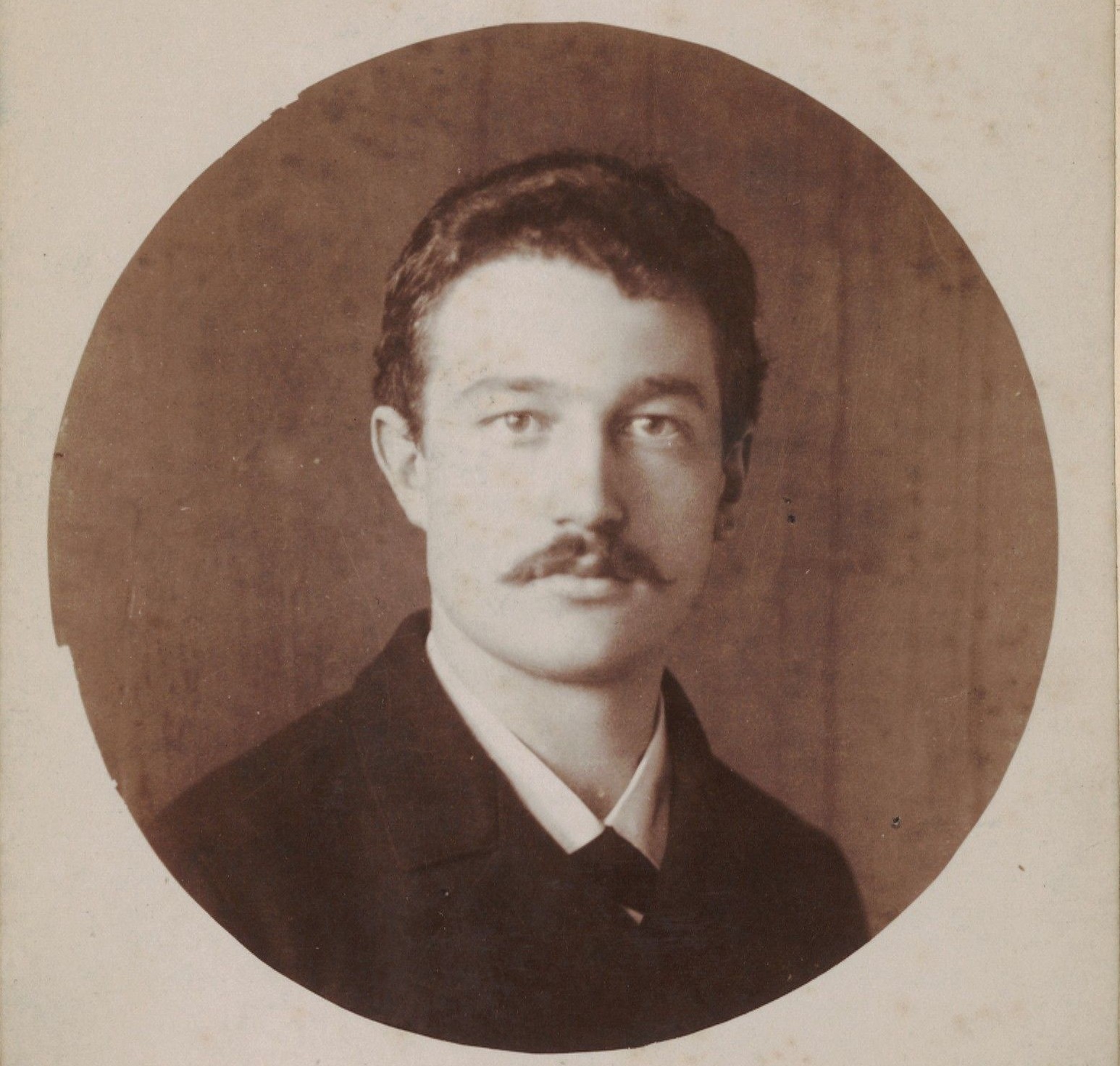
The German-born, ‘dangerously handsome,’ Haymarket martyr Louis Lingg’s defiance was total. On November 10, 1887, the eve of his scheduled hanging, Lingg bit down on a blasting cap smuggled to him by a fellow prisoner. Surviving for 6 hours in agony he wrote “Hoch die anarchie!”, Hurrah for anarchy!, in his own blood on the walls of his cell. Managing to sneak out a final letter to Dyer Lum, it along with his 22-year-old last letters to an unrequited lover, they were printed just weeks after his death in a re-published Alarm. Timeless.
‘Louis Lingg, the, Young Anarchist and Revolutionist’ by Dyer Lum and Louis Lingg from The Alarm (Chicago). Vol. 1 (new) No. 4. December 17, 1887.
Pen Pictures of the Labor Leaders Slowly Strangled in the Name of Christian Civilization.
Louis Lingg, the, Young Anarchist and Revolutionist–His Love Letters to His Sweetheart and His Smuggled Letter to “The Alarm.”
Gary was reported to have said of Lingg that he was “a human tiger.” It is easy to see where he got his opinion. Let us look back to the court before which Lingg was asked to state the reasons why sentence of death should not be passed upon him. Those who were present will never forget the scene. The day was drawing to a close when Lingg took the floor. “Handsome–fearfully, dangerously handsome,” as the correspondent of the New York Herald said, he arose to answer the query. An eloquent and powerful speaker, his imperfect knowledge of the English language obliged him to speak through an interpreter. Yet, despite the necessity of waiting after every sentence that it might be turned into English, he held all present by his manner. Walking back and forth in the small open space before the table at which he stood, never overstepping the imaginary boundary at which he turned, and emphasizing his remarks with blows on the table, it seemed for the moment as if he were the accuser and the judge the accused. Let me here cite the concluding words of that fiery speech:
“I tell you frankly and openly, I am for force. I have already told Capt. Schanck: “If they use cannon against us we shall use dynamite against them.” I repeat that I am the enemy of the “order” of today, and repeat that, with all my powers, so long as breath remains in me, I shall combat it, I declare again, frankly and openly, that I am in favor of using force. I have told Capt. Schaack, and I stand by it: “you cannonade us we shall dynamite you!” You laugh! Perhaps you think: “You’ll throw no ne bombs.” But let me assure you that I die happy on the gallows, so confident am I that the hundreds and thousands to whom I have spoken will remember my words, and when you shall have hanged us, then, mark my words, they will do the bomb-throwing. In this hope do I say to you, I despise you. I despise your order, your laws, your force-propped authority. Hang me for it.”
“A human tiger?” Ah no! Rather give him the title earned in the Brotherhood of Carpenters, to which he belonged–“the lion of the ball-room.” “Fearfully, dangerously handsome” he was. In the first glow of manhood, not yet 22 when arrested, with a form which in ancient Hellas might well have served as a model for an Adonis, and which in the Olympic games would have drawn an admiring glance from every Greek maiden, he was the image of manly health and beauty.
“But he was a bomb-maker!” Yes, and the art did not die with him. In his innocence he believed that the right of self-defense was operative even when the attack came from official brutes. But when once arrested and incarcerated he fully recognized that he was in the power of the official tiger. Never, even for a moment, did hope for life have weight to swerve him from the path of honest conviction. He had made the sign of obliteration over such speculations, and from his first entrance into a cell calmly awaited death. Although the youngest, he was the firmest. His signature to the appeal to the state supreme court was obtained with difficulty, and then given out of regard for the wishes of his comrades. His signature to the appeal to the supreme court of the United States was never obtained. That document did not contain the signatures of all who were awaiting the hireling of the stranglers of Illinois.
I must pass over personal remarks in our frequent meetings. The last time I saw him, after the first number of The ALARM had appeared, he gave me $5, and with a smile and said: “Put that to my credit.” Catching his meaning, I replied: “Where shall I send it, Louis?” His bright, rippling laugh, which echoed along the gloomy corridors; still rings in my ears.
The alleged finding of bombs in his cell was without foundation in fact. They were not found there, but found when placing back what was said to have been removed. At the time excitement ran high and great efforts were being made to save their lives. A revulsion of feeling was deemed necessary to check “sentiment.”. A search was ordered. Lingg’s cell was selected for that purpose, and lo!–the detectives managed to find that for which they sought. He was confined with extra care, shut out from all the world, under the constant watching of two guards, and within view of the whole jail office. Not a motion, not a quiver of a muscle could he make unseen, yet on that same day he sat down and wrote me the last letter he ever penned which reached its destination. When I had read it, knowing its importance, I gave it to the representative of a New York paper, in accordance with Lingg’s verbal wish to let it be given to the public. The correspondent of the New York Herald, to whom I had given the letter, whose hurried translation, by the way, was very imperfect, introduced it by saying:
“After the finding of the bombs in the cell of Lingg, in the county jail, and the removal of the prisoners to new quarters, I mentioned that Lingg “refused to say a word, looked wise, and passed the day in writing.” The sheriff resolved, when he had sized up the import of the presence of the four deadly gas-pipe and dynamite destroyers, that henceforth there should be no surreptitious communication whatsoever between the condemned anarchists and the outer world. Especially was Lingg to come under the ban of extreme precaution. The order was passed that everything going to the handsome young enthusiast should be rigidly inspected, and that he should be denied the privilege of sending out written communications. Much speculation existed as to what Lingg wrote when he passed the greater portion of Sunday at his little table actively engaged in spreading ink on paper. The jailers wondered and queried. Argus eyes followed every movement of the much-feared maker of bombs, and disappointment ensued because the anticipated attempt to send out a letter did not occur. But it did occur, and the attempt was a success.
“The next morning Sheriff Matson, thought he would make sure, and another raid on Lingg and his fellow incarcerates took place. Nothing whatever was found to disturb the peace serene of the dismal jail or to afford the newspapers a sensation.”
Notwithstanding, the letter had been delivered, and an accurate translation will be found below: Concerning Lingg’s tragic death, a few words may be said. Vouched for by his death-watch as a man who never indulged in low language, as one who never tolerated an obscene remark in his presence, and as at all times absolutely truthful, we may easily believe that if the alleged bombs had been in his cell–as they could easily have been–he would not have denied it. Louis had no fear of death. With his calm blue eyes he had looked death in the face for eighteen months unflinchingly. As scrupulously clean in his person as he was in his thought and speech, he grew restive under the suspicion which rested upon him. Branded as “the bomb-maker,” denounced for his firmness of principle as standing in the way of his fellow prisoners, he determined to prevent the “human tigers” of the law from leading him as a captive to the stake. At any time he could, if he had wished, have gone from life to death and carried all around him with him. To leave, his friends unfettered by his firmness, to relieve them from what he considered his devotion to principle, he chose death. In selecting the instrument he chose the material with which his name had been associated. Accustomed to lie on his bed and smoke a cigar, on the morning of the 10th of November, after smoking a good cigar, he placed à dynamite cartridge in his mouth, calmly lit the fuse, and awaited results. Devoted and fearless, never for an instant allowing false hope to swerve him from the path of principle, he died as he had lived–a child of nature.
While in jail he made the acquaintance of Miss Elise Friedel, who had lived in that part of Germany in which he had been born and raised. Her honesty, unsophisticated simplicity, and ingenuousness won his heart. They were, indeed, two children of nature, unspoiled by the civilization in which they lived and untouched by its selfishness. From a large number of his letters to her, which she has, with characteristic trustfulness, submitted to my inspection, I present these few extracts:
“CHICAGO, Sept. 30, 1887. Dear Lieschen: The book you brought me, dear, I read for your sake. My dear Lieschen, you must excuse my candor if I pronounce the book worthless, though I enjoyed reading it from the bottom of my heart: your naive and innocent soul caused me a hearty fit of laughter, when I thought of you delighting over the cunningness of lovers. It amused me to notice that the fact that marriage was generally based upon deceit was unknown to your pure soul and influenced you not. I must beg you most earnestly dear Lieschen, not to read any more of merely such sensational literature. When you have finished reading “The Adventures of a Greenhorn,” or “Der Dreispitz,” or “The Wedding Day” in the Arme Teufel, I will furnish you with Auerbach’s “Schwarzwaelder Dorfgeschichten”, and “Baarfussele.” These stories are not only interesting, but of a far purer type and more instructive than “The Betrayed Bride” or similar trash.
“In the sweet hope that you will cheerfully comply with my request, I most affectionately salute you. Your faithful, loving LOUIS.”
—
“Chicago OCT. 10, 1887–My Sweet Dear:
“Je hocher die Glocken,
Desto schoener das Gelaut;
Und je weiter zum Schatzerl,
Desto gruesser die Freud.
“In a similar strain I say also sing, my darling. It is too bad that I can only greet you by letter, but my non-appearance today, dearest, must be excused on account of ill health. The weather being quite cool and not possessing an overcoat, I care not to risk contracting a fresh cold. Accept, therefore, these few lines as my apology.
“Your dear sister, Barbele, favored me yesterday with a visit. But these heartless and jealous officers prevented her from returning and slipping in some drinkables on the sly. I hope you will not become jealous of your sister, my dear Lieschen, for I can assure you that we have not even–kissed each other, while I kiss you every night in my dreams. I may also sing:
“Du hast es weit mit mir gebracht,
Denn von Dir traumtes mir jeder Nacht!
“Now, sweet dreams, my dear Lieschen, and be heartily kissed by your faithful LOUIS.”
—
“CHICAGO, Oct. 14, 1887–My Dear Lieschen I wish you could have seen me, or rather have helped me, destroy the eatables you presented me with. A meal has not tasted so good for a long time. After your departure I immediately seized them, and swallowed them with as much relish as if had been working hard all day. Sooner after I sat down, and being full to repletion, began reading a robber story of the tenth-century. According to this veracious narrative the widow of a Duke of Suaven engaged a monk, who had greatly pleased her, as her teacher of Latin. But the monk behaved so awkwardly in return to the languishing glances of his pupil that she soon grew disgusted with him. Finally, even the monk had a glimmer of sense and made the most foolish break of his life by kissing the duchess in the castle chapel to be caught by his confreres. Probably he did not know the now familiar eleventh commandment: “Thall shall not be caught.” That the duchess-widow dropped the fool,–i.e. ordered him imprisoned, so as not to compromise herself–surprises nobody. But the monk was afterward aided to escape by the chambermaid duchess, who got the guard drunk.
“The monk afterward lived on a mountain, and became a hermit, where he composed a great poem on knightly heroics and sent it to the duchess, but she no longer took hearing his name. Even his lonely retreat on the mountain could offer no inducement to meet one who had acted so stupidly. The monk finally became a pious and celebrated man, as is usually the case with inexperienced and awkward lovers; but the poor and beautiful duchess remained a widow.
“My dear sweetheart, after having read all this, you can perhaps understand that I felt hungry again, whereupon I began once more to pitch into your excellent bread, butter, and cheese, and drank the third jug of your still better beer. At 3 o’clock I fell asleep and dreamed I was with you, and that I was more clever than the monk. Now, lovely maid, picture to yourself all the blissful embraces and endearing kisses I then gave you. Your faithful, LOUIS.”

—
“CHICAGO, NOV. 2, 1887–My Dear Lieschen: A few days since I intended to write to you my thoughts about my fate. Today I am happy in not having done so because I know now that I don’t need to analyze for you the reasons why and wherefore I cannot and dare not beg for mercy. Your sweet mouth explained it the day before yesterday with the words that “this would resemble a confession.” Your noble, proud words, my dear angel, have gladdened me more than dozens of resolutions passed in various cities and by various labor mass-meetings. I am proud, ineffably proud, dearest of my heart, to possess your heroic love. Despite of all injustice, slander, and meanness, your sublime love has made me, nevertheless, the happier man since I possessed it.
“Believe me, only beloved: I am thankful for your noble and unselfish love. I would have liked very much to give you better proof of my love for you, but our company has been desecrated by the presence of strangers. I think you feel the movements of my heart, knowing that “love does not speak, but loves!” I cannot withhold my inmost self today, my dearest. When I confessed for the first time my must secret love to you, my graciousness, cold and discreet reason reminded me of my, at that time already confirmed, fate. It urged me not to connect the tender fibers of your heart with my fate; but alas, my heart was stronger than my head. Still, I do not feel depressed, thereby knowing that you loved me before I confessed my most sacred thoughts to you, my graciousness. Should you be prostrated in sorrow over the non-fulfillment of my most heartfelt and warmest desires, or lament over my fate, the my sweet angel, edify and comfort yourself with the consciousness of having made inexpressively happy the last days and hours of your sincerely worshiping Louis–the victim of his honest conviction for the cause of liberty. If you hear a poet graced with genius praise sublime liberty, then be kindled with the remembrance of having brought your holy offering of pure, unselfish and devoted love to the shrine of the sublimest—the goddess of liberty.
“Most sincerely loved Lieschen, the strength to endure joyfully every injustice justice lies in men knowing that it is conducive to the welfare of a noble cause. Every attempted consolation by words sounds profane. I say “Thy reward be thy consciousness.”
“Thousandfold be, most sincerely greeted and kissed by your loving Louis. Beware, also, for the future, and at all times keep a free, faithful, and lofty heart for the cause of liberty. Once more my most sincere and heartfelt thanks for your faithful, unselfish, and pure love. With best wishes and a thousand kisses, your faithful and truly loving Louis.”
***
LINGG’S LAST LETTER.
After the Alleged Finding of the Bombs He Writes aLetter to The Alarm Which Safely Arrives.
COOK COUNTY JAIL, Nov. 6, 1887–Dear Comrade Lum: You asked me yesterday to write you a letter suitable for publication In THE ALARM. Well, I think a description of my experience “today and the conclusion I drew from it may Interest vou.
Today is Sunday. Here we “criminals” generally sit uninterrupted in our cells; a good reason to shorten the day by rising late. Thus it happened that at 9 o’clock this morning I was stilt lying in the arms of Morpheus, when suddenly the cell-lock rattled. While rubbing my eyes with my hands to drive sleepiness away I was violently seized, and to my surprise found two minions of the law holding me, who considered such measures advisable notwithstanding my singular “cowardice” (as Grinnell expressed it). Quicker than I am able to describe it I found myself outside of my cell, where, fortunately, no ladies were present to peep at me, and where I was permitted to dress myself with my carefully scrutinized clothing and shoes. Next I beheld my brave friend Engel, whom they considered less dangerous on account of his recent indisposition, and whom they kindly asked if he could walk to the lawyers’ cage.
From that point of view we had a fine opportunity to see how our cells had been cleaned out under the pretense of a search. Everything was again put back, and nothing was found; in the meanwhile other cells had been prepared for us on the lower tier and made habitable. About 1 o’clock we took possession of them. After us Comrades Parsons and Fischer took their turn, and after them Spies, Schwab, and Fielden.
My cell is inside of an iron inclosure, in which guards are constantly stationed who receive all the packages brought for the prisoners by their relatives. Comrades Fischer, Engel, and Parsons are in cells on the same tier with me, but outside said inclosure; consequently without any connection with the other prisoners. Spies, Schwab, and Fielden occupy their usual cells. You see, dear friend, how everything which answers the purposes of your less honorable colleagues is done for display, which all may read in the daily capitalistic papers.
By the scanty twilight of my new cell I read in the “Sunday Chatterings” of the Fackel the fact, so long well known to me, that to hang us (according to the expressed remarks of the bourgeoisie) would not entirely serve the purposes of the ruling class. In connection with this is brought a very correctly expressed view from you that a solid standing together of the prisoners would probably have saved them from the gallows. If by that “solid standing together” be meant for the purpose of signing a petition, or of humiliating our manhood, the “Chatterer” did not mention, as he did not state whether it was in the interest of the ruling class or of the revolutionary labor movement that we should not be hung. I, and probably every one familiar with the situation, knows that if a solid standing by each other could have saved us from the gallows it would have been desirable.
But if not? Judge McAllister says, according to the “Chatterer,” that in the event of our execution the reign of monopoly of capital would go up in smoke and flame in a few years. And who is Judge McAllister? A bourgeois of purest quality. Must I again repeat that to remain faithful to our former revolutionary method of agitation it is our bounden duty not only to write and speak, but also to act? This carries with it a distrust of all mere theorists. You know also that I could not act differently. My contempt for the present system of spoliation and, as I can now well say, my unselfish love for true freedom, obliges me to refuse to ask for justice, not to mention the question of mercy. Therefore I had to decline the proposition of our defense committee to sign a special and strongly worded petition, in connection with Parsons, Engel, and Fischer. Unable to escape death without compromising my principles, you know, my dear comrade, that I will face death calmly and even enthusiastically when I consider the great benefit it will bring to the cause of anarchism. I, and every true anarchist, knows and had to know, as the bitter enemies to death of the present as well as of every other form of government, that adherence to my principles means not alone the sacrifice of liberty, but of life as well.

I have advocated the propaganda by deeds with the intention that it shall not only be a slight return for the exploitation, suppression, and murder of my fellow workmen, but principally that it may challenge our exploiters and their legal tools to vigor our persecution, because I feel confident that the inevitable and also forcible revolution must come soon, when we may be successful. The continuous aggregation of capital under the present system of production permits no gradual elevation of intelligence and the economic condition of the working people, but tends, on the contrary, to continuous degeneration. In fact, the successful open persecutions of workmen by capitalists have arrayed the class interests of workmen against that of their masters, as the events of the past two years have clearly shown. In view of all these considerations I naturally find, however inhuman it may seem, that our rulers are anxious to annihilate us. When I protested against the sentence it was done because some people, from a hypocritical pretense of sympathy, made us responsible for the–by the way, justifiable–bomb-throwing, which it was not in my power to prevent. Now let our sentence be executed, for, although equivalent to the murder of hostages, it will result in the final terror and annihilation of all tyrants. Now, dear Comrade Lum; I will bring this letter, written under great difficulties, to a close. You will notice by the appearance of the manuscript that my facilities as well as the light are considered dangerous for one in my position. If you will have this translated and published for the purpose of defining my position upon these matters you, will confer the last favor I can ever ask from you.
Finally, extend to all my friends and comrades my last greetings and farewell; and in view of the fact that it will not be possible for me to again see you, my beloved comrade, I bid you an earnest and hearty farewell. With “Hoch die anarchie!” your comrade, LOUIS LINGG.
The Alarm was an extremely important paper at a momentous moment in the history of the US and international workers’ movement. The Alarm was the paper of the International Working People’s Association produced weekly in Chicago and edited by Albert Parsons. The IWPA was formed by anarchists and social revolutionists who left the Socialist Labor Party in 1883 led by Johann Most who had recently arrived in the States. The SLP was then dominated by German-speaking Lassalleans focused on electoral work, and a smaller group of Marxists largely focused on craft unions. In the immigrant slums of proletarian Chicago, neither were as appealing as the city’s Lehr-und-Wehr Vereine (Education and Defense Societies) which armed and trained themselves for the class war. With 5000 members by the mid-1880s, the IWPA quickly far outgrew the SLP, and signified the larger dominance of anarchism on radical thought in that decade. The Alarm first appeared on October 4, 1884, one of eight IWPA papers that formed, but the only one in English. Parsons was formerly the assistant-editor of the SLP’s ‘People’ newspaper and a pioneer member of the American Typographical Union. By early 1886 Alarm claimed a run of 3000, while the other Chicago IWPA papers, the daily German Arbeiter-Zeitung (Workers’ Newspaper) edited by August Spies and weeklies Der Vorbote (The Harbinger) had between 7-8000 each, while the weekly Der Fackel (The Torch) ran 12000 copies an issue. A Czech-language weekly Budoucnost (The Future) was also produced. Parsons, assisted by Lizzie Holmes and his wife Lucy Parsons, issued a militant working-class paper. The Alarm was incendiary in its language, literally. Along with openly advocating the use of force, The Alarm published bomb-making instructions. Suppressed immediately after May 4, 1886, the last issue edited by Parson was April 24. On November 5, 1887, one week before Parson’s execution, The Alarm was relaunched by Dyer Lum but only lasted half a year. Restarted again in 1888, The Alarm finally ended in February 1889. The Alarm is a crucial resource to understanding the rise of anarchism in the US and the world of Haymarket and one of the most radical eras in US working class history.
PDF of full issue: https://dds.crl.edu/item/54019

