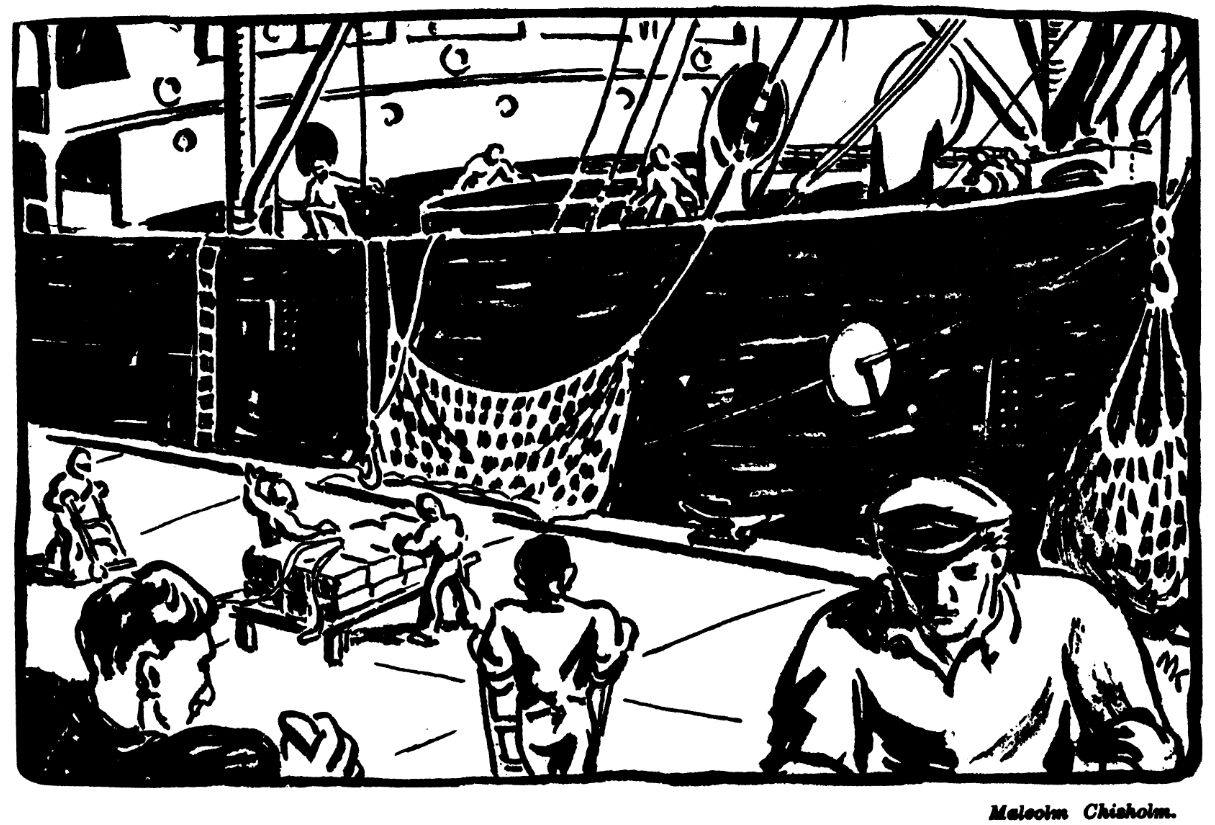
In the aftermath of 1934’s General Strike, from his base on the San Francisco waterfront, Harry Bridges fought for and would win the Presidency of the Pacific Coast District of the I.L.A. in May 1936.
‘Victory on the Pacific’ by Amy Schechter from New Masses. Vol. 19 No. 6. May 5, 1936.
SAN FRANCISCO. “THE group I represent just concluded a war last night—-and we won,” Harry Bridges said. He was speaking in the name of the four thousand members of the San Francisco longshoremen’s local to an audience gathered in Dreamland Auditorium to hear a symposium on war. The audience had warmly applauded the main speaker, General Smedley Butler. But when Bridges, scheduled to speak on “War Cargoes,” came in straight from the longshoremen’s victory, they jumped to their feet and shouted.
“One of the main reasons for the war against us is that there is a war in the making,” Bridges went on. “And when there is a war in the making, such things as strong unions which don’t believe in war are not wanted by those who make wars.”
The longshore lockout had been lifted the night before. That morning the docks had come to life after a week of silence along the Embarcadero. The men were back just “as they came off the job and no other way,” as Bridges had stipulated in behalf of the local at the start of the lockout. The same hiring hall, same award, same agreements and despite repeated ultimatums by the Waterfront Employers Association, the howls of the Hearst press and maneuverings of Ryan and his Pacific Coast District officials, the same militant rank-and-file leadership.
The day the Waterfront Employers Association announced that they had broken off relations with I.L.A. 38-79, locked out its members and discontinued hiring through its hiring halls, they had declared that they would never again deal with Bridges or the rest of the “subversive” leadership of the local, and the negotiations would be carried on only through the district (Ryan) officials. A week later the same employers sat at a conference table with Bridges for hours dickering about the acceptance of the resolution presented by Bridges and passed by a membership meeting of the local. The local insisted this resolution must be incorporated in the agreement to guarantee that the original award and agreements would continue intact until their expiration next September and that the autonomy of the local would be preserved. Finally they signed on the dotted line, above the signature of Bridges.
There is no doubt that the shipowners overreached themselves this time. Authentic reports show that they are bitterly aware and resentful of this fact, which means that the next time they are ready to violate the award and to break the pact they have just signed, a more carefully calculated as well as more violent attack can be expected.
They proceeded according to plan, all right. They followed with almost ludicrous faithfulness the steps in the drive on the longshore local outlined last January in the exposé broadcast by the San Francisco Bay Area District Council of the Maritime Federation, published in The New Masses of February 4, 1936. There was the preliminary barrage of propaganda against the rank and file and its officials in the general press and in the vigilante organ, The American Citizen, sponsored by the Chamber of Commerce.
There was propaganda in the form of letters sent by the Chamber of Commerce and Industrial Association to business and professional men throughout the city. The District I.L.A. officials did their bit by carrying slanderous articles against Bridges and the San Francisco local. for several successive issues in the official organ of the district, The Pacific Coast Longshoreman. Then followed the announcement breaking off relations with the local, abrogating the Award and declaring all agreements void and finally, the diversion of Frisco-bound ships to other ports.
The fatal mistake the shipowners made was, of course, that they took their own publicity seriously and believed the reports of their own paid stool-pigeons. They also erred in believing the reports of Ryan and his district machine, in whom wish was father to the thought. From both sources they received information that Bridges was “slipping.” The vigilante American Citizen fondly reiterated this idea and reproduced an article from the I.L.A. District organ practically in full on its front page as proof. The shipowners also received the information that the unity of the West Coast maritime unions was breaking up and therefore the time to realize their objectives of isolating and destroying the powerful San Francisco rank-and-file controlled unions, prior to a general attack all along the Coast, could now be realized.
Both shipowners and the Ryan machine were eager to force the issue without further delay, because of the emergence of a fighting rank-and-file movement in the East Coast seamen’s unions, the formation of a Maritime Federation on the Pacific Coast plan on the Gulf, the genuine perspective of a national maritime federation of all waterfront crafts. Of primary importance was the fact that two major maritime conventions, the convention of the Pacific Coast I.L.A. District and that of the Maritime Federation of the Pacific, are scheduled for May 5 and 15 at San Pedro respectively. Both employers and I.S.U. and I.L.A. reactionaries hoped that rank-and-file leaders would be eliminated or totally discredited by the time these conventions met.
Bridges is in line for the District I.L.A. presidency, for which elections will be held at the May 5 convention. The question of Bridges’ candidacy is not one of Bridges as an individual, but involves the whole issue of rank-and-file control of the Pacific Coast District versus continued control by the Ryan machine. Similar issues will be fought out at the convention of the Maritime Federation, whose present head, William Fisher, has in recent months been increasingly open in his opposition to rank-and-file policies.
The disillusionment of the employers was immediate and overwhelming. The membership of I.L.A. 38-79 stood solid behind their local and their elected leadership from the first moment of the lockout. In a grave and militant closed session at Dreamland Auditorium, a full attendance of more than four thousand members elected a lockout committee, composed of the local’s officials and Executive Committee of thirty-five plus the more than two hundred men making up the Dock and Gang Stewards Council.
The first day of the lockout messages and resolutions of solidarity began pouring in from ports all along the Coast. I.L.A. locals, controlled by Ryan officials, such as San Pedro and San Diego, defied their officials, fought them on the floor of hastily-convened special membership meetings and put through motions for full support of their San Francisco brothers. Other maritime-crafts and land unions followed suit. The Seattle Central Labor Council, an important body in the Northeast, went on record denouncing the “disruptive and subversive tactics of the shipowners who are attempting to declare a coastwise lockout of the maritime unions and thus lay the basis for national anti-labor legislation.”
The San Francisco Labor Council, in a tense, packed session which observers said was reminiscent of those held during the General Strike, voted unanimously to support the longshoremen, following Bridges’ presentation of their case, forcing the astute reactionary Edward D. Vandeleur, head of the Council and newly-elected to succeed Scharrenberg as secretary of the State Federation of Labor, to go along. Vandeleur tried to offset the action of the Central Labor Council by later appointing a committee of seven—six of them picked super-reactionaries—to take a hand in the negotiation with the Waterfront Employers Association, but the strength of the support rolling up behind the longshore local prevented the committee from harming the longshoremen.
Bridges flew to a Portland meeting where I.L.A. officials and Fisher, Maritime Federation head, subjected him to drastic attack ~—and the audience of Federation members gave him and the Frisco local a vote of confidence, unanimously. That was on Sunday (the lockout had been declared the previous Tuesday). The next day the Joint Council of Teamsters of the San Francisco Bay area took action which came as a climax in the mounting movement of support for the longshoremen and may very well have been a decisive factor in determining the shipowners’ retreat.
Like the longshoremen, the teamsters occupy a strategic position at the gates of San Francisco commerce, and with a membership of over 3,000 run them a close second in membership and strength. Despite the militant tendencies of the teamsters, old Mike Casey, vigorous and a power to be reckoned with despite his years, still holds a firm grip on his local and others in the area. When despite their conservative leadership, the teamsters go along with the waterfront, San Francisco employers pause. Another Dreamland meeting is still vivid in the memory of San Francisco, when the teamsters met there in 1934 while hundreds of longshoremen and seamen were massed in the street outside. The Strategy Committee with the same Vandeleur at the head came in and they and Mike Casey sweated trying to convince the meeting against joining the men from the waterfront. Word went up that Bridges was in the crowd outside the hall. The teamsters shouted to bring him in. They carried him in on their shoulders. He laid the strikers’ case before the meeting in his usual direct and simple way. The teamsters voted to walk out and the General Strike began.
The fact that after hearing Bridges on Monday night, the Teamsters Council voted complete support to the longshoremen and their leadership, had special significance because in so doing they went counter to the I.L.A. District officials, W.T. Lewis, president, and “Paddy” Morris, secretary-treasurer, who had signed the tentative settlement proposals of the shipowners which would have shorn the local of autonomy and taken all power from its elected officials, without the guarantees which the membership successfully insisted on adding.
The Teamsters’ resolution is a key document in the episode just ended. In it the Teamsters state that inasmuch as the Waterfront Employers’ Association suspended work on the waterfront with a “professed purpose of changing the award and agreement and a representation of the I.L.A. for purposes of collective bargaining”; inasmuch as the longshoremen refused to allow its members to be employed except through the hiring hall established by the Award of the National Longshoremen’s Board; inasmuch as the employers have designated and expressed confidence in and support of their duly authorized officials who have been designated to represent them; and inasmuch as the longshoremen are prepared to resume work just as soon as the employers hire through the hiring hall and cease efforts to interfere with the administration of the union: “Resolved that this organization endorse the stand taken by the membership and officials of I.L.A. 38-79 and express their full confidence in same.”
In the drive to oust the rank-and-file leadership of the longshoremen’s local, fire was directed chiefly against Bridges as an individual. The employers are aware that it is easier to lie about and frame an individual and whip up public sentiment against him, than to indict a whole system of rank-and-file policy and control. Actually, the leadership of the longshoremen is exceptionally broad, with the actively functioning elected executive committee of thirty-five and over 200 dock-and-gang stewards elected by the gangs they work in, who bring the union down on to the docks and lead the day-to-day struggle on the job. This is the basic instrument by which the longshoremen here have won and held the best wages and working conditions of any part in the country. The dock-and-gang stewards are a militant bunch. Many started as picket captains during the 1934 strike. They form the backbone of rank-and-file union and job control and meet each week in the Dock and Gang Stewards Council to help hammer out the policy of the union.
Notwithstanding the shipowners myth of one-man control of I.L.A. 38-79, Harry Bridges, despite or rather because of his real genius for leadership, functions as an organic part of the whole apparatus of rank-and-file control, The Hearstian picture of. Bridges as a mysterious and sinister outsider and master mind is in line with the propaganda that the militancy of the West Coast maritime workers is a Bolshevik plot, with Bridges injected from the outside to put it across. This picture is of course sheer bunk.
Actually the shipowners fear and hate Bridges because he is a longshoreman among longshoremen, he has worked here on the docks alongside the men he now represents for twelve of his thirty-five years, from the time he was twenty-two on up to the day of the 1934 strike. He is completely rooted among the men who chose him to lead them.
If any additional proof were needed that the maritime workers of the West Coast did a good job the past week and forced the shipowners and reactionaries to beat a retreat, it is furnished by the press statement of I.S.U. officials in yesterday’s newspapers to the effect that the I.S.U. is contemplating a re-hearing on the question of the revocation of the Sailors Union of the Pacific charter in Chicago within the next thirty days. A week ago, the papers were full of prophesies, apparently emanating from Ryan, that the charter of the San Francisco longshoremen’s local was due to be jerked in a couple of days. The longshoremen still have their charter and it looks as though the sailors may soon be getting theirs back again.
The New Masses was the continuation of Workers Monthly which began publishing in 1924 as a merger of the ‘Liberator’, the Trade Union Educational League magazine ‘Labor Herald’, and Friends of Soviet Russia’s monthly ‘Soviet Russia Pictorial’ as an explicitly Communist Party publication, but drawing in a wide range of contributors and sympathizers. In 1927 Workers Monthly ceased and The New Masses began. A major left cultural magazine of the late 1920s and early 1940s, the early editors of The New Masses included Hugo Gellert, John F. Sloan, Max Eastman, Mike Gold, and Joseph Freeman. Writers included William Carlos Williams, Theodore Dreiser, John Dos Passos, Upton Sinclair, Richard Wright, Ralph Ellison, Dorothy Parker, Dorothy Day, John Breecher, Langston Hughes, Eugene O’Neill, Rex Stout and Ernest Hemingway. Artists included Hugo Gellert, Stuart Davis, Boardman Robinson, Wanda Gag, William Gropper and Otto Soglow. Over time, the New Masses became narrower politically and the articles more commentary than comment. However, particularly in it first years, New Masses was the epitome of the era’s finest revolutionary cultural and artistic traditions.
PDF of full issue: https://www.marxists.org/history/usa/pubs/new-masses/1936/v19n06-may-05-1936-NM.pdf

