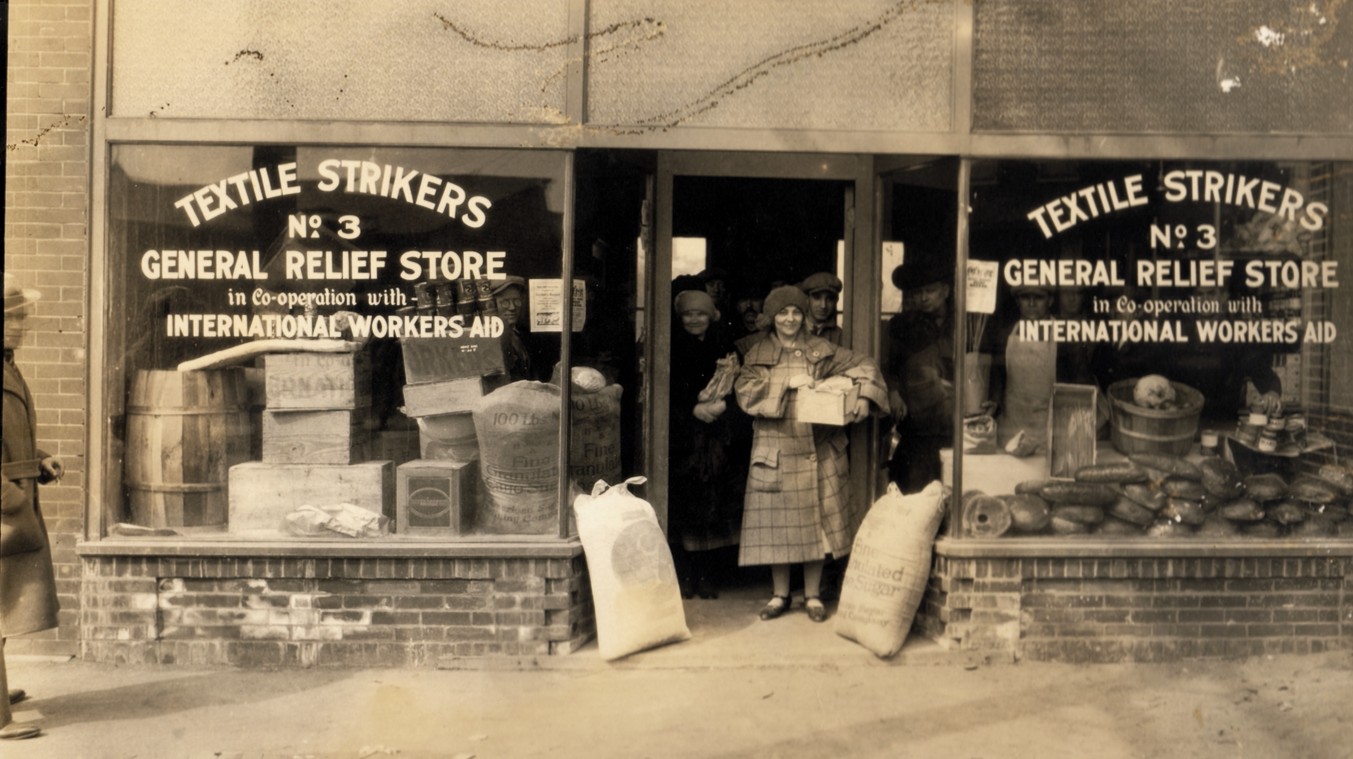
With among the highest percentage of women’s membership of Comintern-affiliated organizations, the Workers International Relief was also among the few to create specific bodies for women. The W.I.R. was dedicated to providing relief, as well as cultural programs, for working class communities in struggle or strife and started with aid to Russia during the famine years. Long headed by Willi Munzenberg, headquartered in Berlin, the W.I.R. was comparatively autonomous for a large Comintern project.
‘The Founding of Women’s Sections in the Workers International Relief’ by Golda Fröhlich-Hartog from International Press Correspondence. Vol. 9 No. 64. November 15, 1929.
In accordance with a decision of the International Congress of the W.I.R. held in Dresden in Spring last, an international women’s section was set up at the Central Committee of the W.I.R.
Broad sections of proletarian women, who a few years ago were only proletarian housewives, have been drawn by capitalist rationalisation into the process of production and have become the most exploited of the exploited. This process is proceeding with giant strides in spite of the “simple” and “comfortable” slogan of the last international working women’s Conference of the Amsterdam International that women should return back into the family! The profession of housewife as chief activity of the woman is altogether a thing of the past.
In Germany alone, with its 26 million of workers, employees and officials, 37 percent of them are women. In England there are, according to the last census of 1928, 5,500,000 working women, chiefly engaged in the textile and paper industries. In France the percentage of women working for wages or salaries amounts to 40 percent of the total number of workers. In Japan this percentage even amounts to 49 to 52. According to figures for 1927 in Italy, the proportion of working women among the metal workers, textile workers and cap-makers is almost 50 percent. In India there are about 45 million working women, of whom 33 million are engaged in agriculture. Regarding Austria statistics report that 40.9 percent of all workers are working women. In America, according to old statistics, 34 percent of the factory and workshop staffs are working women, and it is to be presumed that their number has increased in the meantime.
The reformist trade unions are the last to take this development into account; with their gradual coalescence with the bourgeois State apparatus it inevitably follows that their members are more and more confined to the labour-aristocratic sections, while the working women, who belong to the worst paid and unqualified sections of the working class, are neglected and treated with contempt. Thus for instance some trade unions in England refuse to admit women. The low percentage of organized women is in no way a reflection of their lack of firm determination and class-consciousness.
Mention must be made of the participation of women the struggles in the mining and metal undertakings, the struggles of the women textile and cigarette workers in Gerra the textile workers’ strike in Czechoslovakia and the active support of the miners’ strike by the Spanish women during the Morocco war. The heroic women of China have organized and carried out big women’s demonstrations against the hanging of the proletariat. The 60,000 Indian women mine workers supported the English miners’ struggle in May 1926 by a solidarity strike, also displayed a high degree of class-consciousness. Women fought in the front ranks in the English mine workers’ strike. Finally, mention must be made of the heroic struggle of the textile workers of Gastonia, in which women actively participated and in the course of which a working woman was foully murdered by the vile thugs of hostile capital.
The change of the work of the W.I.R. from general proletarian relief activity to the support of the economic struggle, the degeneration of the reformist trade unions into fascist strike-breaking organisations, the increased specific weight of women in the production process and their political awakening confronts the W.I.R. with the task of adapting its work to the wining of these women. The W.I.R. is of course not to become a substitute for the trade unions. It merely represents a bridge to the higher forms of revolutionary labour organisations.
A great number of women already belong to the W.I.R. There is hardly any other organisation in which their percentage is so large. Nevertheless this strength of the women is not adequately reflected in the composition of the leading organs and the editorial staffs of the W.I.R. It will be one of main tasks of the women’s sections to be set up in all national committees, especially in those countries where no women at all are represented in the national committees, to train women members in order to convert them into active collaborators and functionaries.
The representatives of the bourgeoisie understand excellently how to win and influence the millions of working women. These bourgeois organisations have an enormous number of members in their ranks. These bourgeois women’s organisations are playing an important role in the preparation of the war against the Soviet Union, be it by the use of pacifist phrases or be it by nationalist agitation.
The political advance off the working class and the intensity of our work among the working women will disintegrate these bourgeois women’s organisations and win new fighting women for the ranks of the W.I.R.
International Press Correspondence, widely known as”Inprecorr” was published by the Executive Committee of the Communist International (ECCI) regularly in German and English, occasionally in many other languages, beginning in 1921 and lasting in English until 1938. Inprecorr’s role was to supply translated articles to the English-speaking press of the International from the Comintern’s different sections, as well as news and statements from the ECCI. Many ‘Daily Worker’ and ‘Communist’ articles originated in Inprecorr, and it also published articles by American comrades for use in other countries. It was published at least weekly, and often thrice weekly.
PDF of full issue: https://www.marxists.org/history/international/comintern/inprecor/1929/v09n64-nov-15-1929-inprecor.pdf

